
 Continue with onX Maps
 Sign in with Facebook






Reinforcing flake
|
|
Hello, I have a game plan for reinforcing a massive flake at a crag I am developing and I am looking for some advice. The flake is roughly 4'*4'*1.5' and is limestone, so I'm guessing it weighs around 2000-4000lbs. It is immovably wedged in place and critical for the climb, but when pried on with a 3' crowbar the rock can be flexed from the far end and it is clearly detached from the wall. Right now it is safe to climb on but I am concerned about it eventually becoming loose with freeze/thaw cycles or fracturing from being flexed. 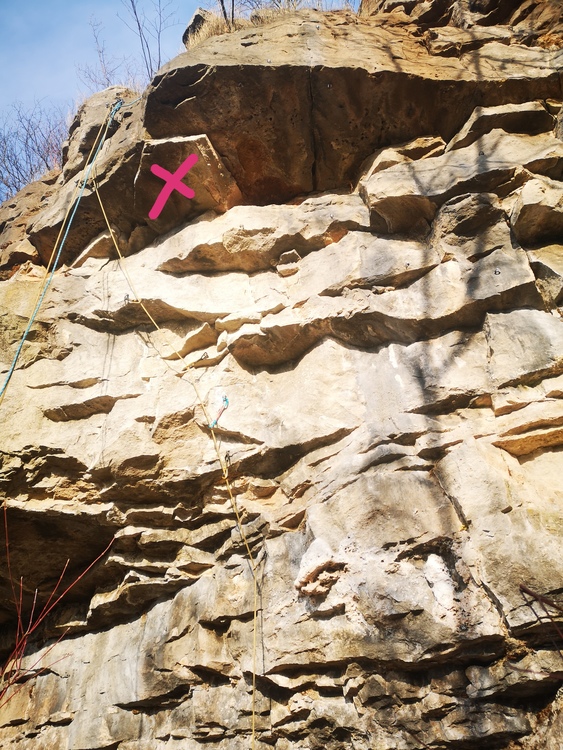 My plan is to drill three 1/2"*18" holes through the flake into the roof above and glue in 3/8" stainless steel threaded rod backed with lock nuts/washers holding the flake. My concerns with this are 1) How do I inject glue into the main roof when the flake below it is around a foot thick? Can I extend the nozzles or buy glue with longer ones? 2) How to ensure glue is in the flake's hole? There is a void between the flake and the roof of a few inches, so the concern is that the rod would just push the glue out of the flake and into that gap area when being inserted. I was considering biting the bullet with some Hilti HIT-SC mesh sleeves, but a local developer told me not to worry about it and just backup the flake-side with nuts so that the glue is a redundancy. I also am wondering about just holding a washer on the backside of the flake holes while I push to the rod through to block the glue around it from following it out. Other thoughts that I had includ long wedge bolts, the downside being that it's limestone and glue would be preferred. I also thought about just connecting hangers on the flake to an anchor on the parent rock using chains... Ideas? Am I crazy to want to reinforce a flake of this size? |
|
|
https://www.mountainproject.com/route/116586431/well-hung (Zoom in on the flake below the roof) This is a pretty big flake, not sure it is glued at all but there are bits of rebar preventing it from falling if it attempted to. The rebar is not touching the flake, unless I remember wrong. The geometry is considerably easier, though, your flake has much less rock near it. I would consider trying to make or find spacers of the same rock type, to glue in above the flake, as long as there is room for enough surface area to hold some hundreds - thousands of pounds. Imagine a tight fitting chockstone, but glued in on both sides. This solution would also locate it to the rock so shifting sideways in small amounts is reduced, unlike the chain solution. You could probably find some decent fitting bits near the base... |
|
|
Not to be one of those people, and please correct me if I'm being an idiot, but those bolts seem pretty close together no? |
|
|
Well I've done plenty of this, the first thing is it isn't "essential" just desirable in your view, if it was missing Adam Ondra would probably solo the route anyway. You can just extend the nozzle with a length of plastic tube, that's all the extensions are but pumping a long way is a problem. You can use a glass capsule if it will go past the gap between the flake and the roof. Alternatively chain it on but it tends to freak climbers out. I 've done all of these methods but nowadays I just smash a couple of long wedge bolts in, I make them any length to order. Normally 12mm but I've done some 16mm ones. |
|
|
Lily Johnsonwrote: The route isn't finished and some will be moved. It's more overhung and difficult that it looks in the photo, and there was almost no pro available, so some of those were installed to clean and figure out the lines. |


|
Delaney Bray-Stonewrote: Maybe. I'd probably try to clean it out of there. That's a big piece of rock... |
|
|
You described 2 potential methods of rock failure, which I'll address individually: 1) Flake wiggling it's way out over time: given that you say it's "immovably wedged," I wouldn't worry about it, doesn't sound like something that will happen. But for the sake of discussion if the whole flake wiggled when you pried on it, even a weakly anchored rod passing through the flake into the rock above would prevent the outward sliding of the flake. 2) Flake fracturing from repeated flexing: This seems a more plausible thing to be concerned about; that flake looks like it would kill everyone in a quarter mile radius if it broke loose. Given how far that flake extends off the wall, you can put a fair amount of leverage on it. I'm not an expert on limestone and fracture planes and whatnot, but 1.5 feet thick seems pretty stout, so I'm hoping someone else with more experience with limestone can come in and tell you not to worry about it. If you want to prevent this method of failure, you'll just need a bolt or two out a few feet from the wall. The methods you described seem like they would get the job done, even if not done perfectly. If you haven't come up with a name for the route, "Death Flake" seems fitting, haha. |
|
|
Brian in SLCwrote: I spent around two hours attempting to do so and made no progress. I could maybe chisel it out but that would take multiple trips and many hours, and I'd be concerned about loosening it further without succeeding in removing it. It is solidly in place now and makes the climb more interesting so I think reinforcement makes the most sense. @JimTitt my thinking is that glue will be more reliable long term, and I'm wanting to install the rods for the future if the rock fails rather than now where it's a backup for peace of mind. @Javkson I like the idea of glueing chockstones between the flake and the roof, however I would be concerned about using a shitload of glue and making a mess. |
|
|
Delaney Bray-Stonewrote: Fair enough, I've never bolted anything before so I'm not one to judge. |
|
|
In Washington there was essentially that same feature, people thought it was too big to come off. Missed the belayer by inches. I think the main safety concern is crushing the belayer or cutting the climbers rope. If it is over hung enough I would maybe consider putting a belay bolt to keep the belayer protected by the roof. Another option to fiddle with it is to have more than a single point applying force on it. You could put a bolt in it then have someone essentially pull on it with a rope applying force in the front of the stone as you prybar in the back. Or get three friends all prybaring on it at once. |
|
|
Lily Johnsonwrote: If it’s a short climb it’s important to protect the lower part of the climb to protect decking. Many routes start out with tightly placed bolts but get spaced further apart the higher you get. Also if there are ledges or outcroppings at any point it’s important to bolt to prevent hitting those objects by a few tightly spaced bolts. I did a new route last year that had a small ledge 80 feet up, the bolts above it looked like a bolt ladder for a bit just to keep someone from breaking a leg because the climbing was pretty difficult right off the ledge. |
|
|
Delaney Bray-Stonewrote: I think it's better to only have glue in contact with the good rock in behind the flake. The nuts and washers will do all the work holding the flake side and this will allow you to tighten the nuts if the flake starts to loosen over time from people yarding on it. Cleaning the hole in behind that flake will require a longer brushes and blow out tube than usual, this may be obvious. |
|
|
have you tried some sort of jack instead of a crow bar? |
|
|
I'm working on a similar issue. Glue is not an option, so I ended up sinking three 3/4"×12" wedge bolts, countersunk and patched, although now I almost think leaving them visible would let people know it is actually attached.. |
|
|
You could glue in some random chockstones way back in the gap between the loose flake and the actually solid rock structure to shore it up. Or, I'd vote, just rip it out. |
|
|
ERRAND WOLFEwrote: Where's the mystery in that? |


