
 Continue with onX Maps
 Sign in with Facebook






Bacterial corrosion of 304 (A2) rock anchors


|
|
Sulphate reducing bacteria seemingly can invade solid stainless steel and set up residence there. It's great for them, but not so good for the integrity of the anchor. This is a short report on a bolt sampled from sulphate sea cliffs of Cabo da Roca. It argues that what we are seeing at locations like this is not SCC as is commonly thought, but something mechanistically quite different, SSC. https://cragchemistry.com/2020/10/25/ssc-vs-scc/ |


|
Interesting and nicely done report! Photo's are amazing. Those little sulpher eatin' bugs are crazy. Curious if there's any other known sea cliff locations that have sulphate and climbing with fixed anchors? |
|
|
Time to change to 316. |
|
|
Brian in SLC wrote: Yes, have a read of Dave's previous articles |
|
|
Mark Frumkin wrote: What makes you think 316 is impervious to either SCC, SSC or both? |
|
|
What it's made out of. Nothing is impervious. 316 is what I used to hold the keel on my boat because it's more resistant to scc, ssc than 304. |
|
|
David Reeve wrote: So I've been following your research and there's a lot that's above my pay grade. However, let's look at it "backwards" for a moment. Let's say your hypothesis is correct and SRB's are causing SSC in seaside bolts. Can you then say why we don't see SSC at inland crags? It would seem reasonable to me that SRB's would be just about everywhere on the earth. Also, you say "Praia da Ursa is a granite/syenite sea cliff, so there is plenty of sea salt to lend credence to the SSC theory. The only catch is that in this particular case you need to explain why the cracking occurred at a point within the nut/bolt contact zone. Is it feasible that the high chloride concentration necessary to initiate the crack could be provided by evaporation at a point not exposed to the atmosphere? Surely, if such a mechanism were to occur, it would be more likely that we’d see it at points on the outside surface." I have had plenty of samples of cracked hangers which occurred on the outside surface. And here's a photo of a stainless rappel ring that cracked. In both cases, there's no anoxic space for the SRB's to grow in. There's been a lot of work verifying that Chloride-SCC IS happening. So, perhaps BOTH mechanisms are cracking the bolts? 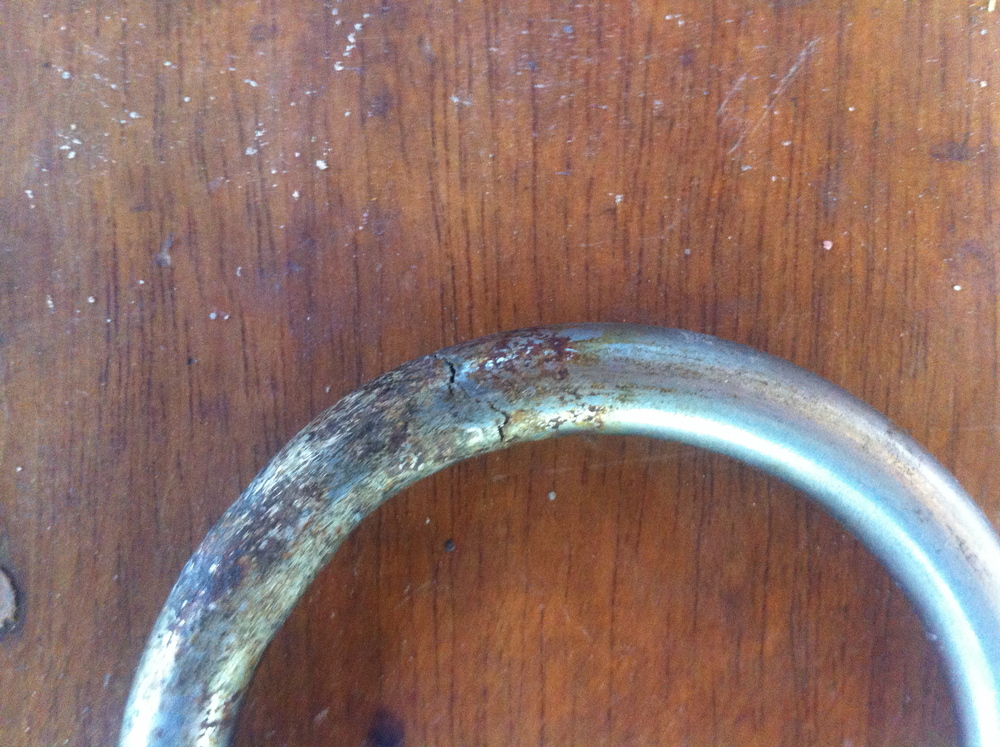 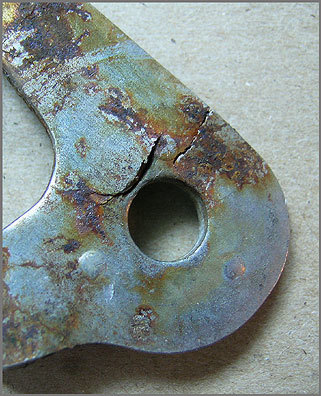 Furthermore, we've seen many stainless glue-ins crack. Perhaps there is an anoxic gap between the glue and the steel, but in most cases I don't think there is, and as you can see in this photo, the corrosion/discoloration of the steel is on the surface as well. 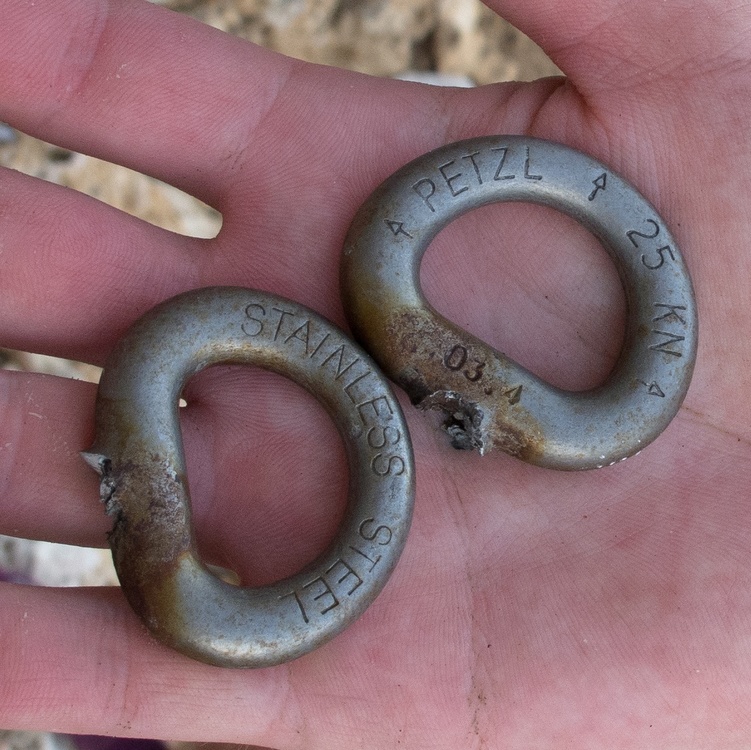 So I'm not saying you're wrong, only that it seems much more likely that BOTH SCC and SSC are, or could be, occurring. |
|
|
In the 1980s one of the largest & best sailboat designers allowed (two boats) 304 to be used instead of the 316 that they had called for on the bolts that hold the keel to the boat IT DID NOT GO WELL. Both boats were lost at sea after their keels fell off. |
|
|
Mark Frumkin wrote: Mark, it's been proven for almost 20 years that "Marine Grade" stainless, aka 316, is susceptible to SCC when used in climbing bolts. It works great on boats where the humidity is always maxed, not so much when it can dry out. Here's a slide show by Angele Sjong, a professional metallurgist, taken from her peer-reviewed article in which she analyses a cracked Petzel 316L bolt hanger. https://d1w9vyym276tvm.cloudfront.net/assets/SCC-Fixed-Climbing-Protection-Thailand-Angele-Sjong.pdf Long slide show with lots of data and background on "traditional" thought about 316, but one big point is that SCC in 316 occurs rapidly at low humidity and in the presence of CaCl2 or MgCl2. A bolt that is actually immersed in sea water never sees low humidity nor chloride salts because the components (eg. Ca and Cl) stay in solution. 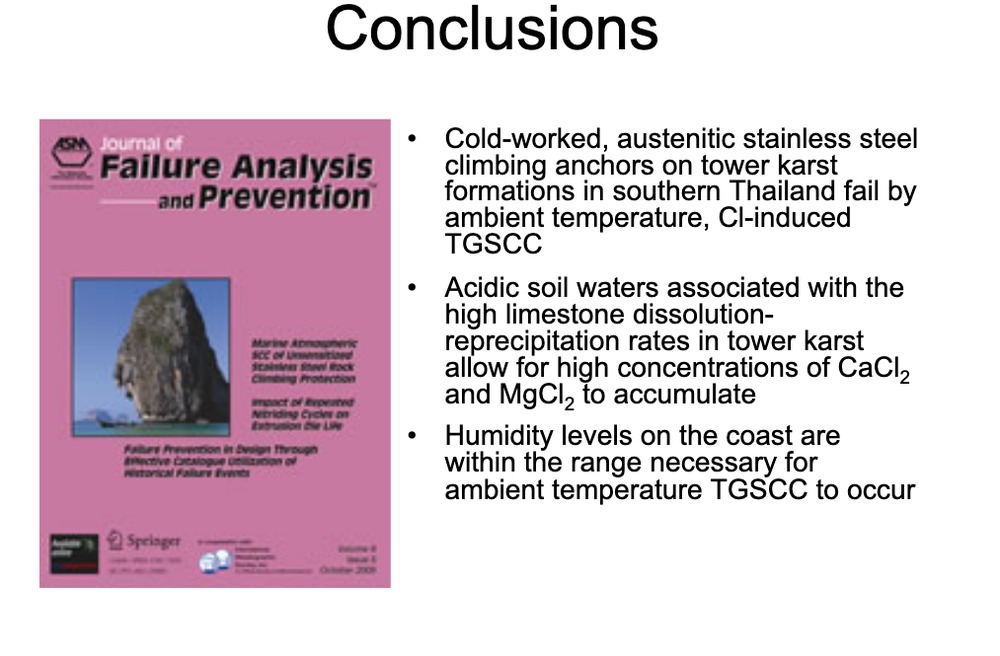 |
|
|
Good article looks like you need to move up to 317 or better. Keel bolts should never be immersed in seawater but they are always in hi humidity & some time wet. |
|
|
Mark Frumkin wrote: Better equals titanium. Duh. |
|
|
John Byrnes wrote: Is that the paper she was going to write a correction for or another one? |
|
|
Which type of Ti? There are as many types of Ti as SS. |
|
|
Well 38 Ti grades and over 200 SS grades but never mind, only Gr 2 Ti comes into question for climbing bolts. |
|
|
Jim Titt wrote: Exactly. So far there's only one manufacturer of Ti bolts, Titan Climbing, and they only use Grade 2 for the Eterna. www.titanclimbing.com After 20 years in the most corrosive conditions (Thailand & Cayman Brac) Grade 2 Ti has been proven impervious to all types of corrosion. |
|
|
Jim Titt wrote: The link points to a slide-show that she gave. I believe it was the same presentation she gave at the Access Fund's Fixed Anchor conference several years ago and that it was based on her original article. Hadn't heard about a correction. What have you heard? |
|
|
John Byrnes wrote: That she got it wrong? There's good reason why the UIAA and in Dave's article it says " despite repeated calls by UIAA Safe Com and by myself, an example of failed 316 hardware is yet to materialise". I'm reliably informed that what she examined was not the same material that she analysed. |
|
|
Also worth noting that some hardware manufacturers don’t actually use the material they advertise (thinking of a specific Spanish company here). Just from reading those articles I would guess many, if not all, of those failed 304/A2 samples have Cr content considerably below the 18% min for 304 and an elevated Sulphur content. I’m just a welder though, so I’m probably wrong! |
|
|
Some companies (including Fixe) never advertised the material grade anyway, just said it was inox (stainless). There is no requirement to give the grade in the standard. |
|
|
Jim Titt wrote: It would probably be better if they didn’t but...Fixe wedge bolts. Their US site has been advertising A2/A-304 for years. It’s not marked on their products but definitely advertised. Not trying to bash a specific manufacturer, just noting that nearly all of the pictures of failed samples seem to be the same brand. Jim, how have your bolts been holding up? I know some have been installed in fairly corrosive environments for a while? |
|
|
C Williams wrote: That's not the Fixe website, that's from their importer and those bolts don't exist on the Spanish website, they still give no material grades for any of their anchors. I guess they are holding up, I don't get much feedback! |


