Continue with onX Maps
 Sign in with Facebook






What's your go-to anchor?



|
Andy Eiterwrote: There was a simialrish thread in 2015 on the not-a-troll! rgold rope anchor set up: mountainproject.com/forum/t… Someone made a video of a variation: https://youtu.be/OasGT6RggGw Would be great to see your video, I'm also working on rope anchor efficiency. |
|
|
I carry 1 double length sling and 1 15 ft cordalette tied with small loops on overhands on each end (webolette style)I like the loops on the end because it is much more flexible interms of length. I rarely use the quad. I think it takes longer to rig and since I don't seem to use bolted anchors much it generally isn't long enough. I also prefer to get 3 pieces in a trad anchor and the quad isn't well suited for that. I'm not really sure what to allure of the quad is unless you're climbing long routes with bolted anchors (like red rocks) |
|
|
Mydanswrote: Pray tell, why isn't a quad well suited for a 3 piece anchor? |
|
|
Bowline on a bight. Similar to a bunny-ears figure eight, but more compact. It’s easy to adjust the lengths of the loops, so it works well for any anchor consisting of two pieces somewhat close to each other (e.g., two good cams in a verticle crack). It doesn’t have quite the redundancy of a cordelette, because if one loop gets cut, it can pull through and release the other one. But it’s quick, simple, and doesn’t take any extra gear. |
|
|
A French caving group posted videos a few years ago illustrating a serious failure of the bowline on a bight when used for "bunny ears." Those videos don't seem to be available any more, and the only thing I could find is https://www.peakinstruction.com/blog/testing-a-method-of-failure-with-a-bowline-on-the-bight-knot/ which is very poorly done and so hard to see what's going on. |
|
|
Here's a good article: https://www.alpinesavvy.com/blog/debunking-anchor/climbing-myths-part-1 The girth hitch anchor shown, guide mode belay, and clove hitch tether, are what I've been mostly doing for the last few years for multipitch anchors. For two pieces close enough together a single length sling. For 3 pieces a double length sling. Super fast to setup and take down: no knots. Uses minimal material, you could argue that using the rope means you are using one less sling, but then you lose some rope and/or you need a longer rope and the rope is more bulky and weighs more than a sling. Powerpoint is a large locking biner, which I like anyway because it's easy to clip multiple things to even when weighted. |
|
|
rgoldwrote: I know you are very experienced, that's why I bother asking. I still see the "knot" of the butterfly loop shifting up and down to slacken leg #1 (as is shown in your picture) but I realize that could get lost in rope stretch / knots adjusting.. however, for pieces within reach, I'd rather a sling, which can integrate the rope for different situations (I.e. for un aupward- or lateral- pull piece with the back side of the clip-in clove hitch). For pieces out of reach, I prefer adjustment at my end, with the nuances you describe. My comment about 2 vs 3 pieces anchors is not meant for fixed-leg systems vs not. I'd never consider a non-fixed configuration. Instead, that I think the complexity added by a 3rd point is noticeable in time, effort, rigging complexity; and, in my experience, doesn't provide a noticeable gain in load distribution. So, I rather have two good pieces triangulated and a third one at the master point. |
|
|
maria bwrote: Here's how I did it: With three legs. A bit different than how he did. |
|
|
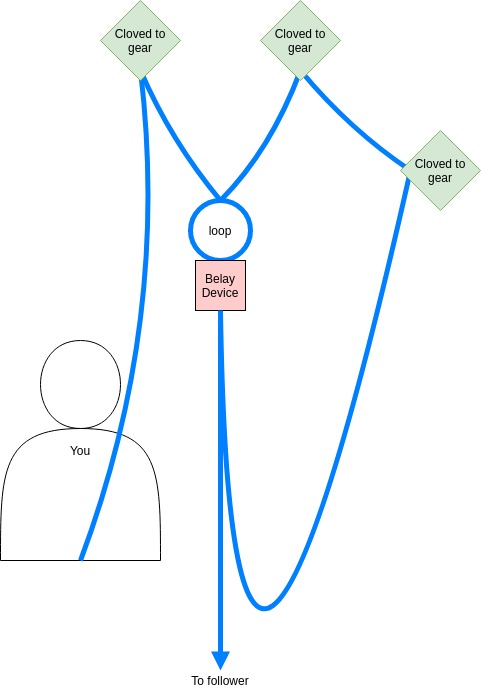 This approach work for 2+ pieces. Put the belay between two good pieces (which don't have to be adjacent). Attach other pieces with minimal slack. |
|
|
Franck Veewrote: Your limiter knots are really far apart. Mine are just about 6-7 inches apart, tied in the middle section of the quad, and semi-permanently left there except when I move them from time to time to even out the wear on the material. Not only will this greatly reduce the extension that many people worry about, it also gives a much longer leg to work with. On two-bolt anchors, I actually like to use the rope because it's quick and easy. The quad really shines when you have more than one follower (most likely block leading), or block leading with 3-point or even 4-point anchors. I can still build an anchor using the rope if I needed, and the time to build an anchor is actually about the same whether I use the rope or the quad. The time saving comes when the follower(s) clip in to the anchor. Using the quad it just takes a few seconds for the follower to clip in with one clove hitch. Using the 3-piece rope anchor shown in this thread, the follower needs to tie 4 cloves plus the adjustment between the cloves. That's around one minute for each follower (and that's assuming they have been rehearsing during the covid shutdown like the guy on Instagram). That (and any variation of a rope anchor) eats up a lot of time when block leading. The "self-load-distribution" quality of the quad is actually very useful. I rarely find an anchor that's directly above the last protection point. Majority of the time, the anchor is off to one side or the other. I also like to keep my connection to the anchor taut, even if I'm not fully weighting it. With the quad, I (and my followers) have much more freedom to move from side to side without putting all the load on a single anchor point. |
|
|
aikibujinwrote: Well, the difference between a foot of extension and 6" shouldn't matter imo on 2 bolt anchors, unless old/sketchy. Extension matters if you think the load that would be applied on any remaining piece could get it to fail. That and applied to the quad, even if there are 12" of distance between limiter knots, most of the time any load will be tied roughly in the middle of that range, therefore any space remaining for possible extension is really just 6" (or 3" if we take your closer version). This seems very acceptable to me in all cases
Pretty much what I like most about this anchor as well. |
|
|
Franck Veewrote: So, for two-bolt anchors: you take a multi-directional point (the bolt), make it non multi-directional and then patch it by having one triangle for the belayer and another for the follower... Just use the bolt as is and you can hang in any direction you want; so does the follower. Even worse, there is a lot of extension in case of a leader fall with gear in (quad inverts) so now an upward-pull piece must be added.. Also, extension is not only an issue for the anchor load, but also for the belayer loosing control of the brake strand! |
|
|
Franck Veewrote: I thought the purpose of this thread is to see best practices from other people, that's why I bothered typing up that whole thing. If you just wanted to tell us why you build your quad that way, I guess I'm wasting my time here. Extension is just a small part of that equation, the bigger reason is to have longer legs to work with. The way you tie your quad is the reason why you can "sometimes get it to work with a gear anchor with a sling". The way I build my quad, it works with 3 piece anchors without the need of any slings majority of the time. It works with 4 piece anchor too although I don't build those often. I only need 2, at most 3 clove hitches or carabiner wraps to adjust it. I never adjust the limiter knot in the field, that would be a PITA. |
|
|
Fran Mwrote: really? we're now protecting bolts from an upward pull? Come on |
|
|
PWZwrote: Not the bolts, the belayer EDIT: can't make another comment in this thread, to reply above to M Apelquist: 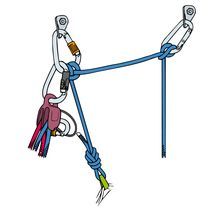 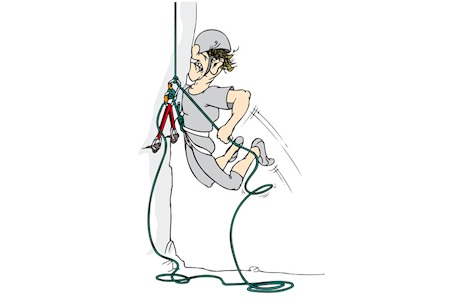 |
|
|
aikibujinwrote: Not how I wanted it to get across. I hadn't really thought about how/why I'd vary the distance between the knots, and your remark prompted me to think about. I was just thinking out loud following what you wrote, which made it more explicite for myself what role extension I think should play/not play in this setup. Not advocating for a particular thing.
This is true. One of the downside of that anchor is that adjustments on it are not that easy. |
|
|
Fran Mwrote: In the US I've never seen someone lead belay directly from the anchor, so this is less of an issue. If you're belaying from your harness it shouldn't be that different from belaying a sport climb from the ground. The "upward pull piece" thing seems a bit overblown to me, but then again I don't really climb with people heavier than me. |
|
|
I outweigh my wife by 75 pounds and tie her down all the time. |
|
|
maria bwrote: Great video. That looks like a great anchor system if you're swapping leads, but your second would have to build another anchor once you're ready to lead again? Seems like that could get messy. |
|
|
maria bwrote: That video is a minor variation of my system, using the harness belay loop rather than a tied power point, and a power point arranged to load only two of the three pieces. I often do something similar, clipping back to my rope tie-in loop rather than the harness belay loop, but typically do not create a power point. The downside is increased difficulty for a belay escape, |