Continue with onX Maps
 Sign in with Facebook






What's your go-to anchor?


|
|
Another drawback of using the rope in the anchor for me is it's a challenge to adjust the tether length. I like using the rope clove hitched to a biner on the powerpoint as my tether so I can quickly and easily adjust to any length needed. For example if I can't hear them and want to extend to lean over the edge of a ledge, or often I'll want to switch stances or go from standing to sitting when belaying a second to stay comfortable. |

|
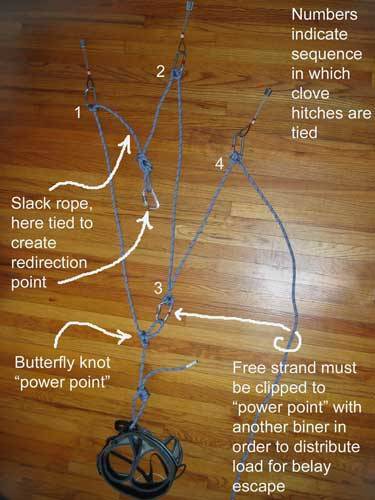
Gloweringwrote: If I am not mistaken, that is not an issue with the rope anchor. In rgold's photo, you would simply adjust clove hitch "1" and it would be no different from what you describe. |
|
|
|

|
Gloweringwrote: It is true that you can't adjust a rope anchor once its been set up, so you do have to anticipate things like positioning for optimal communication ahead of time. If we are speaking of a remote anchor situation, then that's one of the times I default to slings or a cordelette. As for adjusting in the midst of belaying, that sounds a little sketchy to me and I've never done it with any system (and I've used 'em all at one time or another). |
|
|
Banshee |
|
|
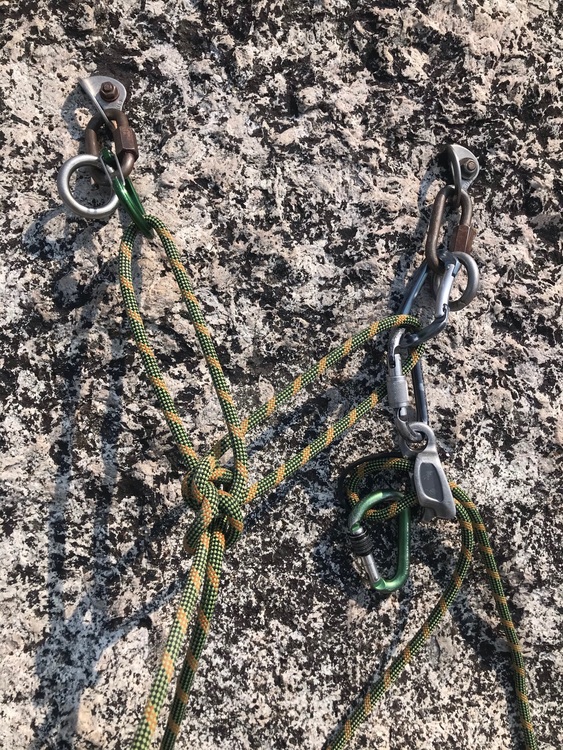
Two sliding x's connected with a Banshee. |
|
|
 |
|
|
Dave K wrote: You, sir, have been watching too many presidential debates. |
|
|
Dave K wrote: Four clove hitches and an overhand loop for a thee-point anchor. Clipping and the knots take maybe 20-30 seconds, compared to 10-15 seconds for a cordelette if you don't screw up and have to redo it 'cause you fumbled a strand trying to tie the knot. And then the cordelette has to be wrapped up at the end, so in terms of total time rigging there's essentially no difference, in spite of a vast difference in ease of adjustment and adaptability to situations. I've used it hundreds, maybe thousands of times. So rest assured, it ain't no troll. |
|
|
rgoldwrote: I've seen it a couple times as well and can't get how this would distribute load efficiently, or how it could be adjusted as fast as a 120 or 180cm sling with a girth hitch (even considering racking time). my observations: 1. The butterfly knot would probably capsize when ring loaded. I don't think the capsized form will be easier to untie than an overhand which doesn't tighten as much when ring loaded (vs in-line loading). And is easier to not mess up.. 2. If the belayer weighs the anchor and distributes the load for that (like in the picture), the leg of the clove #1 becomes loose if the belayer takes his weight off the anchor. 3. Pieces #2 and #4 can not be adjusted independently because they are both part of clove hitch #3. Shortening one of the legs will extend the other. So, cloves #2 and #4 must be within reach. 4. For an upward-pull piece, the "Free strand" must be clipped to the master point. In my opinion, for trad gear anchors, using the rope makes sense when the pieces are out of reach. In which case they will most probably be good placements. So, 2 distant placements would do and one (hopefully) within reach which will double as the master point. |
|
|
rgoldwrote: The way I do it, I skip the "power point" and #3. I put the loop for redirect or direct belay between #1 and #2 (like in the picture) or between #2 and #4 depending on which pieces seem more bomber. There is load distribution between those two pieces, and the third is just a backup. |
|
|
I like Steve's approach. Trying to distribute load for 3 points creates more problems than it helps. In Rgold's picture if leg #1 has no load, then leg 3-4 probably has no load either, leaving only leg 2-3 loaded. To answer to the OP: Bolted anchors: a locking carabiner on one bolt, which becomes the master point. The second bolt is linked either with the rope, a single length sling, a quick draw, existing chain.. (series connection). Trad anchors: Natural: tree, boulder, spike with a sling or the rope. There is one bolt: same as bolted anchors. It becomes the master point and anything else is connected in series (piton, gear). 2 pitons: in-line vertically: series connection with MP on the lower one. Else, a double-length sling with a girth hitch. More pitons or gear: double- or triple length sling. Will clip the lowest piton directly to the MP carabiner if geometry allows. |
|
|
Fran Mwrote: This has never happened in hundreds of uses.
Huh? The strands all tighten together when a load is applied.
False. The slack between 1 and 2 allows for 2 to be adjusted, and the slack after 4 allows 4 to be adjusted. But this seems to miss the point that you adjust everything "to perfection" while rigging the anchor, at which point you have total control over each strand independently. I've never had to make further adjustments once the whole thing is rigged.
Of course. One of the strengths of the system is that it adapts to any number of anchors in any possible configuration,
??? None of these objections hold water, but don't get me wrong, I'm not trying to get anyone to do anything. |
|
|
Bob Harringtonwrote: ok, i give up. what knot is that? some variation on a bowline? |
|
|
Fran Mwrote: Well, any rigging system that has fixed legs will have unloading problems if the load is not applied in the direction the rigging was constructed for. But the loading direction usually is predictable. Fixed-leg systems can default to cascade loading (i.e one piece at a time) when an anchor point fails. They system I described is no better and no worse than all the others in this regard. As more testing is done (the original tests failed to model the situations that actualy occur), it seems that the loads pieces experience if anchor points fail is less with fixed-leg rigging than with extendible rigging, which imposes drops when a leg fails rather than simple pendulums onto the next anchor piece. So in spite of the potential for only sequential loading, fixed legs seem to be the better alternative, I need to say once again that I'm not trying to get anyone to do anything though. The reality is that almost anything will be fine almost all the time. |
|
|
rgoldwrote: Good to know. Would need a pull test to confirm but couldn't find one quick.
Only if the belayer is weighing and in the anchor in the exact direction of the eventual load of a fallen second... I don't know how to better put it into words.
Then all pieces must be within reach, else it's difficult to achieve proper tension on each strand.
Well, the upward-pull piece will be needed (unless one of the pieces is already good for an upward pull and is close enough to the MP)... so clipping the free strand is a necessary extra step. |
|
|
curt86irocwrote: bowline on a bight |
|
|
Fran Mwrote: Most of the time the belayer isn't weighting the anchor at all. For hanging belays, gravity typically determines load direction for belayer and follower. That leaves the occasional situation in which the belay is a hanging belay and a directional piece below directs the rope off the vertical fall line. This is a problem for any fixed-leg system and not just the one I've suggested, and is best solved (if indeed it seems to need solving) by having an additional anchor piece specifically set to resist the lateral load. The system I've described is likely to be better at accommodating this (just another strand in another direction) then sling-based methods, which are likely to run out of enough material and so have to be implemented with other gear on an ad hoc basis.
Once again, you don't have to re-adjust after you've set it up; you've already got "perfect" tension. To get that tension, you don't have to be standing at the anchor piece to get a strand length correct. You clip to the anchor piece, step down to wherever you want to belay from, get in the position you want to be in, put in the amount of strand tension you want, and then "climb" back up the doubled strand and throw in the second loop of the clove hitch. (That would be for the strands to pieces (1) and (4) in my diagram. The strand to piece (2) is adjusted at the belay stance.) I've used the system for remote anchor points countless times. But if the anchor is very remote, multiple strands eat up too much of the climbing rope, and then a cordelette or sling anchor is called for.
If the anchor pieces are in horizontal placements an upward pull directional might be nice but isn't a necessity. In fact this is the case if just the lowest anchor point is in a horizontal. In my experience, when an upward directional is called for, the placement is often not that close to the other placements, and in such cases the "extra step" is needed with all rigging systems, the only difference is that with the system I've described it is accomplished quickly and efficiently in exactly the same way as every other step. By the way, like all experienced climbers, I have a lot of tricks in the bag and don't hesitate to use then if the situation calls for it, I'm not going to impose the system I described on a situation that is better handled in another way. The point of the system is its broad generic applicability, but no system is universal and it is easy come up with this or that special case that is better dealt with some other way. I interpreted the question about a "go to" method as being about something that works in a large and varied majority of cases, and the system I suggested does that. |
|
|
Fran Mwrote: What one understands clearly, one can explain precisely. |
|
|
I thought the rgold anchor was confusing at first, but I had plenty of time to mess around with anchors at the start of quarantine; after a little practice, I could get it all rigged in under a minute. I’ve used it (or the two-leg variant) a couple times in the wild now, and I’m happy to have it in the quiver. Rgold or anyone else, do you have a video of it’s construction? I recorded one while I was practicing. I’d be interested and open to a critique. |