
 Continue with onX Maps
 Sign in with Facebook






slung horn/slung rock
|
|
Hello everybody, I'm reading an article about sport climbing and I've run into two expressions that I don't understand. The first is slung horn. The context is sport climbing history and in particular the first ascension of New Mexico’s Shiprock in 1939. This is the passage: "In 1939, American climbers ascended New Mexico’s Shiprock using four bolts, along with pitons and a slung horn." The second expression is slung rock. The context here is France’s Verdon Gorge, mid-1970s. "A road along the rim of the Verdon Gorge provided easy access to the top of the 1,000-foot limestone walls. French climbers who were looking for more routes decided to rappel down to find potential lines. [...] They began bolting these lines and eschewing all other forms of protection except the occasional slung rock." Could you help in understand? Are we talking about gear? Thank you very much, Vertigo |


|
They're talking about natural protection; i.e. wrapping a sling around a "horn" of rock, and clipping to it with a carabiner so it'll catch you if you fall. This can also be done to "knobs" of rock, "chicken heads" (another term for a knob), "chicken necks" (a feature with a thin handle of rock that you can thread a sling through), and chockstones (a loose rock that's wedged into a crack or constriction). |
|
|
Here are some examples of slinging a chicken head. http://www.climbingtechniques.org/using-natural-protection.html |
|
|
Mara Vertigowrote: Verdon has a lot of holes that naturally form in the limestone. They literally take a sling or cord, thread it through the hole and hitch it or tie it in place and then clip the rope into that as protection. |
|
|
Sport climbing did not exist in 1939. |
|
|
Thank you very much, Andrew, Allen and Csproul! Now I get it! |
|
|
climber patwrote: Maybe this ascension represents sport climbing "prehistory"... An important step toward sport climbing. |
|
|
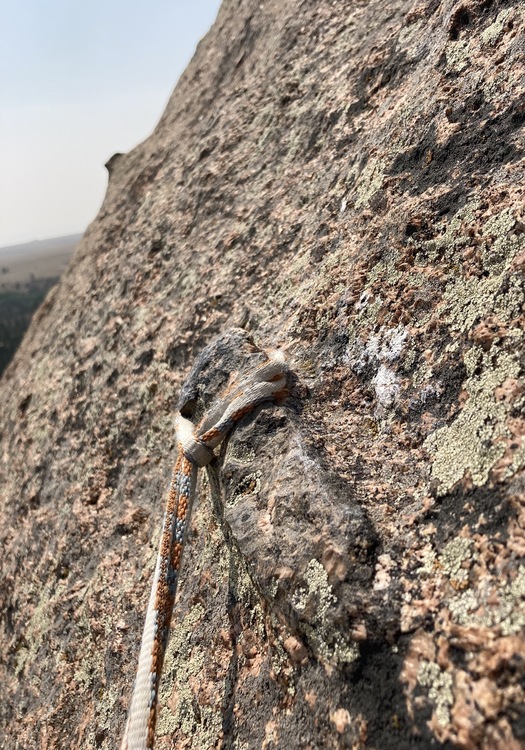 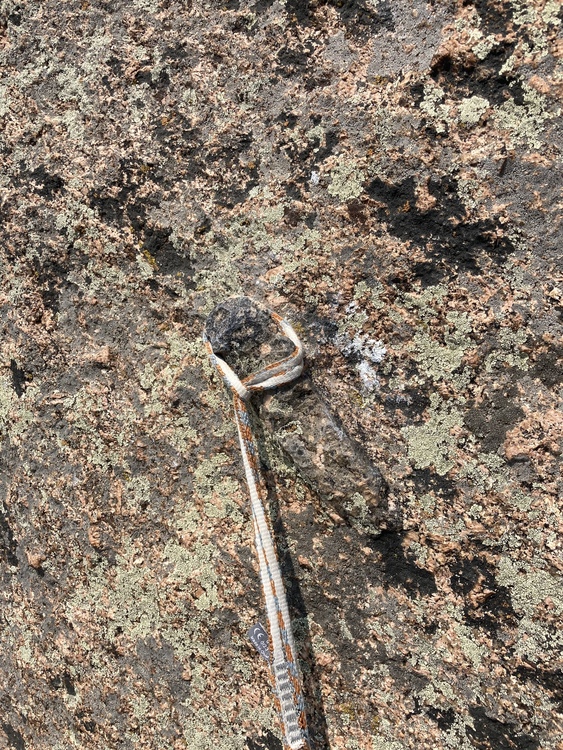 |
|
|
climber patwrote: But One needed to be a “Sport” to climb. |
|
|
Take a look at Patina Pie: 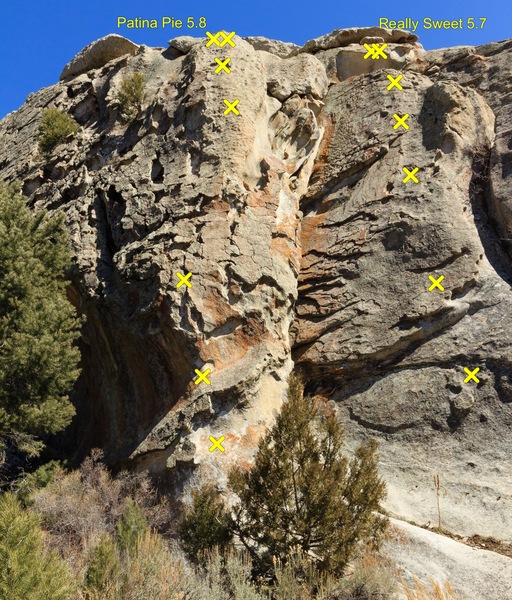 Now, admittedly it is super easy climbing, but sheesh, a huge runout, lol! If one was to try and sling something en route, how do you keep it in place when it has to be multidirectional? And, why does this get called "sport"? Because it has bolts? Or, because it has bolts and is old school? Meaning, easy terrain that assumes you're good to go? Just curious, not complaining. I've known to be heads up at COR since almost my first visit. I actually like that you may not know what you've got until you are there and staring at it. "Do you see any bolts up there?" "Nope. Do you?" Lol! Best, Helen |
|
|
Old lady Hwrote: Clipping/hanging something from it is the easiest way. Always fun to leave heavy gear behind on a multi-pitch for your partner to haul up. Just don't leave your approach shoes... if they have a sense of humor like mine they might leave them behind. |
|
|
Maybe a dumb question, but if I sling a vertical horn midroute that is not tall - say it's 4" tall and 4" diameter base conical shape with no knob/chicken head to it to keep the loop firmly in place, do I need to worry about walking the sling up and off the horn when I am climbing above it? Anything to do other than extend it and girth hitch/knot the slung loop as tightly as possible? Hang something heavy off the loop like the immediately above comment on multidirectionals? I understand this is far from ideal pro and would probably not rely on it alone, but I like testing weird placements in case they could be useful one day, for example to back up another piece. Thx as always! |
|
|
Jim Ottersteinwrote: Yes one needs to aware that once above the sling may come off. Extensions help reduce the issue. |


