
 Continue with onX Maps
 Sign in with Facebook






What's your go-to anchor?


|
|
wivanoffwrote: That's interesting. My hypothesis was that most people would have some bias in what they tend to climb, which would lead to some dominant choice of anchor setup. For me, it's partly because I tend to climb with some people who don't lead on gear but still want to try the routes. That and for multi with bolted anchors, I find it behaves well with 2 person clipped at a hanging/semi hanging belay. |

|
Franck Veewrote: This resonates with me. Quad on bolted anchors of a multi-pitch helps alleviate that sometimes annoyance when one partner shifts their stance and perturbs the stance of the other.
Reminds me of following someone's lead to find them hanging from one bolt by their PAS, belayed from harness with rope running through a draw clipped to the other bolt. Hah - at least I didn't have to worry about bubblegum. |
|
|
Bill I was going to say I don't remember climbing with you, but then I realized I don't use a PAS. I clip in with a single alpine draw. Otherwise coulda been me. |

|
Usually go for a cordellette masterpoint or, if the pieces are spread apart, some rope nonsense with cloves and a masterpoint tied with the slack between two pieces for Guide mode. If it looks like the next pitch will start with a traverse or something and I anticipate wanting to change stances I’ll use an X or (rarely) a Quad. |
|
|
Rpropswrote: I chalked it up to something I could live with at the moment. Still, in the years since, it has not become my go-to anchor rig. But we are probably fated to climb together some time. I also favor an alpine draw when something like a PAS would be useful. :) |
|
|
I use two rabbit runner style cordalettes. Six meters of 7 mL nylon cord, with a small overhand-on-a-bite on each end. Guide-belay off the shelf. Three locking 'biners. We each clove into one, and share the third locker as our backup, using an overhand-on-a-bite. |
|
|
Franck Veewrote: It also depends on who I'm climbing with. If swinging leads with a good partner, we try to anchor with the rope. If climbing with a less experienced partner and I'm the rope gun. then it's mostly a cordelette - which I carry untied for more options. Places I climb are "mostly" gear anchors (although bolted anchors are becoming more common so I'd use a double length sling and girth hitched carabiner) . Often wide ledges. Sometimes the anchor is low and I sit while belaying off my harness. I think it's smart to be flexible and have several arrows in my quiver. |
|
|
The rope 90% of the time. The rope offers so much flexibility. For bolted I use rabbit ears 8 and belay off the shelf of the ears. I haven’t used a cordalette in years. A few slings and the rope and I can adapt to any situation. |
|
|
One pink tricam and one black totem |
|
|
I only use the rope if I am not leading the next pitch (or if it would be really quick for my follower to re-tie the anchor), or if the protection is spread out. Otherwise, I find it more convenient to use cord or slings because I can just take myself off the anchor and go. If there is pine sap, I will avoid using the rope as well. I almost always belay a follower off the anchor. I just find it more comfortable. For two bolts, IMO any redundant anchor is perfectly fine. I mostly do a "banshee belay" - i.e. an unequalized anchor where you just connect the two bolts with minimal slack. I like to call it the "European Death Anchor" because some people seem to think it's dangerous not to "equalize". Of course, if my partner feels uncomfortable with it, I will build a typical V-shaped anchor instead. For monolithic anchors where you don't need to extend yourself very far, I like using a buntline hitch tied with a bight because you can snug it up to hug the feature, and it gives you a nice loop for the master point. If the feature is very large, passing a bight around is impractical, and I will just walk around it and tie a BFK. If I have to extend myself further, I will also use a BFK. In that case, if the terrain I have to extend through is difficult, I will self-lower to the stance with a munter. |
|
|
Patrikwrote: Post-coffee edit: What's your technique for |
|
|
For those using rope, what's your preferred method to build the anchor? Do you clove into every piece? Do you make a cordelette style anchor but using rope instead (ie. clove into first piece, clip other piece(s), pull strands and tie overhand/fig8 as a masterpoint)? Do you use the equalized fig-8? Been looking around and these seem to be the most popular styles. |
|
|
Double Figure 8 Loop (Bunny Ears). Easy to tie. Easy to inspect. Easy to adjust. |
|
|
Reese Stanleywrote: With two good pieces I’ll generally clove each and tie an overhand in the slack between them. With three I’ll ether equalize two with a sling and then do the preceding, or just tie an overhand in the slack between two pieces and clove the third as a backup. With two good pieces in a vertical crack I’ll put a locker on the bottom piece as a “master point” to clove in/belay and clove the piece above as backup. It all really depends on the gear, stance, difficulty of the climb, orientation of the gear, whether it’s bolts, trees or slung blocks. Trying to make a “cordalette” style anchor using the rope like you described would be a huge cluster I think. |
|
|
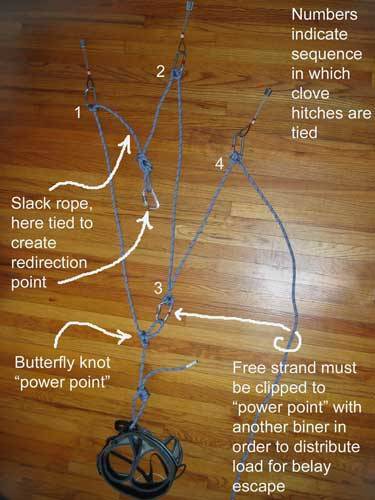 The slack rope redirection point is optional; I almost never use it but the possibility is there. Normally that strand just runs from (1) to (2) but with no tension. An overhand loop rather than a butterfly is fine for the power point almost all the time. If a lot of hanging by the second is anticipated, the butterfly knot will be easier to untie afterwards. The comment about belay escape has to do with the fact that the free strand is likely to be used to take the load in a belay escape, and in order for it to transfer that load to all three pieces rather than just to (4) it should be clipped back to the power point at (3). This is just as fast as rigging up a cordelette and no more complicated while being far more adjustable and vastly more adaptable to any number of anchor points and upward or sideways directionals. |
|
|
rgoldwrote: Very nice setup. I would disagree thought that " it is no more complicated". It feels little more complicated to me, though I suppose after tying it few times it starts to feel familiar. |
|
|
rgoldwrote: In this setup, would that "Powerpoint" be a suitable place to rig a direct belay on the anchor to bring up the second? I know through reading some of your previous posts that you prefer an indirect belay, but I have seen this photo before and wondered about the appropriate setup for a direct belay. It would seem that the redirection point serves that purpose, but then the belay does not utilize the "#4" piece at all. Would this defeat the purpose of a 3-point anchor? Seen this photo many times before and still trying to get a clearer understanding of some of the mechanics. |
|
|
A direct belay for the second goes on the power point (3), not the redirection point. The power point is tied first and so can be positioned exactly where it is most comfortable and convenient for the belayer (well, within some restrictions determined by the gear locations), another advantage over cordelette methods that have little adjustability. |
|
|
Bolts - two burly long draws with locking biners for TRing a single pitch. One 48" sling EQed and tied off with a figure 8 and a locker at the master point for multi-pitching. Trad - three pieces with one 48" sling EQed and tied off with a figure 8 and a locker at the master point. |
|
|
natural all the way... |


