
 Continue with onX Maps
 Sign in with Facebook





Describe your TR Solo Setup


|
|
jbak x wrote: Do the devices interfere with one another? I feel like some weird stuff could happen if they bump into each other. Any advice on how to safeguard against device interference in this setup?
Sam |
|
|
Sam Oudekerk wrote: Gotta pay to play |
|
|
Minimalist approach to TR-soloing. Although my prefered primary device is the Taz Lov2, whenever I'm climbing with a partner I already have the Vergo with me to belay, so the only other thing I need is my Roll'nLock which is the best back-up device there is IMO and has advantages over the Microtrax (even though from my recent survey it seems to be the most popular). It's simple to throw in the pack and should my partner decide to leave early I can always TR-solo and there's only one extra piece of gear to bring. With this setup it's simple to run laps. What's not to like?! |
|
|
Sam Oudekerk wrote: They don't bump into each other if you keep the trax up higher via a quickdraw/dogbone, attached to a chest harness. This is my system. Trax = primary on first rope. Grigri = backup on 2nd rope. |
|
|
I keep both devices on the belay loop with the top device held up, but no extension. As long as the lower device has teeth/ribs, there's never been a problem even if/when they contact each other. |
|
|
Camp Goblin with steel locker. |
|
|
Light and minimalist but still has device redunancy for safety margin. Slides very smoothly. Have used this setup or some variation to it for many hundreds of pitches. No chest harness or neck loop needed. 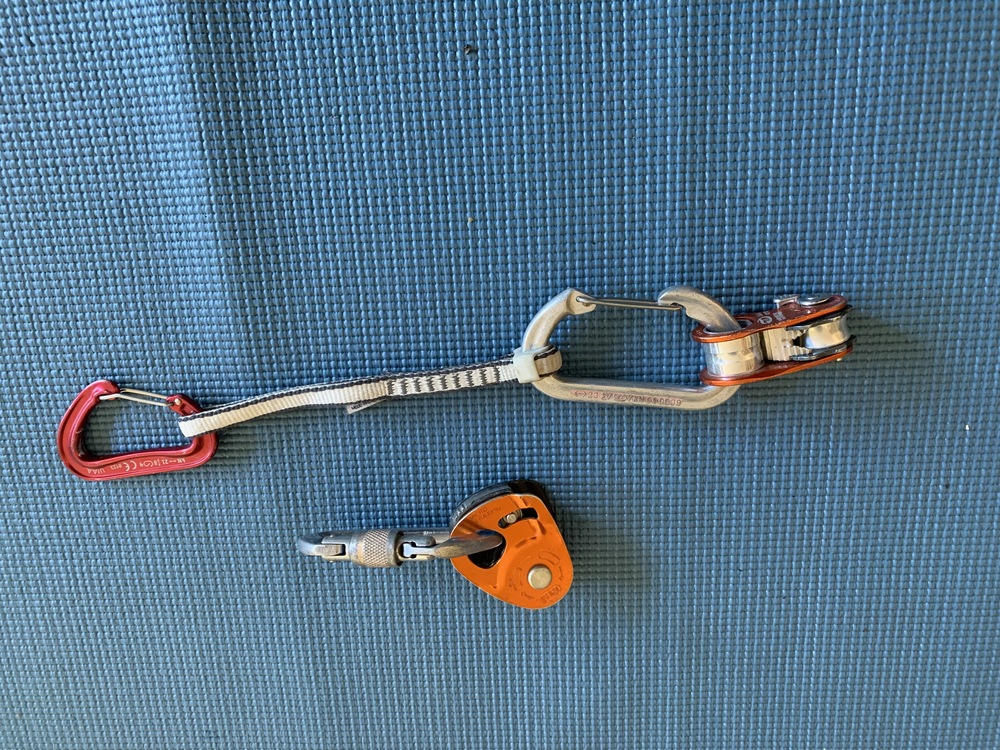 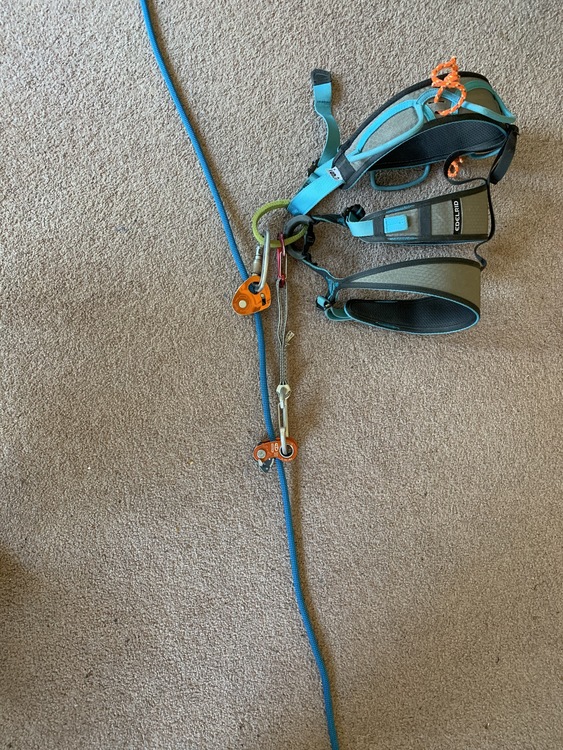 To transition to rappel, put a grigri between the devices (under the microtrax), unweight the rope for a second to unclip from the microtrax, sit down on the grigri, remove microtrax from rope, lock open rollnlock, then rap. That whole transition only takes about 30 seconds once you are dialed and if it is easy to unweight the rope. It can still be done when free-hanging with only mild shenanigans. |
|
|
Sam Oudekerk wrote: My harness (Metol) has 2 loops. No interference. |

|
I use a Microcender and a Microtraxion. Here is a video I made of my setup. youtu.be/ZHB2Vw3iCSE |

|
JCM wrote: Is there a specific reason to use the Roll-n-Lock in that position? Gentler bite on the rope compared to the Microtrax? |
|
|
My "heavy duty" setup is two strands of a single 9.9mm dynamic rope, primary tied with bhk for "redundancy" secondary tied with figure 8 because 6 strands don't fit in a biner. I use a grigri as primary with a gridlock biner to minimize cross loading, ropeman 2 as secondary on D locker(the ropeman tends to hold itself in position on the biner so I'm not too worried about cross loading). Both clipped to belay loop. When weighting my lines I leave just a bit more slack (4-5 inches/10cm) in the secondary so that the ropeman pulls slack later, in turn the gri catches first. It's never failed me in the 30+ times I've used it, and I've never been caught by the secondary. I've never had trouble with too much drag, but I do pull slack through if I'm gonna do a balance-y move so my weight (generally coils) doesn't hinder me as much. On easy routes I'll use a single line with the gri and tie a stopper before I hit the Crux. I kiss my grigri after every use so she won't let me down (pun intended). Bonus tip! If you attach a pulley to the anchor (I usually clip it to the shelf) and redirect your "brake strand" to that pulley you get somewhat of an auto belay for the top half of the route(only the top because you effectively half your rope). Creating a 2:1 for slack to be pulled through. You don't have to pull the weight UP because you are now climbing towards it instead of away from it (if that makes sense). You climb up and the weight goes down, so make sure it's not in your way when you cross paths. It's amazing for working high cruxes near your limit because you don't have the weight dragging you down. In fact it kinda gives you tension upward which is mentally relieving on that near limit crux. You could probably find a way to make it work the whole route but you'd have to faff around at the middle, which I haven't bothered trying. I've only actually used this "autobelay" setup on two routes, but multiple times on each route. I do feel obliged to warn against allowing your weight to land on a ledge while it is going down, as it will stop "belaying" you and could potentially be dangerous. |
|
|
Optimistic wrote: The primary reason is that the lock-out on the Roll-n-Lock (to lock it open) is much more secure. If running multiple laps, once I get to the top I'll add the GriGri, remove the Microtrax, but leave the RollNLock on the rope and just lock it open while rapping down. On the Minitrax it is easy to bump the button and have the cam snap back onto the rope. This is annoying if you leave the backup device on the rope when rapping. The Roll-n-Lock does not have this issue; if you lock it open it stays locked open.
|
|
|
If it hasn't been mentioned before, another plus for CAMP Goblin is you can keep it on the line when you're rappelling, using ATC above the device, (or even more easy and simple, I use a munter on my home wall), and rappel like normal, non-brake hand can tend the Goblin. Then when you get back to the bottom you simply remove the rap device and start climbing. Not practical to use a gri gri in this method. |
|
|
I don't see any one use the pro trax. I've found this set up to be amazing. 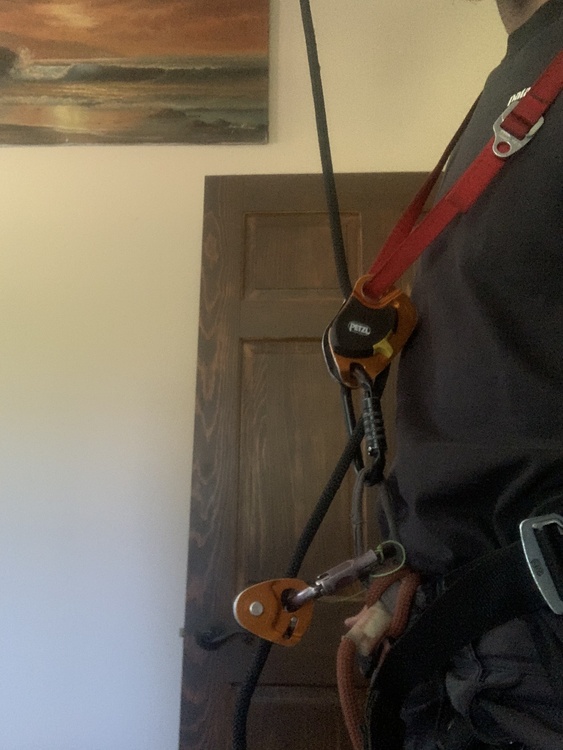 |
|
|
I just use my Soloist. A couple backup knots along the way, and that's a bout it. But, if I'm not climbing with much confidence, that seems to breed more backup knots, which seems to further sap confidence, and so forth. |
|
|
Ancient Jumar I bought from Jimmy Dunn in 1982 plus a Microtraxion. |
|
|
Mr Rogers wrote: That is an interesting way to load the pro-traxion. Any idea if this is an approved way to load the device or the strength like this? I couldn't find any documentation showing the strength in this orientation. |
|
|
No literature supporting it, but ive also never seen anyone else use it like this. |
|
|
Dynamic 10mm rope and a microtraxion. Thats all you need... |
|
|
Matt King wrote: It’s pretty sketchy to only use one device. If only using a mircotraxion I hope that you have modified it so that it can’t be held open. I have had mine get clicked back several times. I have heard from others that climbed whole pitches with one device only to realize that they were just soloing because the teeth weren’t engaged. I used to only use one device but have had some stuff happen that makes you think twice about it. I prefer two ropes with one device one each rope for better feeding and redundancy over edges. I like rappelling on two ropes better. I also like auto locking steel carabiners. I have had screw gates come undone several times as well as carabiners flip to get cross loaded. |


