
 Continue with onX Maps
 Sign in with Facebook





Describe your TR Solo Setup


|
9.8 rope with a fat grigri on there. |
|
|
Single, dynamic, fixed line that is weighted slightly with my pack. I use two progress capture devices: a Camp Lift backed up by an Edelrid Spoc. The Lift is toothless and is my primary device that gets weighted. It is attached to the belay loop with an anti-crossloading carabiner. My Spoc is the backup beneath the Lift and I attach it to another anti-crossloading carabiner that is extended with an 8 inch sling girth-hitched through my two hard points. This allows the spoc to sit low enough that it won't interfere with my top device. I found climbing with a makeshift chest harness to be really unpleasant and this method does a good job of keeping the two devices apart. |
|
|
William Hinrichsen wrote: This is what I use except with two ropes and it works well, I just need a LOT of weight in my pack for it not to hurt my neck, like suggested above |
|
|
I like the grigri for the ease of going down to retry a section or just get back to the ground. Haven't figured out the best way to back it up though. Any ideas/suggestions out there? |

|
Single strand 10.1mm, static. Rope/edge protector (manufactured wrap kind as well as DIY padding on edge; the routes I TR solo all have edges). Grigri on harness belay loop. Microtraxion on a double length sling acting as a "chest harness." Haven't perfected a way to keep it "in line" (carabiner attachment always turns it 90 degrees). Climb way below your limit. |
|
|
Arthur W wrote: I don't quite agree. If the system is not reliable when I try hard, why would I trust it "just in case", and just climb easy stuff? |
|
|
I like to be able to run in to the crag before work so my system prioritizes low weight. Works great for most TR crags in the LA area. - 9mm 40m static canyoneering rope for a nice spot on the burliness/lightweight Venn diagram. Bunny ear loops w/ CAMP Photon lockers for 2-bolt anchor setups. Single line. Weighted at the bottom duh. T-shirt for rope protector if it seems necessary. - (4) CAMP Photon/Nano 22 ultralight draws as directionals - GriGri for rapping in - Petzl Croll S on locking oval biner to my belay loop, with sling girth hitched to the top of the Croll and slung across my chest/shoulder to keep it upright and in line. - MicroTraxion backup underneath that on the belay loop, using a shorter D locker so it can’t move up and interfere with the Croll. - ATC in tow as backup just in case I somehow drop my Gri while I’m switching from the progress capture devices back to rapping - CAMP dyneema daisy chain for backup/hanging when building anchor/transition/whatever. |
|
|
toad lick wrote: This is one of the best and tidiest setups described on this thread so far. Most of this thread is just cringe-inducing, but this setup is sweet. Perfection is achieved when there is nothing else to remove. At the same time, there is still plenty of built-in safety margin here and is isn't sketchy (as compared to the single-microcender setups). I've used the Croll off and on in the past for TR solo (don't use it currently since I'd rather not have to use a chest harness or neck loop), and found it isn't quite as confidence inspiring since there is the potential, in weird loading scenarios, to pop off the rope. So I'd never use it on its own - really any device on its own isn't great. But when the Croll is backed up with a Microtrax (very confidence-inspiring) - that is much better. |
|
|
JCM wrote: can you explain why (other than obvious lack of redundancy) this is so sketchy? I only ask as I’ve definitely rolled with just a microcender on my loop and backup knots |
|
|
J G wrote: Single device with a known failure mode (which can occur somewhat at random); multiple reports of accidents or near-accidents from this system. Just because this system has worked fine for you up until now doesn't mean it will continue to. It just means you haven't encountered the low (but not low enough) probability / high consequence failure. This guy was using a microcender + backup knot setup. The backup knot kept him from hitting the ground, but the reflex to grab the rope as he fell led to heinous rope burns on his hands. There have been other instances previously where this occurred, so it is a possible outcome in the slide to backup knot scenario. Also the potential to clip a ledge and break your ankle with slide to backup knot. There is so little effort associated with trailing a microtrax on a quickdraw below your primary device. It weighs very little, adds a trivial amount of the drag to the system, only takes 20 seconds to set up, and makes your setup dramatically safer. Basically always worth doing. |
|
|
Either a Taz Lov2 or a Trango Vergo as primary device with the Roll'nLock underneath on the same strand as a backup. More info via links listed. Climb; hang; unlock RnL; rap ...rinse and repeat. 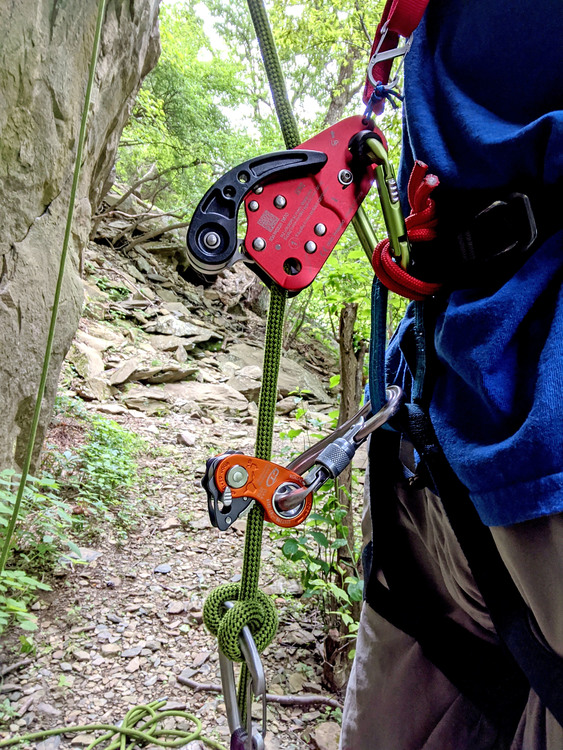 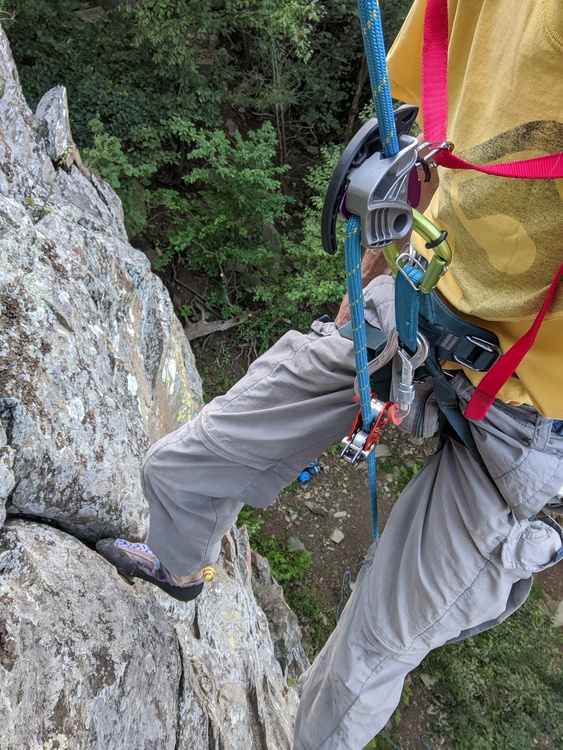 |
|
|
JCM wrote: Thanks for the info! |
|
|
2 strands. Microtrax on one, grigri on the other. Cake. |
|
|
JCM wrote: What is the quickdraw for? Is the idea that the extra length of the quickdraw keeps the Microtrax low enough that it will only engage if the primary belay device fails? |
|
|
Optimistic wrote: Correct. My current minimalist setup has been a microtrax on the belay loop on a Gridlock (to reduce cross loading potential) screwgate, and then a RollnLock trailing below on a regular quickdraw. Simple, light, clean, fast to set up, but everything is backed up. This arrangement does not use a chest harness or neck loop to elevate the microtrax, which adds about 8 inches of fall distance, but for my use-case that is acceptable and avoids the annoyance of a neck loop. Since the microtrax trails below the belay loop, you need the quickdraw to trail the backup device lower to keep it separate from the main device. If you were so inclined you could use a locker-draw for this purpose also for an extra bit of security. |
|
|
Just clip the bolts. Figure 8 through both. Gri gri. Done. |
|
|
I used to just use a grigri with backup knots but spent a bunch of time this summer using a microtrax on one side of the rope and a grigri on the other. I found a second rope to be much more of a pain than I thought it would be, no matter how much climbing I did. It just never felt natural. Probably going to use one side of the rope and two devices for a while. |
|
|
JCM wrote: I usually use a static line (to minimize the fall distance) and the chest sling/belay loop setup. Seems like with the "dangling quick draw" approach, that added fall distance would require a dynamic rope? |
|
|
Optimistic wrote: Correct - I'm generally using a dynamic line, so an extra 8 inches of "TR-whipper" onto the microtrax is no big deal - the fall factor and forces involved are so small. A lot of my TR soloing these days is to repeat pitches that I've just led. This includes TRing as the "second" to clean pitches I've rope-solo led on a multipitch. Also I'll always throw the TR solo kit in the pack for pretty much any cragging day, in case I ever want to do fitness laps on a pitch at the end of the day (without having to make my partner belay me for 4 laps). So in both cases I'm TR soloing on the dynamic lead line. These use cases are also why I've whittled the system down the simplest/lightest it can be while still maintaining sufficient safety margin - minimize the amount of extra stuff to haul around. Even for "normal" TR soloing - hike to the top, drop line - I still just use a semi-retired old lead line and the same devices since I'm used to this system and it works well for me. Also, I have lots of old lead lines to wear out and don't own a static rope, so that plays a role too... The great thing about rope soloing is that your system only has to work for you (no need to compromise with a partner), so you can dial it in exactly to your needs and preferences. |
|
|
Has everyone forgotten what climbing is? Bachar come back! |


