
 Continue with onX Maps
 Sign in with Facebook






Inward flaring cracks and "passive" cam placements


|
|
Say you come to a horizontal crack which flares inward, the crack is under a large roof/arch feature and in very solid rock. You are carrying Metolius UL Mastercams, which have cam stops and can be placed in a passive mode. A certain size cam fits comfortably through the opening and then opens almost completely, while the next size up barely fits through the opening and then opens to a tipped-out but still retracted position (maybe 80% expansion). The crack continues to flare inward past the depth of the placement. Which size would you choose? I went with the smaller one, based on the idea that it's open already, so it can't really walk further in to potentially be out of reach. Would there be some value to using the larger cam in a tipped-out position instead? |
|
|
If it continues to flare inward, an 80% tipped out cam is just going to mushroom the rest of the way, so it will end up fully open too, but the sixes between the two are such that the bigger one isn't going to be that much deeper. I would probably use a hex or some other passive piece. Otherwise, I would use the one I am least likely to need later in the climb. |
|
|
Sounds like a good spot for a Tricam. You should know that the cam stops on the smallest Metolius units aren't really that strong (start at page 3 of the thread linked below). Go with a double axle cam if you make a habit of placing wide-open camming units. https://www.mountainproject.com/forum/topic/110291509/broken-cam-thread |

|
Jared Chrysostomwrote: Have a source for this? I'm pretty sure those cam stops are not load bearing, and are just to hold the spring expansion at a max point. Theres nothing in the master cam pdf that says passive placements are ok. |
|
|
Passive nut keyed in. |

|
A crack that flares inward is, if at all possible, an occasion for a keyholed nut placement, or a tricam if you are carrying them. If not possible, it could be a spot for two cams, angled towards each other (and maybe tensioned), to prevent horizontal rope motions from walking the cams. |
|
|
Yeah, this def. sounds like a nut or tricam placement. |
|
|
Good thoughts. The crack was too big for any nuts on my rack, and the only tricam potentially big enough (brown) was in the anchor below me. I didn't have any hexes. The cams in question were #5 and #6 UL Mastercams if that helps you guys visualize the placement size.
I swear I thought the ULMC's were OK in passive placements but I can't support that so I may have been wrong. If this comes up again I'll grab a double-axle cam from the other side of my harness.
rgold, would you mind elaborating on this? |
|
|
Flat out, only double axle cams are rated passively. The ULMC stops will shear if it’s a strong load. Other option depending on the nut/crack’s internal taper, would be to slide a nut in horizontally, and then rotate and set it in the long axis.. but would probably just be wisest to use a double axle or skip that placement. |
|
|
Gunkiemikewrote: Or better yet: don’t make a habit of placing wide-open camming units (I get that your reply was somewhat tongue in cheek). I would treat this as “no fall” territory and back off if I don’t feel 100% confident I can climb the section cleanly. Relying on the passive rating of cams (rather than reserving it as an “oh shit my cam walked at least I’m not dead” situation) just seems like a recipe for disaster. |
|
|
Mitch Montywrote: That's just not true. Older Wild Country friends all had rated cam stops. wildcountry.com/media/pdf/c… 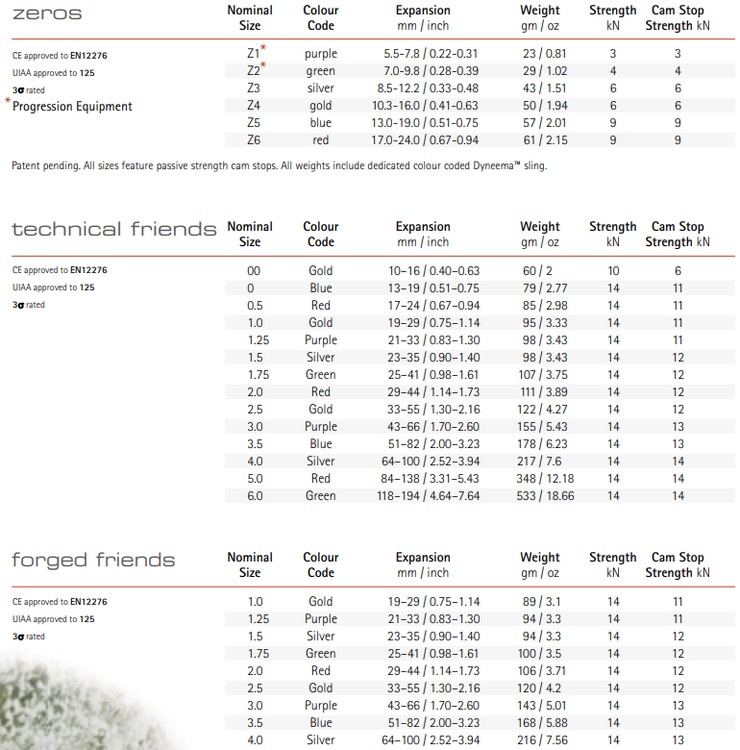 |
|
|
Austin Donisanwrote: Meant new/current production models. Possibly only exceptions retail now being Kouba cams or CT Anchor cams that share designs with the technical friends |
|
|
Don't rely on gear that rattles around randomly in its placement. Those cam stops are a last ditch before failure and possibly your death backup. |
|
|
I encountered a somewhat similar situation a few years ago: .5 size parallel crack that expands after an inch or so to be a #1 or bigger. Placed the .5 and pushed it a tad back and it opened up into the larger spot. wasn't super happy about it but kept climbing. |
|
|
Rob Dwrote: Sounds like we’re both GD. |
|
|
Jared, the takeaway here in your specific case was that the thing you should do differently next time is that after assessing your risks above to the next probable placement, and deciding to go for it, is to grab and place the Camalot rather than the MC. All the other advice, while correct per se, didn’t apply in your case, and likely won’t again at some point— Other than rgold’s. |
|
|
Mark Pilatewrote: Agreed. I’m hoping rgold will come back to explain how he would place two opposed cams with tension applied. |
|
|
Jared Chrysostomwrote: I'm not sure how much more there is to say. The situation is nuanced and might or might not be mitigated by the double placement. The scenario as I understood it was that the cams were properly cammed near the lip, but the flare towards the back could allow rope motions to walk the cams deeper until they sprung totally open. So you want a placement that can't be moved by rope motions. The way to do this, if the crack allows for it, is to place two cams in the horizontal, aimed at each other at an angle (not straight in). The simplest way to rig that one-handed would be to clip a (possibly doubled) full-length sling and attach a carabiner or a quickdraw to that via a girth hitch. If the cams are close enough, you might be able to just clip them together (using two carabiners gates reversed). In this configuration, one of the cams will resist a lateral pull from the rope without walking (much) because the cam is already oriented in the direction of the pull. To further reduce any wiggle room that might walk the cams, they could be tensioned together, but this would often require both hands for rigging. For this you'd use a runner clove-hitched to each cam with the clove hitches adjusted so that the strand connecting the cams is tight. That's what I meant by tensioned. The pro-end carabiner would be girth-hitched (or clove hitched or even clipped to a power-point style loop knot) |
|
|
Don't fall. |
|
|
Nick Goldsmithwrote: All gear is bomber when you don't fall. Even the self-cleaning nuts. |
|
|
rgoldwrote: The clove hitch thing is what I was curious about. Makes sense. Your wisdom is appreciated. |


