
 Continue with onX Maps
 Sign in with Facebook






Bell Buttress, Boulder Canyon Accident Report 8/13/2020
|
|
On Thursday, August 13th, 2020, I was climbing with a friend at Bell Buttress in Boulder Canyon, CO. After climbing a few different routes, I decided to give a redpoint attempt at Arms Bazaar (5.12a trad). I had spent two previous sessions on the route — one in August of 2019 and one the previous week. I had the route fairly dialed, and I felt confident that I could send it that day. I racked up all of my gear in the order that I intended to place it, and began climbing. I climbed to the bolt, clipped it, and then did a few balancy moves to get to a good stance. From this stance, I placed a red Metolius cam in a horizontal crack such that the stem was facing downward. I clipped into this cam with a shoulder length sling. This is a shallow crack, with the head of the cam just fitting in, and the red Metolius is retracted almost as far as it can go in order to fit into this crack. The lobes all have great contact, though, so I was not worried about the shallowness of the placement. After clipping this cam, I rested, and then did a small traverse to get into the crux of the route. From the undercling which begins the meat of the crux sequence, I placed a black Metolius cam in the crack above me. The black Metolius fits in this crack decently well, although the crack does flare slightly. I had fallen on this cam multiple times before, both the week prior and in August of 2019. After placing this cam, I began the crux sequence. I fell with my waist at about the height of the black Metolius. Upon falling, both cams blew out, and I hit the ground from an estimated 25 feet high. I believe that the rope may have begun to catch me just slightly as I hit the ground, although I am not sure. It all happened very quickly, so I am not entirely sure how I hit the ground, but my left side took pretty much all of the damage. About 20-30 seconds after the fall, I began to evaluate my condition along with my partner. We confirmed that I was not bleeding or deformed anywhere (especially on my skull), so I sat down and just began to think and chat with my partner in order to determine my mental state, which was normal, considering the circumstances. I ended up with a bruised left hip, bruised left heel, and what seems to be a hyperextended thumb (the hyperextended thumb is speculation on my part. I got an X-Ray later that day and the doctor did not see any damage). Additionally, the foam on the right side of my helmet is completely cracked (pictures below). It seems as if I likely got a mild concussion, but I have not shown any of the typical symptoms, besides slight confusion for a minute or so after I fell. Analysis: First of all, I consider myself extremely lucky to have walked away from this fall with such minimal damage. If circumstances were just slightly different, my injuries would likely have been much more severe. In regards to the protection pulling out — this was very surprising to me. As stated above, I had fallen on the same black Metolius placement multiple times before, and I also considered the red Metolius to be solid, albeit not perfectly textbook. At the time, I felt comfortable falling on either piece individually. More specific details on the placements are written above, so I will forego repeating those details here. The only answer I can come up with as to how both pieces ripped out is that they interacted with each other in such a way that they helped to torque each other out. Because the red Metolius was only clipped to a shoulder length sling, it ended up running the rope at an estimated 45 degrees down and left of the black Metolius placement. As of right now, I do not have a perfect explanation for both pieces ripping, although I believe the pieces putting unexpected forces on each other played a role. Moreover, as stated above, these were not 100% textbook placements, although they were both placements that one would reasonably expect to hold in a fall. In regards to my injuries, it seems as if the pieces pulling out served as speed bumps, slowing down my fall. Additionally, the bolt clipped below the red Metolius may have helped take a bit of force off of my impact, although I am not sure. The fact that I walked away with such minimal injuries from a fall of this nature is extremely lucky. Had I not been wearing a helmet, I would have been very seriously injured, or worse. I believe that in the past I have not given enough respect to the ways in which wandering placements interact with each other when loaded. Although this can be difficult to predict, I believe it should be something that trad climbers give a lot of thought to, especially when redpointing, where one has time on the ground/hangdogging to really analyze each placement and the system of protection as a whole. Additionally, this fall has reinforced my decision to always wear a helmet when climbing outdoors. When trad climbing, everything gets harder to predict and control for, and the helmet is such an easy safety precaution to take. I strongly believe that I would not be writing this today if I had not been wearing a helmet. Looking at how my partner and I reacted right after I fell, I believe that we should have done a more in depth assessment of my condition, in particular my spine. My partner did not have any wilderness medicine training, but I am a WFR, and together we should have, and easily could have, more thoroughly evaluated my condition before deciding to just take a seat. However, I was so shaken up, and my wilderness medicine training is so minimal, that this did not end up being my initial reaction. Luckily, I did not have a spinal injury, so it was not a big deal in this particular instance.
I wrote this accident report in order to give a data point to the community, with the hope that others could learn from this situation. Please let me know if you have any questions, and I will get to them when I can. Joel 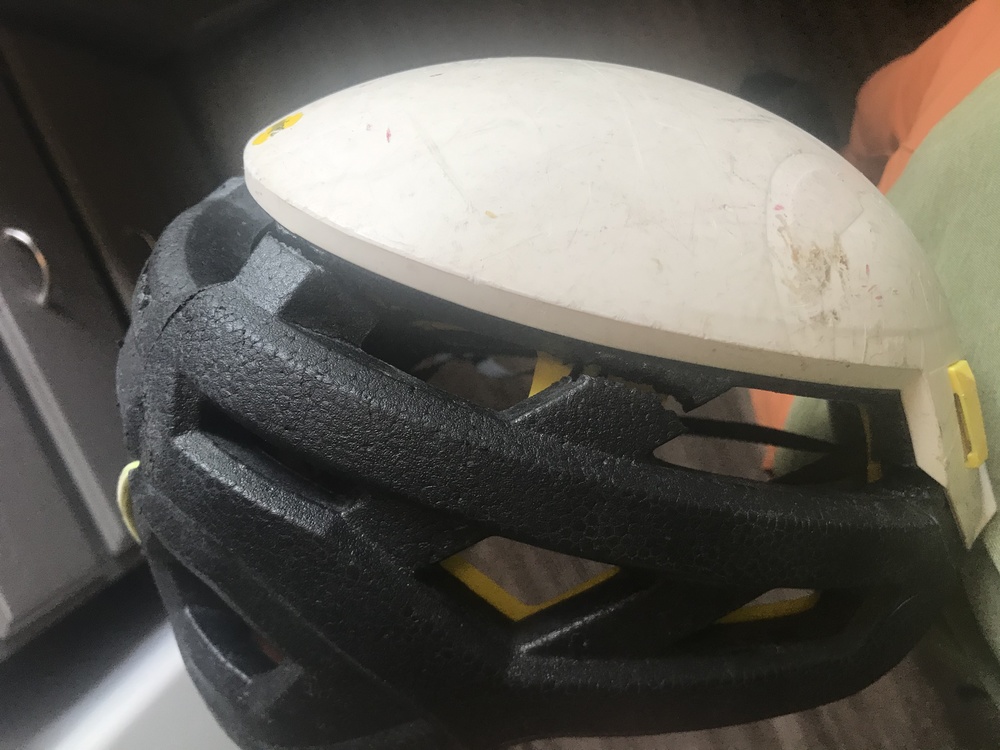 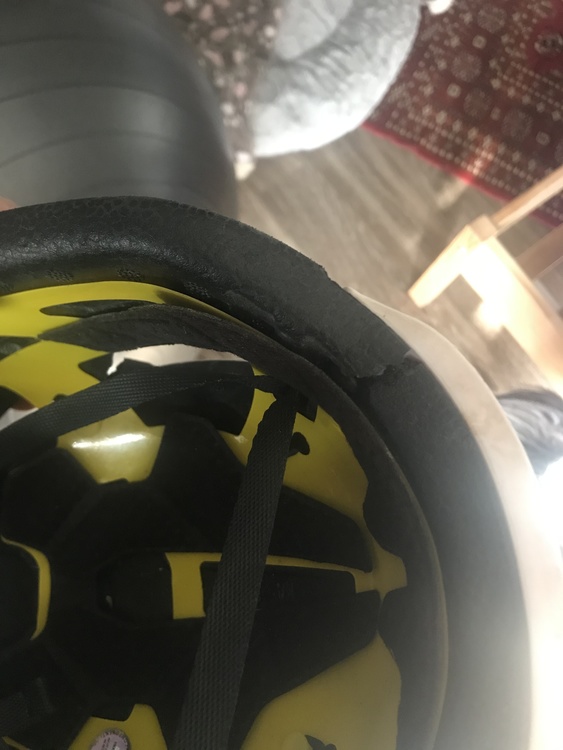 |

|
Glad you walked away from this fall. I think if you had a C-spine issue you would have likely known about it so I wouldn't be to hard on yourself about that. Sounds like you did everything pretty damn well under the circumstances. Was the black metolius clipped only into its sling? No extra runner? If so do you think a longer runner on the red cam (short draw maybe) AND a longer runner on the black cam would have prevented the failure of the pieces? |
|
|
chummerwrote: Thank you. The black cam was not extended at all. I do think that a double length sling (as opposed to the single length that I used) on the red cam may have prevented the failure, as the rope would have been running at a much less severe angle. Personally, I don’t think a quickdraw on the black cam would have helped in this situation. I should reiterate that the angle between the pieces causing the failure is just the best answer that I have come up with, and I’m really not sure if that was the cause or not. |

|
chummerwrote: I had a friend who took a fall and thought he was fine but after a couple of weeks his neck felt a little funny so he went for an xray. He had a cracked vertebrae and was put into a collar immediately. they told him he was lucky he came in as this injury put him at significant risk of paralysis if he had not come in. So please make sure you feel completely ok. I’m happy for you that it was not worse. I usually double up at my first or second piece when that piece is at the 15 foot or more mark out of fear of a groundfall incident with gear pulling. Sometimes with routes, esp as difficult as you were on, this isn’t possible because either there isn’t a space for a double piece or the piece would interfere with critical finger/hand. Again glad you are mostly ok. |
|
|
Thanks you, Phylp. It is worth noting that there is more gear available (.4 size) about 8 inches under the black Metolius. I placed a yellow Totem here on some previous burns, but ultimately determined that it was unnecessary, because I considered the black and red Metolius cams to be sufficient. Had I placed this piece when I fell, I likely would not have decked. Also I will add that I took a few falls onto the black Metolius without the yellow Totem placed, so the Totem was not a necessity in preventing a funky interaction between the Metolius cams. |
|
|
Thanks for the write up! With Phillips comment I know someone who fell on a winter run in Colorado and broke their neck and was lucky they were paralyzed and all they had was mild pain. Looking at the route comments it seems common gear blows on this climb/did any of the rock seemed damaged? |
|
|
Princess Puppy Lovrwrote: We looked up to see if there was any blown out rock, but we couldn’t tell from the ground. The rock is pretty solid there for the most part. I doubt that the black Metolius placement blew out any rock, but it’s possible that the red Metolius did. |
|
|
Thx for the write-up. I will say that the crack at crux is quite flary and much trickier to protect that it appears at first. I remember spending the time to place an Alien low near or in the undercling, to back up the next piece in the flare. I also belayed a friend once who got pumped and asked for tension to hang on a piece in the flaring crack that he thought was bomber. That piece popped as soon as he weighted it, and he took a long pendulum whipper onto the bolt, very narrowly missing the ground as he swung by.... helmuts are wise. |
|
|
Thanks for sharing, accident reports like this help us all be more aware. Glad you landed (semi?) OK and I hope you find you are OK after getting further checked out by a doc. FWIW I recently lead this route after previewing it several times (twice on lead) last year and will add a comment on the gear. I'm not a bold climber at all when ground-falls are concerned and this route was very red-flag to me; I only lead it after very careful evaluation of the placements. In my estimation, the placement in the downward-facing horizontal (I used .5 camalot) was a 'prayer' piece, and the placement you used in the flared hand-crack at the crux (some place a 1 camalot) was not trustworthy; it rotated severely under body-weight tension. I placed the downward .5 anyway as dubious insurance and placed a .3 camalot low in the crux, just up and left of the good undercling hold. Likely the same placement ref'd by Steve. It's still downward-facing, but at least 2/4 lobes are very well cammed, the other two are not bad, and the crack constricts. I also think your observation of the pieces creating large angles in the rope is worth us all to consider. Anyway, to all suitors of this route, take it seriously. |
|
|
It's been so long since I did that route that I can't remember what I placed. I do remember being pretty worried about falling on parts of it though. |
|
|
Drew Thayerwrote: Thanks for the input, Drew. I don’t know how the .5 fits in that horizontal crack, so I can’t speak to that piece. My thoughts on the red Metolius are in the post. I wouldn’t consider this just a “prayer” piece. As for the black Metolius, I cant tell if that’s what you placed, but my evaluation of it was more favorable than yours. As I stated in the post, I have fallen on that piece multiple times. There’s no question that backing it up with another piece below (above the undercling where the crack is thinner) is the way to go. |
|
|
J M happy you are OK. I have watched folks knock placements out with feet, rope etc. leaving them naked. Happens at Josh all the time, many times with fatal consequences. |
|
|
Thanks, Guy. I agree that placing more gear rather than less is typically the right call, especially in ground/ledge fall territory. However, as trad climbers, we’re constantly making calculations. Sometimes we choose to place less gear in order to conserve energy, which is what I did here. I thought the gear that I had in was sufficient, and that was clearly a miscalculation. Thankfully luck was on my side. |
|
|
Sorry for the slight thread drift but has anyone done a study to determine if pulling pieces help at all? I've often wondered if they do slow you down a bit or no change in velocity at all. |
|
|
Blakevanwrote: Theoretically, pulling gear will decelerate you by absorbing the amount of energy that it takes to pull the piece. That being said, the energy absorbed by a peice pulling can vary a lot thus the amount that it can slow you down (before you start accelerating again) will change. Example: imagine you take a fall, generating 2 kJ of kinetic energy (energy due to movement) at the "time of interaction" with your piece which, unbeknownst to you, will only absorb 1 kJ due to that being the energy needed to lever that expanding flake off of the wall, and into the atmosphere. This energy can only come out of the kinetic energy of your fall, as that is the only energy that exists in this system. The only way to take energy out of a fall is to reduce mass or velocity, and if taking whippers makes you thinner than boy do I have a great idea for a new fad diet So yes, pulling peices will affect velocity. By how much? As with any good question: It depends. |
|
|
Sawyer Wwrote: Other than "it depends", this answer looks very odd... kN is a measure of FORCE not of energy. Did you mean kJ (kilojoules)? But... you talk about force to lever a flake off the wall... |
|
|
Great write up! Nice to hear you came out of this accident with no major injuries. Also a quick question, I noticed that you have what looks like a Mammut Wallrider Helmet that has the MIPS technology in it. Do you think that helped any during your fall compared to a helmet without it? |
|
|
Normal Customerwrote: Thank you! Of course I can’t be sure, but the helmet is really messed up (I don’t think the iPhone pictures I posted really do it justice), and I have little to no concussion symptoms. Because of that, I do think that the MIPS helped, and the helmets that I buy in the future will include MIPS. |
|
|
Glad you survived. The interaction of pieces is one reason we use double ropes in the UK. However in our case it is propensity of wires to be lifted out once higher pieces are placed. I guess you don't know if the failure sequence was black then red, or red then black. But assuming the former, One thing I have worried about is when a cam is placed horizontally in a shallow placement, the force might not be at a normal to the lobes, but downwards, hence squashing one pair and opening the others. This would only be true in cracks horizontal in both planes, not cams stuffed upwards under a flake for example. |


