
 Continue with onX Maps
 Sign in with Facebook






Equalette direct belay
|
|
I am looking into the use of the equalette for multi pitch trad and am wondering the best solution for setting up a direct belay point, seeing as the master point isn't a knot. I prefer to clip the two strands at the master point, rather than making a sliding x. Is there anything wrong with the setup in the photo?I have constructed a 4 point equalette (as equalized as I can get the 4 points) I have tied directly into the 2 lockers with my lead rope in a figure 8. Then I have put the gri gri onto the bight of that same figure 8 to re direct the belay. Any advice is greatly appreciated. 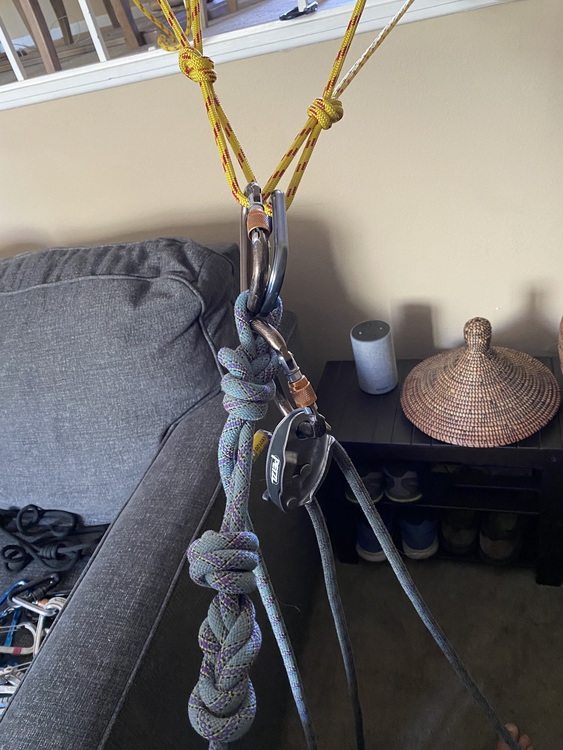 |
|
|
This isn't a redirect belay, this is a direct belay (off the anchor). It's okay as a direct belay, but you may want to clip it into you the carabiners or set up a third carabiner for the device. Using a figure 8 vs. a clove to tie-in will add time in both the set-up of the belay, and leaving it. 1. Before building your belay, climb about the stance to set-and-clip a high piece (i..e jesus nut) (ideally with a locker), then down climb and build your belay. This sets up the follower for leading the next pitch and gives them ample protection on the first moves of the belay (no factor 2 fall possible); 2. Clip a strong, omni-directional piece of your belay with a locker and use that as your high-point; or 3. Or separate third locker clipped into your carabiners to redirect the belay strand through. Edit: Fourth option: 4. Extend your stand significantly below the belay (redirect your end through the masterpoint carabiners and clove to your self) and follow as per point 3. This may not be viable depending on the stance, but gives you more space to belay and see your follower. |
|
|
Alec Baker thanks for the input 1.) Second would clip in to each strand of the master point, same as me (As seems to be recommended on an equalette) 2.) I don't know much about rescue or escaping the system, (A course thereon hopefully to be done soon) But if you just mean being able to escape and walk off (provided it's safe) to look for help can't you just lock off the gri gri and untie yourself from the rope? How would moving the gri gri up to the 2 lockers be any different, except maybe for a longer tail (which if long enough could be a benefit if needing to rap down to an injured climber) But I still don't see how it changes being able to escape the system. 3.) If you use a sliding x where would you clip the gri gri to if you want independent connections for climber and belayer? 4.) Thanks for the info on the quad with runners, I will look in to that. |
|
|
Thank you FosterK. I did mean a direct belay I will amend the heading. When you say use a clove hitch rather than the 8, do you mean one clove hitch going over both lockers, that would definitely make things quicker, I just wasn't sure if the clove hitch would only be good over one solid bar or if it still works fine over 2. If I use the clove hitch instead of the 8, then that would necessitate moving the gri gri locker up to the 2 carabiners. As it is currently set up I put it in the bight of the 8 1.) to not have metal rubbing on metal and 2.) to not have the locker pinching and rubbing the bight of the 8. I'm guessing these are probably not issues worth considering and with the added benefit of having a much longer tail available in a rescue situation I see the benefit of moving it up to the carabiners. You mention setting up a 3rd carabiner, where would you set that up? Thanks Ryan |
|
|
Ryan Stuartwrote: It's fine to clip your clove through both 'biners.
That's correct, these are not issues with meaningful consequence. There is no metal on mental issue.
Clip into any one of the points the other two biners are in. |
|
|
K.I.S.S. keep it simple stupid. Especially for beginners. Unnecessary redundancy doesn't make you safer, it just increases the opportunities to fuck up. I've never seen an equallette used on a climb. I've played around with it, but what's the point? 1 correctly placed cam can hold over 3,000 pounds. That's the weight of a Subaru Impreza. Place 2 or 3 cams and use something simple and easy to inspect to make them redundant. You don't need to worry about perfectly equalizing, just worry about making solid placements. A cordelette with a BFK is probably they simplest thing for beginners. Or bunny ears with the rope if you are swinging leads. One biner at the masterpoint is plenty. For multipitch you are standing there the whole time keeping an eye on it. You don't need two. For top rope where it may get jostled and you can't see it then you want two reversed opposed biners. |
|
|
TLDR Just clip yourself to one of the lockers. Use a clove, not an eight. Clip your belay device to the other locker. Done. Keep it simple people. There is plenty of room for your partner to clip in with a third biner when he/she arrives. |
|
|
Alec Baker wrote: Is that a question or a statement? Most climbers consider it perfectly acceptable to anchor with just the rope and a locker to a redundant anchor and belay off a single locker on a redundant anchor, which is what I described. Feel free to elaborate. |

|
Gloweringwrote: This. Same. Simpler is safer. Faster is safer. Less complicated is easier to inspect. I like the cordalette with 3 pieces; I will extend them with draws if I have to, or if I really need to spread out I will untie the cordalette and tie figure 8s into the ends with the middle piece on a bight... if I really felt the need for 4 pieces (and that's rough, cause I am a weenie and hate not having the extra piece to lead on), then I'd probably combine two pieces and still use a 3-point cordalette. If it makes organization easier, I can usually put 2-3 more biners into the master point knot for the grigri/atc-on-guide or the second when they get up. But I don't think they are necessary for safety. Also, I like the clove a lot more for tying myself to a master point for a couple of reasons, the main one being that you can very quickly adjust how long it is. |
|
|
Greg Dwrote: While we all recognize that bringing up the second does not produce large loads on the anchor, many folks would not be comfortable with their belay being a single strand of 7mm cord suspended obliquely at a large angle (i.e. the equalette single locker situation). |
|
|
Alec Baker wrote: Perhaps I missed something in the photo. I have used the equalette for many years and would never clip to a single strand. I thought that was assumed and obvious. Always clip both strands. That is equalette basics as well as redundant basics. Did this really need to be explained? Seriously people. Gunkie Mike
|
|
|
Greg Dwrote: I think you did miss something in the photo. Your suggestion to the OP to use single lockers to anchor, belay, and secure the second is fine if each locker is sliding X'ed to capture both strands, but as Alec has pointed out, OP's anchor is not. So single lockers would be on a single strand (as his are). |
|
|
Gunkiemikewrote: My post was based on the op saying: "I am looking into the use of the equalette for multi pitch trad and am wondering the best solution for setting up a direct belay point, seeing as the master point isn't a knot. I prefer to clip the two strands at the master point" I'm thinking you are not reading my posts. It is equalette and redundancy basics to clip both strands in a manner similar to a sliding X. The photo does not display proper connection to an equalette, which I did miss. Gunkiemike wrote: Large angles? How is this specific to an equalette? It is not. This in one of those jargon things that get exaggerated. To respond to rocknice2 below: no I'm not confusing this with the gumbi quad. quite familiar with both quad and equalette. |
|
|
Greg Dwrote: I think you're confusing it with a quad. |
|
|
I think what is also causing confusion is casually calling where the bottom carabiners clip in a “master point”. I wouldnt call it a master point because there are actually two separate clip in points instead of one. Also, be careful loading a figure 8 on a bight in the direction of the knot. In the setup shone above it happens to be okay, but you usually wouldn't want to load that knot with a biner in the direction of the knot (versus towards the bight). |
|
|
Alec Baker wrote: It's called a cordelette. There's a reason why it's used by so many climbers. |


