|
|
Bold Pueblo
·
Mar 5, 2020
·
Unknown Hometown
· Joined Sep 2017
· Points: 0
Luke Reardon wrote: Hi,
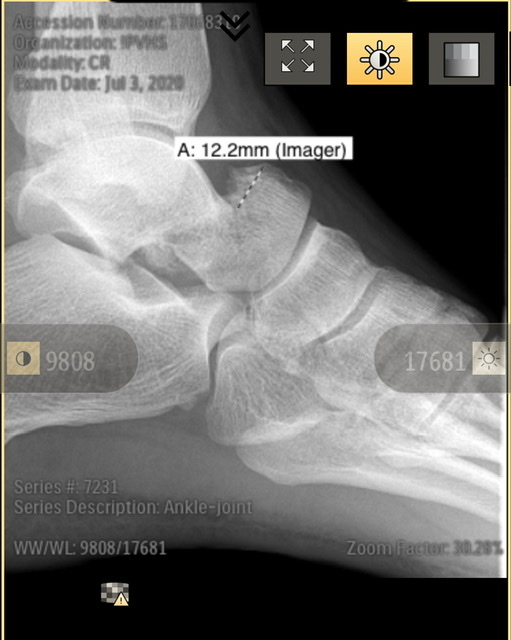
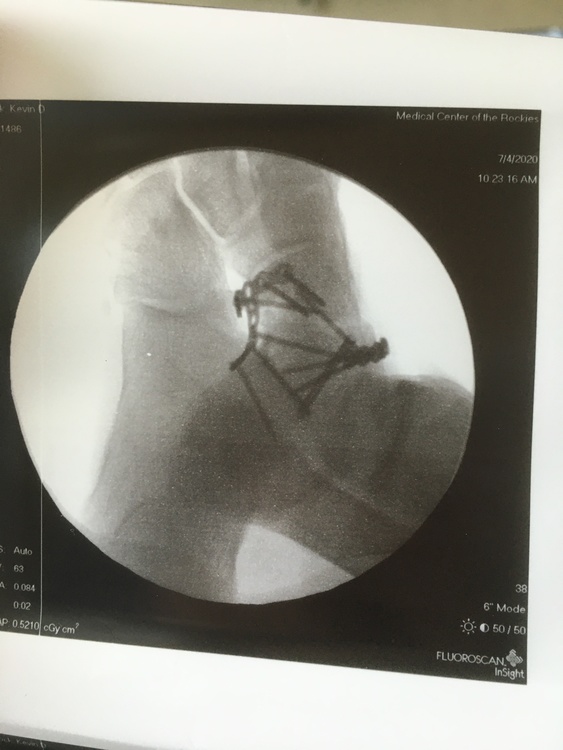
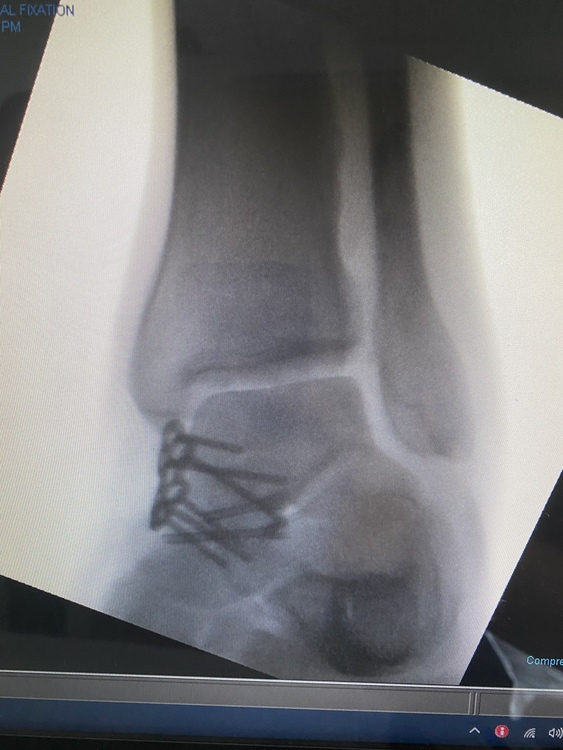
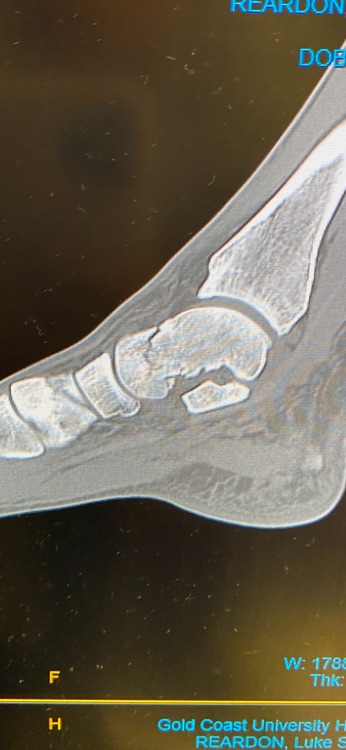
I race motocross professionally, & unfortunately came short on a jump almost 3 weeks ago. I dislocated my ankle, shattered my Talus & Broke my cuneiform in 3 spots. Underwent surgery 2 weeks ago. I received a plate & 8 screws to piece my Talus back together.
I am currently in a moon boot, and will be getting stitches out in 2 days! I am wondering if anyone can help out who have had an injury like this to when I could potentially be able to walk on it and begin therapy! I have commitments to be back on the bike so I will be pushing to do whatever it takes to make the recovery time as short as possible. Below is my fracture & post surgery images.would love to hear your guys thoughts
thanks
Luke, sorry to hear about your injury. I can’t speak to the specifics of each situation on recovery time, but one thing I’ve noticed seems to be consistent on this thread and in my personal experience with a talus fracture is that remaining as active as possible and getting in workouts, even if it’s just core and upper body when you’re still not walking, help you to be ready for a speedy recovery once you’re cleared to start walking and doing PT. Plus they’re good for staying sane. Once you start PT, be religious about it! Healthy diet and lots of sleep help with healing. I’m sure other folks can offer more/better guidance. Keep your head up and remember it can be a slow process, but things will get better. Wishing you a smooth recovery!
|
|
|
Derek Yu
·
Mar 13, 2020
·
Unknown Hometown
· Joined Feb 2020
· Points: 25
Hey everyone!
Great thread. I recently fractured my talus and it's been helpful hearing everyone's experience with the injury. I notice people preaching consistency with physical therapy without going into specifics about the regimen. I understand it's case-by-case, but is anyone willing to share their specific exercises + stretches, and the frequency of said protocol? I am about to start looking for a physical therapist, but I think this information would help guide people (including me) in the right direction on what to expect for recovery :)
|
|
|
mollycoddled anteater
·
Mar 14, 2020
·
Unknown Hometown
· Joined Jan 2016
· Points: 22
I visited the PT twice a week, but was told to do particular exercises twice a day. The plan was always evolving as I progressed.
The constants were:
Warming up with a 10 minute ride on a stationary bike (important!)
Stretching calves (standing, with a wedge)
Stretching hamstring (laying, with towel)
Four-way ankle resistance band (working through the whole rainbow of thera-bands)
Scar tissue massage
Ankle mobility with an adjustable wobble board
One-legged total-gym squats
And I progressed through a whole range of exercises that worked on balance, leg/ankle strength, and eventually agility. Every week I was a little more capable, and the PT knew exactly how to modify the exercises/equipment to keep me challenged. At first, it was challenge enough just to shift partial weight onto the foot.
I reached a point where the foot was somewhat useful in the climbing gym (did a lot of one-legged climbing prior to that) and tapered down to one day a week of PT and one at the climbing gym. After PT or climbing I would be very swollen and limpy, so I could really only do one thing or the other.
Some time after that, the co-pays were really starting to add up and I wanted to spend more time in the gym so I stopped going. I'm not sure if this was the right choice. I think I would have benefited from some help progressing into jumping, jogging, etc.
Hope that's useful in some way. Good luck!
|
|
|
Derek Yu
·
Mar 15, 2020
·
Unknown Hometown
· Joined Feb 2020
· Points: 25
mollycoddled anteater wrote: I visited the PT twice a week, but was told to do particular exercises twice a day. The plan was always evolving as I progressed.
The constants were:
Warming up with a 10 minute ride on a stationary bike (important!)
Stretching calves (standing, with a wedge)
Stretching hamstring (laying, with towel)
Four-way ankle resistance band (working through the whole rainbow of thera-bands)
Scar tissue massage
Ankle mobility with an adjustable wobble board
One-legged total-gym squats
And I progressed through a whole range of exercises that worked on balance, leg/ankle strength, and eventually agility. Every week I was a little more capable, and the PT knew exactly how to modify the exercises/equipment to keep me challenged. At first, it was challenge enough just to shift partial weight onto the foot.
I reached a point where the foot was somewhat useful in the climbing gym (did a lot of one-legged climbing prior to that) and tapered down to one day a week of PT and one at the climbing gym. After PT or climbing I would be very swollen and limpy, so I could really only do one thing or the other.
Some time after that, the co-pays were really starting to add up and I wanted to spend more time in the gym so I stopped going. I'm not sure if this was the right choice. I think I would have benefited from some help progressing into jumping, jogging, etc.
Hope that's useful in some way. Good luck! Wow, what a thorough answer. This definitely helps - thank you so much!!
|
|
|
Amber Greve
·
Apr 9, 2020
·
Omaha, NE
· Joined Apr 2020
· Points: 0
Hello all,
I am so glad I found this site. On Oct. 13th 2019 I was in a MVA and my talus broke out of my foot after it broke and twisted a part of my tibia. I had 2 extensive surgeries and had the x fixation in for 4 weeks. After 6 weeks I started PT but no weight bearing until 3 months ago and now full weight bearing learning how to walk again. I have 5 screws in my foot now. 3 where the tibia was broke and two in the talus and are aligned where the bone would be so they said I would be able to run walk again with that. Yesterday I had my 6 month check up with still not a lot of motion upward to get the 90°. The doctor then told me I would not walk normal again which crushed me . I have a 4 year old son I promised I would run with him again. I want to say fuck the doctors but has anyone had this issue of getting more motion and is there a chance I can walk normal again. I'm so discouraged at this point I want to give up. Any advice would help
|
|
|
Blakevan
·
Apr 9, 2020
·
Texas
· Joined Sep 2015
· Points: 56
Amber, just keep a positive attitude and work as hard as you can because only you can impact the change. I was told that at the one year mark you're about 90% of where you will end up but I still see improvements week to week based on my activity. I do still walk with a slight limp but only people that knew me before the accident can see it. I can't run but I didn't like to do that before either so not really motivated. I'm not sure if you're a climber so this might not mean much but I was able to climb an 11a and 11c in February which is where I was before the accident so it depends on your motivation. As my teenage daughter says "Dad, it's funny to see you limp up to a hard climb and then just float up the wall". Kids will love and accept you regardless if you limp or can't run with them. He'll be happy to walk beside you no matter what.
|
|
|
Paul Hutton
·
Apr 17, 2020
·
Nephi, UT
· Joined Mar 2012
· Points: 740
Paul Hutton wrote: It's been almost a year since my talar dislocation. I've been working a job that involves looking for unexploded ordnance on what used to be a desert training range for the air Force in the Sonoran Desert. 7 miles a day, and subject to all kinds of terrain. It's been a challenge every day, for the past 3 months. My climbing is definitely getting better–I was projecting a gym 5.13 on Saturday. Still sore and stiff first thing in the morning. I haven't made a climbing gear error during my recovery! Emphasize acknowledgement of the tie in knot, enjoy the climbing! I've taken several lead falls now–not a scratch. I went to see a doctor since moving from MO to AZ. They say my skeletal structure looks fine. Just that arthritis is remarkable. And they see the limited range of motion with pain. They've recommended a cortisone injection. An MRI has been ordered, before anything goes further The doctor saw the MRI, and can see a fracture in the talus. It'll need to be fused together. And there's a dislocated ligament on my lateral ankle that's supposed to route posterior to my lateral projection. I can't get surgery til after COVID. I climbed a 10b and 11a at the black cliffs in Idaho yesterday
|
|
|
Blakevan
·
Apr 17, 2020
·
Texas
· Joined Sep 2015
· Points: 56
Paul Hutton wrote: The doctor saw the MRI, and can see a fracture in the talus. It'll need to be fused together. And there's a dislocated ligament on my lateral ankle that's supposed to route posterior to my lateral projection. I can't get surgery til after COVID. I climbed a 10b and 11a at the black cliffs in Idaho yesterday Dude, I hope you can get it fixed and get back out there.
|
|
|
Samantha Shiells
·
Apr 22, 2020
·
Unknown Hometown
· Joined Apr 2020
· Points: 0
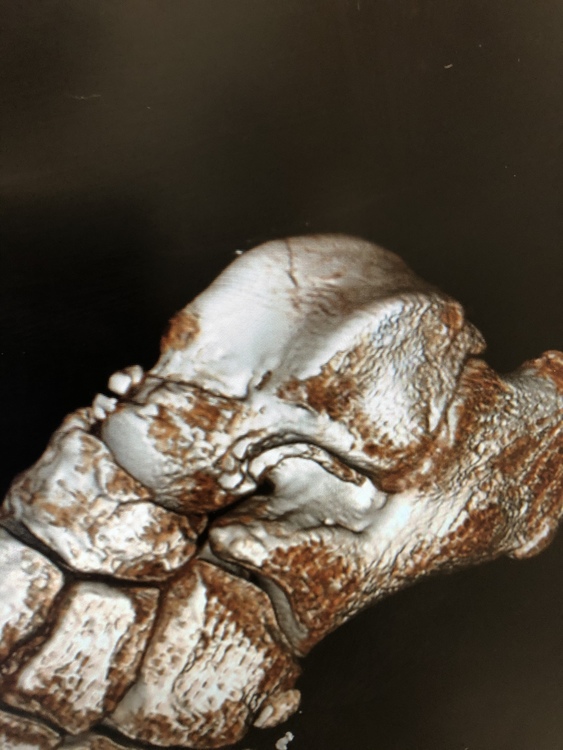
![]() So glad to have found this thread! I’m 7mos out from a talus fracture and going through a lot of the same emotions (frustration, fear, regret..) Feels good to know I’m not alone.My story: bouldering outdoors and jumped down from what turned out to be a higher height than I realized (maybe 8ft, so dumb, uggh). Landed on my left heel. Diagnosis at the ER was an ankle sprain. Given crutches and a boot. Finally six months after the initial injury I got an MRI because I was still having pain. MRI showed a minimally displaced closed talar body fracture (confirmed by subsequent CT, see photo - it’s that line on the top).
I found a talus specialist since I didn’t trust the original doc; new doc said I was lucky that the misdiagnosis didn’t lead to a worse outcome. Since the displacement was minimal (less than 1mm) he said the risks of surgery outweighed the possible benefits (his words: “I’m a very good foot and ankle surgeon, and I don’t think even I can improve this”). His advice was to do low impact exercise like cycling and yoga but avoid high impact like running. He said climbing was okay as long as I didn’t fall (as a boulderer I laughed at that). When I asked about the timeline for returning to “normal”, he said I should think about a “new normal” where I found other activities I enjoyed that were different from what I enjoyed before - definitely not what I was hoping to hear. Based on what I’ve read here it sounds like 7mo out is still too early to say. I guess we learn to adapt no matter what happens, but it’s pretty depressing to think I may never run or boulder again.
Though I’m not sure it would have changed the ultimate outcome for me, my advice:
- find a talus specialist. These are not common fractures so a general orthopedist or trauma surgeon may misdiagnose or not know how to treat it properly
- listen to your foot. If it hurts, don’t do it. I realize there’s some conflicting advice on this but I credit my conservative management despite my original doc telling me I was fine with not displacing the fracture further
I’ll check in again at the 10mo mark. Fingers crossed for continued improvement.
|
|
|
Samantha Shiells
·
May 15, 2020
·
Unknown Hometown
· Joined Apr 2020
· Points: 0
Samantha Shiells wrote:So glad to have found this thread! I’m 7mos out from a talus fracture and going through a lot of the same emotions (frustration, fear, regret..) Feels good to know I’m not alone.My story: bouldering outdoors and jumped down from what turned out to be a higher height than I realized (maybe 8ft, so dumb, uggh). Landed on my left heel. Diagnosis at the ER was an ankle sprain. Given crutches and a boot. Finally six months after the initial injury I got an MRI because I was still having pain. MRI showed a minimally displaced closed talar body fracture (confirmed by subsequent CT, see photo - it’s that line on the top).
I found a talus specialist since I didn’t trust the original doc; new doc said I was lucky that the misdiagnosis didn’t lead to a worse outcome. Since the displacement was minimal (less than 1mm) he said the risks of surgery outweighed the possible benefits (his words: “I’m a very good foot and ankle surgeon, and I don’t think even I can improve this”). His advice was to do low impact exercise like cycling and yoga but avoid high impact like running. He said climbing was okay as long as I didn’t fall (as a boulderer I laughed at that). When I asked about the timeline for returning to “normal”, he said I should think about a “new normal” where I found other activities I enjoyed that were different from what I enjoyed before - definitely not what I was hoping to hear. Based on what I’ve read here it sounds like 7mo out is still too early to say. I guess we learn to adapt no matter what happens, but it’s pretty depressing to think I may never run or boulder again.
Though I’m not sure it would have changed the ultimate outcome for me, my advice:
- find a talus specialist. These are not common fractures so a general orthopedist or trauma surgeon may misdiagnose or not know how to treat it properly
- listen to your foot. If it hurts, don’t do it. I realize there’s some conflicting advice on this but I credit my conservative management despite my original doc telling me I was fine with not displacing the fracture further
I’ll check in again at the 10mo mark. Fingers crossed for continued improvement. What’s up talar team. I didn’t like the prognosis described above for obvious reasons so I found a different doc. He says my pain is coming from the damaged cartilage (seen on MRI) and consequent fluid leaking into the bone. He recommends an OATS procedure, where he’d use bone and cartilage from my knee to replace the useless stuff on my messed up talus. He says this has great results but long term prognosis unknown since it’s a somewhat new procedure. It’s also not covered by insurance, so would be 8k out of pocket. Has anyone had an OATS on the talus? How’d it go?
|
|
|
Karthik Raveendran
·
Jun 18, 2020
·
San Francisco, CA
· Joined Feb 2017
· Points: 0
It's been 2 years since I broke my talus (hit a ledge from 8 feet above on a slabby sport route) and thought I'd post a positive update here. At the onset, my surgeon said that it didn't fit any of the Hawkins criteria due to multiple fracture planes. Specifically, he told me to stop looking at worst-case outcomes on the internet and stay positive. This turned out to be really good advice!
I started PT after 6 weeks of non-weight bearing and continued sessions 2-3x a week for roughly 9 months after surgery. I started running, climbing and backpacking at the 6 month mark. Two years since surgery, I'm back to running 30+ miles a week with no pain at all and I'm optimistic about long distance races once things return to normal post-Covid. A couple of tips for runners who're recovering from a shattered talus:
- Work with a PT who has raced cross country / is still an active runner. It took months to see real progress in terms of range of dorsiflexion but this was critical to running and I'm glad that they convinced me to work through the discomfort.
- Do plenty of foot speed and single legged hops / squat drills. A year in, I still wasn't ready to handle high mileage (e.g. a tempo 8 mile followed by a 5 mile recovery run the next day or hiking 15+ miles on rocky terrain made my ankle very stiff) because the other muscles in that leg weren't quite strong enough.
- Once you're back to light running, reconsider all your running / hiking shoes. I haven't radically changed my footwear and still prefer firm, neutral shoes like the Adidas Boost, but my foot definitely changed in shape since surgery so finding the right sizing and using shoes with plenty of life left in them made my ankles considerably happier.
- Stay positive! It's exhilarating to return to an activity you loved and worth the wait.
Best wishes to those who're recovering!
|
|
|
Court E
·
Jun 28, 2020
·
Unknown Hometown
· Joined Jun 2017
· Points: 0
Hi everyone! This thread has been such a great resource - thanks for sharing all the info and encouragement. I'm now eight months out from fracturing my talus and thought I'd add my own experience so far.
I managed to break my talus in a clean fall onto a crashpad on flat ground - couldn't do the next move on the boulder, down-climbed to a jug, sized up the landing, let go as I had on the previous three or four attempts, and landed just so. Urgent care said it was a sprain, but then reviewed the X-rays again when they saw my pain level. I had a Hawkins III talar neck fracture and had ORIF (seven screws and a plate) nine days after the accident. Three months non-weightbearing (two weeks in a splint and ten in a boot), ditched the boot after a week of being cleared to bear weight, and ditched the crutches another 1.5 weeks later. I started PT six weeks post-op and went for about three months, stopped for a couple months and continued working on strength and mobility on my own, then went back to PT after my six-month X-rays. My second PT place and therapist has been miles better than my first. It perhaps helps that my new PT broke her own talus twice (though it was talar body and didn't require surgery).
Regaining dorsiflexion seems to be one of the biggest struggles with this injury, as others have mentioned. I was cleared for impact activity after my six-month X-rays, but my PT did not let me try impact exercises for another six weeks as my dorsiflexion range made landing rather unsafe with all the other compensations going on. She showed me three things that seem to really have helped in the dorsiflexion department over the last several weeks - ankle distraction with a band and belt, subtalar stretch with band (standing and kneeling), and a brace like this. She suggested the last because my ankle felt great right after mobilizing and working on it, but was usually right back to the limited range just minutes later. I've been doing the ankle distraction and subtalar stretch to get some range several times a day, and then putting on the brace to maintain the dorsiflexed position for an extended period while I'm working or sleeping. Still got a long ways to go (I'm at five degrees of active ROM - after some mobilization - and 11 degrees of passive ROM), but there's definitely been progress as it's not as hard to take those first few steps after getting out of bed or getting up after sitting for a while. I could pistol squat on a slackline pre-injury and would love to get back to that level of mobility and strength (my PT does think pistol squatting again is possible - anyone been able to do it after a talus fracture?).
For those of you who are a year or more out from surgery - have you considered getting any or all of the hardware out, and what has your surgeon said? I've read a bit about people getting tib/fib hardware taken out but haven't turned up much on talus hardware removal. My surgeon said to wait at least a year before considering it, and that if it's not bothering me, it might be best to leave it in. If I do want to remove hardware, he recommends not taking everything out so that the bone doesn't have to heal so much. I don't like the idea of another surgery, but would rather have them out sooner than later if it is the better option so am wondering if anyone has explored the same.
|
|
|
Blakevan
·
Jun 28, 2020
·
Texas
· Joined Sep 2015
· Points: 56
I have no interest in having mine taken out. I have a Chinese co-worker that was told it had to come out due to possible corrosion but maybe they use cheaper metals in China. It's been over a year and I wouldn't want to take the time off or have to re-heal that area.
I have found that playing tennis has helped me a lot more than anything else in getting back into shape.
|
|
|
Marisa Shapiro
·
Jun 28, 2020
·
Albuquerque, NM
· Joined Jun 2015
· Points: 0
Hi Court,
I am 14 months post type 4 talus fracture and seem to be having some similar issues as you. I also can't seem to make much progress with dorsiflexion. I've been doing the same exercises you mentioned above, along with a PT manually distracting the joint to try and break up adhesions. I am still at 0 degrees for dorsiflexion. Unfortunately, that makes me limp pretty significantly, which affects my hips and other leg. I have 2 plates and 9 screws in my ankle, and I've decided to have them removed in the next month or so. Likely some of the pain I'm still having is related to the plates digging into my malleolus, plus the surgeon thinks I "have a 50% chance" of regaining some ROM with the hardware removed. My fingers are crossed!
Side note - I had avascular necrosis of the talar dome for for most of the past 14 months, but it is actually is getting better. The AVN is barely visible on an x-ray anymore. For anyone who has AVN... there is hope that the bone will revascularize. I was non-weight bearing for 5 months, then "limited" weight bearing for another 5 months to try and keep the bone from collapsing. It sucked, but it was worth it.
|
|
|
Court E
·
Jun 30, 2020
·
Unknown Hometown
· Joined Jun 2017
· Points: 0
Thanks for the replies! Blakevan, I'm almost in the same boat with the idea of more time off and more healing but the thought of taking some good falls onto my metal-loaded ankle is also uninviting...maybe just because I managed to break it in such a routine fall.
Marisa, thanks for sharing, and wow - glad to hear that the AVN is going away. Talus fractures are so scary! I'd be very interested in hearing how your hardware removal goes and any related info that might be useful in making a decision, if you could post an update here or send me a PM. My surgeon said that I shouldn't feel any hardware as everything is flush with the bone according to the X-rays, though one screw looks a tad long to me and is also around the one spot near the front of the lateral malleolus where I feel something while dorsiflexing. I'll get X-rays in a few weeks so will have another look. Your injury was much worse than mine and with AVN and a much longer time non-weightbearing on top of it, so I don't know if your PT would say the same, but mine said that what my ankle needed was extended time being loaded in dorsiflexion to get the tissues to adapt to the greater range. For a while I was doing the two exercises that I mentioned and then either sitting on a step with my foot underneath to load it in that flexed position or just hanging out in as low a squat as possible, but you can only do that for so long. The brace that she recommended seems to have been a game changer so far as I can have the foot dorsiflexed for several hours a day. Prior to weight-bearing, I couldn't get to zero degrees of dorsiflexion for anything; after weight-bearing for a bit, I got to neutral or a couple degrees; after wearing the brace as much as possible during the day and night for the past month or so, I can get to five degrees walking into PT in the afternoon ("cold" - but after wearing the brace on and off all morning) and ten degrees after a bit of mobilization. The talus definitely still needs help moving, especially after it's been compressed a while due to being on my feet, but my off-the-couch limp has gotten less pronounced.
|
|
|
Blakevan
·
Jun 30, 2020
·
Texas
· Joined Sep 2015
· Points: 56
I fell in a gym on a V2 that should have been a warm up at the time. I still cannot believe how much damage came from such a simple fall in a "safe" gym environment. I'm no longer the fearless faller I was before the accident and will down climb or ask for a take sooner than before but happy to be back out on the rock. I try to tell myself that it's healed and to trust the ankle but after a year of healing/PT my brain just won't believe it.
|
|
|
David Pham
·
Jul 7, 2020
·
Surrey, BC
· Joined Apr 2020
· Points: 0
Hey everybody! Hope nobody minds me joining the fractured talus club. Read and reread this thread a few times since I broke my ankle, and it's been a solid reference for what I have to look forwards to.
I hit a slab on what would've otherwise been a fairly routine if somewhat sketchy lead fall on a sport route. I fell off at 3rd bolt (not yet clipped in) and hit a very low angle slab at 1st bolt. Couple of takeaways from this incident. First, I managed to put the draw in bolt but didn't get to clip the draw, in what I felt was a moderately scary stance. I didn't wanna ruin my onsight attempt and tried to reposition ; ethics be damned, next time I will just grab the draw if safety is a concern. Second, I asked my belayer to watch me on the spot, which had high decking potential and would've required a hard catch and belayer jumping back to prevent decking. It is better to communicate all this, than just 'watch me', if possible. On this note, my belayer is lighter than I am (although only by ~30lbs. We weigh 105/135 ish) and the distance of her getting pulled up was enough for me to break my foot. I've since gotten an Ohm, for when I can be on rock again. Thirdly, I now know what it feels like to break a bone and in retrospect choosing to hang out at the crag and belay for the rest of the day was stupid.
It's been 2.5 weeks since the fall and 1.5 post op. I've got 2 screws and another 5 holding a plate put in. Another 4.5 weeks of no weight bearing. Fortunately, the ankle isn't actively hurting anymore.
Today was the first day off any pain meds for me and I got in my first short hangboarding session since injury. I get a bunch more time to reflect on what I've done (bedrest of shame). Very much looking forwards to when I can get to crutch-hike, or perhaps be one of the one-foot, cast wearing climbers, and eventually back on rock.
|
|
|
Kevin L
·
Aug 1, 2020
·
Unknown Hometown
· Joined Sep 2019
· Points: 0
I get to join the club, unfortunately this isn’t my first Talus fracture rodeo. Back in college I broke my right talus playing rugby, surgery led to two pins. My recovery was a long road but I was back attempting to play rugby again ~6 months out but it was likely too early and I was no where near as fast as I had been. This was a in 2008, I was able to hike extensively about 7-8 months after the injury to complete the field component of my Geology Degree. I had some swelling and discomfort for 4-5 years after the injury but I didn’t slow me down too much. Now for the recent injury, I took what should have been a fairly routine whipper while climbing up at the beehive (I was ~2ft above my last clip). Unfortunately, I came down and must have hit the slab section wrong. I was lucky in that a PA with ER experience was climbing right next to me and was able to reduce in the field and put a bomber splint on. I’m about a month out of surgery (got myself 2 pins, 10 screws and 2 plates this time). I’m starting some PT, pain seems to come and go depending on activity/elevation & ice. Most of the time pain is pretty controlled with Tylenol &/or Aleve, elevation and ice (middle of the night or morning when I’ve been off any medicine can be rough). null Trying to stay as active as possible and to stay positive. This break is certainly worse but I’m glad to hear of all the positive outcomes here. As I recall with the last one healing is a long road but diligence with self care and PT is key in making it back. Good luck to everyone going through this!
|
|
|
Craig Demartino
·
Aug 1, 2020
·
Loveland, CO
· Joined Aug 2020
· Points: 0
Hey Sarah, I did sorta the same to both of mine. Yes it takes a while to heal, but keep doing little steps and you will be back out and at it soon enough. Also try to remember it’s a long haul, whatever is going on today is temporary and will pass, good or bad, so try to enjoy the present and move forward. Hope all goes well.
|
|
|
Blakevan
·
Aug 1, 2020
·
Texas
· Joined Sep 2015
· Points: 56
Kevin, ouch! Hang tight and heal up. Anyone have suggestions for an ankle brace? My PT guy asked me not to wear one while I was still healing but wondering if now ~18 months post it will help a little while hiking. Just support and something small and light would be the ticket.
|

 Continue with onX Maps
 Sign in with Facebook