|
|
ErikaNW
·
Jul 11, 2020
·
Golden, CO
· Joined Sep 2010
· Points: 410
Lori Milas wrote: I'm so curious what this is about. I hope you will take pictures. Double ropes, half ropes, is not something I have yet learned about. But it sounds like a really fun adventure for you! Lori - definitely what Helen said about traverses. I find seconding a big traverse to be one of the most fear-inducing things in climbing (for good reason, you are more exposed than the leader is). Climbing on doubles is great for this as the leader can often protect the traverse with a single rope, leaving the other free until they are above the traverse. That way the second always has a rope above them (top rope) for the traversing section. We climb on doubles almost exclusively for trad climbing - they are great for reducing rope drag on wandering routes. It's also really nice to have 2 ropes to descend sometimes.
|
|
|
Carl Schneider
·
Jul 12, 2020
·
Mount Torrens, South Australia
· Joined Dec 2017
· Points: 0
ErikaNW wrote: Lori - definitely what Helen said about traverses. I find seconding a big traverse to be one of the most fear-inducing things in climbing (for good reason, you are more exposed than the leader is). Climbing on doubles is great for this as the leader can often protect the traverse with a single rope, leaving the other free until they are above the traverse. That way the second always has a rope above them (top rope) for the traversing section. We climb on doubles almost exclusively for trad climbing - they are great for reducing rope drag on wandering routes. It's also really nice to have 2 ropes to descend sometimes. When using two ropes, do you always use two very thin ropes or do you use two normal thickness ropes? I've only ever climbed using two normal thickness ropes, when it's a long rappel or when climbing in a party of 3.
|
|
|
rgold
·
Jul 12, 2020
·
Poughkeepsie, NY
· Joined Feb 2008
· Points: 526
I use 8.5mm half ropes, but may go closer to 8mm on the next set. Haven't used a single rope (except when forced to by an unwilling partner) for about 30 years.
|
|
|
Buck Rogers
·
Jul 12, 2020
·
West Point, NY
· Joined Nov 2018
· Points: 240
Old lady H wrote: An experienced climber leads, belayed by an experienced climber. The noob is tied in to the leaders rope, and climbs, also tied in and trailing the rope for the other experienced climber. They unclip and reclip the draw to each of the ropes as they go up past each draw. Once up, the noob is simply clipped in to the anchor, and the leader brings up the other experienced climber. The noob isn't belaying, cleaning anchors, just climbing when it's their turn. It's rather a nice way to get out, with people who are willing.
Best, Helen I used to use double ropes a lot back when I was leading ice and meandering trad routes but that was 15 years ago. Both of those types of climbing are great for doubles as well as the traverses as the leader can protect themselves well but leave the other for the seconder and then set the belay, if possible, more over the middle of the traverse.
The real reason we want them for my next trip are all of the rappels. We'll be doing up to 16 pitch climbs and to be able to rap full length on two ropes will make it much faster.
As for climbing with three people and having one in the middle (not two followers at once) I never used "double/half/twin" ropes for that. I've climbed that way (3 people each doing the route in succession to each other) but we always had full single strength ropes for those scenarios, although I guess you could have the half ropes b/c it would be no different than having two followers at once on the ropes, right?
|
|
|
Buck Rogers
·
Jul 12, 2020
·
West Point, NY
· Joined Nov 2018
· Points: 240
rgold wrote: I use 8.5mm half ropes, but may go closer to 8mm on the next set. Haven't used a single rope (except when forced to by an unwilling partner) for about 30 years.
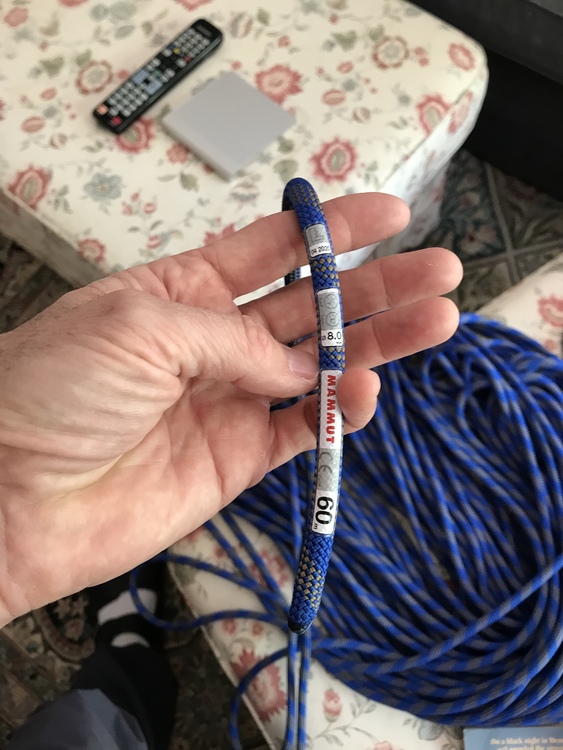
But brother, these 8.0 mm ropes are thin!!!
|
|
|
Idaho Bob
·
Jul 12, 2020
·
McCall, ID
· Joined Apr 2013
· Points: 757
Buck Rogers wrote: But brother, these 8.0 mm ropes are thin!!! Wow, makes my 8.5's look fat!
|
|
|
ErikaNW
·
Jul 12, 2020
·
Golden, CO
· Joined Sep 2010
· Points: 410
I think when climbing as a party of 3 where the climbers are in series as described here, it’s advisable to climb on full single rated ropes. The mechanics and forces are no different than climbing in a party of 2. As a leader, I would not want to rely on a single strand of a double pair. When using doubles each rope is attached to protection, so unless you run it out on a single rope at the start of the pitch both ropes are in play.
Buck - you will be so happy to have doubles on those long raps! Make sure you study the topos or get beta on if there are raps that aren’t good to combine. Sometimes it’s a bigger cluster to skip a station if the pull isn’t super clean. I’m sure you already know that (not your first rodeo!) I’m super jealous - please post lots of photos!
|
|
|
Buck Rogers
·
Jul 12, 2020
·
West Point, NY
· Joined Nov 2018
· Points: 240
ErikaNW wrote: I think when climbing as a party of 3 where the climbers are in series as described here, it’s advisable to climb on full single rated ropes. The mechanics and forces are no different than climbing in a party of 2. As a leader, I would not want to rely on a single strand of a double pair. When using doubles each rope is attached to protection, so unless you run it out on a single rope at the start of the pitch both ropes are in play.
Buck - you will be so happy to have doubles on those long raps! Make sure you study the topos or get beta on if there are raps that aren’t good to combine. Sometimes it’s a bigger cluster to skip a station if the pull isn’t super clean. I’m sure you already know that (not your first rodeo!) I’m super jealous - please post lots of photos! Yes! That makes total sense about the single rated ropes. Forgot that the leader would have to be climbing on only one of the doubles and the ropes are not rated for that. We always used single rated ropes when we did that and never doubles and that was why. Thanks for kicking my little grey cells into gear and making me remember why!
|
|
|
Buck Rogers
·
Jul 12, 2020
·
West Point, NY
· Joined Nov 2018
· Points: 240
Idaho Bob wrote: Wow, makes my 8.5's look fat! So thin! On lead I’ll be glad to be clipping them both as i go, either left and right or to the same piece.
|
|
|
ErikaNW
·
Jul 12, 2020
·
Golden, CO
· Joined Sep 2010
· Points: 410
I’ll be interested to hear how you like them Buck! We are getting ready to replace our doubles - I think ours are 8.5mm.
|
|
|
Dallas R
·
Jul 12, 2020
·
Traveling the USA
· Joined May 2013
· Points: 191
rgold wrote: Metacognition I had to look that up...
BITD the when I was teaching young air traffic controllers the training report had a bunch of check boxes on it for pass/fail on the training session. The first check box was separation maintained, you let two aircraft get to close together and you fail. The second check box was "Awareness maintained". Basically if you daydreamed or became distracted at all you failed. If you missed a critical piece of information you failed. 20 or 30 years of that tends to make paying attention and not letting your mind wander a habit.
Which leads into...
Bob Gaines wrote:
Nevertheless, Dill found at least three states of mind that frequently contribute to the majority of outdoor climbing accidents: ignorance, casualness, and distraction. Ignorance is why we are here, inquiring minds want to know and knowing minds want to share. Lori is going about learning by surrounding herself with knowledgeable people. I learned from books and practice. rgold, senor, bob learned from years of practice. Others it's was a mix of mentoring and practice. Ignorance dissipates with practice.
Casualness, there are old climbers and there are bold climbers but there are no old bold climbers. While that is not exactly true I think you can glean the meaning. If you are gonna be dumb you gotta be strong and if you aren't strong you cannot be dumb.
Distraction, awareness not maintained.
What ErikaNW wrote:
Doesn't always work though, a few weeks ago my partner asked me if I actually wanted to take the draws with me as I was starting off up the route! Don't feel alone in this, aka how do 2 people rap off with one ATC... One of the greatest aspects of climbing is the companionship. Just the joy of being with people that you actually like. It's easy to get to chatting and not paying attention to what you are doing. So it takes an effort to remain focused. Which is one reason we pick excellent partners that constantly double check each other, usually silently, but are willing to correct when necessary. When I climbed with rgold I clipped both strands of an anchor bench, he pointed it out, had me split the strands to clip, and then explained why what I did was not as safe. He was right and I knew better, so why did I do that, I was distracted concentrating on how I could do to help manage two ropes with 3 people at an anchor.
BuckRogers
Congrats on the two ropes. Belaying with 2 ropes takes a bit of practice. I short roped rgold when he was leading simply because I was not well practiced. Very embarrassing. At least you will have shiny new slick thin ropes. Other climbing trips I have belayed double full sized ropes where one of the ropes was an older fuzzy rope, one that sheath was worn and had a lot of drag. That was some work...
- - - - - -
Tools in the tool box, and knowing how to use them. Now I have to go find my knot book and cord, it's been a long while since I have tied a munter mule and I can't picture it in my head, time to go practice.
|
|
|
Dallas R
·
Jul 12, 2020
·
Traveling the USA
· Joined May 2013
· Points: 191
Bob Gaines wrote:I'm working on a new book with John Long and we have a chapter about managing risk. First off let us know that the title will be and when it is expected to be released, I definitely want to read it. Are you guys addressing panic? Mind stopping, adrenaline rushing, fight or flight panic. It happens, but knowing it happens helps you understand what is going on and this in turn helps you get your wits back.
|
|
|
rgold
·
Jul 12, 2020
·
Poughkeepsie, NY
· Joined Feb 2008
· Points: 526
ErikaNW wrote: I think when climbing as a party of 3 where the climbers are in series as described here, it’s advisable to climb on full single rated ropes. The mechanics and forces are no different than climbing in a party of 2. As a leader, I would not want to rely on a single strand of a double pair. When using doubles each rope is attached to protection, so unless you run it out on a single rope at the start of the pitch both ropes are in play.
Buck - you will be so happy to have doubles on those long raps! Make sure you study the topos or get beta on if there are raps that aren’t good to combine. Sometimes it’s a bigger cluster to skip a station if the pull isn’t super clean. I’m sure you already know that (not your first rodeo!) I’m super jealous - please post lots of photos! When clipping half ropes, one strives to create parallel lines. This often involves clipping the same rope successively, so you are most definitely "relying on a single strand of a double pair" in some cases, as the piece with the other rope might be a ways down. This is the way half ropes are meant to be used, and I personally do not worry about the strength of a single strand. The one concern with thin ropes is cutting over sharp edges; this is a situation in which one might want to clip in a way that keeps both ropes in play, or even go into twin rope mode. For extensive cragging, 8.5's are still probably the robust solution. Properly deployed half ropes significantly reduce rope friction, but it is also possible to mess up and create more drag than you'd have with a single. It's not rocket science, but you do have additional things to think about. You have to try to anticipate whether you will be trending left or right and where the gear is going to end up. Sometimes you get it wrong and have to climb back and/or down to fix it. I find myself periodically consulting my belayer about which strand would be best. Perhaps the one general rule is that if you start a traverse, you clip the "outside" of the parallel strands (so left strand if you are moving right and right strand if you are moving left). Otherwise you end up with crossed strands and possibly more friction. Speaking of left and right strands, I find it helpful to always tie in with the same colors for left and right, so that I can grab the appropriate rope without pausing to recall which side is which. I'd also note that although the need for long runners is reduced, it is not eliminated; there are still various situations that call for a long runner. Every one of my draws is a tripled "alpine" draw, so I always have the extension option even after installing the draw.
Besides the weight penalty of half ropes, management at stances is another issue. Half ropes magnify managing missteps, so extra obsessive-compulsiveness is called for. A relatively small amount of time spent getting ropes properly stacked or piled is far better than the large amounts of time it takes to undo a big tangle. The piles or stacks do not have to be separated for each pitch. But when at the top with the ropes in a pile, the best thing to do for coiling is for both partners to pull out their strand at more or less the same pace. Pulling just a single strand out of a pile of both ropes will often create a big tangle.
Another management issue is getting the strands twisted, This happens because the leader and second often make full turns at the belay stance (turn right to face out after clipping in, turn right again to unclip...) The second should make an effort to unwind these twists before starting to climb. If the stances permits it, the unwinding should be done by turning around the requisite number of times rather than by passing a loop overhead and stepping over it. The latter method puts a kink in the strand and ultimately makes for a kinky rope.
A word on belay technique. The belayer will have to typically pay out just one strand for clipping. If the clip was overhead, that strand will have to be taken in for a short time while the other non-clipped strand is paid out. This takes some getting used to, and requires a notably higher level of engagement from the belayer than a single strand (which might actually be a very good thing). A very useful trick for the belayer is to pay attention to the rope directly in front of them. Naturally there should be a little bit of slack there (nothing like the horrendous J-loops one sometimes sees nowadays), and it is from this view that the belayer can detect which strand is being pulled up and so react appropriately and in time. Just watching the leader (even if they are not out of sight) won't cue you in on which strand to pump out until you are already fighting with the leader for slack. Then the tendency is to pump out both strands, which nullifies one of the advantages of half ropes. It can be helpful for the leader to call out the color of the strand they are clipping, but of course that communication may not work over distance or in noisy environments or when there are other parties shouting analogous things, so keeping an eye on the rope motions directly in front of the belayer is still the best way to keep the belay effective.
'Nuff for now methinks...
|
|
|
Bob Gaines
·
Jul 12, 2020
·
Joshua Tree, CA
· Joined Dec 2001
· Points: 8,738
Hi Dallas,
"Are you guys addressing panic?"
We don't address panic attacks, but we do delve deeply into the psychology of trad leading, or as John puts it, the protection problem:
"This is the challenge igniting the core of all trad climbing, where the moment of truth awaits us all whenever we push our limits. The key is knowing that grace under pressure is a skill that can and should be slowly developed."
The book is scheduled for a spring, 2021 release date. Still working on the title, but it will simply be Rock Climbing with a subtitle. Text is done, just working on the photos. John did some incredible writing- he feels like it's his best work yet, and I have to concur.
|
|
|
Brandt Allen
·
Jul 12, 2020
·
Joshua Tree, Cal
· Joined Jan 2004
· Points: 220
rgold - In the bottom paragraph of your last comment you touched on an issue I've thought about a lot over the years. There are some obvious advantages of double ropes that have appealed to me, namely minimizing rope drag, enabling longer raps; and another one that has sounded really good is the ability of the leader to pull up an armful or two of slack without risking a longer fall in the event that he blows the clip.
Which brings me to my question. Perhaps you can teach this old dog a new trick. Years ago I climbed with some folks who used doubles and ran into a problem belaying when it was time to feed out one strand for clipping while still maintaining a firm grip on the other in case of a fall. Indeed, this called for a "higher level of engagement." I found myself wishing I could grow a third arm so as to have two brake hands, one for each strand. What I found myself doing was either momentarily letting go of the non-clipping strand completely (obviously a bad idea), or loosening my grip on both strands and pulling the clipping strand through the belay device (not always so easy), or feeding both strands through my device and then taking back rope on the non-clipping strand. Clearly all these methods are less than ideal. Also, after the clip is made and the leader heads up again I have a similar problem of taking in one rope while feeding out the other.
I'd love to hear any tips on how you handle this process. A short instructional video would be helpful.
Thanks for all the wisdom you've shared with us here.
|
|
|
rgold
·
Jul 12, 2020
·
Poughkeepsie, NY
· Joined Feb 2008
· Points: 526
Brandt Allen wrote: rgold - In the bottom paragraph of your last comment you touched on an issue I've thought about a lot over the years. There are some obvious advantages of double ropes that have appealed to me, namely minimizing rope drag, enabling longer raps; and another one that has sounded really good is the ability of the leader to pull up an armful or two of slack without risking a longer fall in the event that he blows the clip.
Which brings me to my question. Perhaps you can teach this old dog a new trick. Years ago I climbed with some folks who used doubles and ran into a problem belaying when it was time to feed out one strand for clipping while still maintaining a firm grip on the other in case of a fall. Indeed, this called for a "higher level of engagement." I found myself wishing I could grow a third arm so as to have two brake hands, one for each strand. What I found myself doing was either momentarily letting go of the non-clipping strand completely (obviously a bad idea), or loosening my grip on both strands and pulling the clipping strand through the belay device (not always so easy), or feeding both strands through my device and then taking back rope on the non-clipping strand. Clearly all these methods are less than ideal. Also, after the clip is made and the leader heads up again I have a similar problem of taking in one rope while feeding out the other.
I'd love to hear any tips on how you handle this process. A short instructional video would be helpful.
st
Thanks for all the wisdom you've shared with us here. There are two techniques for this situation, but neither of them involve dropping a brake strand! First of all, I sort the ropes through my fingers on both hands, one strand through thumb and first fingers, the other strand through first and second fingers. With only a little bit of practice, you can actually simultaneously take in one strand while using the non brake hand to pump out the other strand, but this only works for relatively small amounts of slack. In any case, it is pretty easy to sequentially pump out the non-clipped strand and take in the clipped strand. What seems critical is that the brake and non-brake hands both have the ropes gripped by the same finger combinations. As I mentioned above, I keep my eyes on the ropes in front of me and continually adjust them so the amount of slack in each is the same. So finger-pinch manipulation is one technique, and it works for small amounts of slack in or out. The second technique is to use the non-brake hand for both pumping out and drawing in slack. In this system, the brake hand sort of just sits there waiting for a fall and the non-brake hand rushes back and forth pumping strands out and (crossing "behind" the brake hand) pulling strands in. This can get a little hectic but not unreasonably so. Something that really impedes handling techniques is rope weight. If a large amount of the slack is hanging down the pitch below, it is going to be hard to do the things I described, and the chance of unintentionally locking up the belay device goes way up. So you need your ropes piled or flaked over a tie-in in order to belay effectively.
There is no avoiding the fact that with the finger pinches, the various motions, the smaller diameters, and the need to grip two ropes to brake one all mean that your grip on a strand in case of a fall is going to be less than you'd be able to apply in the case of a single rope. For this reason, I believe some sort of assisted-braking device is the best idea. Unfortunately, most of them don't work well with the hand motions and pinches I described and end up being prone to too much unintentional locking. Moreover, according to test by Jim Titt, most of them are poor performers when it comes to the rarer but critical big falls. In my opinion, the best gadget for half-rope handling is the CT Alpine Up, which handles more or less like an ordinary belay plate and allows me to use my brake hand in the otherwise weaker palm-up position, which definitely facilitates the kinds of motions I described. The Alpine Up rappels decently with 8.5's and reliably autolocks, eliminating the need for extending the device and using a prusik backup. But if you are going to rely on this feature (especially with thinner ropes), you should test it in a safe context at the end of a free-hanging rappel where there is little rope weight to activate locking.
A final note: if using half-rope technique with two followers, each on can belay on one of the two strands and there are no handling issues.
|
|
|
ErikaNW
·
Jul 12, 2020
·
Golden, CO
· Joined Sep 2010
· Points: 410
rgold wrote: When clipping half ropes, one strives to create parallel lines. This often involves clipping the same rope successively, so you are most definitely "relying on a single strand of a double pair" in some cases, as the piece with the other rope might be a ways down. This is the way half ropes are meant to be used, and I personally do not worry about the strength of a single strand. The one concern with thin ropes is cutting over sharp edges; this is a situation in which one might want to clip in a way that keeps both ropes in play, or even go into twin rope mode. For extensive cragging, 8.5's are still probably the robust solution. Properly deployed half ropes significantly reduce rope friction, but it is also possible to mess up and create more drag than you'd have with a single. It's not rocket science, but you do have additional things to think about. You have to try to anticipate whether you will be trending left or right and where the gear is going to end up. Sometimes you get it wrong and have to climb back and/or down to fix it. I find myself periodically consulting my belayer about which strand would be best. Perhaps the one general rule is that if you start a traverse, you clip the "outside" of the parallel strands (so left strand if you are moving right and right strand if you are moving left). Otherwise you end up with crossed strands and possibly more friction. Speaking of left and right strands, I find it helpful to always tie in with the same colors for left and right, so that I can grab the appropriate rope without pausing to recall which side is which. I'd also note that although the need for long runners is reduced, it is not eliminated; there are still various situations that call for a long runner. Every one of my draws is a tripled "alpine" draw, so I always have the extension option even after installing the draw.
Besides the weight penalty of half ropes, management at stances is another issue. Half ropes magnify managing missteps, so extra obsessive-compulsiveness is called for. A relatively small amount of time spent getting ropes properly stacked or piled is far better than the large amounts of time it takes to undo a big tangle. The piles or stacks do not have to be separated for each pitch. But when at the top with the ropes in a pile, the best thing to do for coiling is for both partners to pull out their strand at more or less the same pace. Pulling just a single strand out of a pile of both ropes will often create a big tangle.
Another management issue is getting the strands twisted, This happens because the leader and second often make full turns at the belay stance (turn right to face out after clipping in, turn right again to unclip...) The second should make an effort to unwind these twists before starting to climb. If the stances permits it, the unwinding should be done by turning around the requisite number of times rather than by passing a loop overhead and stepping over it. The latter method puts a kink in the strand and ultimately makes for a kinky rope.
A word on belay technique. The belayer will have to typically pay out just one strand for clipping. If the clip was overhead, that strand will have to be taken in for a short time while the other non-clipped strand is paid out. This takes some getting used to, and requires a notably higher level of engagement from the belayer than a single strand (which might actually be a very good thing). A very useful trick for the belayer is to pay attention to the rope directly in front of them. Naturally there should be a little bit of slack there (nothing like the horrendous J-loops one sometimes sees nowadays), and it is from this view that the belayer can detect which strand is being pulled up and so react appropriately and in time. Just watching the leader (even if they are not out of sight) won't cue you in on which strand to pump out until you are already fighting with the leader for slack. Then the tendency is to pump out both strands, which nullifies one of the advantages of half ropes. It can be helpful for the leader to call out the color of the strand they are clipping, but of course that communication may not work over distance or in noisy environments or when there are other parties shouting analogous things, so keeping an eye on the rope motions directly in front of the belayer is still the best way to keep the belay effective.
'Nuff for now methinks... Thanks for chiming in - I didn’t mean to imply you weren’t ever on a single rope with doubles- varies on the pitch as you pointed out. I just wouldn’t be comfortable leading an entire pitch on one strand of a double pair - for the reasons you also mentioned. As always - you are much more coherent in your writing than I am - thanks!
|
|
|
Lori Milas
·
Jul 12, 2020
·
Joshua Tree, CA
· Joined Apr 2017
· Points: 250
Wonderful to see all the experience being exchanged here. It is miles above my head, hopefully not forever.
I spent the day climbing in the Sierra with Chris. First, I don’t know what the HELL has happened to my body and emotional state. I’m really trying to get the joy back... it comes then goes. At 7000 feet I was really lagging physically. But mostly I was thinking “Do I even like this?” And so I remembered rgolds words about enjoying this journey and enjoying the climb.
How is everyone else doing currently with fitness and stoke? Is everyone fully recovered from quarantines and back up to speed?
Since the rock I was on was not slab and actually required upper body and coordination I really felt the loss from months without a gym. Not to make excuses...
I did ask Chris to explain the self-rescue with a prussik. The lengthy process involving a stuck toprope, using a prussik tied as a klemheist with a nylon sling to use for stepping up and a grigri looked very involved and not how I pictured it. Next time maybe we can tackle it at the beginning of a day, not the end. He had energy to burn. Not me.
Dallas said something about how we all learn. (So did Helen, earlier). I would be embarrassed to admit how many hours I’ve spent with Bobs book (and others) and various Apps, tying knots and envisioning all the scenarios.
But ultimately I like to be taught. Shown. (And then DO) Some of my best and favorite memories of my life are of sitting in a packed college class where a living professor (aka Erika ) holds forth and we could just absorb and digest and luxuriate in being taught. And although I had my favorite subjects I would be happy in any class, learning anything. I need that human vibe.
I hope we never become an entirely virtual world. It seems climbing especially has to be taught in person. Unfortunately to learn climbing personally and one-on-one it is a paying proposition... I would always expect to pay for all that time and transmission of what I need to know. But then again starting SO late and with none of the prior experience of Senor (for instance) I always felt it had to be “a class” all the way. Had I not had this opportunity I would not be climbing.
![]()
|
|
|
Andrew Rice
·
Jul 12, 2020
·
Los Angeles, CA
· Joined Jan 2016
· Points: 11
rgold wrote: I use 8.5mm half ropes, but may go closer to 8mm on the next set. Haven't used a single rope (except when forced to by an unwilling partner) for about 30 years.
What length are your doubles, Rich? Last winter I picked up a pair of 50m Beal Icelines at a screaming deal. Given my primary trad destination is Tahquitz I've been leery of using 50m ropes when I typically climb there with a 70m single and often find myself doing pitches that use all of that. But I'm intrigued by the doubles and can see how they'd save you a lot of length by avoiding wander.
|
|
|
rgold
·
Jul 12, 2020
·
Poughkeepsie, NY
· Joined Feb 2008
· Points: 526
I use 60m doubles and never found them too short anywhere in the country I've climbed. I did some climbing at Tahquitz in the 1970's with what was probably a 150' single rope. Don't remember names but did most of the 5.9's and 5.10's at the time. Are you passing up belay stances along the way with your 70m rope?
Half ropes take a little getting used to; I know quite a few good climbers who try them once, kinda muck things up, and never go back. I think the prospect of relearning some things they thought they already knew well might be a factor for them. When I climb with a single rope I'm frequently aware of things that would go better with my halves, and its not just about less friction...
|

 Continue with onX Maps
 Sign in with Facebook