Mountain Project Logo

Accident at DL yesterday?

Ted Pinson · · Chicago, IL · Joined Jul 2014 · Points: 252
M Mobleywrote: Common decency would be helping the community understand WTF happened ASAP.
Could this have been an anchor spot/configuration that was commonly used?

So that’s just the thing...people belay on single point anchors all the time.  If it’s after a lead and you’re just belaying your partner up...sure, though there are ways to be redundant there (e.g: tie a figure 8 rather than girth hitch).  But if you’re setting and forgetting a TR for a bunch of people to take laps on it’s not enough.  That boulder obviously wasn’t going anywhere but redundancy in soft goods is essential.  Even if they had double wrapped it this could have been prevemted.

Bill Lawry · · Albuquerque, NM · Joined Apr 2006 · Points: 1,818
M Mobleywrote: Common decency would be helping the community understand WTF happened ASAP.
Could this have been an anchor spot/configuration that was commonly used?

Helps no more so than the bazillion accident reports out there. How many of us search about as a matter of practice for accident reports involving any new-to-us climb we may do?

Edit:  If we really took to heart the WTF-ASAP argument, we’d be doing that search every time.

M Mobley · · Bar Harbor, ME · Joined Mar 2006 · Points: 911
Bill Lawrywrote:

Helps no more so than the bazillion accident reports out there. How many of us search about as a matter of practice for accident reports involving any new-to-us climb we may do?

DL is a TR hotspot, this may have been a standard way to anchor the climb. Wouldn't you want to know if an anchor you use actually doesn't work sometimes?

Bill Lawry · · Albuquerque, NM · Joined Apr 2006 · Points: 1,818
M Mobleywrote:

DL is a TR hotspot, this may have been a standard way to anchor the climb. Wouldn't you want to know if an anchor you use actually doesn't work sometimes?

Sure - but not as urgently wanted as to blow past the victim, partner, etc.. There is a ton of information out there about how to build good TR anchors. 

M Mobley · · Bar Harbor, ME · Joined Mar 2006 · Points: 911

BS, people use one tree, one boulder, even one bolt all the time

Andrew Krajnik · · Plainfield, IL · Joined Jul 2016 · Points: 1,739
M Mobleywrote: BS, people use one tree, one boulder, even one bolt all the time

For raps, sure, but for toproping? With a single (non-redundant) piece of soft goods? With a slingshot belay on an unattended anchor?

James Schroeder · · Fort Collins, CO · Joined May 2002 · Points: 3,171

It's worth separating the rigging material from the anchor when talking about "single-point anchors."

You can have a single-point anchor that is effectively redundant. By this I mean some massive (and therefore internally-redundant) object. I tend to think of this as something so big, it wouldn't matter what other redundancies were in the system because the failure of that block or tree (or whatever) will be an effectively equal threat to that posed by an anchor failure. BUT, the rigging of that massive object still needs to be redundant in order to make the anchor redundant. Trusting one's life to a single piece of rigging material, especially in an unattended anchor, assumes a lot of risk with little (if anything) in return.

pfwein Weinberg · · Boulder, CO · Joined May 2006 · Points: 71
Nick Rhoads wrote:

That's nice of them but I think when there's a public incident on public land the victim and partner lose the right to privacy regarding the circumstances. Hiding the info would negate the point of a report.

However, the injuries incurred fall under Hippa (or whatever) and the victim has every right to keep those private. 

Agreed, and to put in another way:  do the folks who think it's necessary to clear accident reports with the involved parties thing the same thing about, say, automobile or aviation accidents?  If I get a pilot license and fly a Cessna into the side of Longs Peak, should newspapers wait until my next-of-kin decides it's OK to report that?  

Climbing accidents are newsworthy events in and of themselves.  That should really be the end of the discussion, but if that's not good enough for you, the fact that they do affect our common understanding of what's safe seals the deal.  The safety information can be specific (there's loose rock wherever, climbers should be extra careful) or general (another person dies thinking they'll be lowered and belayer takes them off belay -> need more education to try to prevent that).  

It would be prudent to get accident information from the involved parties to make sure the reporting is accurate, as far as that is possible.  But this notion that somehow climbers have special rights to censor accident reporting if they feel like it should be put to rest.  

There may be some reasonable judgment involved in reporting certain aspects of climbing accidents, such as names and specific injuries.  I don't have strong feelings on that one way or the other, but I'd suggest the best way to get a handle on that is by journalism ethics rather than appeals to half-baked climber lore or random and unexplained notions of "decency." 

Mel Champer · · Unknown Hometown · Joined Apr 2020 · Points: 85

Hi everyone, Mel here again. This thread is getting pretty interesting.

To those asking if the accident report has been cleared with the climbing party - it has. I am in close contact with all involved parties. I also agree that we can all learn a lot from accidents in climbing and mountaineering. There are two distinct categories: how to avoid an accident like this, why did this accident occur. I think it is interesting that this thread seems to be split on what they deem important. Right now I am waiting on important pictures that will help solve the why as the rangers involved are trying to get us a report. As well, someone asked me about what 'experts' I was consulting. The AAC accidents managing editor is taking a look at the report this week, as well as a BD product engineer, and a couple of other friends in engineering.

I will admit that I am an engineer (in UW-Madison grad school) so I am much more biased towards finding out everything about the why. I certainly know that both sides are important. Please understand my delay for a full, accurate, and informative report :)
Best,
Mel

Guy Keesee · · Moorpark, CA · Joined Mar 2008 · Points: 349

Mel Thanks for keeping US informed

One time back in the swami belt days, I purchased 30 feet to wrap around my waist. About 9 feet in was a bit of tape going around the webbing- I didn’t question it, being new and all that.
The wise and more experienced climbers laughed at me! Made fun of my ignorance- one of them even came over to me and ripped the webbing in two! It is common for webbing to be taped together- true
My point- sometimes an accident has a simple root cause. Sometimes the cause is quite clear- “the webbing used was cut” was mentioned up thread. Why was it cut? How did it get cut? Where was it cut? What does this cut webbing look like? 
Now this accident points to the reason climbers try to make everything redundant, if this had been done we would not be discussing this unfortunate accident now would we.
I hope the injured climber recovers fully, he has a long road ahead of him and will need his friends to come visit often. 

Ted Pinson · · Chicago, IL · Joined Jul 2014 · Points: 252
Nick Rhoads wrote:

I can't prove causation when the result is something doesn't happen (save for an overwrought statistical analysis) but what I can tell you is that being "scared straight", in the context of climbing, works. 

People hear, see, or read about accidents and they change their behavior. I have seen other people do it and I myself have done it and I'm willing to bet that you have to.

Ted, you don't always use redundent anchors?!

Mobley, the standard is to use a redundant anchor.

Nick I said “people,” not me, though I have gotten to the top of a climb set by a fairly experienced DL regular and discovered the anchor was a single slung tree.  The belay was also off a tree rather than the harness; I’ll say nothing more.

Eli 0 · · northeast · Joined May 2016 · Points: 5
Guy Keeseewrote: One time back in the swami belt days, I purchased 30 feet to wrap around my waist. About 9 feet in was a bit of tape going around the webbing- I didn’t question it, being new and all that.
The wise and more experienced climbers laughed at me! Made fun of my ignorance- one of them even came over to me and ripped the webbing in two! It is common for webbing to be taped together- true

This reminds me of a fatal top rope anchor failure I read about where the non-redundant anchor was secured with taped-together webbing purchased the previous day:


https://static1.squarespace.com/static/552e8f43e4b07f0b3920027b/t/566b4fd7841abafcc8ddb684/1449873367506/AnalysisHappyHour1.pdf

Brett V · · Unknown Hometown · Joined May 2020 · Points: 0
Ted Pinsonwrote:

Nick I said “people,” not me, though I have gotten to the top of a climb set by a fairly experienced DL regular and discovered the anchor was a single slung tree.  The belay was also off a tree rather than the harness; I’ll say nothing more.

How large was the tree?  Not you specifically, but if a person is not comfortable having the anchor foundation be one large tree that's a foot in diameter or more, perhaps there's a better outdoor activity for them to enjoy.  Not everyone is appropriately comfortable with the average risk associated with an activity, I would say.

Guy Keesee · · Moorpark, CA · Joined Mar 2008 · Points: 349

Eli O.......  it is not uncommon. Thx for the
links
to this day I go over every inch of new gear- even 70m ropes. 

slim · · Unknown Hometown · Joined Dec 2004 · Points: 1,093
Brett Vwrote:

How large was the tree?  Not you specifically, but if a person is not comfortable having the anchor foundation be one large tree that's a foot in diameter or more, perhaps there's a better outdoor activity for them to enjoy.  Not everyone is appropriately comfortable with the average risk associated with an activity, I would say.

depends on what shape the tree is in.  i have rapped off of much smaller, and i have declined to rap off of some that were larger...

slim · · Unknown Hometown · Joined Dec 2004 · Points: 1,093
Eli 0wrote:

This reminds me of a fatal top rope anchor failure I read about where the non-redundant anchor was secured with taped-together webbing purchased the previous day:


https://static1.squarespace.com/static/552e8f43e4b07f0b3920027b/t/566b4fd7841abafcc8ddb684/1449873367506/AnalysisHappyHour1.pdf

the deceased was my friend's college roommate.  horrible incident.

Ted Pinson · · Chicago, IL · Joined Jul 2014 · Points: 252
Brett Vwrote:

How large was the tree?  Not you specifically, but if a person is not comfortable having the anchor foundation be one large tree that's a foot in diameter or more, perhaps there's a better outdoor activity for them to enjoy.  Not everyone is appropriately comfortable with the average risk associated with an activity, I would say.

So this is the kind of thinking that led to this accident.  The tree was fine, as was the boulder in this case; however, not being redundant with a “set it and forget it” TR anchor is a bad idea.  The issue is lack of redundancy in soft goods.  Assessing the strength of used webbing and slings can be difficult and it’s not always obvious when one’s about to go.  If they had tied off the boulder redundantly (e.g: two slings) this wouldn’t have happened.
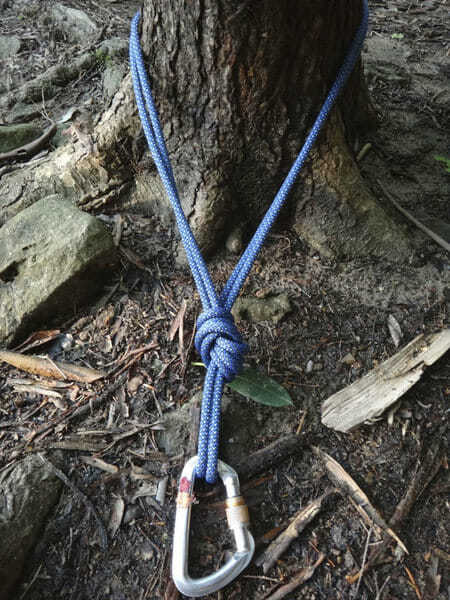
Example of a redundant (in terms of soft goods) single piece anchor.
Jill Griffis · · Madison, WI · Joined Nov 2010 · Points: 5
M Mobleywrote: BS, people use one tree, one boulder, even one bolt all the time

Just because people are using this one bolt, doesn’t mean it is right. So much of it has to do what happens after you decide what you are going to use. Climbing is about making decisions. A One piece anchor isn’t a decision I would ever choose. I would choose to use one massive tree but not once. I’d use it twice. Why would you rely on it once when you can use it twice? Redundancy is the root of managing risk in climbing. Hope that helps with some stuff to think on! 

Jill Griffis · · Madison, WI · Joined Nov 2010 · Points: 5
James Schroederwrote: It's worth separating the rigging material from the anchor when talking about "single-point anchors."

You can have a single-point anchor that is effectively redundant. By this I mean some massive (and therefore internally-redundant) object. I tend to think of this as something so big, it wouldn't matter what other redundancies were in the system because the failure of that block or tree (or whatever) will be an effectively equal threat to that posed by an anchor failure. BUT, the rigging of that massive object still needs to be redundant in order to make the anchor redundant. Trusting one's life to a single piece of rigging material, especially in an unattended anchor, assumes a lot of risk with little (if anything) in return.

Ya. What he said! 

Buck Rio · · MN · Joined Jul 2015 · Points: 16

For anybody who has climbed at the lake for a long time this is self evident...but the boulders that get slung often have VERY SHARP pinch points, as evidenced be the decades old pieces of tat left stuck in them. Almost like laying your webbing in the crotch of an open scissors. I have no idea if this is related at all to the OP, but I see it every time I go there.

This topic is locked and closed to new replies.

Log In to Reply
Welcome

Join the Community! It's FREE

Already have an account? Login to close this notice.


