Mountain Project Logo

Asininely specific rappel question

Original Post
Billy Daffin · · columbus · Joined May 2019 · Points: 140

Hey folks, I might be dreaming up an unrealistic scenario, but let's say youve got to retreat off a ~75m face because of a storm rolling that will definitely kill you if it hits (idk, knife storm lol). Basically you've got to get off and you're not worried about retrieving the rope and you've got an 80m, harness, one screwgate and a reverso/Grigri etc. Now let's suppose that there are three small trees, so small you can't trust just two. How would you tie the rope around all three in such a way that there that there is just one strand coming off of the, for lack of a better word, masterpoint. I know with two trees it's fairly straightforward, an eight around one tree and an AB with a huge loop around the other, but I can't come up with any really great way of equalizing three.

Educate me, trad climbing side of mountain project!

Billy Daffin · · columbus · Joined May 2019 · Points: 140
Not Hobo Greg wrote: Bowline.

Lol thanks

Andy Wiesner · · New Paltz, NY · Joined Sep 2016 · Points: 35

This takes 13 meters. That leaves 67 meters from the master point. If you're a big Billy, with static elongation you might just get close enough to drop . . . 
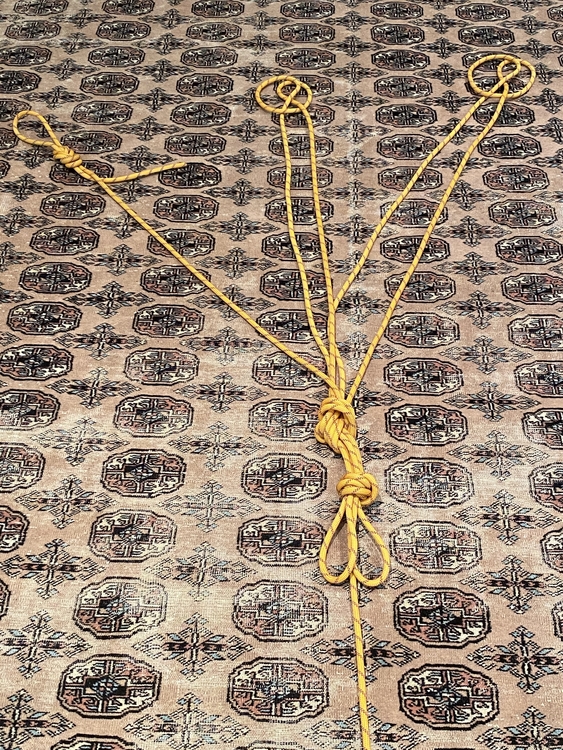

Edit: Don't need the cloves. Guess I was gripped on acct of oncoming storm . . . but as it's a knife storm, perhaps the add'l redundancy is in order. 
Billy Daffin · · columbus · Joined May 2019 · Points: 140
Andy Wiesner wrote: This takes 13 meters. That leaves 67 meters from the master point. If you're a big Billy, with static elongation you might just get close enough to drop . . . 

WOW, that was fast! Thanks alot man! "Big Billy" that made me laugh

Andy Wiesner · · New Paltz, NY · Joined Sep 2016 · Points: 35

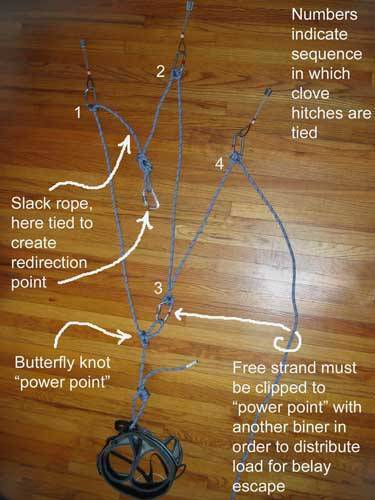
Or, if you had one more carabiner (or were really good at the dulfersitz rappel) you'd use RGold's setup:
Marty C · · Herndon, VA · Joined Aug 2008 · Points: 70

I am sure you could do this with only the climbing rope. There are numerous knot configurations that would work.
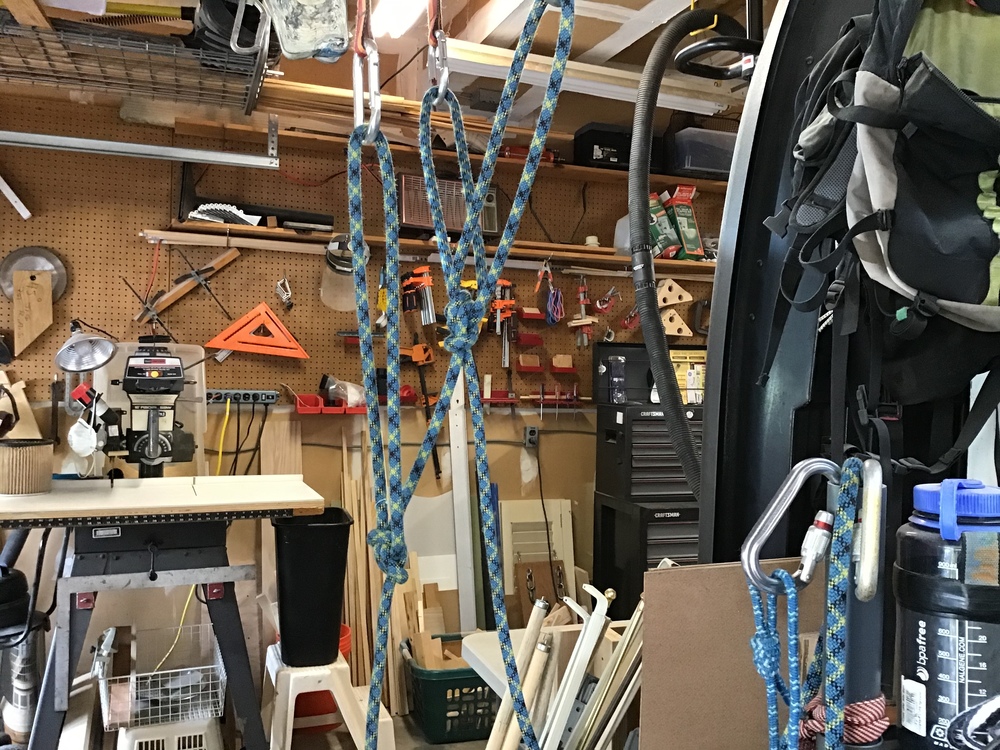
One suggestion that I quickly tied in my workshop:
- tie a bowline knot with a very long tail around the central tree
- with the long tail, extend it to the left tree and tie another bowline and adjust knot so that it is inline with the first bowline
- with the tail from the second bowline, wrap the right tree and do a follow through bowline on a bight with the second bowline
- adjust knots as needed to “equalize” tension on all three trees

Hope for Movement · · USA, Europe · Joined Aug 2019 · Points: 0

Cut about 5 meters off the end of rope and use...

Bill Lawry · · Albuquerque, NM · Joined Apr 2006 · Points: 1,821

+1  Get out the knife.  

And remember:  measure twice. Cut once. 
Allen Sanderson · · On the road to perdition · Joined Jul 2007 · Points: 1,100

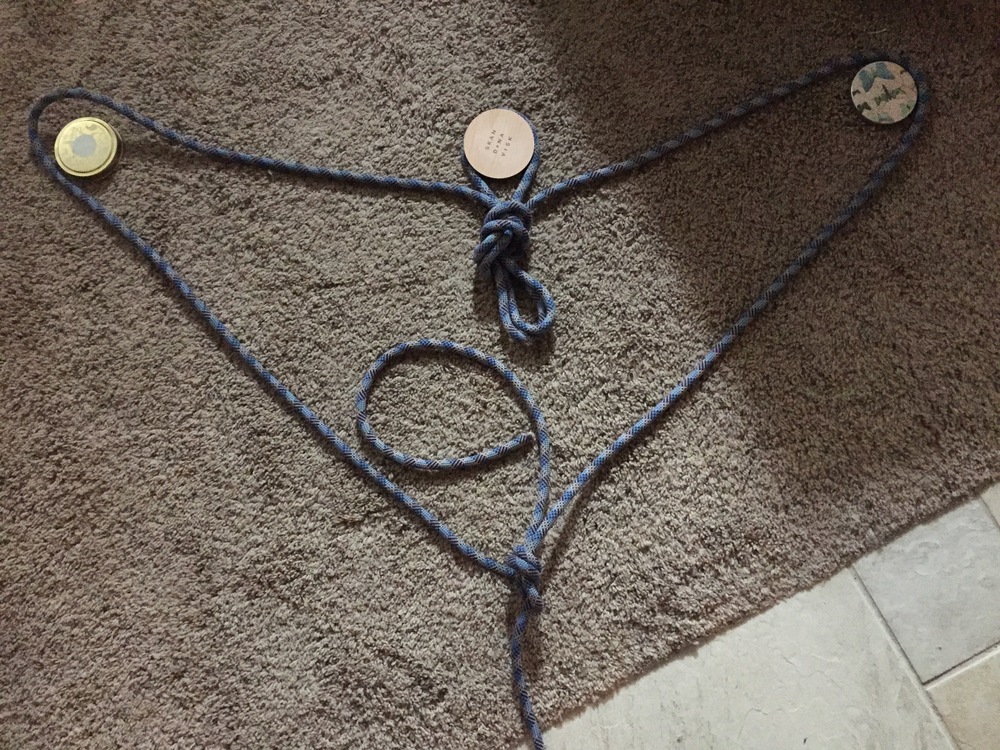
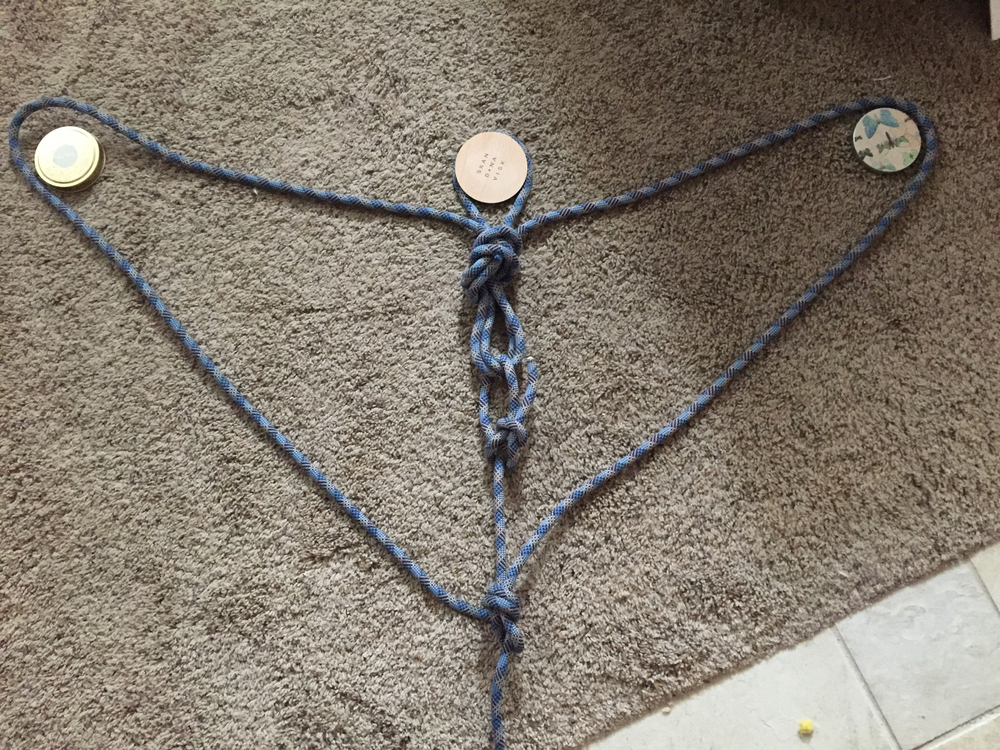
Here is my solution. It took about 6 meters of rope, in the wild probably 8 meters. Still enough for a skinny willy. I call it the thong.
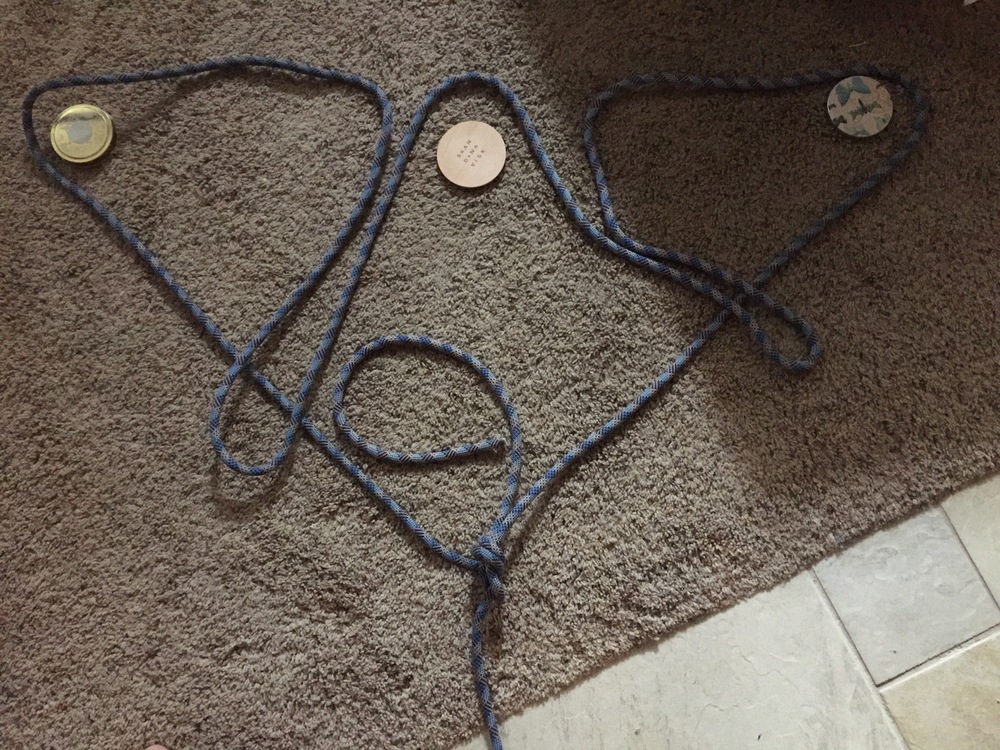
First picture for these three steps:
1. A bight the rope around all three trees.
2. Tie a bowline with a long tail.
3. Pull a bight of rope from between each tree.

Second picture:
4. Tie an overhand with the two bights

Last picture:
5. Using the long tail tie a bowline into the tail of the overhand.


What I like about this anchor is that if one goes away there is no shock loading. However, not easy to get nicely equalized. Most of all it was easy to set up and clean. Which is important when that knife storm moves in.
X C · · Yucca Valley · Joined Mar 2010 · Points: 72

Equalization is bullshit. If the anchors are truly bad enough that whatever marginal 'equalization' you achieve in your anchor makes a difference, you're fucked anyway. Just tie them off in series and think light thoughts. The time you will have saved not overthinking it will surely keep a knife or two out of your back. Oh yeah, and have your partner rap first.

George Bracksieck · · Unknown Hometown · Joined Oct 2008 · Points: 3,920
Not Hobo Greg wrote: Bowline.

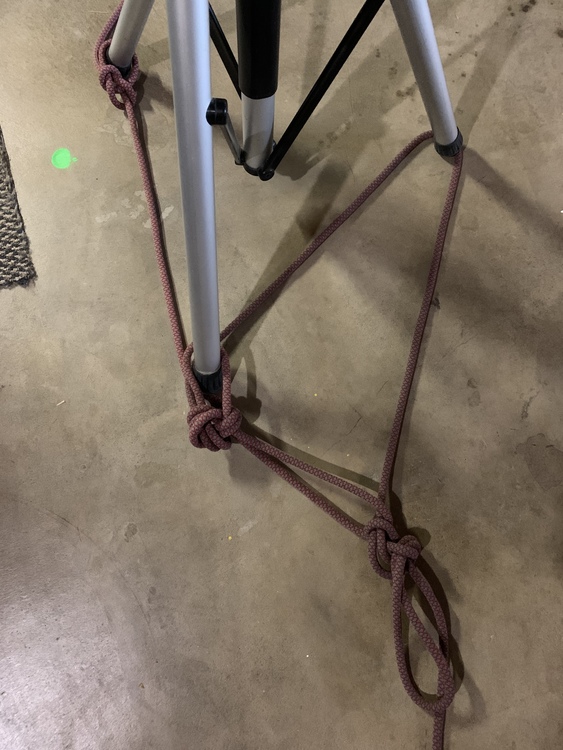
Did I hear “bowline?”  I tied three bowlines around the bases of three small “trunks,” using less than six meters of 10mm rope and using NO slings or carabiners. This configuration provides equalization and allows no extension if one “trunk” were to fail. This arrangement can be adjusted according to the arrangement of the “trunks.” I used the base of each “trunk” without throwing the rope over the tops of the “trees.” See attached pic. 
Allan Ange · · Sylva, NC · Joined Oct 2013 · Points: 0
Sha Boinkey · · Dehli, india · Joined Dec 2016 · Points: 408

as you're tied in, walk around the back of all three trees, then, facing the trees, pull the two strands in between the outside trees and the middle tree, then you have two loops. From here, take your tie in strand and create another loop and take the loose strand and make a loop. tie all loops together to make a big overhand on a bight. this leaves the long loose end coming out the backside of this BHK knot, along with your tie in strand. From here take a locking carabiner and clove hitch the loose strand going down the cliff to the masterpoint, then get on rappel. Untie from the tie in and tie an overhand on bight and clip that back into the locker on masterpoint. This would probably use much more that the allotted 5 meters. I would guess this set-up would use about 10-15 meters based on where the trees are.

David Coley · · UK · Joined Oct 2013 · Points: 70

The storm is about to hit. You need to move fast. You don't even want to be doing anything complex, or a knot you have never used.

1. wrap end of rope around (as in 360 deg) first tree, then on to the second and wrap then the third,.....then the nth.
2. finish with a bowline and stopper

Time to complete = 9 seconds (just tried it on a chair).

First person raps with backup, others rely on first person holding the bottom of the ropes

Run.

i shore · · London · Joined May 2018 · Points: 0

If the saplings were really weak then you might decide  to take more time setting up the anchor and accept the risk of an early lightening strike in order to decrease the chance of a 75m fall. You'd want to minimize shock load if an anchor failed and lessen the angle at the masterpoint. You might need as much rope as possible for the anchors, which would necessitate only a single strand going to each anchor.
 So perhaps lower the rope from middle tree until it touches the ground, then cut the rope.  Tie the ends of the short bit to the two outer trees with eg rethreaded overhands, and tie an overhand with small bight below the middle tree as a masterpoint. The single krab is presumably reserved for the ab device; therefore use a rethreaded overhand to attach main rope through masterpoint bight, tie its long tail to the middle tree and adjust this this knot (eg overhand or bowline) so all three anchor strands are taut when abseiling.
   Obviously the exact details will depend on geometry of tree arrangement, relative strength of each tree, and distance of trees from edge. Its an odd masterpoint  setup but it uses easy knots that everyone knows. I haven't actually tried setting it up, but thanks for a bit of lockdown distraction.

Blue Collar Climbing · · Gear Protected Lowball · Joined Jan 2020 · Points: 0

I'm a big fan of "knife storm" as a metaphorical objective hazard.

I have nothing productive to contribute to the discussion at hand. I've just made a big loop around some small rhodos and called it good as an anchor before. Probably unwise.

Jeremy Bauman · · Lakewood, CO · Joined Feb 2009 · Points: 1,107

David Coleys suggestion is the best thing you could do. The amount of friction from one wrap on each tree can be pretty significant.
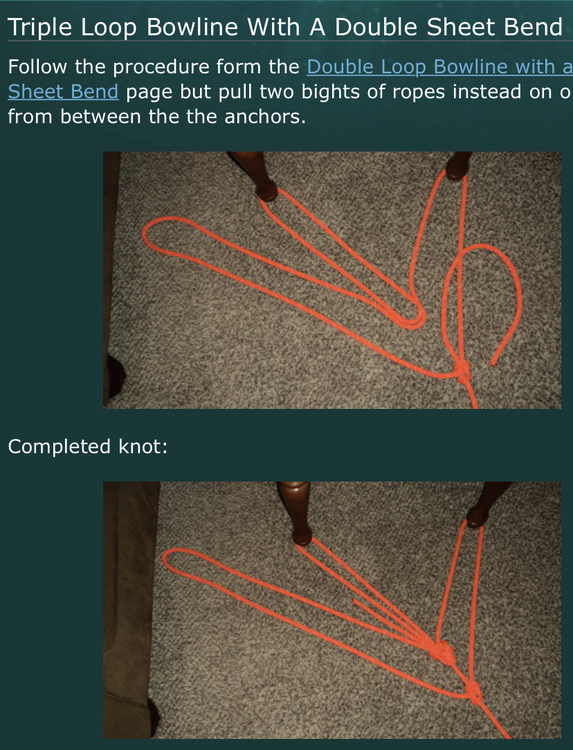
But for the sake of learning some more useful knots!

http://rope-work-101.wikidot.com/bowline-family

The triple loop bowline double sheet bend is super fast and easy to tie once you’ve mastered both knots.

My version is a little simpler and anyone who can tie a snap bowline could tie it:
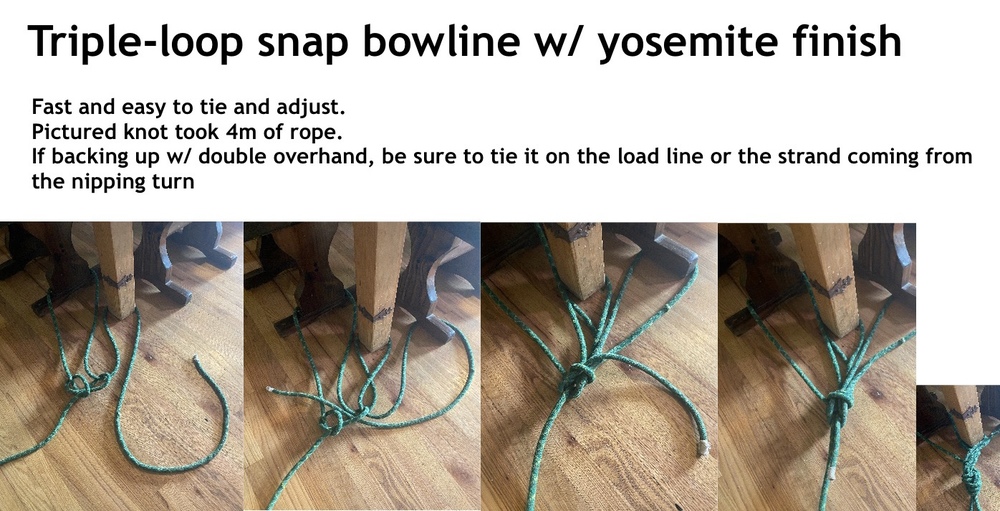
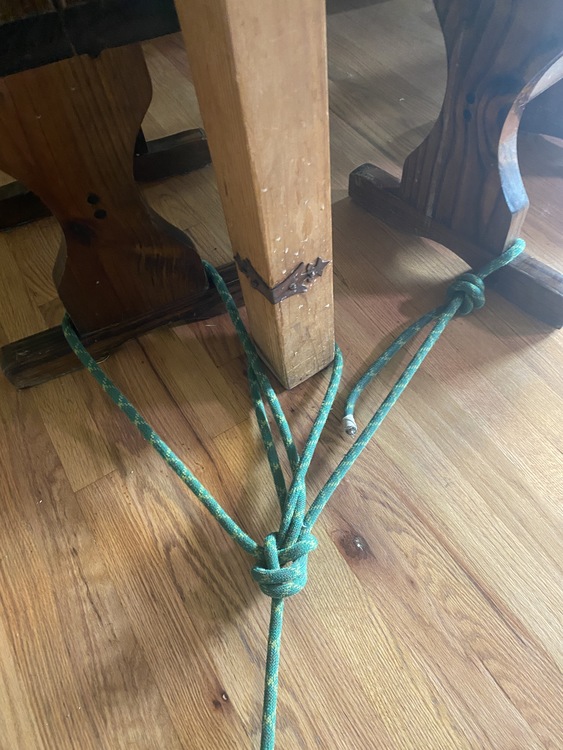
you could save a little rope by only doing a 2 loop snap and tying off the tail to the third tree 
Ian Fried · · Brooklyn · Joined Jul 2017 · Points: 21

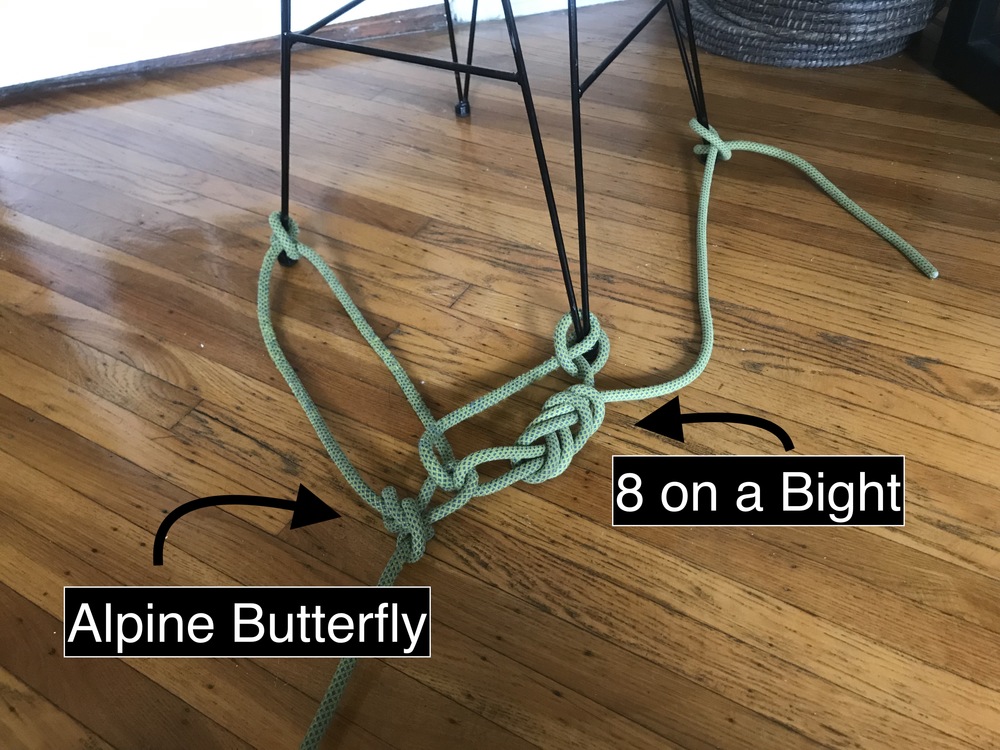
I have a new one!

I'd love to hear some critiques. My biggest issue is that it will not pull on all three equally. I imagine the one with the Alpine Butterfly will always receive the most weight. Thoughts?

it took just under 4.6 meters and I'm going to assume that your trees aren't quite as skinny as my chair legs, but I'll also assume your rope stretches, and if it really is raining knives, a 1 meter fall wouldn't be the end of the world--the knives would.

Keith Wood · · Elko, NV · Joined May 2019 · Points: 480

It seems like the solutions provided don''t result in true equalization, but the premise of the OP is that no two trees will support you so the quest is for equalization among all three trees with minimal equipment. He said you can't trust just two, so if the attempts at equalization load one tree or two of the trees disproportionately, you die.
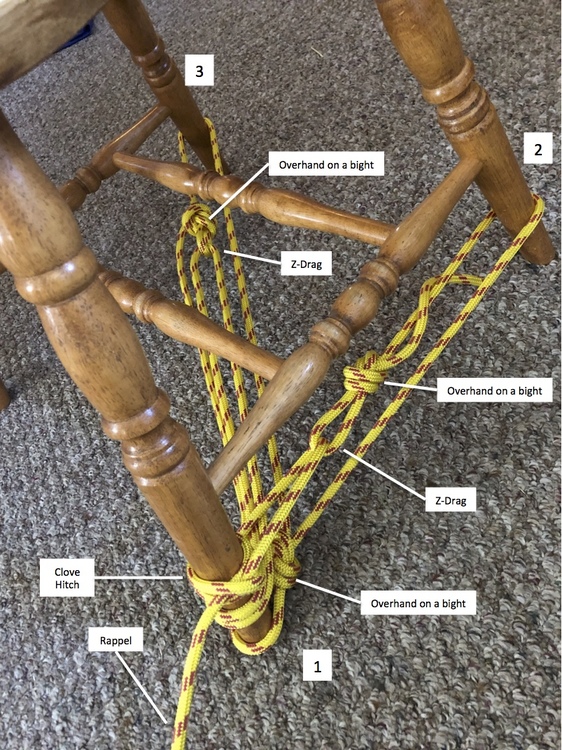
As I study the solutions provided, I see ones where knots are used on the trees in an attempt to structure equalization by getting the lengths right from the central point to each tree. In fact this could be quite difficult to manage quickly, or even with plenty of time.

Another solution provided allows for splitting the load in two, then equalizing half the load between two trees, while all the other half goes to one tree. So the load is split 50:25:25%. This would not satisfy the goal of equalization among three points either, because the tree with the 50% load would fail, and then the two others would fail too.

Here is my attempt to get them all equalized evenly:

Tree 1 at bottom gets an overhand on a bight with a long tail on the right and the rest of the rope on the left. The long tail passes around behind tree 2 and ends in an overhand on a bight. The rest of the rope passes behind tree 3 and gets an overhand on a bight. From there the remaining rope passes around tree 1 and through the bight from tree 2, creating a z-drag, then back around tree 1 and through the bight of tree 3 creating another z-drag. These two z-drags can be tightened so the rear two trees help support the front tree. Tension it up so the rear trees are each being pulled toward the front tree and finish it off with a clove hitch, which securely retains the tension within the tree system, with the remaining rope going down the cliff.

When you load this, the load looks like it is all on tree 1, but it is really shared with rear trees because they are tensioned up by the two z-drags. This took 17 feet of rope.

I'm not sure if it's perfectly equalized, but I tested the tension between trees 1-2 and 1-3 and it seemed the same and I got it pretty tight using the z-drags.
Dave Olsen · · Channeled Scablands · Joined Dec 2019 · Points: 10

"so small you can't trust just two."

So in this scenario, equalization is everything and building to prevent shock loading is BS. Connecting in series will just create a zipper, as there is no redundancy available anyway.

The answer then is the sliding W. (See page 280 Wilderness Search and Rescue, Tim Setnicka)
Either cut the end of the rope for quick assembly or visualize how to do it without cutting. Use the carabiner to reduce friction at the sliding part of the system.
Probably lower the first person on a meat anchor with the shrubs for the backup. This takes no carabiner and adds some redundancy. That person can collect any gear left from the climb up, to be pulled up, used for the rappel device or any other anchoring. If there is none then the last down can Dulfersitz. Hopefully the person doing both the hip lower and the body friction rappel has thick skin or is climbing in a stylish leather jacket and Lederhosen.

Heaviest first or last?  or leave the orphan for last?

Andrew Krajnik · · Plainfield, IL · Joined Jul 2016 · Points: 1,739

If nothing else, this thread has introduced both "asininely" and "knife storm" to the MP zeitgeist. There are not necessarily new words, but rather novel uses of existing words. My sincerest thanks to the OP.

Guideline #1: Don't be a jerk.

Trad Climbing
Post a Reply to "Asininely specific rappel question"

Log In to Reply
Welcome

Join the Community! It's FREE

Already have an account? Login to close this notice.