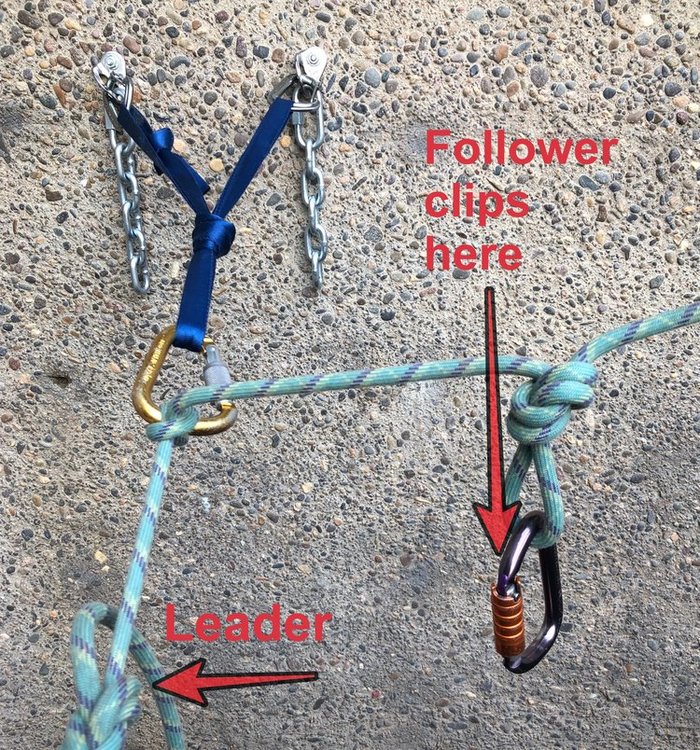
|
|
Em Cos
·
Mar 1, 2020
·
Boulder, CO
· Joined Apr 2010
· Points: 5
Saddle-bagging would be the best option, eliminating the risks of the loops of rope getting stuck below you or pulling down rocks on yourself from above.
I’m not clear on the benefits of this method though - it doesn’t seem to save any time as someone is sooner or later going to have to untie the cloves and set the two ropes up for rappel, and it’s not like this can be done concurrently with someone rapping on them. I can’t see how it offers a safety advantage either, if anything it’d be better to complete this step when both partners can check the set-up. Can you enlighten me on why this would be helpful?
|
|
|
Terry E
·
Mar 1, 2020
·
San Francisco, CA
· Joined Aug 2011
· Points: 43
coppolillo wrote: Mike, you need a book, dude! I’ll send you one...PM me your address! Totally agree. Mike, send coppolillo your address! It's like what Colin Z did for ACMG course structure and training :-)
|
|
|
John Godino
·
Mar 2, 2020
·
Bend, OR
· Joined Jul 2016
· Points: 0
|
|
|
Niccolo Gallio
·
Mar 2, 2020
·
mainly Italy
· Joined May 2019
· Points: 0
John Godino wrote: Here's an article that covers the procedure pretty well, along with a short video.
(Disclaimer, the article is mine.)
Not exactly the double rope scenario dimension, but if people want a little longer explanation of how this works, this is a good start.
https://www.alpinesavvy.com/blog/benefits-of-the-backside-clove-hitch
Hey, are you the person behind Alpinesavvy? I LOVE your website.
I bought "The Mountain Guide Manual" because it was quoted so many times on Alpinesavvy.
|
|
|
Billcoe
·
Mar 2, 2020
·
Pacific Northwet
· Joined Mar 2006
· Points: 936
Interesting that the video only covers the first part of the description. I don't see myself convinced this is better. There are advantages and disadvantages. It seems to me it increases the clusterF level.
|
|
|
Marty C
·
Mar 2, 2020
·
Herndon, VA
· Joined Aug 2008
· Points: 70
I have on occasion used this technique. I don’t know if it is much faster, but one advantage is that it minimizes/eliminates much of the cluster at the rap anchors/bolts.
Using this technique eliminates both the leader and the second’s need to use a PAS/leash to clip in. Not having these slings and biners in the way can make feeding the rope through the rap anchors easier.
Just another tool to store away to be used when deemed appropriate.
|
|
|
coppolillo
·
Mar 7, 2020
·
Unknown Hometown
· Joined Sep 2009
· Points: 70
niccolo---apologies for the delay. we're on a good storm cycle here and now managing cancellations from The Virus. ack!
there's a section in the book describing "clean stack" and "dirty stack," so hopefully review that.....and you're doing it, so your ropes are neat/tidy...and ready for backside rap-feed!
if there's no loose rock to worry about and the terrain is steep, less featured (think yosemite rather than vegas; val d'orco more than dolomiti), you could honestly just chuck your stack over the edge and let it fall---no wind, less featured rock, and definitely NO LOOSE ROCK to grab and knock down. that's the most aggressive approach and requires neatly stacked ropes to feed down the cliff when they fall. next most-aggressive strategy might be pause before rappelling and hand-feed the ropes down the cliff.....yes, just like throwing the stack over the edge, the ropes are now just hanging down the cliff in a big loop/bight. lastly: wind, loose rock, vegetation, featured rock, you might want to saddle bag them and hang them below you, pulling out 40 feet at a time as you rappel.....good idea on lower angle terrain, featured rock, or with loose rock.
advantages and disadvantages. if the technique works for you, awesome, if it doesn't, awesome, too------
as i see it the advantages are simpler, faster transition from 5th class climbing to rappelling, without ever using a low-stretch tether to connect to the anchor. So, rather than connecting to the anchor, just to disconnect from it moments later, you go directly on rappel---as the following climber, you come up and go directly on rappel; you're always on the rope (dynamic, stronger, more cut-resistant, etc). that approximately cuts in half how much force you can put into your anchor (rope vs. low-stretch tether) in the event you slip on the ledge or something unexpected. your body will appreciate this, but perhaps the anchor, too. consider, too, the following climber doesn't untie; he can't rappel off the ends of the rope. obvious advantage.
and, the leader can most definitely save time----while belaying the second up, the leader can install his rappel device (i generally climb/guide with a Gigi for top-belaying and then a rap device like an ATC for rappelling) on the backside of both clove hitches, tether into it, so now he's on rappel, block it with a BHK. if the second is slower or it's a long pitch, the leader might even have time to double-check his rappel set-up and the clove hitches, then untie and thread his ends of the rope thru the rap anchor, tie a flat overhand, double check it. the leader is now safe by virtue of being on rappel. when the second arrives, the second goes onto rappel just below the leader's device and the BHK, and starts rappelling. leader cleans the now-unnecessary Gigi, anchor rigging, preps himself to rappel, sorts gear, etc. faster than having the second come up, tether into the anchor, then go on rappel, only to unclip from the anchor....,
also: if there are two followers, the leader goes on rappel below the clove hitches, which effectively fixes both strands of the rope----now the followers can each rappel on a single strand of rope. it is not simul-rappeling and doesn't incur most of the risks of simul-rappelling. rather, the followers just need to be experienced enough to manage a single-strand rappel. often appropriate, sometimes not. your call. but, it allows the first two rappellers to start down at the same time. the leader at the top starts down after the two climbers are at the next rap station. note both followers don't untie if they can help it (ropes untangled, etc), so they can't rappel off the ends of the ropes.
make sense? drive up from tuscany, dude, and we can demo real-time in the mtns! all the americans are cancelling, so i've got free time, ha! just don't bring the bug with you! anyway, hope you're well, drop me a line if this doesn't make sense......a presto, fratello!
|
|
|
rgold
·
Mar 7, 2020
·
Poughkeepsie, NY
· Joined Feb 2008
· Points: 526
If your second is inexperienced, the concern about having them rap first is how they might deal with tangles and hangups on the way down.
Depending on the ropes, leaving the second tied-in can cause problems for them. Some rope/device combinations produce significant twisting during the rappel, and if the ends are bound and aren't free to unwind, a considerable mess can accumulate that could actually keep the second from finishing the rappel and short of that could still make for a struggle. They might have to go hands-free and untie the ropes to get the tangles out, in which case it would have been far better to untie and toss the ropes at the start of the rappel. So knowing how your ropes behave with the devices being used would be an important consideration.
If the ropes hang up on the way down, the second might have to go hands-free (yes, they are using a friction knot backup but still...), but---perhaps more concerning---they might inadvertently rap past a hangup point.
Saddle-bagging is a way to keep control of the ends in windy conditions and/or when there is a possibility of hitting climbers below with thrown ropes (or bights). But in addition to the twisting potential already mentioned, it also introduces the possibility of nasty tangles caused by pulling the ropes out of slung coils if the stacking of progressively shorter loops hasn't been done right. On balance, I don't think this makes much sense for the one-pitch descent scenario.
Leaving the bights piled on the ledge still leaves a bight to be tossed over when the rappeller is 1/3 of the way down. If that bight hangs up above the rappeller and can't be dragged down, the party is in for a possibly very time-consuming exercise in retrieval, and that potential alone would be a deal-breaker for me if there is anything on the rap route that could snag the bight. But even so, the rappeller may be hit by the falling bight and still has to contend with the issues of a hanging bight for the remaining 2/3 of the rappel. For these reasons I wouldn't leave the bight piled on the ledge.
So one has to make a judgement about the second's experience level as well as an evaluation of the terrain below and the potential for snags. If the second is judged competent for what might go wrong, and the ropes aren't prone to twisting, and the terrain below isn't too gnarly, then toss the bights over. If the ropes are twisty, I think it makes more sense to untie them from the rappeller and knot the ends. But the rappeller still has to be competent enough to safely stop and clear snags.
If there is only one follower, I think all this is moot, because in a single-pitch scenario with a second who isn't fully and independently capable of dealing with the vagaries of equipment and terrain, by far the fastest, safest, and simplest approach is to just lower them back down the pitch. (Actually, this is true for all seconds, including highly experienced ones, and is particularly appropriate for windy conditions.) If he belay is from a plaquette on the anchor, then the Load Strand Direct transition is the way to go.
If there are two seconds, then having each rap on a single strand has the potential issues mentioned above and the added concern about sufficient device friction. The device/rope combination should have been verified as adequate ahead of time, and whether to use two carabiners to increase device friction should likewise have been decided upon. I've never personally tried to lower two seconds simultaneously via the LSD method, so can't vouch for its appropriateness, but if some safe-location testing with the gear you'll actually be using indicates the friction-level is adequate, then again I'd go with lowering rather than rappelling for all but the last person down.
The method can, of course, be set up so that the leader raps first. But there are also descriptions that has the second(s) rapping first while the leader threads and sets up the rappel.
Caution: I have a lot of experience and a semi-relevant technical background, but am not a guide and have no certifications, so keep that in mind when evaluating these remarks. This was typed while a real guide was posting just above, so apologies for any cognitive dissonance caused.
|
|
|
coppolillo
·
Mar 7, 2020
·
Unknown Hometown
· Joined Sep 2009
· Points: 70
All valid concerns, Rich!
|
|
|
Derek DeBruin
·
Mar 7, 2020
·
Unknown Hometown
· Joined Jul 2010
· Points: 1,129
rgold wrote:Caution: I have a lot of experience and a semi-relevant technical background, but am not a guide and have no certifications, so keep that in mind when evaluating these remarks. This was typed while a real guide was posting just above, so apologies for any cognitive dissonance caused.
This is laughable. If your thoughts on the matter aren't as valuable as Coppolillo's (no offense, Rob), then we should all just stop climbing. Hell, maybe we can petition the AMGA powers that be to award you some kind of honorarium, as I've always found you to be a measured and cogent voice of reason and sound judgment (at least online; I suppose there's always the chance you're an asshole in person). Certifications or not, I appreciate you and what you contribute to the online climbing community. If you ever find yourself in the Wasatch, look me up and I'll provide beverages and a belay.
|
|
|
Adam Fleming
·
Mar 7, 2020
·
SLC
· Joined Jun 2015
· Points: 534
Em Cos wrote: Saddle-bagging would be the best option, eliminating the risks of the loops of rope getting stuck below you or pulling down rocks on yourself from above.
I’m not clear on the benefits of this method though - it doesn’t seem to save any time as someone is sooner or later going to have to untie the cloves and set the two ropes up for rappel, and it’s not like this can be done concurrently with someone rapping on them. I can’t see how it offers a safety advantage either, if anything it’d be better to complete this step when both partners can check the set-up. Can you enlighten me on why this would be helpful? You definitely could rig the rap while someone is rapping on the clove hitches. With enough tail, you could tether in, untie, pass a rope through and tie a flat overhand, all while someone is on the ropes. Removing the clove and anchor is the final step. One benefit occurs if the station is small. Having lots of people up there can crowd things and make working difficult. By getting the followers out of the way, you have more space to set up the rap.
I agree, more eyes on rap setups is a good thing and this technique is less secure than other practices. Not every stance lends itself to prerigging or a stacked rappel. There's tradeoffs in everything we do as climbers.
|
|
|
coppolillo
·
Mar 7, 2020
·
Unknown Hometown
· Joined Sep 2009
· Points: 70
Derek DeBruin, how dare you?! Ha, totally with you, I read Rich's post and laughed a bit ... he's the anti-sprayer. Everybody reading this, digest the book stuff, read what Rich said, figure out what's appropriate for you!
I remember writing stuff early on with Chauvin and he made the point --- everything new feels like a cluster at first. If you're a snowshoer, your first day skiing probably felt complicated, sketchy, inefficient. But who would say snowshoeing is a more efficient, more fun way to enjoy the backcountry when compared to skiing? Ha!
People often listen to a description of LSD lower and say, "Sounds complicated," then you show them and the light bulb goes off....given half of my spring work has cancelled over here, maybe I'll do a video of a backside rap feed.....it's faster, simpler, and safer, in my opinion....how you manage the rope stack is secondary; easy to sort it out, too, if you don't like staying tied in, etc.....
Anyway, yeah, Derek, with you. Rich's posts should all come out in bold or something (same with Bearbreeder and Jim Titt), so we know to skip to them and read 'em first!
|
|
|
Niccolo Gallio
·
Mar 8, 2020
·
mainly Italy
· Joined May 2019
· Points: 0
coppolillo wrote: maybe I'll do a video of a backside rap feed..... That would be great! And thanks for the thorough explanation, I'll review the "stack" section of the book.
|
|
|
Derek DeBruin
·
Mar 8, 2020
·
Unknown Hometown
· Joined Jul 2010
· Points: 1,129
- coppolillo wrote: given half of my spring work has cancelled over here, maybe I'll do a video of a backside rap feed.....it's faster, simpler, and safer, in my opinion....
Glad I wasn't too horrifically offensive ;)
And you should definitely make the video! It would be a great adjunct to the descriptions in the manual.
|
|
|
coppolillo
·
Apr 19, 2020
·
Unknown Hometown
· Joined Sep 2009
· Points: 70
Yo senders---who would be interested in a Chauvin-led MGM clinic online?
|

 Continue with onX Maps
 Sign in with Facebook