Mountain Project Logo

I lowered someone in “guide mode” today

Russ B · · Yosemite · Joined Jun 2011 · Points: 42

Nah a smart/jul style device would maintain it's autoblocking function configured this way just as it would when top rope or lead belaying. You just couldn't set it up in "guide" mode.

Tom Sherman · · Austin, TX · Joined Feb 2013 · Points: 433

Rich: Thank you, Thank you!! Had not seen the LSD.

I appreciate that there’s some actual good information to be found on this site.

If anyone is still reading, page 5 (I couldn’t make it past page 3) sifting through trolls, tards, and virtue-signalers (and boy was this a good opportunity, you could come in on your high horse covid virtue-signaling and use the fallback of climbing system safety v-s as a layup if you needed more points)... anyway here’s some thoughts.

In all my years of climbing I’ve never done guide-mode lowering. It’s something that’s been in my head and I probably could recite mfr data verbatim and probably could implement in a safe way with effectiveness, but it’s interesting to me how this and other ’necessary’ skills go unpracticed.

I think I’ve probably set the system up on the ground or in another practice scenario, but really can’t recall. From my memory, I think I’ve had to lower a climber less than a handful of times and have been fortunate enough to to have coincidentally set the system with a Grigri or have used the carabiner ratchet method when required with an ATC. Thankfully to the latter setup, none of these events were too memorable.

Really appreciated seeing the LSD and hope I get a chance to implement and solidify that in my toolbelt/skillset.

Lastly, Connor, your comment of thinking on your feet was so spot on and a good chuckle. I believe effective climbers are all too aware of their peers and fellow climbers who have achieved memorization of a system/the minimum necessary systems, but in actuality have no/limited idea what they’re doing. It can be scary.  Thinking on your feet while considering the systems known and unknown to you, immediate and objective dangers, etc. is IMO a necessity of an effective climber.

wivanoff · · Northeast, USA · Joined Mar 2012 · Points: 714
Russ B wrote:

Any reason you didn't mention that you should tie in with a bowline follow-though when doing this?

I've started using this technique quite a bit the past couple years, probably after reading some of your other posts about it. I switched to using the bowline follow-though out of concerns of ring-loading a figure 8. Is that not a concern with the possible forces you can generate on TR?

How are you ring loading the Fig 8 tie in? 

The "live" end goes to your anchor. You're belaying off the taut line and rope loop tied to your harness. That's a straight line. Do you think your body is side pulling and ring loading the F8 loop?

Andy Wiesner · · New Paltz, NY · Joined Sep 2016 · Points: 35

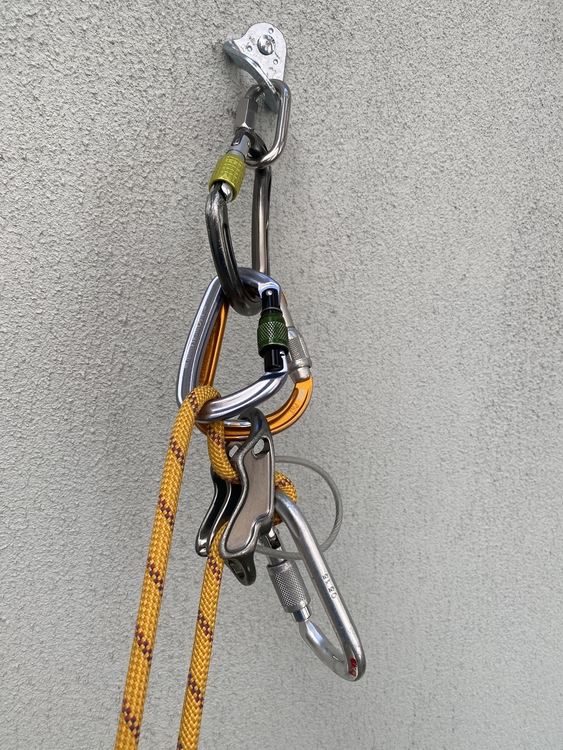
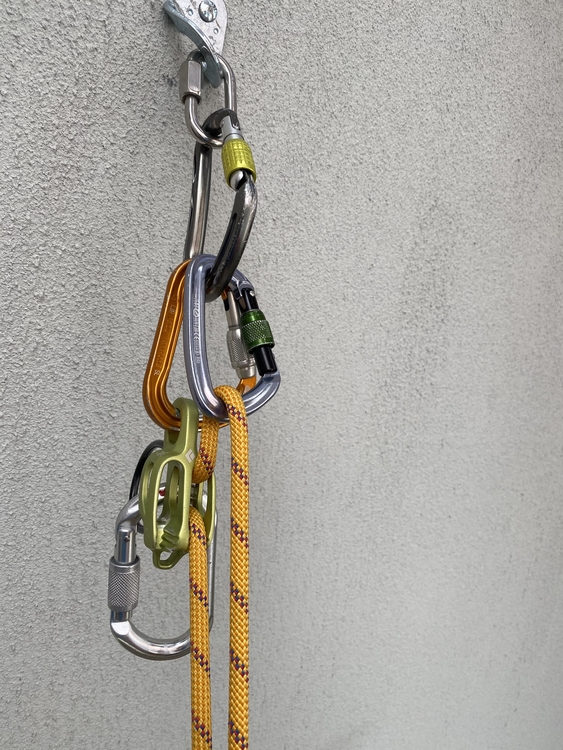
Since the advent of LSD (thanks Chauvin and Coppolillo) I've switched to a BD ATC Guide. Its anchor attachment point is rotated 90 degrees from that of the Reverso, Pivot, Gigi. That rotation makes the LSD lower align better (eliminates a twist).
ATC:

 
Reverso:
rgold · · Poughkeepsie, NY · Joined Feb 2008 · Points: 526
Russ B wrote:

Any reason you didn't mention that you should tie in with a bowline follow-though when doing this?

Well, the Brits have been doing it for many years with figure 8's and no incidences.  A figure-8 with a backup knot (something folks say isn't necessary) would certainly be bombproof, but  It's actually hard to get into a ring-loading configuration at all.  You can't when using the technique for upper belays as we've just been discussing, but it is conceivable if highly unlikely that you might ring-load with a leader fall if you use the system for that too (I do).

The reason ring loading is so unlikely is that when the load is taken by the tie-in, the knot and carabiner are automatically oriented properly by the opposing forces.  On top of all this, ring-loading a loop is not the same as loading a EDK.  The strands in the knot in a loop only get about half the load.  Moreover, I'm not sure we even know if figure-8's roll under brief high-impact loads, as all the testing is slow-pull.

For all these reasons I wouldn't be worried about using the rope-loop belay with a figure 8 tie in, and if, in an abundance of caution, one put a backup overhand after the knot, then absolutely no problem under any circumstances.  I might have said something to this effect in the distant past...

All that said, the follow-through bowline is a superior knot for almost all applications...

rgold · · Poughkeepsie, NY · Joined Feb 2008 · Points: 526
chris p wrote:

I'm having a lot of trouble visualizing this set up. Any chance you have a photo or diagram to show it? Do you tie into your anchor pieces with the rope equalizing the rope coming from your harness to the gear and then belay off the loop where you tied to your harness? I'm picturing that twisting the belay device around in a way that would maybe make it not function right. 

https://www.ukclimbing.com/articles/skills/belaying_-_rope_loop_or_belay_loop-1129

rgold · · Poughkeepsie, NY · Joined Feb 2008 · Points: 526
Jared Chrysostom wrote:

When you’re doing this, do you need to make sure that your brake hand is on the “uphill” side? Or does it not matter?

Not totally sure what you mean. Perhaps the pictures in the linked posted just above  clarify? 

Russ B · · Yosemite · Joined Jun 2011 · Points: 42
wivanoff wrote:

How are you ring loading the Fig 8 tie in? 

The "live" end goes to your anchor. You're belaying off the taut line and rope loop tied to your harness. That's a straight line. Do you think your body is side pulling and ring loading the F8 loop?

You are right. Now that I stop and think about this, I could have sworn rgold had said that in the past, and that's why I bought it up. I probably got something mixed up and never stopped to think about it again because I was looking for a good excuse to use the bowline FT anyways. 

Glowering · · Unknown Hometown · Joined Oct 2011 · Points: 16
Andy Wiesner wrote: Since the advent of LSD (thanks Chauvin and Coppolillo) I've switched to a BD ATC Guide. Its anchor attachment point is rotated 90 degrees from that of the Reverso, Pivot, Gigi. That rotation makes the LSD lower align better (eliminates a twist).

ATC:
 
Reverso:

Thanks for posting this. Everyone should read the link before trying this LSD method because the redirect biner disables the autolocking function so you need a friction hitch. This does seem like a good method if you wanted to lower someone to the bottom of a pitch when in guide mode. 

On another note: I think you need to critically think about everything you read and even everything a guide or more experienced climber tells you. You are ultimately responsible for your own safety. Threads like this always has people claiming they’re worthless. Often bad information is posted but if you are able to analyze what is posted and decide what works for you (and best of all practice it) there’s often great information. I have learned a lot from threads like these. 

There are often multiple ways to do things and it’s up to you to decide what method makes the most sense and works best for you. If I wasn’t able to do this I wouldn’t climb trad or walls. Too much can go wrong and you may need to be able to figure things out and have a variety of options in your toolkit to deal with it. 

Even that article on LSD by professional guides has some things I would question. They say “Before lowering, build an autoblock with a Prusik”. Well is it an autoblock or is it a prusik? I guess they mean a tied cord sling is a “prusik”, but a prusik and an autoblock are friction hitches. The article then goes back and forth between the two terms. This is just an example of not writing clearly but goes to show you need to think critically about information from any source. They also recommend an overly complicated method (IMO) of what to do if the climber can’t get their weight off the rope for you to install the redirect biner. I would first just use the manufacturers recommended method to lower to get them to a point (e.g. a ledge) where they could get their weight off the rope. In fact I’d use the manufacturers method unless I needed to lower a long way, it seems safer and simpler to me than the LSD. 

Another good thing about threads like this is you have a variety of view points to read. People like to call out when people give bad info. Again you need judgement to discern what’s accurate but I like that compared to an article (or even what a guide tells you) that’s allows no discussion or ability to call out questionable info.
Chris K · · Clemson, SC · Joined Oct 2017 · Points: 136
Even that article on LSD by professional guides has some things I would question. They say “Before lowering, build an autoblock with a Prusik”. Well is it an autoblock or is it a prusik? I guess they mean a tied cord sling is a “prusik”, but a prusik and an autoblock are friction hitches. The article then goes back and forth between the two terms. This is just an example of not writing clearly but goes to show you need to think critically about information from any source. 

An autoblock is not necessarily a specific knot but a rope device. So yes you would indeed build an autoblock with a prussik loop. Typically most people tie the French prusik friction hitch with a prusik loop. 

So you’re building a prussik hitch, specifically the French prusik which is also an autoblock device, with a prusik loop. https://en.wikipedia.org/wiki/Autoblock
Prusik can refer to the hitch or the loop. https://en.wikipedia.org/wiki/Prusik
Cole Pazar · · Boulder, CO · Joined Apr 2018 · Points: 413

After reading this whole thread, the OP sounds super sketchy. Asking questions like which side of the rope he should be grabbing? LOL. You should really consult people who actually know what their talking about in person when trying to learn new systems. Online information is only supplemental at best. Never test something you've never done before on your "quarantine partner", you completely risked her life and created unneeded risk for her and for health workers in your county. At least you knew how to use a munter hitch...

@Andy Wiesner, you absolutely killed it with those photos of the guide ATC and reverso setups. This is a perfect example of why the guide ATC is superior. Obviously you need a backup on the brake strand, i.e. a hollow block, to catch the rope in the event of uncontrolled speeds. There are many methods of achieving this end result after a climber has fully weighted the device and you don't have enough gear to create a 3–1 to hoist them higher (or to a rest where they can unweight the rope).

Jared Chrysostom · · Clemson, SC · Joined Oct 2017 · Points: 5
rgold wrote:

Not totally sure what you mean. Perhaps the pictures in the linked posted just above  clarify? 
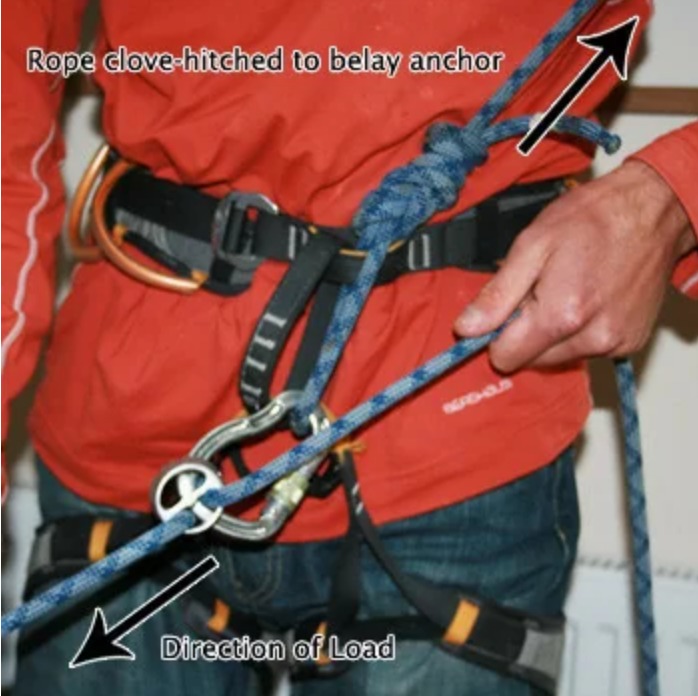
Yes, exactly that. I was wondering how you would position your body / brake hand relative to the load direction, makes sense now. Thanks. 

Jared Chrysostom · · Clemson, SC · Joined Oct 2017 · Points: 5
Cole Pazar wrote: After reading this whole thread, the OP sounds super sketchy. Asking questions like which side of the rope he should be grabbing? LOL. You should really consult people who actually know what their talking about in person when trying to learn new systems. Online information is only supplemental at best. Never test something you've never done before on your "quarantine partner", you completely risked her life and created unneeded risk for her and for health workers in your county. At least you knew how to use a munter hitch...
MP needs an eye roll emoji. Learn to read, man. 
Eric Engberg · · Unknown Hometown · Joined Apr 2009 · Points: 0
Jared Chrysostom wrote: MP needs an eye roll emoji. Learn to read, man. 

What I remember reading:

1. You were "surprised" by the forces involve - despite over a decade's worth on anecdotes and documented fatalities in similar situations.
2. You had never never experimented with the technique in a controlled environment - figured "book learning" was adequate.
3. You wildly overestimated your partner's ability.
4 You could not comprehend how your behavior cold have an impact on the COVID-19 situation (if you said you had decided to go after a cost/benefits analysis and made an informed decision I could respect that.  Not agree with, but respect.  But being ignorant is inexcusable).

Cosmiccragsman AKA Dwain · · Las Vegas, Nevada and Apple… · Joined Apr 2010 · Points: 146
Eric Engberg wrote:

What I remember reading:

1. You were "surprised" by the forces involve - despite over a decade's worth on anecdotes and documented fatalities in similar situations.
2. You had never never experimented with the technique in a controlled environment - figured "book learning" was adequate.
3. You wildly overestimated your partner's ability.
4 You could not comprehend how your behavior cold have an impact on the COVID-19 situation (if you said you had decided to go after a cost/benefits analysis and made an informed decision I could respect that.  Not agree with, but respect.  But being ignorant is inexcusable).

I wish I could give you more than one Thumbs up.

Kellen Miller · · Fullerton, CA · Joined Jun 2017 · Points: 15

I don't see what the problem actually was? Did you tie off the device set up another anchor and escape the belay? It sounds like a step was missed somewhere? Maybe I miss read something. 

Devin Bishop · · Granite Falls, WA · Joined Oct 2014 · Points: 648

Kudos for backing up your system! Here's some info you might find helpful:

How To Lower A Climber From A Loaded Auto-Locking Device https://youtu.be/EyxeUg7_4Kk

  1. You need an auto block back up
  2. You need to redirect the brake strand upwards
  3. You need to flip the device out of guide mode
  4. You need to practice this process over and over on the ground before doing it with live bait
Sprayloard Overstoker · · Conquistador of the Useless · Joined Mar 2020 · Points: 220

Guide mode is for guides. Newbies should actually learn how to belay.

Kellen Miller · · Fullerton, CA · Joined Jun 2017 · Points: 15
Devin Bishop wrote: How To Lower A Climber From A Loaded Auto-Locking Device https://youtu.be/EyxeUg7_4Kk

  1. You need an auto block back up
  2. You need to redirect the brake strand upwards
  3. You need to flip the device out of guide mode
  4. You need to practice this process over and over on the ground before doing it with live bait

Was that what he trying but did not do? I have never had too much of a problem with a fallen second. But I learned Self rescue years ago. Before the Guide mode thing was popular. It does not seem any more high speed than anything else as anchor systems for belaying go. Maybe so. 

greggrylls · · Salt Lake City · Joined Apr 2016 · Points: 276
Eric Engberg wrote:

What I remember reading:

1. You were "surprised" by the forces involve - despite over a decade's worth on anecdotes and documented fatalities in similar situations.
2. You had never never experimented with the technique in a controlled environment - figured "book learning" was adequate.
3. You wildly overestimated your partner's ability.
4 You could not comprehend how your behavior cold have an impact on the COVID-19 situation (if you said you had decided to go after a cost/benefits analysis and made an informed decision I could respect that.  Not agree with, but respect.  But being ignorant is inexcusable).

Woah there buddy.....  

1.Textbook Munter backup with a few inches of stretch when unlocking the device.   (Sounds like the exact experience I've had when trying out a new type of guide device)

2. Does he have to announce his decision-making methodology to gain your approval?  What?  Oh and he is ignorant now?  (See 1.)

3.Have you never lowered in guide mode?  

Yes? Then you are also guilty of "drastically" overestimating a partner's abilities.  (I damn well have)
No? Then I'd say I'm glad you're well-read but get some real experience before discussing gear techniques.  

So which is it?

Addition: OP solid question about a device that I agree is more finicky lowering than other more standard guide devices.  Glad there were solid contributions from other members on other valid techniques to consider.  

Guideline #1: Don't be a jerk.

Climbing Gear Discussion
Post a Reply to "I lowered someone in “guide mode” today"

Log In to Reply
Welcome

Join the Community! It's FREE

Already have an account? Login to close this notice.