Mountain Project Logo

I lowered someone in “guide mode” today

Tim Hawkins · · Unknown Hometown · Joined Dec 2017 · Points: 0

If you belay from the top with a munter on your anchor then you can lower without changing your system.

Sirius · · Oakland, CA · Joined Nov 2003 · Points: 660

Pretty rare that someone comes forward to say they made a mistake, got in over their head, saw or did something they didn't fully understand.

Respect to OP for starting the thread. Some assholes chiming in, yeah, but mostly valuable responses.

Jared Chrysostom · · Clemson, SC · Joined Oct 2017 · Points: 5
Sirius wrote: Pretty rare that someone comes forward to say they made a mistake, got in over their head, saw or did something they didn't fully understand.

Respect to OP for starting the thread. Some assholes chiming in, yeah, but mostly valuable responses.

Thanks. I didn’t feel like the situation was ever not under control, it just wasn’t as easy/smooth/comfortable as it should have been. In hindsight I could have made some different decisions, and I’ll remember this experience next time  

The funny part, for me, is that my main climbing partner would say that my technical ability with rope systems and gear is more developed than my raw climbing skills; now I have a bunch of strangers calling me an idiot n00b for admitting that something didn’t work quite like I expected it to. 
Malcolm Daly · · Hailey, ID · Joined Jan 2001 · Points: 380

Use a Munter as your direct belay off the anchor.

There. I said it.


Unless you’re skilled, practiced, have an ideal setup and have the proper equipment handy for a “plaquette belay” you are playing with fire. 
And did someone up-thread actually say they that like it because you can go hands-free? Are you f*cking kidding me?
Learn the proper technique and you won’t kink the rope. Climb safe,Mal
Ryan Tilley · · Kings Beach, CA · Joined Feb 2016 · Points: 148

A DMM Pivot is especially designed for the lowering where you invert the devise, usually this method is the method that offers the least amount of control while lowering your climber. Mammut also uses this same system with their devise, the sad part is that in their diagram that they offered it doesn't show the redirection of the break strand. If you do this step then you can maintain easier control of the lower, you will need to put on a friction hitch on the break strand so you don't loose control and drop the climber all the way to the ground.

You used a Munter hitch, was it on your belay loop or the anchor? I'm assuming you used your belay loop, having the Munter hitch rather than a friction hitch could make the lower a lot more awkward than it has to be- however that being said it was right of you to use a Munter hitch if you didn't redirect the break strand. If you hadn't done that and just held the rope in your hand then your partner would have zipped straits to the ground.

Overall there are a little too many variables that we would need to see for anyone on this forum to offer you the proper advice to fix the problem you described.

That being said-- 

One easy way to fix everything is to change up the lowering method, there is a newer method of lowering a follower that most guides have been switching to using and teaching. It's called the "load strand dependent," or "load strand direct," or "LSD" for short. This video shoes the older method and the newer method together, the LSD method works with any devise that is set up the same as an ATC guide devise so it should work just fine on the Mammut Smart.

https://www.youtube.com/watch?v=zx8JP4TRJlM 

Cosmiccragsman AKA Dwain · · Las Vegas, Nevada and Apple… · Joined Apr 2010 · Points: 146
Sunday Ruff wrote:

These assholes didn't get their chance to chime in so here it is. 

Sunday;
They don't care. All they think about is their own selfish gratification.

Harris P · · Denver, CO · Joined Jun 2014 · Points: 60
Jared Chrysostom wrote: 

Yeah, if I go climbing with this particular person again I will belay from my harness.

Hey Jared, I agree with most people here that you did the right thing given the circumstances. I think belaying off the anchor is likely still preferable, but just practice the transition from belaying to lowering. It's like an optimistic vs. pessimistic approach... You should set up your belay system to optimize performance in support of your goal (of finishing the route, I would assume). Think about easy solutions that would allow your climber to reach the top first, and then progress to more complicated solutions only IF the situation requires it. One way to mentally organize this info is as follows:

You can bring your climber UP:

1.) tight belay, encouragement, and coaching

2.) Hard pull (also vector pull) to take weight off climber and haul rope through belay device

3.) "Drop C" and other simple haul methods

You can lower your climber DOWN:

1.) Plaquette Release (for short distances)
2.) Load Strand Direct - LSD (to lower a climber who is capable of unweighting the rope)
3.) Belay Escape and Counterweight Rappel (Most complicated for unresponsive victim)

There are transitions to each solution, but you can start each one from the same baseline of a standard belay off the anchor.

Sam M · · Portland, OR · Joined Oct 2017 · Points: 30
Jared Chrysostom wrote:

Now I have a bunch of strangers calling me an idiot n00b for admitting that something didn’t work quite like I expected it to. 

Funny because the exact technique you used is illustrated in the ATC guide manual. 

Sam M · · Portland, OR · Joined Oct 2017 · Points: 30
Malcolm Daly wrote: And did someone up-thread actually say they that like it because you can go hands-free? Are you f*cking kidding me?

I guess I should have put a disclaimer. Always be aware of the risks you are taking and decide what level you and your partner are comfortable with beforehand. This is not "manufacturer recommended" but is commonly done on big routes, along with plate hanging. On long easy routes (where the primary protection is your hands and feet), it is nice to occasionally have two hands free while the second is coming up. Ymmv. 

Matt Simon · · Black Rock City · Joined Nov 2012 · Points: 203
Jared Chrysostom wrote:

Yeah, if I go climbing with this particular person again I will belay from my harness. 

That sounds uncomfortable if there’s a chance she (or anyone) is gonna be hangdogging. 

Assuming you’re not using half/twins, why not just use a grigri and belay off the anchor like someone mentioned upthread? Problem solved.

Billcoe · · Pacific Northwet · Joined Mar 2006 · Points: 936


Jared, thank you for sharing your experience here. It's damned valuable to others. Not the smart-ass know-it-all assholes of course, but to many others. For myself, I like having the knowledge of using an auto block for those very rare times where it's a solution to some problem, but realistically, most of the time I have no business using it for the same reason you discovered.

Regardless, thank you for sharing and helping impart some knowledge to others who may be in need of it and find it of value. 

Connor Dobson · · Louisville, CO · Joined Dec 2017 · Points: 269
Malcolm Daly wrote: Use a Munter as your direct belay off the anchor.

There. I said it.

Unless you’re skilled, practiced, have an ideal setup and have the proper equipment handy for a “plaquette belay” you are playing with fire. 
And did someone up-thread actually say they that like it because you can go hands-free? Are you f*cking kidding me?
Learn the proper technique and you won’t kink the rope. Climb safe,Mal

Can't tell if troll or not? Are you upset because people are using hands free devices in the way they are intended? 

Tradiban · · Unknown Hometown · Joined Apr 2004 · Points: 11,610
Connor Dobson wrote:

Can't tell if troll or not? Are you upset because people are using hands free devices in the way they are intended? 

Mal is just a little "old school". Lol, who says "plaquette" nowadays anyway?

The devices aren't intended to be hands free but they pretty much work that way. My advice is, you do you and take 'er easy. Nawmean?

rgold · · Poughkeepsie, NY · Joined Feb 2008 · Points: 526
Matt Simon wrote:

That [referring to belaying off the harness] sounds uncomfortable if there’s a chance she (or anyone) is gonna be hangdogging.

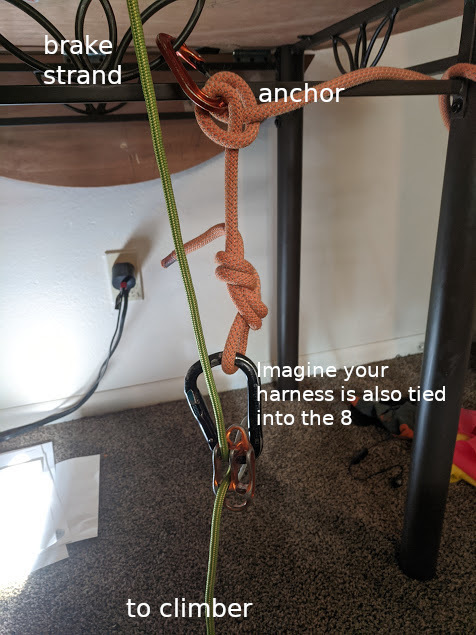
I've come to terms with sounding like a broken record on this.  You set up your tie-in to the anchor so it is snug.  Typically, you sit at the edge of the cliff where it is easy to see and communicate with the second.  You clip your belay device to your rope tie-in loop, not the harness belay loop, and belay as you ordinarily would with a plate (meaning that the brake hand has to be moved back toward the belayer's body to engage braking.)  Your second can hang-dog all day long (once or twice I've had a second prusik with this set up), the load goes straight to the anchor via the snug tie-in with no belayer discomfort.

If the anchor is remote from the cliff edge, this is actually the best way to belay, and it is almost the only good way if the anchor is very low on the belay ledge.  On trad climbs that don't have installed comfort stations, such situations are not uncommon. I find it superior to a harness belay with redirection through a high anchor point, which can have a ton of friction and can pull the belayer towards the anchor.  Of all the methods, redirecting through a high anchor point is the most uncomfortable; I never use it any more.

I use it the rope-loop belay most of the time, as I'm not a fan of fixed-point plaquette belays, but even if you are devoted to your plaquette, it's a good technique to have in the toolbox.

Russ B · · Yosemite · Joined Jun 2011 · Points: 42
rgold wrote:

You set up your tie-in to the anchor so it is snug.  Typically, you sit at the edge of the cliff where it is easy to see and communicate with the second.  You clip your belay device to your rope tie-in loop, not the harness belay loop, and belay as you ordinarily would with a plate (meaning that the brake hand has to be moved back toward the belayer's body to engage braking.)  

Any reason you didn't mention that you should tie in with a bowline follow-though when doing this?

I've started using this technique quite a bit the past couple years, probably after reading some of your other posts about it. I switched to using the bowline follow-though out of concerns of ring-loading a figure 8. Is that not a concern with the possible forces you can generate on TR? 

Harris P · · Denver, CO · Joined Jun 2014 · Points: 60
Russ B wrote:

Is that not a concern with the possible forces you can generate on TR?

Not a concern. You’re gonna be fine.

Jared Chrysostom · · Clemson, SC · Joined Oct 2017 · Points: 5
rgold wrote:

I've come to terms with sounding like a broken record on this.  You set up your tie-in to the anchor so it is snug.  Typically, you sit at the edge of the cliff where it is easy to see and communicate with the second.  You clip your belay device to your rope tie-in loop, not the harness belay loop, and belay as you ordinarily would with a plate (meaning that the brake hand has to be moved back toward the belayer's body to engage braking.)  Your second can hang-dog all day long (once or twice I've had a second prusik with this set up), the load goes straight to the anchor via the snug tie-in with no belayer discomfort.

If the anchor is remote from the cliff edge, this is actually the best way to belay, and it is almost the only good way if the anchor is very low on the belay ledge.  On trad climbs that don't have installed comfort stations, such situations are not uncommon. I find it superior to a harness belay with redirection through a high anchor point, which can have a ton of friction and can pull the belayer towards the anchor.  Of all the methods, redirecting through a high anchor point is the most uncomfortable; I never use it any more.

I use it the rope-loop belay most of the time, as I'm not a fan of fixed-point plaquette belays, but even if you are devoted to your plaquette, it's a good technique to have in the toolbox.

When you’re doing this, do you need to make sure that your brake hand is on the “uphill” side? Or does it not matter?

chris p · · Meriden, CT · Joined Oct 2018 · Points: 556
rgold wrote:

I've come to terms with sounding like a broken record on this.  You set up your tie-in to the anchor so it is snug.  Typically, you sit at the edge of the cliff where it is easy to see and communicate with the second.  You clip your belay device to your rope tie-in loop, not the harness belay loop, and belay as you ordinarily would with a plate (meaning that the brake hand has to be moved back toward the belayer's body to engage braking.)  Your second can hang-dog all day long (once or twice I've had a second prusik with this set up), the load goes straight to the anchor via the snug tie-in with no belayer discomfort.

If the anchor is remote from the cliff edge, this is actually the best way to belay, and it is almost the only good way if the anchor is very low on the belay ledge.  On trad climbs that don't have installed comfort stations, such situations are not uncommon. I find it superior to a harness belay with redirection through a high anchor point, which can have a ton of friction and can pull the belayer towards the anchor.  Of all the methods, redirecting through a high anchor point is the most uncomfortable; I never use it any more.

I use it the rope-loop belay most of the time, as I'm not a fan of fixed-point plaquette belays, but even if you are devoted to your plaquette, it's a good technique to have in the toolbox.

I'm having a lot of trouble visualizing this set up. Any chance you have a photo or diagram to show it? Do you tie into your anchor pieces with the rope equalizing the rope coming from your harness to the gear and then belay off the loop where you tied to your harness? I'm picturing that twisting the belay device around in a way that would maybe make it not function right. 

Russ B · · Yosemite · Joined Jun 2011 · Points: 42
chris p · · Meriden, CT · Joined Oct 2018 · Points: 556
Russ B wrote:

Thanks. That's kinda what I thought, but for some reason I thought I must be wrong because I thought it would interfere with the belay device functioning right.  


One downside is I imagine this would defeat the smart's assisted braking functionality. 

Guideline #1: Don't be a jerk.

Climbing Gear Discussion
Post a Reply to "I lowered someone in “guide mode” today"

Log In to Reply
Welcome

Join the Community! It's FREE

Already have an account? Login to close this notice.