
 Continue with onX Maps
 Sign in with Facebook






The great Snow Pickets Mystery


|
|
I m taking advantage of all the free time I have atm to ask you a very pressing question: In which situation(s) do you use snow picket, the kind MSR makes for ex? |

|
Typically when you're traveling on glaciers as a roped team. If your partner falls in a crevasse you use the pickets to build a snow anchor for the haul system to then pull them out. |

|
Here is some good information. |
|
|
sandrock wrote: Typically when you're traveling on glaciers as a roped team. If your partner falls in a crevasse you use the pickets to build a snow anchor for the haul system to then pull them out. For crevasse rescue I would use, as a much more versatile alternative, buried ice axe(s) or even a buried backpack full of snow or, on ice, just ice screws. Setting up fixed ropes I get it but its not a recreational use, there is no fixed ropes around snow or ice in the alps so its a beggining of an explanation |
|
|
I have hammered pickets into steep neve, for protection. |
|
|
George Bracksieck wrote: I have hammered pickets into steep neve, for protection. Why not use your ice axe/ice tool(s) instead ? |
|
|
I used my tools for climbing. I occasionally placed pickets for protection on steep pitches, to catch a possible leader fall. |
|
|
Fabien M wrote: I believe a lot of it has to do with the remoteness. Your ice axe is used in self arrest and holding yourself, so you'd have to bury another party members if you go this route. Filling and burying a backpack with snow takes time that is worth a lot more in the US for reasons I explain below. Ice screws are a great alternative, but in my experience during summer months the glacial ice gets soft on the top and ice screws aren't ideal. For reference on my experience I have climbed a lot in the Cascades in Washington and British Columbia. A lot of times on mountains or routes you're on in the US you're the only party on the mountain or route unless you're doing a really popular one like Mt. Rainier. A lot of these routes involved driving 3 or more hours from civilization to a trail head, and then hiking at minimum 10km to get to the base of the glacier. No one is around and rescue is a long way away. Often times if you have to call for rescue they will get to you the next day cause you're so far out there. Pickets are lightweight and easy to take an extra one or two of to ensure some extra safety. Compare this to the alps, I had a friend who helped rescue a kid from another party from a crevasse on a route there. By the time he was done pulling the kid out the helicopter arrived to help. In the alps your safety threshold involves less gear cause help is nearby. In the US the mountains are so remote that while rescue will come, it is largely your responsibility to self extract your selves - time and having enough gear is a big issue when you're that far from the trail head. |
|
|
George Bracksieck wrote: I used my tools for climbing. I occasionally placed pickets for protection on steep pitches, to catch a possible leader fall. Fair enough. I think I already understand differences of approach a little bit better now |
|
|
Jacob Wolniewicz wrote: Thanks for the detailed feedback! I think it helps a lot to understand the "why" of snow pickets. You re totally right that in many cases help, in the form of fellow climbers or a chopper, is often not too far in the Alps. |
|
|
Fabian, I don't disagree with you. I have at times not carried a picket. If you can hammer in a picket, it is likely that it would be desperate to deadman a T rated tool or axe. It would be a tremendous amount of work. however, it's not unreasonable depending on the objective. |
|
|
You may not want to separate yourself from your axe for your continued safety or may need to use it as part of lip prep. Additionally, a picket is a good way to get an anchor started from a prone/self arrest position which could them be backed up by another more improvised anchor (backpack/skis/etc). |
|
|
On a crevasse fall, I would not use my ice axe for the anchor. I would keep the axe with me to probe for more crevasses as I travel to the lip, and also to pad the lip so the victim's rope doesn't cut the wall and get sucked into the crevasse wall. |
|
|
sandrock wrote: I'd say that's a mischaracterization. While traveling unroped on glaciers probably happens more in the alps then elsewhere, barring soloing (the same everywhere), it really only occurs during the summer on bare glaciers where the crevasses are apparent. When the glacier is covered with snow, the vast majority of people on foot in the alps are roped up, just like everywhere else. Skiers much less so, even though carrying crevass rescue gear.
|
|
|
Aaron Liebling wrote: Agree with all this. Its rare to be unroped on glacier except if you know there is not crevasse at all (more and more common unfortunately due to global warming when the glacier shrink to almost nothing...) or of course if you go solo or skiing (up or down) For rescue I realize the situation is quite different as well, what may also be at play is the fact that mountain rescue is "free" (ie. included in your taxes) in France and Italy and cost CHF 30 per year in Switzerland (Rega membership) thus you certainly hesitate less to call them... there is also very litlle "blank space" for phone signal |
|
|
A solid picket is worth its weight. Climbing steep snow in Alaska I’ve used them many, many times. I last rappelled off the summit ridge of Mount Huntington with a T-slotted picket. I’m here today. When your option is a picket or nothing, I’ll take the picket. |
|
|
I have used pickets a lot in the mtns. They are a great piece of protection for steep hard snow where a screw will not work. They work nicely in rime/snow/ice mixtures. |
|
|
Running anchors above bergshrunds and cliffs, and/or on steep snow slopes. Flukes and shovels work too. |
|
|
clint helander wrote: I last rappelled off the summit ridge of Mount Huntington with a T-slotted picket. I’m here today. When your option is a picket or nothing, I’ll take the picket. There is an inverse relationship between the size of the anchor and the mass of the cajones it will hold. |
|
|
running belays in steep glaciated terrain... |
|
|
Everyone else has pretty much covered it: 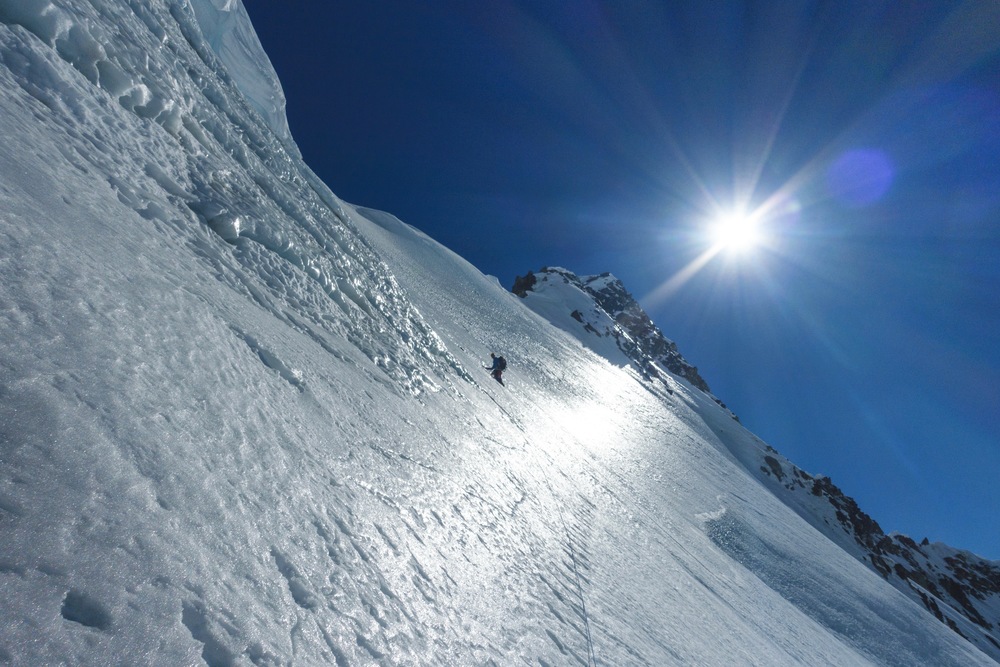 I've also used pickets as an anchor to start a rock route or pitch, especially where there is no protection for a while at the start of the rock. They are also useful to have for rapping, when it's too soft for v-threads but too hard for a snow bollard. Likewise for crevasse rescue, sure you might be able to bury your ice axe or bag, but what if the snow's too hard for that? These are pretty common snow conditions in my experience. |


