|
|
John Reeve
·
Feb 13, 2020
·
Durango, CO
· Joined Nov 2018
· Points: 15
frank minunni wrote: No on the clove hitch. That's a good way to twist up your rope. How much does an ATC weigh, anyway? I'm not the OP and this is kind of offtopic, but I am pretty sure in the context of "solo aiding" a clovehitch isn't terrible and safer to rig for solo use than an atc.
|
|
|
rob.calm
·
Feb 13, 2020
·
Loveland, CO
· Joined May 2002
· Points: 630
Mark Frumkin wrote: The breaking of teeth or teeth being ripped out comes on the fall.
It is natural to clench your jaw at the beginning of a fall & then in a millisecond scream.
I know two people who lost teeth because the rope was in their mouth when they fell & a third person who lost teeth and fuck his face up horribly.
The chance of it happening is small but it's there & the consequences or why not worth the risk. If you train yourself not to put things in your mouth you will find you can do anything just as fast and better. It does happen. Saw a climber lose teeth from the rope in his mouth while falling off Orphan at Joshua Tree.
|
|
|
Juan Vargas
·
Feb 13, 2020
·
Bakersfield, CA
· Joined Apr 2014
· Points: 1,170
Artem Vasilyev wrote: Present your argument, sir. Here is mine:
You can flip through the sizes much quicker and find a secure micro cam, before unclipping it and adding a draw. You no longer have to deal with going back and forth from your harness or settling for a subpar micro cam for the sake of efficiency. In concept, it is faster to treat micro cams the same as nuts. You wouldn't rack each of your nuts individually, would you?
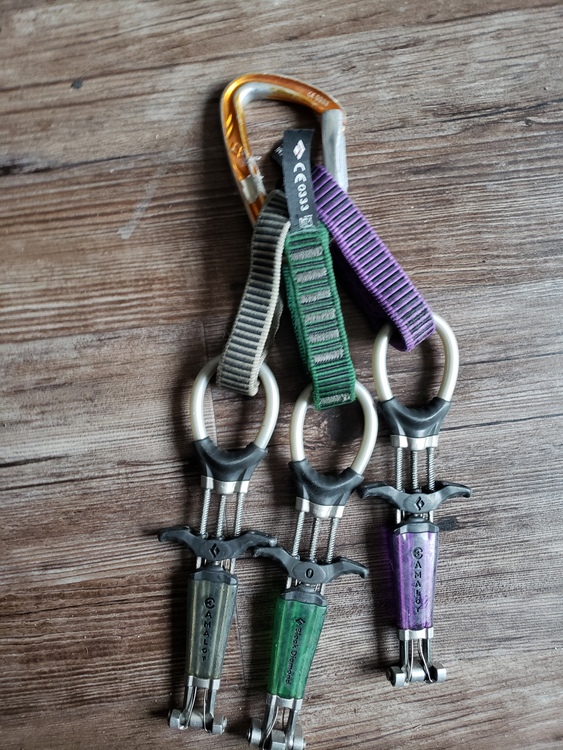
Now please present your argument in response to my argument. So you are climbing some random crack and need a purple C3. You grab your racking biner with all three C3 cams attached to it. you place that purple C3, unclip it from the biner that will now be holding your other two micro cams, clip that biner with the cams back to your harness, you grab a quickdraw or spare biner and clip it to your cam, then you clip the rope to your cam. Then you move a little higher and realize you need your green C3 and do that all over again. How is this efficient? How is this a good idea when getting through a crux? Have you ever climbed continuous finger cracks such as those found in Yosemite or the desert? I keep my small cams racked with their own biners. I need to place one, I grab it from my harness, place it, and clip my rope to it (if i need to extend my placement, i just clip a quickdraw to it.)
|
|
|
j sittler
·
Feb 13, 2020
·
Carbondale, CO
· Joined Oct 2013
· Points: 0
Andrew Reed wrote: Tricks for unsticking gear:
Pulling the trigger does not actually detract the lobes to their fullest extent. If you can get your fingers in there you can manipulate the lobes to get just a couple more millimeters of movement which sometimes does the trick. If the cam is too far in to reach with fingers, use a nut tool as a lever with the outside edge of the crack as the fulcrum. Place the side of the nut tool against the stuck lobe and you can pry the lobe further open. Sometimes pouring a little water on a really fixed cam can get it moving again.
The water is a great trick for granite...just not in sandstone. I once watched someone with a stuck #3 on potash road keep pouring water in the crack and then using a nut tool to just chisel away the now crumbly rock until it got unstuck...oof
|
|
|
bryans
·
Feb 13, 2020
·
Unknown Hometown
· Joined Jun 2006
· Points: 562
Artem Vasilyev wrote: Same here. This is how I rack my micros and it is definitely the most efficient/fastest way to do it. Artem, when you place 1 of those 3 cams, you have to then remove the biner (which still has just 2 cams on it) from the cam you placed. This means that you will always have to then put a draw on the cam you just placed, since there is no biner to clip. Correct? You also can never clip direct, you have to do a mandatory extension with a draw, as there is no biner to clip using this method. Here's how i see it, and I'm willing to be convinced, but: Your method:
1- place cam
2- remove biner/other cams from placed cam (probably a bit fumbly, no?)
3-put biner/cams back on harness/rack
3- grab and place draw on cam loop (there is nothing to clip until you add a draw)
4- clip rope
Conventional (w/o extending):
1-place cam
2-clip rope to cam biner/loop
Conventional (with extending):
1-place cam
2- grab and place draw on cam biner/loop
3- clip rope to draw
Seems like the time saved by grabbing 3 cams at once is offset by the extra steps to clip. Grabbing a single cam is clearly fastest, but grabbing the wrong cam might ultimately be the slowest. So grabbing a single cam is a gamble, but your method will always be slower than just grabbing the right cam first go. So, do you feel lucky, punk?
|
|
|
Pat Light
·
Feb 13, 2020
·
Charlottesville, VA
· Joined Nov 2017
· Points: 0
Juan Vargas wrote: So you are climbing some random crack and need a purple C3. You grab your racking biner with all three C3 cams attached to it. you place that purple C3, unclip it from the biner that will now be holding your other two micro cams, clip that biner with the cams back to your harness, you grab a quickdraw or spare biner and clip it to your cam, then you clip the rope to your cam. Then you move a little higher and realize you need your green C3 and do that all over again. How is this efficient? How is this a good idea when getting through a crux? Have you ever climbed continuous finger cracks such as those found in Yosemite or the desert? I keep my small cams racked with their own biners. I need to place one, I grab it from my harness, place it, and clip my rope to it (if i need to extend my placement, i just clip a quickdraw to it.)
So you are climbing some random crack and need a #4 nut. You grab your racking biner with all of your nuts attached to it. you place that #4 nut, unclip it from the biner that will now be holding your other nuts, clip that biner with the nuts back to your harness, you grab a quickdraw or spare biner and clip it to your nut, then you clip the rope to the nut. Then you move a little higher and realize you need your #5 nut and do that all over again. How is this efficient? How is this a good idea when getting through a crux? Have you ever climbed continuous finger cracks such as those found in Yosemite or the desert? I keep my nuts racked with their own biners. I need to place one, I grab it from my harness, place it, and clip my rope to it (if I need to extend my placement, i just clip a quickdraw to it.)
|
|
|
Lone Pine
·
Feb 13, 2020
·
Unknown Hometown
· Joined May 2014
· Points: 0
Pat Light wrote: So you are climbing some random crack and need a #4 nut. You grab your racking biner with all of your nuts attached to it. you place that #4 nut, unclip it from the biner that will now be holding your other nuts, clip that biner with the nuts back to your harness, you grab a quickdraw or spare biner and clip it to your nut, then you clip the rope to the nut. Then you move a little higher and realize you need your #5 nut and do that all over again. How is this efficient? How is this a good idea when getting through a crux? Have you ever climbed continuous finger cracks such as those found in Yosemite or the desert? I keep my nuts racked with their own biners. I need to place one, I grab it from my harness, place it, and clip my rope to it (if I need to extend my placement, i just clip a quickdraw to it.) LOL
|
|
|
Andy Eiter
·
Feb 13, 2020
·
Madison, WI
· Joined Jul 2014
· Points: 276
bryans wrote: Your method:
1- place cam
2- remove biner/other cams from placed cam (probably a bit fumbly, no?)
3-put biner/cams back on harness/rack
4- grab and place draw on cam loop (there is nothing to clip until you add a draw)
5- clip rope
Conventional (w/o extending):
1-place cam
2-clip rope to cam biner/loop
Conventional (with extending):
1-place cam
2- grab and place draw on cam biner/loop
3- clip rope to draw I think the conventional method with extending covers the majority of trad climbing (maybe?). So the only difference is the added steps of removing the racking biner and reclipping it to your gear loop. These are probably the two easiest, quickest steps. For me, it's worth it.
|
|
|
bryans
·
Feb 13, 2020
·
Unknown Hometown
· Joined Jun 2006
· Points: 562
Artem Vasilyev wrote: People grab the wrong micro cam more often than not imo. Very finicky pieces to place properly. This way you have the best possible placement each time with little time add in clipping motions. This is the same reason people rack their nuts together. Nuts obviously always require a draw unlike small cams so it' not the same situation. Plus nuts are in general (for me) a bit harder to eyeball than even micro cams. If I'm placing a micro cam while things are cruxy, I want to clip that bad boy right away and not be fumbling with other micro cams on a biner to get them back on my harness, then still needing to grab a draw. If it's not cruxy, there is no rush, and so no real consequence to not grabbing the wrong micro cam the first time.
|
|
|
Andrew Rice
·
Feb 13, 2020
·
Los Angeles, CA
· Joined Jan 2016
· Points: 11
Artem Vasilyev wrote: So what if its cruxy and you got the micro cam wrong the first time? Then, you have to fumble around much much more while cruxing out. Making my method quicker, safer, and more conducive to a send. If your Plan-A is based around screwing up the first time, that's not a great Plan-A. Probably time better spent to get really dialed in about what finger size compares to what cam, with precision.
|
|
|
Suburban Roadside
·
Feb 13, 2020
·
Abovetraffic on Hudson
· Joined Apr 2014
· Points: 2,419
Artem Vasilyev wrote: If you think you get the perfect micro cam right the first time, each time, then you are climbing on bad gear via ignorance. 1-2mm can turn a good micro cam into a bad micro cam - I've never met a climber who is that sharp on the first draw and I likely never will. Do you rack your nuts individually or all on one biner? First off ~Bunch of hang-dawgs 'round here! .~. Try to climb in better style instead of chasing the numbers That you have never met a climber who is that good on the sharp end surprises me.
Of course, there are a shit-ton of good climbers who have their sizes dialed & those climbers know that micro-cams, while maybe, equal in surface area making contact, getting them "keyed" into place takes equal or more time & may not provide the same speed of placement, security and the general ease of 'bomb-proof' placement that a nest of small wires does.
|
|
|
Andrew Rice
·
Feb 13, 2020
·
Los Angeles, CA
· Joined Jan 2016
· Points: 11
Artem Vasilyev wrote: If you think you get the perfect micro cam right the first time, each time, then you are climbing on bad gear via ignorance. 1-2mm can turn a good micro cam into a bad micro cam - I've never met a climber who is that sharp on the first draw and I likely never will. Do you rack your nuts individually or all on one biner? I didn't say I get them right the first time, every time. But if you're racking three to a biner, just like that, the odds of me getting the right one just grabbing blindly at one of the same three individually racked would be 33.3%. With some additional knowledge and experience, I'm going to get WAY better than 50%. So you're treating them like nuts but foregoing the great benefit of plugging the right piece in a finger crack, clipping the racking biner and just GOING.
I'm glad it works for you but I think it's a solution to one thing that creates other liabilities greater than the problem it solves.
|
|
|
ryan albery
·
Feb 13, 2020
·
Cochise and Custer
· Joined Mar 2009
· Points: 290
When climbing on terrain with chickenheads or horns, if you’ve got some over the shoulder slings, you can slide the sling right off your shoulder and sling the hold without changing your grip on that hold. Not really mission critical cause anything you can sling is likely a bomber hold, and you might want to secure it with a half-hitch after that, but it does make you feel like a superhero a little bit.
|
|
|
Lone Pine
·
Feb 13, 2020
·
Unknown Hometown
· Joined May 2014
· Points: 0
Artem Vasilyev wrote: Stick the next cam you'll need into your mouth before you head into a sequence of hard moves. Super useful if you need body tension and a quick placement in a particular section. Is this what you do with your micro-cams? Do you have a bunch of cams dangling from your mouth before heading into a crux? Because by your own logic, since you might get the size of a micro cam wrong more often than not, then you need to have these readily available
|
|
|
Kellen Miller
·
Feb 13, 2020
·
Fullerton, CA
· Joined Jun 2017
· Points: 15
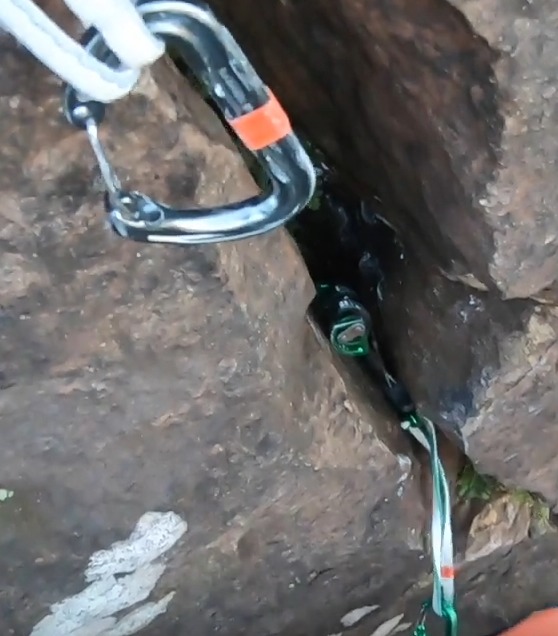
Gunkiemike wrote: Not a trick, just basic know-how: cams work best in parallel(ish) cracks. If there's a pronounced taper to the crack, go with passive gear. We all know cams can open up if they walk into a wider part of the crack, but some folks still get a "cam fixation" and place them where they are inappropriate, Here's a screenshot from a recent video:
It is ok to place cams into a constriction that gives it some redundancy. If the crack is flaring it is still always best to find a constriction either way a parallel crack with a constriction is always better than a flaring unprotected crack. But if you can place passive gear great. Sometimes that is all you get.
|
|
|
Michael S
·
Feb 13, 2020
·
Somewhere, USA
· Joined May 2019
· Points: 30
Artem Vasilyev wrote: Same here. This is how I rack my micros and it is definitely the most efficient/fastest way to do it. Great way to drop multiple cams...
|
|
|
Matthew Jaggers
·
Feb 13, 2020
·
Red River Gorge
· Joined Sep 2017
· Points: 695
It's been said by a couple people in the way they rack their gear with color coded biners, but I call all cam's sizes from any manufacturer by their Black Diamond size. Yellow Totem=.4=Gray Biner. C3's are the only tricky ones that I haven't wrapped my head around yet. Red 1 is a .2, Yellow 2 is a .3? Pricks. Did they do that accidentally?
|
|
|
JaredG
·
Feb 13, 2020
·
Tucson, AZ
· Joined Aug 2011
· Points: 17
Matt Simon wrote: ...placing / clipping at the waist: 1) shorter falls if you peel while clipping
pretty sure this is incorrect
|
|
|
Thomas Claiborne
·
Feb 13, 2020
·
Flagstaff
· Joined Apr 2016
· Points: 41
The trick is to hold your sphincter tight, so when you whip on your small gear you don't shit yourself.
|
|
|
Travis S
·
Feb 13, 2020
·
Colorado
· Joined Jul 2018
· Points: 70
JaredG wrote: pretty sure this is correct Fixed it for ya.
|

 Continue with onX Maps
 Sign in with Facebook