|
|
Not Not MP Admin
·
Nov 20, 2019
·
The OASIS
· Joined Nov 2018
· Points: 17
Looking to improve mobility in the hips, primarily my hip adductor and abductor, as well as overall shoulder mobility.
What are some routines you guys use?
|
|
|
Eric Chabot
·
Nov 21, 2019
·
Salt Lake City, UT
· Joined Jul 2011
· Points: 45
Be careful, flexibility might not really be what you want. To much can lead to joint instability and injury.
As your flexibility increases, make sure to strengthen your body throughout the new range of motion you're building. You'll be super weak in the new range at first, take it slow.
I'm pretty flexible, but getting my foot up high isn't the same as being able to use that high foot effectively.
|
|
|
Gumby boy king
·
Nov 21, 2019
·
Unknown Hometown
· Joined Oct 2019
· Points: 547
J T wrote: Looking to improve flexibility, primarily my hip adductor and abductor, as well as overall shoulder mobility.
What are some routines you guys use? What you are looking for is mobility. So working the joints and muscles through a specified range of motion. Static stretching isn't necessarily bad but active mobility stretching will train your muscle/nerves/joints to work in all range of motion.
|
|
|
Wes Martin
·
Nov 21, 2019
·
Golden, CO
· Joined Dec 2015
· Points: 15
|
|
|
grog m
·
Nov 21, 2019
·
Saltlakecity
· Joined Aug 2012
· Points: 70
Yoga, CARs (controlled articulated rotations)
|
|
|
Nick Drake
·
Nov 21, 2019
·
Kent, WA
· Joined Jan 2015
· Points: 651
Tagging onto what Eric said above (good advice). Flexibility is not a measure of functional range of motion and does not directly carry over to movement on the wall. There are a lot of extremely flexible people in the world who can get into the craziest high step, but don't have the strength to actually move out of it. They actually tend to get injured quite frequently because they can easily get into positions that they can't actually control.
I also worked static stretches and did a medium to high volume of yoga for years, but after a slight improvement from the onset I really wasn't seeing any improvements. Both were honestly a waste of time. This last winter I switched up the focus and turned it to mobility during the warm up and then just focused climbing.
- Do your mobility work at the end of a warm up and before really getting into your climbing session. If you work a desk job going into a lunge and tensing glutes to get a deep hip flexor stretch is beneficial, go for a long hold of 60 seconds a side (the goal being to let your glutes fire fully and get rid of any anterior pelvic tilt before climbing). Follow this up with CARS like Grog mentioned (I've gone to doing those with an ankle weight, the really help you get into high steps with good turnout).
- Then Moonboard or other steep climbing squared up with high hand foot matches and you'll be working the full range of motion, actually be climbing and learn movement at the same time. Make sure to turn out only so far as you can without arching your lower back (turns your core off). Engage your flagged foot hard, think about driving your hips toward the wall and holding them there.
For thoracic mobility, two lacrosse balls taped together (or a RAD roller) going up and down your spine, arms crossed to keep scapula out of the way, arch back over the roller on each vertebra to let it release. Larger ball behind the top of the trapezious laying on your back, move arm overhead with thumb oriented like you're steering a bus.
After that work other muscles in the shoulder, a great routine here: web.archive.org/web/2012121…
For thoracic mobility the prone Ys (focus on depressing scapula), band pull aparts, and wall angels are the most helpful.
|
|
|
Gumby boy king
·
Nov 21, 2019
·
Unknown Hometown
· Joined Oct 2019
· Points: 547
Nick Drake wrote:
- Do your mobility work at the end of a warm up and before really getting into your climbing session. If you work a desk job going into a lunge and tensing glutes to get a deep hip flexor stretch is beneficial, go for a long hold of 60 seconds a side (the goal being to let your glutes fire fully and get rid of any anterior pelvic tilt before climbing). Follow this up with CARS like Grog mentioned (I've gone to doing those with an ankle weight, the really help you get into high steps with good turnout).
For thoracic mobility, two lacrosse balls taped together (or a RAD roller) going up and down your spine, arms crossed to keep scapula out of the way, arch back over the roller on each vertebra to let it release. Larger ball behind the top of the trapezious laying on your back, move arm overhead with thumb oriented like you're steering a bus.
After that work other muscles in the shoulder, a great routine here: web.archive.org/web/2012121…
For thoracic mobility the prone Ys (focus on depressing scapula), band pull aparts, and wall angels are the most helpful. No. Mobility and targeted soft tissue work (i.e. gemni ball, RAD Roller, etc...) belong at the beginning of your warm up. 1. Cardio
2. Targeted soft tissue
3. Targeted muscle group activation
4. Warm up climbing
5. Climb hard
My warm up is as follows (takes around 15-20 min once you got it dialed):
Row Machine: 5 minutes (~1400-1500 meters)
Assault Bike: 2 minutes (60 calories or ~80 RPMs)
Foam Roll/Targeted Soft tissue work - I like the gemni ball while hugging a 15 pound medicine ball on my chest rolling from side to side to warm up the spine.
TRX Overhead diaphragm breathing exercise
Supine Bridge
Bird Dog with serratus muscle holds
Lunge Matrix
Overhead lunge walk (2 kettle bells pointed to sky)
Band Pull Aparts
|
|
|
Not Not MP Admin
·
Nov 21, 2019
·
The OASIS
· Joined Nov 2018
· Points: 17
Gumby the White wrote: What you are looking for is mobility. So working the joints and muscles through a specified range of motion. Static stretching isn't necessarily bad but active mobility stretching will train your muscle/nerves/joints to work in all range of motion. Correct, I need to edit the post to say mobility (not flexibility). However, I am looking for specific routines/protocols/exercises to improve this in my hips and shoulders.
|
|
|
Not Not MP Admin
·
Nov 21, 2019
·
The OASIS
· Joined Nov 2018
· Points: 17
Nick Drake wrote: Tagging onto what Eric said above (good advice). Flexibility is not a measure of functional range of motion and does not directly carry over to movement on the wall. There are a lot of extremely flexible people in the world who can get into the craziest high step, but don't have the strength to actually move out of it. They actually tend to get injured quite frequently because they can easily get into positions that they can't actually control.
I also worked static stretches and did a medium to high volume of yoga for years, but after a slight improvement from the onset I really wasn't seeing any improvements. Both were honestly a waste of time. This last winter I switched up the focus and turned it to mobility during the warm up and then just focused climbing.
- Do your mobility work at the end of a warm up and before really getting into your climbing session. If you work a desk job going into a lunge and tensing glutes to get a deep hip flexor stretch is beneficial, go for a long hold of 60 seconds a side (the goal being to let your glutes fire fully and get rid of any anterior pelvic tilt before climbing). Follow this up with CARS like Grog mentioned (I've gone to doing those with an ankle weight, the really help you get into high steps with good turnout).
- Then Moonboard or other steep climbing squared up with high hand foot matches and you'll be working the full range of motion, actually be climbing and learn movement at the same time. Make sure to turn out only so far as you can without arching your lower back (turns your core off). Engage your flagged foot hard, think about driving your hips toward the wall and holding them there.
For thoracic mobility, two lacrosse balls taped together (or a RAD roller) going up and down your spine, arms crossed to keep scapula out of the way, arch back over the roller on each vertebra to let it release. Larger ball behind the top of the trapezious laying on your back, move arm overhead with thumb oriented like you're steering a bus.
After that work other muscles in the shoulder, a great routine here: web.archive.org/web/2012121…
For thoracic mobility the prone Ys (focus on depressing scapula), band pull aparts, and wall angels are the most helpful. Ok, turns out I kind of know what to do for shoulder mobility, I just need to stick with it as I have been doing these things for the past week.
|
|
|
Nick Drake
·
Nov 21, 2019
·
Kent, WA
· Joined Jan 2015
· Points: 651
Gumby the White wrote: No. Mobility and targeted soft tissue work (i.e. gemni ball, RAD Roller, etc...) belong at the beginning of your warm up. 1. Cardio
2. Targeted soft tissue
3. Targeted muscle group activation
4. Warm up climbing
5. Climb hard I did the order you described, mostly because of following Kelly Starrett (sounds like you might based on the gemini recomendation and it's use). I found that unless I did a far longer non specific warm up for a very long period of time my muscles weren't warm enough to have useful soft tissue work. At the end of all that I still wasn't technique ready to climb hard, so I'm looking at damn near an hour before being ready to climb hard. Now I start with an easy traverse and then continuously climb up/down around 6ish V1, 3-4 V2, 2ish V3, 1-2 V4. For me I don't find anything negative about actually climbing to warm up, but that also looks a LOT different than my normal climbing. I might pause in the middle of a V1 for example and do scapular engagement pulls on each arm, I'll downclimb jugs working on turnout, etc.
I can get that warm up done and do the soft tissue work before climbing hard and be ready to go in half an hour. Since I'm frequently doing 2 sessions a day (on a day on, day off format) being able to cut the warm up time down really makes a difference.
I'd encourage people to try different methods, keep a log in a notebook and do what works best for you.
|
|
|
Nick Drake
·
Nov 21, 2019
·
Kent, WA
· Joined Jan 2015
· Points: 651
J T wrote: Ok, turns out I kind of know what to do for shoulder mobility, I just need to stick with it as I have been doing these things for the past week. I've been doing most of those for four years, stick with it and things only get better. I'm still seeing progress today. Most important thing is to be consistent, second most important is to progress volume/load and eventually do more complex movement patterns. I came into climbing with a ton of issues in my left shoulder from a dislocation in 2009 that I failed to rehab properly, so my results have taken ages because I was working out a lot of terrible compensatory movements. Hell I couldn't actually DO a prone Y with no weight in my hands when I first started and couldn't bring my left arm straight over head.
|
|
|
Gumby boy king
·
Nov 21, 2019
·
Unknown Hometown
· Joined Oct 2019
· Points: 547
Nick Drake wrote: I did the order you described, mostly because of following Kelly Starrett (sounds like you might based on the gemini recomendation and it's use). I found that unless I did a far longer non specific warm up for a very long period of time my muscles weren't warm enough to have useful soft tissue work. At the end of all that I still wasn't technique ready to climb hard, so I'm looking at damn near an hour before being ready to climb hard. Now I start with an easy traverse and then continuously climb up/down around 6ish V1, 3-4 V2, 2ish V3, 1-2 V4. For me I don't find anything negative about actually climbing to warm up, but that also looks a LOT different than my normal climbing. I might pause in the middle of a V1 for example and do scapular engagement pulls on each arm, I'll downclimb jugs working on turnout, etc.
I can get that warm up done and do the soft tissue work before climbing hard and be ready to go in half an hour. Since I'm frequently doing 2 sessions a day (on a day on, day off format) being able to cut the warm up time down really makes a difference.
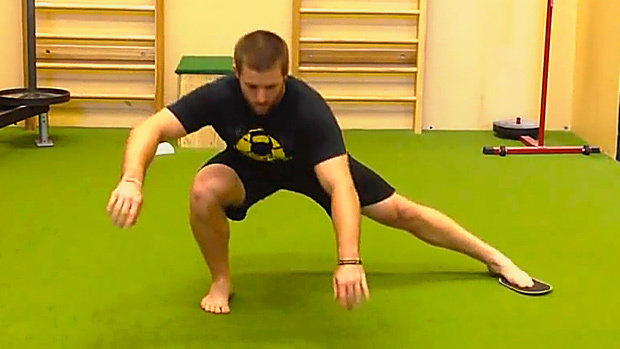
I'd encourage people to try different methods, keep a log in a notebook and do what works best for you. I have never heard of Kelley Starrett. I base most of my training and knowledge on other sports, like baseball, because lets face it - climbing training and knowledge is just not as up to date. Hopefully this changes with all of the new money coming into the sport. Everyone is different and will second everyone trying different methods. I will also add that you need to modulate and change your routine every month or so so the body doesnt get used to the same routine - same goes for stretching. OP - Try something like these for hip strength and mobility for starters. you want to hit every plane and range of motion here - forward, backward, side, and everything in between. you can google lunge sliders for videos and shit.
|
|
|
PNW Choss
·
Nov 21, 2019
·
Unknown Hometown
· Joined Sep 2019
· Points: 0
|
|
|
Nick Drake
·
Nov 21, 2019
·
Kent, WA
· Joined Jan 2015
· Points: 651
Gumby the White wrote: I have never heard of Kelley Starrett. I base most of my training and knowledge on other sports, like baseball, because lets face it - climbing training and knowledge is just not as up to date. Hopefully this changes with all of the new money coming into the sport. Everyone is different and will second everyone trying different methods. I will also add that you need to modulate and change your routine every month or so so the body doesnt get used to the same routine - same goes for stretching. He's the guy who designed that gemini roller, he's a big name in the crossfit world and really got them to start working on expanding functional range of motion. His book "becoming a supple leopard" is a pretty decent read for someone self coaching working on mobility. It's got some things (squat form) that seem to be off, there's some broscience thrown in, but overall it's a pretty good resource. He has some really good ideas on improving ankle dorsiflexion for example (got me to finally do pistol squats). Totally agree on climbing training knowledge and changing things up.
|
|
|
Jane Atlas
·
Nov 23, 2019
·
Unknown Hometown
· Joined Nov 2019
· Points: 0
Yoga and Pilates. Try beginner yoga poses for 20-30 minutes per day, like downward-facing dog, seated forward bend, tree, the child's pose, and the bridge pose.
|
|
|
Aweffwef Fewfae
·
Nov 28, 2019
·
Unknown Hometown
· Joined Oct 2016
· Points: 0
https://www.ncbi.nlm.nih.gov/pmc/articles/PMC5117171/
Sinaki M. Yoga spinal flexion positions and vertebral compression fracture in osteopenia or osteoporosis of spine: case series. Pain Pract. 2013;13:68–75.
Smith EN, Boser A. Yoga, vertebral fractures, and osteoporosis: research and recommendations. Int J Yoga Ther. 2013;23:17–23
yoga has increased risk of injury the older you get. the 44..65 age group had a much higher incident of injury.
|
|
|
Matt Michaels
·
Jan 3, 2020
·
Pittsburgh, PA
· Joined Sep 2014
· Points: 0
|
|
|
Dan Austin
·
Jan 4, 2020
·
San Francisco, CA
· Joined Oct 2010
· Points: 0
Nick Drake wrote: He has some really good ideas on improving ankle dorsiflexion for example (got me to finally do pistol squats). Can you share more? I think I could benefit from improved ankle flexion
|
|
|
Pat K
·
Jan 4, 2020
·
Unknown Hometown
· Joined Oct 2017
· Points: 55
Look at GMB fitness. Gold Medal Bodies by Ryan Hurst. He has a lot of videos on his site and a Facebook page.
|

 Continue with onX Maps
 Sign in with Facebook