|
|
L Kap
·
Nov 28, 2019
·
Boulder, CO
· Joined Apr 2014
· Points: 225
I'll repost what I posted on the other thread. This summarizes some of what others have said on this thread.
I have heard a convincing argument that the amount of time saved in a simul-rap is negligible and not worth the additional safety risk.
The arguably equally efficient way to do it is for both partners to set up a stacked (pre-rigged) rappel and then rap one at a time. With this method, the top partner's rappel device and weight serve to fix the rope in place, which eliminates the need to tie a knot in both ropes. You only need one rope end (ETA - the end fed through the next rap anchor) to be knotted since rapping off one strand won't cause the rope to pull through if the top is fixed. This saves the time it would otherwise take for each rappel (after the first one) to pull up the rope strand that you pulled down from the rappel station above you (and which typically falls past you at that time) in order to tie a knot in the end before rappelling. Between that time savings and, as others have pointed out, the time you save as the first partner starts feeding rope through the next rappel station, it's arguably just as fast as a simul-rap with knotted rope ends for safety.
|
|
|
Jeremy Bauman
·
Nov 28, 2019
·
Lakewood, CO
· Joined Feb 2009
· Points: 1,124
Another way to maintain the speed/efficiency of a simul rappel but add considerably more safety is to fix the more experienced climbers rope with a reepschnur and a backup knot. Tether both rappellers together using their pas/slings and go. The tether protects the second rappeller against losing control or sliding off the end of their unknotted rope.
Upon reaching the next station, carefully disconnect your slings from one another and go into the anchor.
Thread the non-knotted end through, tie a new backup knot and start pulling being careful to untie the old backup knot first.
Once the reepshnur knot reaches the anchor, gri-Gris on and repeat.
Benefits of this system are that you only need a backup knot on the blocked side of the rope so no need to pull up the slack each time. It also provides a safe backup for the weaker/less experienced rappeller who doesn’t necessarily need a gri gri or prussik to still be backed up.
|
|
|
Anson __
·
Nov 28, 2019
·
Unknown Hometown
· Joined Nov 2019
· Points: 0
I prefer simul-rapping, personally, mainly because it helps make a grigri a better multipitch option.
A grigri saved me from a bad belay once so I strongly prefer my belayer to use one, even on multipitch. Simulrapping means we can leave the reverso's at home without having to deal with the higher chance of stuck ropes using a carabiner block on the rappel. Plus, a grigri in guide mode is much smoother than an atc, and is overall so useful for so many other things- hauling, rope solo'ing, managing slack simul-climbing, etc.
As long as there are knots on the end of the rope, I don't think it really ads any significant risk. Sure, I have to trust my partner...but I do that every time they belay me anyways.
Using a grigri for rapping seems like one of the safest options. It's definitely the simplest redundant rappel option out there, and simplicity counts when it's dark, you're tired, etc. No chance of a prussic getting sucked into an ATC or some kind of rigging error. Just chuck the rope in the grigri, make sure it locks and the carabiner is locked, undo PAS/sling and away you both go.
With bolted anchors the added weight on the anchor doesn't matter, and the time savings seem significant.
|
|
|
Tradiban
·
Nov 28, 2019
·
Unknown Hometown
· Joined Apr 2004
· Points: 11,610
Once again MP provides the entire spectrum of opinions based solely on personal experience. Bravo!
Guys/Gals, know your options and do what's best for you considering the options presented. Cause everybody's different.
Gobble, Gobble, Bitches, Don't Die.
|
|
|
Joe Crawford
·
Nov 28, 2019
·
Salt Lake City, UT
· Joined Jan 2014
· Points: 105
Anson __ wrote: I prefer simul-rapping, personally, mainly because it helps make a grigri a better multipitch option.
A grigri saved me from a bad belay once so I strongly prefer my belayer to use one, even on multipitch. Simulrapping means we can leave the reverso's at home without having to deal with the higher chance of stuck ropes using a carabiner block on the rappel. Plus, a grigri in guide mode is much smoother than an atc, and is overall so useful for so many other things- hauling, rope solo'ing, managing slack simul-climbing, etc.
As long as there are knots on the end of the rope, I don't think it really ads any significant risk. Sure, I have to trust my partner...but I do that every time they belay me anyways.
Using a grigri for rapping seems like one of the safest options. It's definitely the simplest redundant rappel option out there, and simplicity counts when it's dark, you're tired, etc. No chance of a prussic getting sucked into an ATC or some kind of rigging error. Just chuck the rope in the grigri, make sure it locks and the carabiner is locked, undo PAS/sling and away you both go.
With bolted anchors the added weight on the anchor doesn't matter, and the time savings seem significant. A GriGri is not a redundant device. One point of failure is catastrophic rapping on a grigri. Assisted Braking Devices are great, but dont treat them as a fail safe. Extend your rappel with a double length sling, single length sling or PAS to eliminate the possibility of the 3rd hand being sucked into the device.
Trusting your partner isn't exactly the issue. It is that a mistake by one person while simul rapping usually results in both people being injured or worse.
|
|
|
David Bruneau
 ·
Nov 28, 2019
·
St. John
· Joined Feb 2012
· Points: 3,401
·
Nov 28, 2019
·
St. John
· Joined Feb 2012
· Points: 3,401
Anson __ wrote: I prefer simul-rapping, personally, mainly because it helps make a grigri a better multipitch option.
A grigri saved me from a bad belay once so I strongly prefer my belayer to use one, even on multipitch. Simulrapping means we can leave the reverso's at home without having to deal with the higher chance of stuck ropes using a carabiner block on the rappel. Plus, a grigri in guide mode is much smoother than an atc, and is overall so useful for so many other things- hauling, rope solo'ing, managing slack simul-climbing, etc.
As long as there are knots on the end of the rope, I don't think it really ads any significant risk. Sure, I have to trust my partner...but I do that every time they belay me anyways.
Using a grigri for rapping seems like one of the safest options. It's definitely the simplest redundant rappel option out there, and simplicity counts when it's dark, you're tired, etc. No chance of a prussic getting sucked into an ATC or some kind of rigging error. Just chuck the rope in the grigri, make sure it locks and the carabiner is locked, undo PAS/sling and away you both go.
With bolted anchors the added weight on the anchor doesn't matter, and the time savings seem significant. I usually only bring a gri-gri on multi-pitch, but rig a carabiner block instead of simul-rappelling. It's gotten stuck once or twice but it's not that bad if you use a clove hitch.
I would argue that there are many better ways for the average climber to gain speed than simul-rappelling. I've had a couple close calls simul-rappelling, and can think of at least three additional ways to die compared to normal rappelling. For example, if one climber gets secure and goes off rappel, out of habit, without telling the other climber, and the other climber happens to lean back without getting secure and plummets. Two more are listed in here: climbing.com/skills/4-reaso…. I think that the average climber should consider getting more efficient at changeovers, getting better at climbing quicker, dialling in their rappels so they aren't getting ropes stuck, etc. before introducing simulrappelling to increase speed. Even modern simulclimbing is safer in my opinion
|
|
|
csproul
·
Nov 28, 2019
·
Pittsboro...sort of, NC
· Joined Dec 2009
· Points: 330
Joe Crawford wrote: A GriGri is not a redundant device. The Grigri isn’t a redundant device? Tube device while rappelling = one brake hand
Grigri while rappelling = one brake hand + lever
Ie redundant
|
|
|
Matt Wetmore
·
Nov 28, 2019
·
Lost Wages, NV
· Joined May 2017
· Points: 565
Another option is to bring one guide atc and one grigri. Leader takes the atc for top belay and is belayed by the grigri. For raps, fix the rope for the leader of the rap, who uses a grigri. This is nicer for sorting tangles, etc. Once they are at the next rap station, the ropes have been sorted and the second can unfix the rope and rap with the atc easily.
|
|
|
Anson __
·
Nov 28, 2019
·
Unknown Hometown
· Joined Nov 2019
· Points: 0
Joe Crawford wrote: A GriGri is not a redundant device. One point of failure is catastrophic rapping on a grigri. Assisted Braking Devices are great, but dont treat them as a fail safe. Extend your rappel with a double length sling, single length sling or PAS to eliminate the possibility of the 3rd hand being sucked into the device.
Trusting your partner isn't exactly the issue. It is that a mistake by one person while simul rapping usually results in both people being injured or worse. Everyone knows how to rig a rappel with an atc and a prusik, but the more complexity there is the more chances there are for something to go wrong. Not enough wraps on the prusik; only clipping one strand, things like that. Sure, decent safety checks will cover them- but the odds of failure are higher nonetheless.
And a GriGri is fine as a rappel backup. I've never heard of someone using a prusik and a grigri, and frankly it sounds ridiculous. I've rope solo'd on a grigri some. I trust my life to it just fine, much more than a prusik and more than many belayers. Two things have to fail for you to fall; your hand, and the cam. That's redundant.
In the incredibly unlikely event that my partner's grigri failed somehow (which has never been reported to have occurred, to my knowledge) and their brake hand failed, they fall to the knot on their side and I fall half that distance. That seems acceptable as an extremely improbable worst case scenario. The comparably improbable scenario using an ATC + prusik ends with me falling all the way to the knots, which is actually a further fall.
Add to this the lower chance of something going wrong (both leading and rappelling) due to using a grigri, and the fact that speed is also a factor for safety, and I truly think it's one of the safest choices, barring sketchy anchors...but then again, fuck rapping off sketchy anchors.
But hey, everyone can do their own risk assessment. Just my two cents.
|
|
|
saxfiend
·
Nov 28, 2019
·
Decatur, GA
· Joined Nov 2006
· Points: 4,216
Another simul-rap safety measure I don't believe I've seen mentioned is using a tether between the two rappellers. Clip one end of a runner to one climber's belay loop, the other end to the other climber's belay loop. If one of the partners loses control of their rappel, being tethered to the other partner will keep them from going into free-fall. Of course you still have to knot the ends of the rope, the tether is no help if one or both rap off the end of an unknotted rope.
JL
|
|
|
Anson __
·
Nov 28, 2019
·
Unknown Hometown
· Joined Nov 2019
· Points: 0
David Bruneau wrote: I usually only bring a gri-gri on multi-pitch, but rig a carabiner block instead of simul-rappelling. It's gotten stuck once or twice but it's not that bad if you use a clove hitch.
I would argue that there are many better ways for the average climber to gain speed than simul-rappelling. I've had a couple close calls simul-rappelling, and can think of at least three additional ways to die compared to normal rappelling. For example, if one climber gets secure and goes off rappel, out of habit, without telling the other climber, and the other climber happens to lean back without getting secure and plummets. Two more are listed in here: climbing.com/skills/4-reaso…. I think that the average climber should consider getting more efficient at changeovers, getting better at climbing quicker, dialling in their rappels so they aren't getting ropes stuck, etc. before introducing simulrappelling to increase speed. Even modern simulclimbing is safer in my opinion
Carabiner blocks are a very bad idea at Red Rocks I find. You're just begging for a stuck rope, and that's a much more significant safety risk than any rappel technique under discussion. All the "risks" seem equivalent to being on belay, which I trust my partner with all the time. The points in that article seem particularly minor. But again, to each their own.
Some people suggest clipping the two partners together with a sling. Not sure why, as either will fall to their knot and the other will fall half that distance with or without the sling should they loose control, but I guess you could do that if you're feeling paranoid.
|
|
|
Anson __
·
Nov 28, 2019
·
Unknown Hometown
· Joined Nov 2019
· Points: 0
saxfiend wrote: Another simul-rap safety measure I don't believe I've seen mentioned is using a tether between the two rappellers. Clip one end of a runner to one climber's belay loop, the other end to the other climber's belay loop. If one of the partners loses control of their rappel, being tethered to the other partner will keep them from going into free-fall. Of course you still have to knot the ends of the rope, the tether is no help if one or both rap off the end of an unknotted rope.
JL How does this help? The same thing will happen without the sling. Person who looses control falls to the knot on their strand, other person falls half that distance (give or take, depending on friction and weight differences). I've heard this suggested in multiple places but unless I'm missing something I don't think it changes anything...
|
|
|
Bill Schick
·
Nov 28, 2019
·
Unknown Hometown
· Joined Oct 2019
· Points: 0
Mikey Schaefer wrote: Not sure why having the end clipped to you isn't just standard practice. Most ropes will twist and make a mess until they are pretty well broken in, or at least until after several raps. I have done this when worried about wind. Standard vs simul - for a competent team, they are so close I don't think it matters to me. I've done both - and I look at the added risk and heightened awareness you need to maintain - and the risk is for so little it just seems stupid for the long haul - it's just not how I roll.
Really - sometimes I have to ask - what is the hurry? You're probably up high in a beautiful place - on your way back to a car parked in the woods next to a road.
|
|
|
Joe Crawford
·
Nov 28, 2019
·
Salt Lake City, UT
· Joined Jan 2014
· Points: 105
I've worked on a gri gri as a rock scaler and driller. I have been a rock and alpine guide since leaving that job. So, I've got a bit more than personal experience guiding my choices. But thanks for the usual drivel tradiban.
Grigri is a fine device for rappelling a single strand. It is definitely safer for single strand raps than a tube with no backup. However it is not redundant, if the cam fails there is no backup. Obviously it is quite unlikely that the cam fails, but stranger things have happened.
An extended tube device with an autoblock is a redundant system.
Redundancy is not the core issue that makes simul rapping so much less safe. It is the coordination of two peoples actions. One mistake by one party member will most likely result in the injury or death of both.Barring an anchor failure, that kind of system failure can't happen with pre rigged rappels.
Safety checks are a mandatory step to every climbing system. Those who.chose not to perform them every single time they set up a system will eventually have an accident. Criticizing a system because it requires safety checks is bogus.
|
|
|
David Bruneau
·
Nov 28, 2019
·
St. John
· Joined Feb 2012
· Points: 3,401
Anson __ wrote: Carabiner blocks are a very bad idea at Red Rocks I find. You're just begging for a stuck rope, and that's a much more significant safety risk than any rappel technique under discussion. All the "risks" seem equivalent to being on belay, which I trust my partner with all the time. The points in that article seem particularly minor. But again, to each their own.
Some people suggest clipping the two partners together with a sling. Not sure why, as either will fall to their knot and the other will fall half that distance with or without the sling should they loose control, but I guess you could do that if you're feeling paranoid. To each their own! I don't consider a stuck rope to be that great of a safety risk in the majority of situations, but it can definitely be a time sink. I definitely see more accident reports that list simulrappelling as a cause of death, compared to deaths from freeing stuck ropes. And a lot of routes at red rocks require a double rope rappel, which has about the same chance of getting stuck as a carabiner block. Carefully choosing which side of the anchor to put the knot on will reduce the likelihood of getting the rope stuck. Maybe I've had bad luck while simulrappelling, but I've had a partner get secure and go off rappel when we met on a small ledge before I got secure, which is surprisingly easy to do if you're not used to simulrappelling. I've also had a lot of difficulty while simulrapping on a small diameter rope with an atc, I really had to fight to stay in control.
|
|
|
Nick Baker
·
Nov 28, 2019
·
Salt Lake City, UT
· Joined Jan 2016
· Points: 138
Anson __ wrote: All the "risks" seem equivalent to being on belay, which I trust my partner with all the time. Not really accurate. It is like being on belay while your belayer rappels at the same time. You would likely get irritated at or never climb with a partner that took on the same level of activity/distraction/risk of a rappel while belaying you. Rocks are more likely to fall on heads, people bash knees/hands/heads etc and let go of ropes. Not saying its not ok to simulrap, but that justification really isn't accurate to the complexity. On the full topic, simulrapping is just more risky. That can be mitigated at the cost of speed advantages. I also see redundancy being talked a lot about in terms of equipment failure. Something to consider is that redundancy is not just for equipment failure, which is extremely rare. I would argue that redundancy in systems is more about preventing death in the (much more common) case of user error. The chances of me screwing up both my backup prussik and my main rappel device is exponentially lower than only rigging one system wrong. A simulrap on gri-gris is a whole lot of non redundant systems being used dynamically with double the number people at risk for any mistake, it is just inherently less safe. I personally would save it mostly for emergencies/weather escape or in groups of 3 with a fixed center for the first 2. The increased risk isn't worth getting to pizza 20 mins faster for me but it might be if other risks like time under objective hazard/weather change the calculus.
|
|
|
L Kap
·
Nov 28, 2019
·
Boulder, CO
· Joined Apr 2014
· Points: 225
Anson __ wrote: How does this help? The same thing will happen without the sling. Person who looses control falls to the knot on their strand, other person falls half that distance (give or take, depending on friction and weight differences).
I've heard this suggested in multiple places but unless I'm missing something I don't think it changes anything... How is it possible for one climber to fall to the knot at the end of their rope and the other to only fall half that distance if the two people are tethered together by a sling?
I believe the idea of the tether is that if one partner loses control, their weight will fall onto the other climber due to the sling, and this provides an opportunity for the falling climber to be caught and regain control . The tethered partner would have to also lose control of their belay device, or their belay device would have to fail, for the fall to continue.
|
|
|
sgt.sausage
·
Nov 28, 2019
·
Unknown Hometown
· Joined Apr 2013
· Points: 0
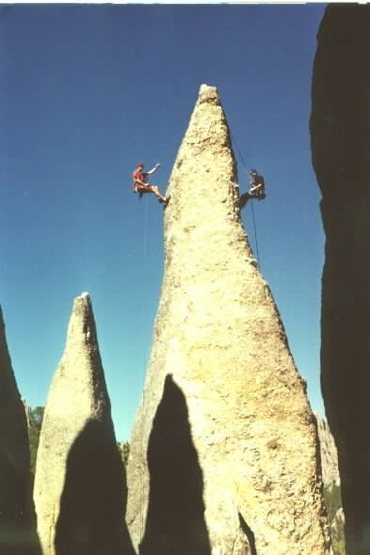
Brandon R wrote: Threading through what? I'm talking about short (single pitch) towers with no fixed anchor at all, or bolts with no rings/chains right in the middle and not set up to rap off of. Like I said, rare (but not unheard of - I've done it twice). I've always known this as a "Needles Rappel"
The Needles, S. Dakota
It's used all over the place.
Simul is pretty much your only viable option.
|
|
|
JCM
·
Nov 28, 2019
·
Unknown Hometown
· Joined Jun 2008
· Points: 115
Joe Crawford wrote: Grigri is a fine device for rappelling a single strand. It is definitely safer for single strand raps than a tube with no backup. However it is not redundant, if the cam fails there is no backup. Obviously it is quite unlikely that the cam fails, but stranger things have happened.
Yes, stranger things have happened, but has this specific strange things happened? Do you know of any instances of someone losing control of the rope while rapelling with a GriGri? I have never heard that specific failure mode actually occurring. I'm not refering to failing to set it up correctly (that has happened and caused accidents) I'm not refering to not knotting the end and then rapping off the end (that has happened, way too many times) I'm not referring to dropping someone while belaying (different use case)
I'm not referring to the GriGri failing to catch while rope soloing (different use case)
Rather, the case in question is whether an experienced climber has set up the GriGri correctly, knotted the end of the rope, and then somehow had the GriGri fail on them while rapping?
|
|
|
Anson __
·
Nov 28, 2019
·
Unknown Hometown
· Joined Nov 2019
· Points: 0
L Kap wrote: How is it possible for one climber to fall to the knot at the end of their rope and the other to only fall half that distance if the two people are tethered together by a sling?
I believe the idea of the tether is that if one partner loses control, their weight will fall onto the other climber due to the sling, and this provides an opportunity for the falling climber to be caught and regain control . The tethered partner would have to also lose control of their belay device, or their belay device would have to fail, for the fall to continue.
Because one person is a counterweight for the other? If my partner looses control of the rope, they fall to the knot and my weight pulls about half of that slack through to my side of the rope. If they're attached to me and loose control of the rope, I now have no counterweight. My weight pulls the rope through the anchor until the knot hits their belay device.
Same thing, same fall distances. I guess maybe the sling means we only fall as fast as the friction of the rope through the anchor allows? But that doesn't seem like a significant difference
|

 Continue with onX Maps
 Sign in with Facebook