Continue with onX Maps
 Sign in with Facebook






Giga Jul Initial Impressions


|
|
Chris Cragsocks wrote: $10 shipped? |

|
rgold wrote: Kevin, could you please post sources for these results? Also, could you define "redirected belay plate?" Thanks! Rich, Kevin is referencing some testing at the Petzl Technical Institute at the AMGA annual meeting last month. There are no published results as these tests were informal and conducted during some instructional clinics. The test is question was using the Megajul (as opposed to Gigajul, I believe, at least that's what I recall discussing with the individual running that clinic) directly on the fixed point in ABD mode, with the premise that the ABD might engage in the FF2 fall case. It did not, and frequently caused significant rope damage, in addition to the increased forces on the anchor (and therefore leader). |
|
|
Derek DeBruin wrote: How did it cause rope damage and increase forces if it did not engage? DAV test: A FF2 (or 1.77, not sure) fall held with a grigri on a fixed point will result in less than 7KN on the anchor point and no rope damage. |

|
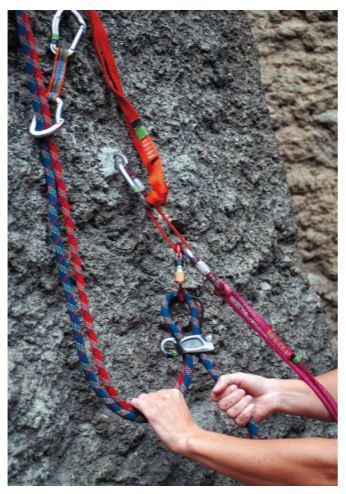
rgold wrote: Kevin, could you please post sources for these results? Also, could you define "redirected belay plate?" Thanks! https://cdn2.apstatic.com/forum/107355.jpg This is a Redirected plate off the belay. |
|
|
Fran M wrote: I think they mean when it does lock up it damages the rope .Never having seen or tested a Gigajul but most of the others I'll have speculate that IF Edelrid did (as claimed) increase the woeful braking force of the Megajul when they changed to the Gigajul I can well believe it shreds the rope at high forces, the CT Up series certainly do. The Grigri doesn't. The new Smarts look like they will do as well. The certification test for the Gigajul would not detect this as the rope cannot move in the device. |
|
|
Matt N wrote: From what I've read and experienced first-hand, the Smart is smoother in guide mode vs an ATC. Yes, rope biner outside of the device vs inside. Used it for 3 years. Sometimes I'll put my ATC guide up just to give it some usage as well. |
|
|
Chris Cragsocks wrote: Weird. My smart is much smoother, especially with fatter ropes vs ATC guide. |
|
|
Derek DeBruin wrote: Things like this convince me that the only good reason to put any kind of belay device, as opposed to the Munter hitch, on an anchor to belay the leader is because you want to use half-rope technique. The belay plate workarounds can be awkward in terms of rope management and some, like the "redirected" version posted by Kevin above, are notably worse than Munter hitch usage in terms of load intensity and distribution. |
|
|
Fran M wrote: This is interesting to hear - what is the reason behind this? I was taught to simply do a munter using both rope strands on the same carabiner (if not using an ATC). I'm also pretty sure this technique was following the Swiss Alpine Club guidelines (although I don't have a copy of Bergsport Sommer at hand to check). |
|
|
Helge L wrote: You were taught for twin rope technique. Half rope technique requires the belayer to sometimes pay out one strand while taking in the other, and this isn't possible with a single Munter formed from both strands. |
|
|
sorry, but wasn't much of the reason Edelrid developed a plaquette that could run in either "regular" or ABD mode, to allow a belayer to rig the thing directly on the anchor in "regular" mode? much of the pre-launch info on the Giga had to do with having the versatility to direct-belay with it when NOT in ABD mode....."testing" a tool (how many actual "tests" were run, Derek, do you know?) in a way that it wasn't meant for strikes me as particularly fraught. |
|
|
Helge L wrote: The Italian Alpine Club (CAI) found that on a single munter, when only one half rope was taking the load, the non-loaded rope was getting damaged by the running rope. |
|
|
Jim Titt wrote: Yes, this. Sorry for the lack of clarity the first time. |
|
|
rgold wrote: I tend to agree with you. But there are definitely folks in the AMGA who really like the ATC option. |
|
|
coppolillo wrote: sorry, but wasn't much of the reason Edelrid developed a plaquette that could run in either "regular" or ABD mode, to allow a belayer to rig the thing directly on the anchor in "regular" mode? much of the pre-launch info on the Giga had to do with having the versatility to direct-belay with it when NOT in ABD mode....."testing" a tool (how many actual "tests" were run, Derek, do you know?) in a way that it wasn't meant for strikes me as particularly fraught. Co-opting ABDs for off-label use has been something of an open question. As far as I know, at the time when the CAI was first testing the fixed point, it was late 90s, so that meant munter, atc, figure 8, and grigri. Jul, Smart, Pilot, etc. didn't exist yet. So how they might perform with a fixed point was a bit unknown. I know Jesse Williams and I discussed it a few times, Chris Burk asked about it, I think I had a conversation with Dale Remsberg about it, etc. I specifically spoke with Andrew Councell about it this year as he's been using it regularly in Squamish; he ran the clinic and was the one I'd heard about the results from, so you might reach out to him directly for more details. |
|
|
Fran M wrote: Definitely believe that. Just saw a white paper with tears from a couple months ago regarding this with parallel rope technique (used in guiding; two single ropes, but leader only belayed on one of them). That seemed to indicate that except for the most extraordinarily tangled messes of rope, the parallel rope system didn't significantly damage ropes in any manner that would recommend against using it with ropes clipped as twins. Not sure if there's a public link to that paper or not. |
|
|
DDB, ACouncell was using an ABD during direct belaying, or just a regular plaquette? |
|
|
coppolillo wrote: DDB, ACouncell was using an ABD during direct belaying, or just a regular plaquette? My understanding is that it was in ABD mode. I agree, the sample sizes are small, and this was not a formal study by any means. I also think that it is a useful exercise to consider what data we do have, however limited. In this case, the tests also seem to confirm what the manufacturer states: don't do that. Bigger picture, I certainly can't control the zeitgeist or the narrative that grows out of it, but I think I do try to express a healthy skepticism. See above for phrases such as "seemed to indicate," etc. |
|
|
A problem with belay-device experience is it is massively skewed towards low-impact events which just about anything will handle competently. I've climbed 63+ years and caught two factor-two falls in all that time. I have friends who, in their day, were among the leading climbers in the country who have never had to catch a factor 2 fall or anything close to it. The role of testing is to get some insight into those rare worst-case scenarios, the ones many people never experience, but which, if they happen, might be catastrophic without effective device performance. The trouble with "experience" in evaluating such results is that it tends to make people discount the findings as "unrealistic," which is, in my opinion, an unfortunate substitute for "rare." |
|
|
Derek DeBruin wrote: 4 or 5 fall factor 2 drops on the same piece of rope? If so I am not on the least bit surprised or concerned. |