
 Continue with onX Maps
 Sign in with Facebook






Name of this deciduous (not a protected pitch pine!) tree in Peterskill, NY


|
|
I am almost certain that is a Red Oak (Quercus rubra). |

|
Photos of the leaves up close would be a dead give away. I don’t think it’s an oak either. It could be but the original post said smooth margins on the leaves. So probably not an oak |

|
If you want a solid ID in the future, make sure to take a photo of the leaves, bark, and buds on the twigs. These will all be incredibly helpful. |
|
|
Nathan Flaim wrote: We need better pictures. I demand the OP return to the sight at first light to supply more definitive optical fodder. The OP can't wait for an opportunity to go back to that anchor, and post great pictures of the habit of the tree, canopy, leaves, buds, stems, bark, possible fruit, and other. In the meantime, some of us seem to enjoy the ID challenge! |
|
|
Ash trees are opposite leaves not adjacent. Not oak or sassafrass unless it was a willow oak but leaves look too wide. Guessing a hickory or elm |
|
|
Gene O Desideraggio wrote: Thanks for the challenge! I have narrowed it down to either pignut hickory, Carya glabra, or mockernut hickory, Carya tomentosa. Both are found in upland environments in your region. They match the original description of an alternate branching tree with rounded leaves. It’s definitely no kind of oak, based on the leaves and bark furrows. Elms wouldn’t be found in this setting, and ashes would have opposite branching, and likely wouldn’t be found with such shallow upland soils. Although hickories have compound leaves and the OP said this tree’s leaves “seem simple” I think that based on the growth form of the branch seen in the second photo and the sparseness of leaves on the branch that it does have compound leaves, they are just missing some on that branch. Fantastic answer. I promise to go up therw soon, and snap more pics! |
|
|
m Mobes wrote: Hey m Mobes, I didn't mean to offend anyone, sorry if it sounded that way! I was just expressing my surprise and then asking what I thought to be an important clarifying question. I'm happy to see that through collective deductive reasoning, something closer to an answer has been identified! Cheers, and happy ID-ing! |
|
|
Nathan Flaim wrote: Sassafras. If the leaves near the top of the photo belong to the tree in question. Definitely not sassafras, of those leaves near the top are from the right tree. Pretty sure it's not oak either (though the bark does look like it). My best guess for matching those leaves to that bark is some type of Elm. |
|
|
What climb is this at the top of? I might be out there tomorrow so I could just go look. |
|
|
David K wrote: What climb is this at the top of? I might be out there tomorrow so I could just go look. It's at the top of the Reach Around Wall looking straight with the right side of your body on the cliff side at 10 o'clock past the bolted anchors. The picture is of the wall... Naturally the tree is at the top, so not visible on this pic: 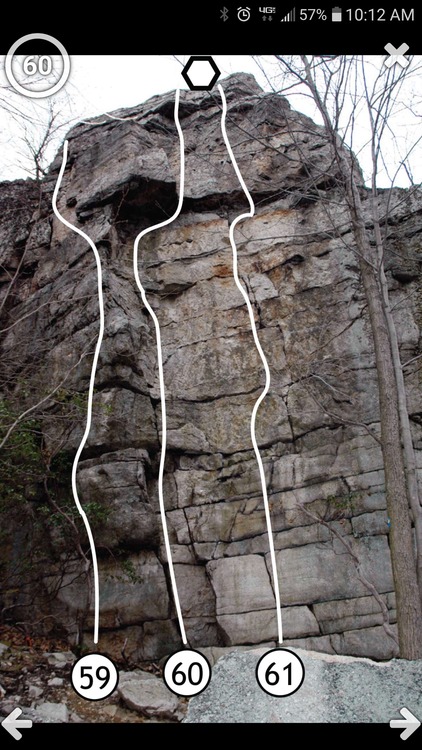 |
|
|
The suspense is killing me. |
|
|
My money's on it being a chestnut oak. They are the dominant small hardwood up there. |
|
|
Gunkiemike wrote: My money's on it being a chestnut oak. They are the dominant small hardwood up there. Yep, that’s what I thought too. I’ll be up there later this week and may have to do some sleuthing as well:) As an aside, if anyone uses the app iNaturalist it’s pretty amazing for IDing species through crowdsourcing. Each observation/ID is geolocated so you can look at a map of where you are and see what species (plant, vertebrates, invertebrates) have been observed nearby and see pics. You can also post a pic of something, choose the general category it might exist in (i.e. “trees”), and let others confirm a more detailed ID. Pretty fun |
|
|
Toni Parellada wrote: I led Reach Around and took a bunch of whips for head game practice earlier in the day you originally posted this question--it's a shame you didn't post a bit earlier! I'll probably be up there sometime this week, though. |
|
|
Jennie Matkov wrote: I posted a good number of pictures... Maybe ironwood tree? |
|
|
Gunkiemike wrote: My money's on it being a chestnut oak. They are the dominant small hardwood up there. I took many more pictures. The tree is pretty much meatless, and I didn't see any fruit. I tend to think that it may be an ironwood. |
|
|
Jay Sullivan wrote: It is an old serviceberry (Amelanchier spp.) I think you nailed it! Thank you! |
|
|
Jay Sullivan wrote: I just like this stuff, and I met my climbing partner in dendrology class (several decades ago). You know, I don't remember the leaves being pubescent, but it's probably because it is an old tree - I'm still alive, though! |
|
|
I find this sentence here quite interesting: |
|
|
Toni Parellada wrote: And from what I read, they tend to have an extensive root system, which I guess they need to grow on rocky cliffs... |


