
 Continue with onX Maps
 Sign in with Facebook






Yates Screamers, obsolete or niche?



|
So when the screamer rips in ice, it can help cause the screw placement to fail? The ice breaks more than otherwise? |
|
|
Crewdog your younger than me seeing u can hyper link posts and read this dumb shit did u want to sell mell me 2 new screamers for 20 buckaroo's?? |
|
|
Ehhhhh hope this goes 6 pages |
|
|
Let's apply rgold logic to other safety devices: You can find internet testimony about skull fractures that would certainly have occurred didn't because of an air bag. No one making these claims went back and had the same accident without the air bag, so the claims are about as meaningful as saying the rabbit's foot you carried for good luck kept your skull from impacting the windshield. (Well, not exactly the same; we know the air bag might do something...) If you look a little more carefully, you'll also find accounts of fractured skulls and airbags. Yeah, I know, the plural of anecdote is not data. |
|
|
Sloppy Second wrote: Let's apply rgold logic to other safety devices: The only thing the "rgold logic" says is that you can't ascribe an effect to a treatment if you never test without the treatment. Airbags haven't been tested by anecdote but rather by all kinds of sophisticated crash dummy tests. And although I have no personal knowledge of this, I assume the test results are published so that other engineers can read the results, criticize the tests if they see problems, and then try to replicate the results. The end result of that extensive process is why we "know" air bags reduce the incidence of "skull fractures." It is not because a few people in accidents who didn't get skull fractures claim they would have had skull fractures without the air bag. And It isn't because the guy who invented the air bag gave figures that no one with any technical expertise believes and which never have come anywhere close to being replicated. And it isn't becuase the airbags were tested in some set up that was not well related to what happens in actual car crashes. |
|
|
Sorry rgold, that last run on sentence made my head hurt like I got my bell rung or some thing, but point taken. |
|
|
Sorry Roy. I edited it but ended up making it longer, so perhaps the migrane effect remains the same. |
|
|
rgold wrote: If someone was in a car accident and said "the airbag saved my life" you'd be the guy saying "well you have to go back and have the same accident to be sure the airbag made a difference..." |
|
|
I use them on ice ... Usually on first 2 - 3 ice screws.. Never used them on the rock - to be honest never even seen someone using them on the rock :) |
|
|
I’ll attempt to answer the above questions. |
|
|
Sloppy Second wrote: Well of course I wouldn't say anything like that to an accident victim! And he doesn't have to go back and repeat the crash, precisely because we know from all the real testing that the airbags probably did save his life, and that's what gives him the ability to make that claim. That said, we don't actually know whether the airbag saved his life or not, do we? Anecdotes from climbers aren't necessarily the best data, we do have the CAI tests for example, the only tests I know of that put a human belayer at the end of the rope rather than tying it to a totally rigid anchor. We have Mark's tests on vibrating out ice screws. (Mark, the I posted the graph you recall upthread here , and then Jim posted further results here.) The DAV also has the resources to do good testing, as does ENSA. No one seems particularly interested, perhaps because the sense from most of those experienced climbers is a resounding "meh." If multiple experienced climbers report positive experiences with a type of gear, I respect the information they bring to the conversation. I respect the climber, I respect their sincerity, but I don't feel obligated to agree with their conclusions. |
|
|
RGold - agree that there is little interest today. I lost mine about 15 years ago.... |
|
|
I am curious if the load reducers used on via ferrata rigs are different than a screamer, and how this discussion would affect the accepted practice of their use in that situation. Edit: Failed anchors in a Via Ferrata shouldn’t be an issue but with no rope in the system the question then becomes is there enough of a load reduction to prevent injury to the climber. |
|
|
I’ve never bothered to look into the via ferrata rigs, but my vague understanding is that they (or most of em) work on a friction principle similar to belay devices. This would be very smooth action (no ripping stitches). Plus, the cable systems on via ferratas would essentially be immune to failure by vibration effects so no worries anyway. |
|
|
Take a big whip on one and post the video. |
|
|
Mark Pilate wrote: I’ve never bothered to look into the via ferrata rigs, but my vague understanding is that they (or most of em) work on a friction principle similar to belay devices. This would be very smooth action (no ripping stitches). Plus, the cable systems on via ferratas would essentially be immune to failure by vibration effects so no worries anyway.http://www.youtube.com/watch?v=mvigA51z4R4 There are different types of lanyards but some do work with a similar mechanism as a screamer. |
|
|
rgold wrote: High load rates occur at high-fall-factor, short falls. I expect differences between results due to a constant pull rate on a tensile tester and loading produced by a springy rope; in the latter, the load rate will be dominated by the spring-constant of the rope (and fall geometry) rather than the spring-constant of the screamer. |
|
|
RGold’s analysis from early in this thread is pretty good. Include the friction of the rope as it runs over the carabiner as the screamer deploys, and you’ll get a reasonable energy absorption for a reasonable climber mass. His conclusion that there is a limited window of screamer utility in terms of fall distance and climber weight is correct. In the event of long falls—especially with massive climbers—there will be negligible reduction of forces or perhaps slight increases in the force on the top anchor. Excel spreadsheet calculations of the ratio of force with screamer-like device to force without device (80 kg mass, no energy transferred to the belay) look something like this: 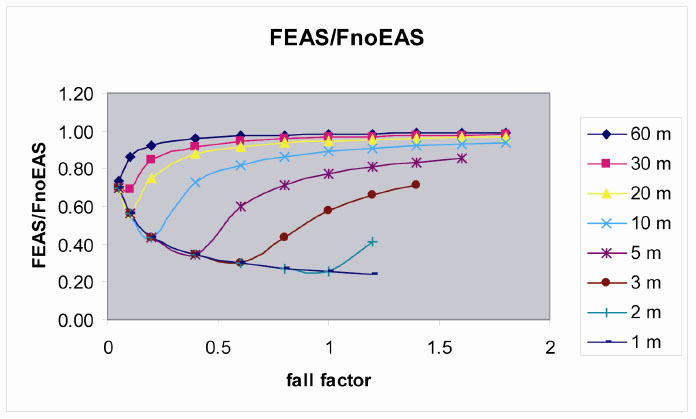 Anecdote has it that John Bouchard demonstrated the utility of the Wild Things predecessor of the screamer (can someone refresh my memory, what was it called?) by tossing climber-like masses from the railroad trestle at Frankenstein. With the proto-screamer, the 6 mm (?) cord held, but without the proto-screamer, the cord failed. Again, short, high-fall-factor situation. 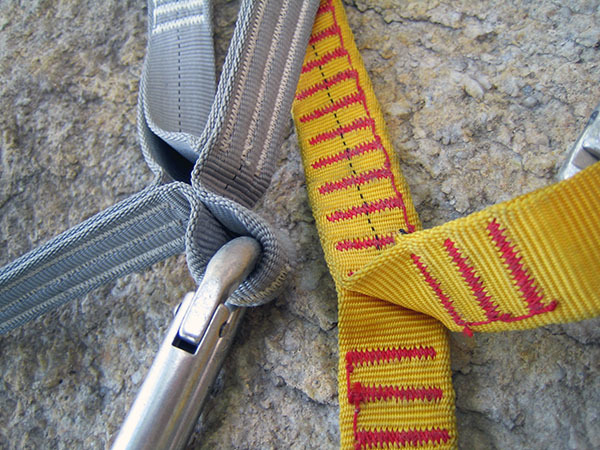 ("modern" Yates screamer on left; old Wild Things screamer on the right) The stitching pattern on the Wild Things proto-screamer had the side effect of nicely coupling with the carabiner gate oscillation frequency, resulting in broken carabiners, a problem that was fixed by using locking carabiners. Modern screamer-like devices have improved stitching that produces less vibration at higher frequencies. That said, Mark Pilate’s thoughts on vibration deserve further investigation (does anyone have data on oscillatory, compressive loading of ice?), and locking carabiners might still be in order. Modern Screamers/Nitros are limited in the breaking force by the amount of stitching that can be crowded onto a sling that a climber would be willing to carry (1” webbing +/-). Which is a shame, because if that force could be increased by a factor of two or three, such devices might have more utility. A sorry semblance of “data” can be scrutinized for insight in this image. 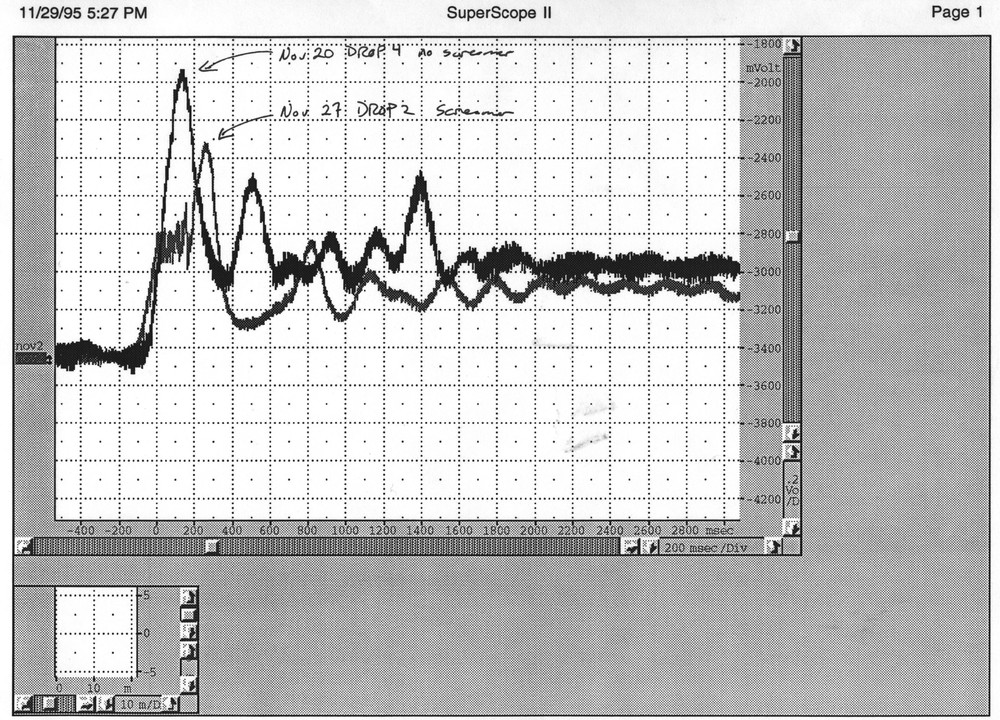 Details aside, the data show peak force can be reduced when a screamer-like device is employed; as RGold predicts, some advantage is seen for a short fall. Perhaps as important as force reduction, the time to peak force is extended, which is of some importance for ice climbers because the strength of ice is (slightly) dependent on the loading rate: lower loading rate (jerk) results in (slightly) stronger ice. Modern screamer-like devices have the potential to be useful for ice climbers in short-fall, large-fall-factor situations. My GUESS is that this time-prolonging phenomenon will be more beneficial than screamer induced vibration is detrimental. Me personally, I own a pair of screamers to use ice climbing on the first anchors above a belay stance, but I don’t carry them very often on account of the bulk. I’m confident that skinny (and/or half) ropes and belaying are effective at reducing both force and load rate. Judicious choice of belay stance can insure that the likelihood of a short, high-fall-factor fall is tiny. If the belay stance MUST be just below the crux of an ice climb, it is possible to lead beyond the belay stance, place reasonably good gear (yes, I know this must effectively be an anchor placement), clip the rope(s) to the good gear, and down-climb to the convenient belay stance, thus reducing the fall distance and fall-factor of any shenanigans that occur when leading out of the belay stance. Oh; and don’t ice climb when it is cold; colder temperatures have the same effect as higher load rates. Similar trickery in terms of skinny ropes and belay stance choice can often be employed in the event of sketchy rock/pro, though the temperature has little effect on the strength of rock or metal. |
|
|
The paper to read on why screamers have higher forces when the fall is larger is this;- https://www.google.com/url?sa=t&rct=j&q=&esrc=s&source=web&cd=1&ved=2ahUKEwijz7Sdo5njAhXE16QKHRqZApgQFjAAegQIAhAC&url=http%3A%2F%2Fciteseerx.ist.psu.edu%2Fviewdoc%2Fdownload%3Fdoi%3D10.1.1.473.7055%26rep%3Drep1%26type%3Dpdf&usg=AOvVaw3eVQhFmoHtej6vPfKNHRb_ |
|
|
There is good information on the effectiveness of screamers at RopeLab in two members-only (non-free) articles: |


