
 Continue with onX Maps
 Sign in with Facebook






Is this rope core shot?


|
|
Your ropes fine. If you are nervous and/or are climbing on sharp rock and hangdogging, replace it for leading and use this one for top roping. The thing that causes ropes to fail (with very few exceptions although there are exceoptions) is battery acid. If you toss it in the back of your trunk sans rope bag, or down on the ground when you get back to the car, you're asking to bad juju. |
|
|
Mikey Wally wrote: I for one would be very interested to see a rope that had core damage but an intact sheath. Baring manufacturing defect what is the mechanism for such a thing? |


|
Mikey Wally wrote: Are you saying that the core had separated or been cut but the sheath was still intact? I don't see how the core could become damaged in that way without simultaneously damaging the sheath, and to be completely honest, I've never heard of a rope failing in that way or that occurring before you mentioning it in this thread. The concern, and how it's always been communicated to me, is that when the core becomes soft it flattens out more when pulled over sharp edges, which makes it more susceptible to being severed in the event of a fall, but I admit that I could be misunderstanding or misinformed. |
|
|
Mikey Wally wrote: Correct. Like HB, I'd like to see a documented case of this kind of damage.
Yep. Soft spot, damaged area, flattened spot. But definitely not core shot. |
|
|
Mikey Wally wrote: I'd like to see what they look like? There may be some sort of stretching of the core under pressure then it stays elongated (we know a rope that has been fallen on many times loses elasticity) so the core would possibly not feel as "tight" as it did before? But there is no significant loss of strength for our purposes as the rope cannot be broken by a falling human...but, impact forces are going up afaik. |
|
|
I've been seeing comments regarding a core shot being said, only when the sheath reveals a flawed core. Newbs seeing this could spell danger--the takeaway being that if you can't see the core, the whole rope is fine. Tactile feel/inspection is something I learned in SPRAT/IRATA training, in which you slide your hand along the rope, and stop and focus on suspect spots, to feel for flaws that the sheath may hide. The core is built very tightly, and loosens up with use. Very normal! Traumatic blows to certain spots (watch those edges!) can loosen the core fibers underneath the sheath. I've wondered if the sheath is strong enough to withstand the remainder of the climb to at least get you back down. I've whipped on a rope to the point that I had a few people gathered around me and my rope at the gym, gasping at how soft my rope felt! 9.2 Volta, I loved that rope! And all my friends did, too! I retired that rope that day lol! I will continue to refer to a soft, flat (when pinching a bight), or fat spot with or without sheath as a core shot. |
|
|
Paul Hutton wrote: I will continue to refer to a soft, flat (when pinching a bight), or fat spot with or without sheath as a core shot. And like Mikey, you're redefining a well understood term, and no one will know what you're talking about. |
|
|
What I'm reading here is a semantics difference. A "core shot" is similar to a photography term such as, in climbing, a "butt shot." The core is showing, so you are seeing a core shot. Which is different than, "the core is shot."
|
|
|
FrankPS wrote: The core is showing, so you are seeing a core shot. Which is different than, "the core is shot." Thank you. |
|
|
Mikey Wally wrote: so core shot is purely a term for the core being visible? Yes. |
|
|
This whole thread is LOL |
|
|
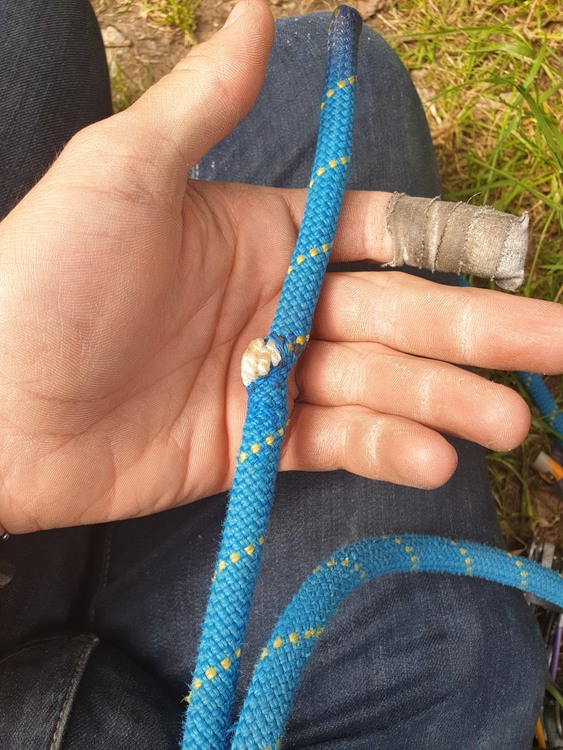 core shot |
|
|
FrankPS wrote: So what term constitutes a core shot that's covered by sheath? |
|
|
Paul Hutton wrote: There is no such thing as "a core shot that's covered by sheath". Asked and answered up-thread. |
|
|
Nathan Anderson wrote: Could somebody speak to this? I've got a similar situation where the rope is abraded, but is bends just fine with a nice gap still. I know the rope is still good to use and whip on, and I will continue to do so, but I'm curious about the slightly softer spot. Is that just from the sheath being a bit looser from some of the sheath threads being torn, and so not keeping everything as tight? Could it signify early stages of damage to core strands? Not sure if it matters, but mine is a unicore construction. |
|
|
Garrett Collier wrote: Is that just from the sheath being a bit looser from some of the sheath threads being torn, and so not keeping everything as tight? Yes. |
|
|
Likely OK. I noticed that new ropes' sheath is less stuck with core filaments and it is easier to bend the rope especially after the minor damage to the sheath. I have a similar problem and will eventually "operate" my rope to see what's really happening inside. |
|
|
Ivanchenko Vladimirwrote: Helpful to know 5 years later. |
|
|
Robert Swrote: That’s the great thing about MP. Good information is timeless. Some of us wait our entire lives and still don’t get the right answer! lol |
|
|
Mark Pilatewrote: Indeed. OP could have just gone out and whipped on a dangerously damaged rope (nb. not like the one in the photo) and, yup, it would be the rest of his (tragically shortened) life without a proper answer. |


