|
|
Brocky
·
Apr 7, 2019
·
Unknown Hometown
· Joined Jun 2016
· Points: 0
Sorry, was thinking top rope when I posted.
|
|
|
Sam Skovgaard
·
Apr 7, 2019
·
Port Angeles, WA
· Joined Oct 2017
· Points: 208
Brocky wrote: Sorry, was thinking top rope when I posted. Gotcha. Such an energy absorber would be unnecessary for top rope solo because... well... it's toprope. A toprope solo "fall" is really just sagging down onto the rope. For lead rope solo, that setup is entirely too much faff at your harness.
|
|
|
Sam Skovgaard
·
Apr 8, 2019
·
Port Angeles, WA
· Joined Oct 2017
· Points: 208
Chris Williams wrote: Greg, I would never clove hitch any pieces. Why do you do that? The reason why I would not do that, is that you are taking dynamic rope out of the system, and therefore giving yourself a much harder catch when you fall on the clove hitched gear. Or did I misunderstand what you are doing? After building a trad ground anchor, I will clove to the first piece to pre-tension the ground anchor for upward pull. Otherwise there tends to be a lot of slack piled up on the ground. I also like the idea of a fall coming onto a pre-tensioned/equalized ground anchor than the rope whipping and flicking wildly as it comes tight. For sport climbing, I use the first two bolts to make my ground anchor. I tie the end of the rope into the first bolt with a locker, then clove into the second bolt using a quickdraw with two lockers, putting tension in the strand between the two bolts. This keeps the lower locker properly aligned and tensioned on the hanger, otherwise it's easy for it to get cross-loaded/nose-loaded as it pulls upward on hanger.
I wouldn't clove into the third piece/bolt.
|
|
|
Sam Skovgaard
·
Apr 8, 2019
·
Port Angeles, WA
· Joined Oct 2017
· Points: 208
I've actually had a foot blow and taken a fall onto a clove hitched bolt from slightly above it. The fall was probably around 5 or 6 feet, but high fall factor. Was it a little harsh? Yes. But there was no death, no serious injury, and no injury at all. A black hole didn't open up, the world didn't come to an end. Dynamic climbing rope is a wonderfully effective piece of equipment. I agree with you that high fall factors are to be avoided, and your system appears very effective at reducing their impact. If taking the time setting up your system seems worth it to you, then by all means, go for it!
|
|
|
Tradiban
·
Apr 8, 2019
·
Unknown Hometown
· Joined Apr 2004
· Points: 11,610
Chris Williams wrote:I’ll emphasise my point by using a term that we are all familiar with – fall factor.
By putting a clove hitch at the first piece of gear or bolt, in contrast to my system, you are moving from a fall factor of probably less than 1 (in my system) to a fall factor of TWO (in your system). I can’t think of a situation involving ropes in which I would want to do that...save for the only other option being death or serious injury. Waaaay overwrought.
|
|
|
Chris Williams
·
Jun 24, 2019
·
Brisbane, Queensland, AU
· Joined Apr 2019
· Points: 0
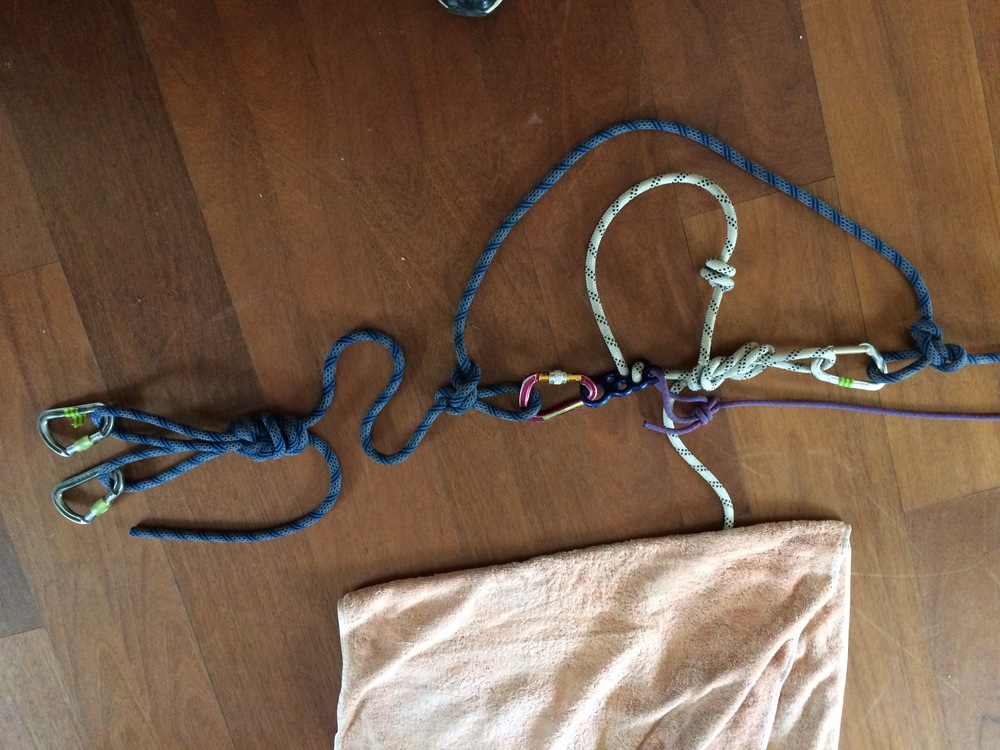
Thanks to whoever it was up thread, who suggested using a short length of rope to feedthrough the Kong, to avoid glazing of the dynamic rope. In the photo: off to the left, a bunny years with two carabiners to the ground anchor; off to the far right, dynamic going up to the first piece of gear and the climber (using silent partner), and the thin piece of blue cord is the tensioning for that I have described much further up thread; in the middle, blue dynamic with two Alpine butterflies to ensure redundancy, with the white static going through the Kong . For the static I would use dynamic, but I didn’t have a short piece of it for this photo. you can see that I’ve got about 30 cm/12“ of static with a stopper knot in the end, to feedthrough the Kong to absorb the fall. Comments appreciated.
|
|
|
Tradiban
·
Jun 25, 2019
·
Unknown Hometown
· Joined Apr 2004
· Points: 11,610
Chris Williams wrote: Thanks to whoever it was up thread, who suggested using a short length of rope to feedthrough the Kong, to avoid glazing of the dynamic rope. In the photo: off to the left, a bunny years with two carabiners to the ground anchor; off to the far right, dynamic going up to the first piece of gear and the climber (using silent partner), and the thin piece of blue cord is the tensioning for that I have described much further up thread; in the middle, blue dynamic with two Alpine butterflies to ensure redundancy, with the white static going through the Kong . For the static I would use dynamic, but I didn’t have a short piece of it for this photo. you can see that I’ve got about 30 cm/12“ of static with a stopper knot in the end, to feedthrough the Kong to absorb the fall. Comments appreciated. Cute, but totally unnecessary. A dynamic rope is a shock absorber.
|
|
|
Chris Williams
·
Jun 25, 2019
·
Brisbane, Queensland, AU
· Joined Apr 2019
· Points: 0
Tradiban wrote: Cute, but totally unnecessary. A dynamic rope is a shock absorber. I’m glad to see you haven’t broken your foot yet. I need the comfort factor for peace of mind. Or maybe I just need to not be a crap climber.
|
|
|
Darin Berdinka
·
Jun 25, 2019
·
Unknown Hometown
· Joined May 2009
· Points: 654
Your rope is your shock absorber. This just increases the clusterfuckery and extends your falls even further. I’ve whipped plenty on both free and aid pitches including some less than perfect anchors and it all works out fine. Consider clove hitching your rope to the first piece of pro using a screamer. This has two advantages 1) keep your anchor biners all aligned and 2) a factor 2 fall onto the first piece will actually decrease the force on that piece vs a slightly-less-than factor 2 fall that might otherwise happen. And place lots of gear off the anchor. FWIW I once fell onto my first clove hitched piece of gear on an aid climb when the second piece blew. Felt fine and only partially blew the screamer.
|
|
|
Tradiban
·
Jun 25, 2019
·
Unknown Hometown
· Joined Apr 2004
· Points: 11,610
Chris Williams wrote: I’m glad to see you haven’t broken your foot yet. I need the comfort factor for peace of mind. Or maybe I just need to not be a crap climber. Braj, I am the OG SP whipmaster. https://vimeo.com/9988058
|
|
|
J A
·
Jun 25, 2019
·
Unknown Hometown
· Joined Jun 2006
· Points: 45
Just curious – is the Tradiban thing an ongoing part of any and all threads now? Is he like the drunk, socially inept uncle at the wedding who barges into every single conversation and continually makes an ass of himself?
On topic – the rope is dynamic, but unless you have a lot of rope out, not anywhere near like getting a soft catch from a live belayer. I have done a lot of lead rope soling and while I have avoided taking many lead falls, I did take one on a sport route that I thought I could manage and because there was only about 25 feet of rope out, the fall from just a couple of feet above the bolt resulted in my slamming my knees into the wall and now I have ongoing knee problems 12 years later in my left knee which took all the force of the impact. If I had had a live belayer, I am sure that just a little bit of the natural give would have made that a much better fall, even if the belayer had not been practiced at giving soft catches. Anyway, incorporating some sort of dynamism into the system so that you don't have such a hard catch is a real issue for these sorts of falls – a dynamic rope really isn't adequate for that by itself if you don't have a lot of rope out. I have tried putting a screamer into the system (at the anchor) as a shock absorber, but I have never taken a hard fall on it. I like some of the suggestions mentioned above, but I think that it might be worthwhile to keep in mind that all rope-solo lead falls can have more serious consequences that those with a live belayer. Anyone saying that rope solo lead falls with not much rope out (maybe less than 30 feet) onto a hard connection with an anchor are going to be fine and nothing to worry about because the rope is dynamic is someone who hasn't actually taken lead falls in such situations.
|
|
|
Chris Williams
·
Jun 25, 2019
·
Brisbane, Queensland, AU
· Joined Apr 2019
· Points: 0
Thanks Darin. I guess there are old climbers or bold climbers. I most certainly am not a bold climber; and age is starting to weary me and the years condemn. For the unitiated, I agree that my system does look like a cluster stuff. However, it is permanently set up (I just loosen the knots at the end of each day); the extra weight that I carry amounts to 2 carabiners and a Kong (2/10 of stuff all), plus about a 1-2 m of dynamic (another 2/10 of stuff all); It has redundancy; it assures me of a soft catch when I need it most (at the first and second pieces of gear); the tensioning cord is permanently tensioned, so that after deployment of the Kong, cross loading of biners in the system is impossible...meaning that if I fall higher up on the pitch (and therefore have a lot more dynamic rope in the system), I can confidently choose to climb on knowing that no biners are cross loaded. I have broken the gate of a locking steel carabiner due to cross loading, and I have also broken a foot on a high impact full. The system that I’ve got pretty much guarantees neither of those things are going to happen ever again. But each to their own.
|
|
|
Brocky
·
Jun 26, 2019
·
Unknown Hometown
· Joined Jun 2016
· Points: 0
Hey Chris, make sure that you test the rope you decide on in the Kong Kisa, for the falls that might happen. This will let you know if you have the right diameter and the length of rope you will need. My first trial I used too large of a diameter rope, stepped off the ladder and got a jolt, it didn’t slide any through the device.
|
|
|
rockhard
·
Jun 26, 2019
·
Unknown Hometown
· Joined Jul 2010
· Points: 75
How about incorporating the metolius dynamic daisy? Anyone see one yet... wondering if it's like a bomber bungee
|

 Continue with onX Maps
 Sign in with Facebook