|
|
Sam Skovgaard
·
Feb 6, 2019
·
Port Angeles, WA
· Joined Oct 2017
· Points: 208
On Mt. Lemmon, there is an area called Amateur Hour Crag that has a known beehive on the route Senior Saga. I've really been wanting to do some routes in this area, but have been hesitant.
It's colder now, so my intuition tells me that the bees will be less active. I don't really know much about bees so I'm not sure if that's true. I'm not planning on climbing Senior Saga itself, but how close can you reasonably get to a hive without getting swarmed?
Also if anyone has any recent bee-beta related to Amateur Hour Crag, please share.
|
|
|
Kelley Gilleran
·
Feb 6, 2019
·
Meadow Vista
· Joined Sep 2012
· Points: 2,851
|
|
|
Roy Suggett
·
Feb 6, 2019
·
Unknown Hometown
· Joined Jul 2009
· Points: 9,350
I believe that the European Honey Bee needs at least 55* F to get out and about, as do many other wild species. Do not know about those African hybrids. You might call your local ag extension, they could make your foray less scary.
|
|
|
Peter Underwood
·
Feb 6, 2019
·
Tucson
· Joined Sep 2018
· Points: 226
Beekeeper here,
While it is true that honey bees don't actively forage for nectar and pollen until it is 50-55 degree air temp, they still can be quite active around the hive at temps lower than this. Honey bees cluster in their hive and keep the central aspect of cluster at least 70 degrees no matter the outside temperature, so, somebody is always warm enough to fly out of the hive. I recently moved to Tucson from Wisconsin and it could be 30 degrees outside and I could open colony and a bee could & would zip out and sting me (would very rarely open a hive at these temps as not kind to the bees to break their cluster). Both European and Africanized honey bees are similar in this respect. And because it is cold, almost all the bees will be in the colony so all the older guard honey bees will be home instead of out foraging, so the mean troops are there ready to deploy.
In fact, honey bees will depart from the colony in 30 degree air temps if sun is warming the entrance on their own accord for "elimination flights" (bathroom breaks, they don't like to go to the bathroom in the hive). This is often at their own demise as the departing honey bee will quickly lose flight ability and fall the the ground and freeze to death before it can make it back to the colony. But, if you are 10 feet away, you are fair game.
Previous poster is correct that you have to assume that any feral colony in southern Arizona is africanized and will act aggressively when disturbed.
Assuming that the colony is still viable (was as of at least March of this past year), I would avoid the climb and to some distance to each side of that climb.
I haven't been to this crag but it noted as being North West facing, so no doubt the bees are unlikely to be very active below about 45 degrees, but they can easily sense vibration in the rock from a climber and a couple guard bees could come out and sting you. If you are close enough to the hive entrance and there is even a glimmer of sun this could quickly turn dangerous.
How close is too close? Depends on temperature and temperament of the bees. But, when I am visiting an africanized colony I will suit up no closer than 30 feet from the hive. I have been standing 50 feet from a known africanized colony doing nothing and have been chased away (chased another couple hundred yards).
This is in contrast to known european honey bees that I kept in Wisconsin. I would walk up right behind the colony and look at the entrance of an active colony from 1 foot away with no protective gear and think nothing of it. I never wore gloves and sometimes would wear shorts or short sleeves when opening and inspecting fully active colony with 50,000 bees in it (still almost always wore a veil as stings by the eye or mouth are never any fun and accidents happen - usually my fault). In Tucson on the other hand I wear cowboy boots, full bee suit from ankle to head, and double gloves (unless I know from history that colony is pure european genetics and gentle history). Head netting is great, and I would certainly take a mosquito netting headcover like what I take camping if I had no other choice, but it isn't reliable protection - any part of that netting touches your skin and you will be stung (see video below, beekeeper veil stands away from all skin contact). And if you are being attacked I wouldn't waste the time putting it on unless I already had it out, I would just run and run and run.
I would give this climb a wide berth and I would not climb probably either of the 2 climbs to each side of it (depending on proximity). And I would put binoculars on the hive entrance to see if there was any activity and if any I might avoid the whole crag. If disturbed you could easily sustain hundreds of stings before you got back to the ground.
Here is a video of how persistent africanized bees can be from a beekeeper's maintained colony who I was helping out this fall This could have been a dangerous situation even suited up. In fact the colony owner sustained 15-20 stings fully suited up (found a way into his boot and up his leg).
https://youtu.be/gmeHOQlwC_Q
|
|
|
CTB
·
Feb 6, 2019
·
Cave Creek, AZ
· Joined Jul 2015
· Points: 300
Damn that video is terrifying!!! Were you guys standing outside the hive and yelling “yo queen is so fat....” jokes?
|
|
|
Peter Underwood
·
Feb 6, 2019
·
Tucson
· Joined Sep 2018
· Points: 226
CTB wrote: Damn that video is terrifying!!! Were you guys standing outside the hive and yelling “yo queen is so fat....” jokes? Actually we opened the colony for less than 2 minutes & just abandonded the inspection. We had to drive my truck with windows down & full suits on for 1/4 mile then get out & bees cleared. (We had done this before in previous effort to dispatch the queen & replace her with more gentle queen, but simply could not make headway to find the queen, in previous attempt they werent quite this irritated). We knew enough not to calling the queen any names, tho foul language was being used.
During that video was like lead climbing for me - there was a tinge of terror somewhere beneath that calm demeanor. I knew if they found an entryway into my suit i was in big doo doo. It was like trusting a marginal piece of gear. Great for confidence as long as you dont think about how precarious it might be :-)
|
|
|
Charles Vernon
·
Feb 7, 2019
·
Colorado megalopolis
· Joined Jan 2001
· Points: 2,754
Greg Opland wrote: I won't go full mp forum nutty, but it's nothing to take super lightly if you have concerns (or previous warnings by other climbers), considering we've had at least a couple instances where climbers have died as a result of bee attacks in Arizona. Couple things you can do to mitigate, seems like. Wear long sleeves and pants, bring a head net along (I've seen some SoAZ climbers that say they now have one in their pack at all times) just in case of attack, and pay close attention to bee activity in general, and if they start getting more inquisitive, or you see more activity/bees, then probably time to bail for the parking lot. Discretion is the better part of valor.
I can say one of the creepiest things I ever went through was doing some solo recon in the Superstitions one day and having an entire swarm pass over my head. From what I've read since, they're more interested in the moving of the hive rather than "defending" anything in that situation, but it sure put an interesting spin on the whole carefree "I'm out here by myself" thing. Shudder. Yep. Had a similar experience in the Supes when I was by myself 200 feet up Weaver's Needle. Most terrifying moments of my life. In addition to the climbers that died mentioned by Greg there have been numerous other incidents where climbers were hospitalized as well in the southwest. PS-Amateur Hour has some good climbing but not so great that you're missing out if you don't visit. There's probably enough to do even if you avoid the area around Senior Saga, though. The next routes to the left are around a corner and up the hill in an alcove reasonably far from the hive (wouldn't be a great place to be if the bees did decide to attack you, though, as it's sort of a box canyon with the only way out downhill past Senior Saga, but it seems unlikely they'd seek you out up there). In this pic it's the obvious alcove in the middle of the cliff: https://cdn-files.apstatic.com/climb/108641090_large_1494291690.jpg.
I actually climbed Senior Saga some years ago not realizing that there was a hive on it. Woke the bees up and they started bouncing off my helmet. I got out of there as fast as I could!
|
|
|
Peter Underwood
·
Feb 7, 2019
·
Tucson
· Joined Sep 2018
· Points: 226
The "reproductive swarm" as noted by Greg above is when honey bees (including africanized) are their most docile & very little to worry about as the swarm is traveling to new home. They have no home & no food stores or young to protect. So he is correct that he was safe. They are entirely focused on following scouts to the new home they have chosen - they would not be diverted to attack someone.
No doubt an intimidating sight & experience though as the swarm can be quite loud & large (usually 10k to 15k bees in the air). But, they are not aggressive. I have stood and watched hundreds of these swarms and not been stung (even stood in the middle of the tornado of bees with no gear on). But, to the uninitiated it is a scary experience and best to give them a wide birth.
If you were climbing next to a cavity that is emitting a swarm you may luck out and just watch it fly off, but you wouldn't be able to distinguish from a colony emitting a reproductive swarm and africanized bees sending out a firehose of bees to attack you,
The reproductive swarm It is a 2 stage affair. First the swarm of about 1/2 of the colony and the old queen leave the original hive (all at once essentially) in a tornado of bees (in the air they occupy the space of about the volume of a minivan or a bit larger and they fly as a group mostly at about a walking pace).
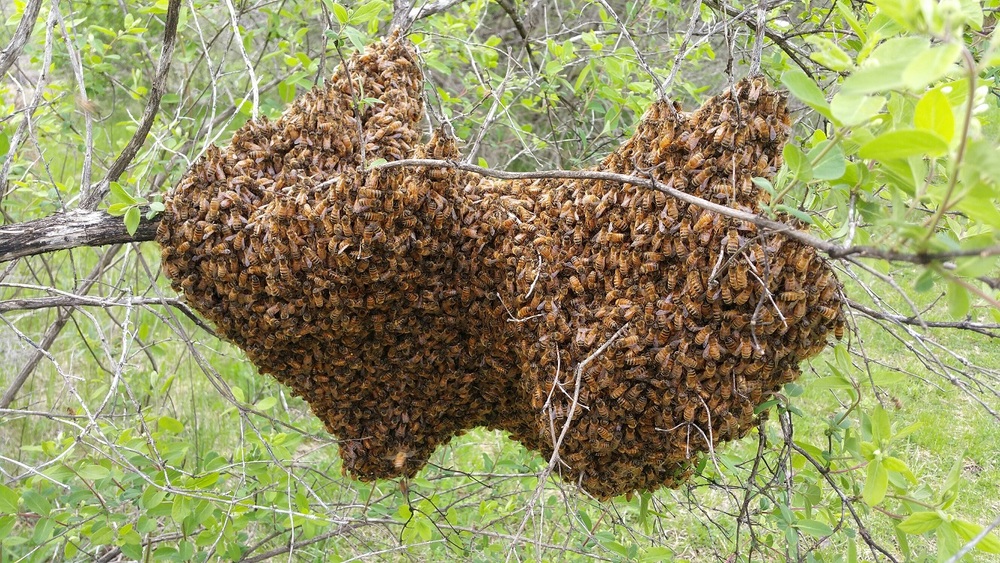
They are poor planners and have not found a new home yet, so they ALWAYS first land on some object about 50 to 100 feet from the parent hive. Usually this is a tree limb, but it could be anything from a boulder to a backpack - it is somewhat random where they land. It takes this swarm about 10 minutes to congregate on this branch or other place and they form a cluster of bees such as the picture below. They have no intention of staying in that place and they are quite docile while in this swarm cluster. They are also very quiet when they cluster like this so it isn't unheard of that you might walk right up to such a cluster and not know it is 2 feet away from you. But again, they are docile while in this cluster. I would approach this cluster to within a couple feet with no protective gear, but I wouldn't recommend it. If you bump the branch a big chunk of bees may fall off and even though they will be relatively docile, a lot of bees will be in the air and it is possible to get stung by mistake.
Once bees sting someone they release an alarm pheromone and then others think their is something to worry about and can start stinging.
From this spot the bees will send out scouts to find a new home and within 2 hours to 2 days they will depart again all of the sudden and once again become a tornado of (docile) bees and fly directly to the new home and occupy that home (takes about 10-15 minutes to congregate within the new cavity. The new home is anywhere from 500 feet away to a number of miles away.
The parent hive goes on about its business in the original spot. They are already about to birth a new queen to that colony and other than seeing an abrupt population drop will continue on in the original site.
On average, a colony sends out one of these reproductive swarms about once a year (africanized bees swarm a bit more frequently and probably average 2 a year though I haven't looked at the research on this). It is an important part of their reproductive process.
When they are in swarm cluster as in the picture below they are easy pickings for beekeepers. It is easy to just clip off that branch and carry the cluster of bees to a new hive box and place the bees in there. Free bees who will walk into the new box and say "hmmm, I guess we are home" and take up residence quite readily. I have captured hundreds of swarm clusters such as this - though less apt to in Arizona as 95% of the time it will be an africanized group of bees who are gentle now, but once they set up their home they will revert to there bad behaviors. No way to distinguish whether they are africanized or not as noted in somebody's post above, even for an experienced beekeeper.
If you ever see a cluster of bees such as in the picture in the Tucson area go to the Southern Arizona Beekeepers Association web page and find a beekeeper in the area the bees are in to come and collect the swarm. Beekeepers like the free bees (even if africanized someone will want to manage them, often giving them a new docile queen to take over the bunch) and it also saves that cluster from establishing a new hive in some other bad place (near another rock climb or in the side of someones home or in their shed.
http://southernazbeekeepers.org/bee-removal/
If you are in some remote area you are obviously not likely to get someone to spend the effort to grab some unknown genetics bees so just leave them alone and they will leave soon enough on their own.
People on this swarm collection and bee removal list will remove established colonies from structures (such as a home or a shed or water meter bin), but it is near on impossible to remove bees from a rock cavity.
![]()
|
|
|
Kelley Gilleran
·
Feb 7, 2019
·
Meadow Vista
· Joined Sep 2012
· Points: 2,851
Peter Underwood wrote: The "reproductive swarm" as noted by Greg above is when honey bees (including africanized) are their most docile & very little to worry about as the swarm is traveling to new home. They have no home & no food stores or young to protect. So he is correct that he was safe. They are entirely focused on following scouts to the new home they have chosen - they would not be diverted to attack someone.
No doubt an intimidating sight & experience though as the swarm can be quite loud & large (usually 10k to 15k bees in the air). But, they are not aggressive. I have stood and watched hundreds of these swarms and not been stung (even stood in the middle of the tornado of bees with no gear on). But, to the uninitiated it is a scary experience and best to give them a wide birth.
If you were climbing next to a cavity that is emitting a swarm you may luck out and just watch it fly off, but you wouldn't be able to distinguish from a colony emitting a reproductive swarm and africanized bees sending out a firehose of bees to attack you,
The reproductive swarm It is a 2 stage affair. First the swarm of about 1/2 of the colony and the old queen leave the original hive (all at once essentially) in a tornado of bees (in the air they occupy the space of about the volume of a minivan or a bit larger and they fly as a group mostly at about a walking pace).
They are poor planners and have not found a new home yet, so they ALWAYS first land on some object about 50 to 100 feet from the parent hive. Usually this is a tree limb, but it could be anything from a boulder to a backpack - it is somewhat random where they land. It takes this swarm about 10 minutes to congregate on this branch or other place and they form a cluster of bees such as the picture below. They have no intention of staying in that place and they are quite docile while in this swarm cluster. They are also very quiet when they cluster like this so it isn't unheard of that you might walk right up to such a cluster and not know it is 2 feet away from you. But again, they are docile while in this cluster. I would approach this cluster to within a couple feet with no protective gear, but I wouldn't recommend it. If you bump the branch a big chunk of bees may fall off and even though they will be relatively docile, a lot of bees will be in the air and it is possible to get stung by mistake.
Once bees sting someone they release an alarm pheromone and then others think their is something to worry about and can start stinging.
From this spot the bees will send out scouts to find a new home and within 2 hours to 2 days they will depart again all of the sudden and once again become a tornado of (docile) bees and fly directly to the new home and occupy that home (takes about 10-15 minutes to congregate within the new cavity. The new home is anywhere from 500 feet away to a number of miles away.
The parent hive goes on about its business in the original spot. They are already about to birth a new queen to that colony and other than seeing an abrupt population drop will continue on in the original site.
On average, a colony sends out one of these reproductive swarms about once a year (africanized bees swarm a bit more frequently and probably average 2 a year though I haven't looked at the research on this). It is an important part of their reproductive process.
When they are in swarm cluster as in the picture below they are easy pickings for beekeepers. It is easy to just clip off that branch and carry the cluster of bees to a new hive box and place the bees in there. Free bees who will walk into the new box and say "hmmm, I guess we are home" and take up residence quite readily. I have captured hundreds of swarm clusters such as this - though less apt to in Arizona as 95% of the time it will be an africanized group of bees who are gentle now, but once they set up their home they will revert to there bad behaviors. No way to distinguish whether they are africanized or not as noted in somebody's post above, even for an experienced beekeeper.
If you ever see a cluster of bees such as in the picture in the Tucson area go to the Southern Arizona Beekeepers Association web page and find a beekeeper in the area the bees are in to come and collect the swarm. Beekeepers like the free bees (even if africanized someone will want to manage them, often giving them a new docile queen to take over the bunch) and it also saves that cluster from establishing a new hive in some other bad place (near another rock climb or in the side of someones home or in their shed.
http://southernazbeekeepers.org/bee-removal/
If you are in some remote area you are obviously not likely to get someone to spend the effort to grab some unknown genetics bees so just leave them alone and they will leave soon enough on their own.
People on this swarm collection and bee removal list will remove established colonies from structures (such as a home or a shed or water meter bin), but it is near on impossible to remove bees from a rock cavity.
I've been climbing trees doing work when this happens. In my case it was like the sky turned black with bees. Then they all conglomerated on an adjacent branch. Pretty scary when you're on a rope and can't run away.
|
|
|
Tzilla Rapdrilla
·
Feb 7, 2019
·
Unknown Hometown
· Joined Jan 2006
· Points: 980
So Peter, have you seen the hives at the Homestead? When I was there several years ago there were a few apparently active hives right in the midst of the routes.
|
|
|
Peter Underwood
·
Feb 7, 2019
·
Tucson
· Joined Sep 2018
· Points: 226
No, never been to the homestead. Quite new to Arizona
|
|
|
Tzilla Rapdrilla
·
Feb 7, 2019
·
Unknown Hometown
· Joined Jan 2006
· Points: 980
If you ever get a chance, check it out. I think the local climbing community could benefit from your expertise. The prevailing wisdom, when I inquired about the situation before, was to run away really fast if the bees were agitated. Not sure which would be worse, getting thousands of stings, or trying to run fast through the terrain surrounding the crags there.
|
|
|
J.Kruse
·
Feb 11, 2019
·
Albuquerque, NM
· Joined Jul 2011
· Points: 897
Peter, thanks for dropping such great knowledge in this thread. To echo the poster above, the bees at the Homestead are indeed crazy and it might be interesting to an expert like yourself.
|
|
|
Sam Skovgaard
·
Feb 28, 2019
·
Port Angeles, WA
· Joined Oct 2017
· Points: 208
I finally was able to get out to Amateur Hour crag today (2/28/19) and I didn't die! Hooray!
It was a nice 70 degree day today. This was a few days after a rare Tucson snowstorm, but everything was melted up there. I walked below the beehive route (Senior Saga), and climbed some routes off to the right. The closest I got was Back in the Shadow Again. I couldn't see any bees flying in and out of the area where the hive is, and I never encountered any flying bees at any point throughout the day.
Interestingly, I did see several dead/dying bees on the ground. This was probably on the ground 100-150 feet away from the base of the hive-containing route.
The climbing at Amateur Hour Crag was great btw, nice and shady in the morning.
|
|
|
Jeanette Clark
·
Feb 28, 2019
·
Tucson, AZ
· Joined Mar 2018
· Points: 0
I saw a dying bee on the ground, and a dry empty small hive (size of an orange? looked like a honeycomb sort of) in one of the cracks going up the first pitch of Chunky Monkey at Milagrosa. Any of the bee experts want to weigh in on either? I thought about knocking the hive out of the crack since it was empty but was honestly scared to even though there wasn't a bee in sight and climbed past it
|
|
|
Peter Underwood
·
Mar 1, 2019
·
Tucson
· Joined Sep 2018
· Points: 226
jeanette c wrote: I saw a dying bee on the ground, and a dry empty small hive (size of an orange? looked like a honeycomb sort of) in one of the cracks going up the first pitch of Chunky Monkey at Milagrosa. Any of the bee experts want to weigh in on either? I thought about knocking the hive out of the crack since it was empty but was honestly scared to even though there wasn't a bee in sight and climbed past it Without a picture i cant guess what the orange sized "hive" is that you saw. A piece of wax comb possibly dislodged from the hive due to critter or weather possibly. The dead bee? Would be guessing. Bees have a somewhat short lifecycle (a month during nectar season, up to a few months during winter. Honey bees are fastidious & throw out dead & dying bees. As winter ends it isnt unusual to find a bunch of dead bees in front of a colony as the workers "bring out yer dead" (sorry, a little monty python snuck in there).
|
|
|
Peter Underwood
·
Mar 1, 2019
·
Tucson
· Joined Sep 2018
· Points: 226
Sam Skovgaard wrote: I finally was able to get out to Amateur Hour crag today (2/28/19) and I didn't die! Hooray!
It was a nice 70 degree day today. This was a few days after a rare Tucson snowstorm, but everything was melted up there. I walked below the beehive route (Senior Saga), and climbed some routes off to the right. The closest I got was Back in the Shadow Again. I couldn't see any bees flying in and out of the area where the hive is, and I never encountered any flying bees at any point throughout the day.
Interestingly, I did see several dead/dying bees on the ground. This was probably on the ground 100-150 feet away from the base of the hive-containing route.
The climbing at Amateur Hour Crag was great btw, nice and shady in the morning. Might have expected bee traffic at that elevation given the temps yesterday. I certainly saw wasps out by prison camp climbing areas. But, honey bees are under great stress these days & stats show about 40% annual colony mortality, so certainly possible the colony on Senior Saga died out over winter. Cant say for sure of course. Not sure about your dead bees. Could be from a different colony with similar notion from below about workers cleaning out the hive of dead & dying bees.
Pretty interesting to watch a honey bee pick up another dead or dying bee & fly off with it. Clearly they are at their max payload but they are determined & get airborne & eventually drop it far from the colony (or sometimes not that far). But they dont take them to the same place. So it would seem to be from different colony unless weather event (water) displaced the winter die off bees.
|
|
|
Kyle vH
·
Mar 1, 2019
·
Unknown Hometown
· Joined Oct 2006
· Points: 31
|

 Continue with onX Maps
 Sign in with Facebook