Continue with onX Maps
 Sign in with Facebook






Quad anchor for trad


|
Ted Pinson wrote: Eli, there’s a rope between YOU and the anchor. So yes, a person falling will not shock load the anchor. But if a big enough fall were to cause one of your pieces to pull/fail (say, a ~FF2), the only thing between your first piece and the second is a semi-static cord, which WILL shock load it, even with small amounts of extension. It doesn't matter what is between your first piece and second piece, what matters is what is between your load and your anchor (or anchor point). 99% of the time, there's gonna be a dynamic rope in the system somewhere between your load and your anchor. If a piece fails, yes it is going to causes an increase in load on your next piece, but the magnitude of this increase is often blown out of proportion. Probably the worst case scenario for anchor extension is if somebody was tied into the anchor, climbed above it, and took a factor 2 fall. Let's say they'red tied in with 3 feet of rope. Their quad extends 4". The extension represents a fall with a FF of .1111111111, which is pretty small in the grand scheme of things. For a bomber piece of gear in bomber rock, that's no big deal. |
|
|
Ted Pinson wrote: Yup. This. I use the quad all the time for two bolt anchors, and have used it for three piece anchors. I just think a cordelette is easier, and faster, to set up when your anchor pieces are not all in one crack close together (like the video and pic already posted in this thread). So because of that, I rarely use it for trad climbing. |

|
eli poss wrote: Eli, read the damn article. Everything that you are saying is outdated and inaccurate. “Adjustable anchors. Anchors that self-adjust, like quad and sliding X configurations, do not eliminate extension. Mathematical data suggest the potential shock loads created by extension (even limited and minimized extensions) can be severe. If an anchor is constructed with only two pieces of equipment, like two 10kN cams, all the requirements of a SRENE anchor could be met. Yet a load large enough to make a single piece fail could catastrophically shock-load the second piece as well.“ |
|
|
Ted Pinson wrote: I read the article when it came out, and I've also read a lot of the literature that it comes from, although certainly not all of the literature out there. There's lots of data showing a huge increase in force due to extension when there isn't any dynamic rope in the system. However, I haven't come across much literature or data that uses the dynamic rope in the system, which is always the case when I climb. If you know of some data or other literature that tests how extension affects peak load with varying amounts of dynamic rope in the system, I'd love to get my hands on it to read. But for now, I have come to the conclusion that extension isn't as much of an issue as it is made out to be unless there isn't a dynamic component. This is one of the reasons why I teach people to tie in with a clove hitch instead of clipping in with a static tether. Honestly, the biggest hazard associated with extension is not anchor failure, but the possibility for the belayer to lose their stance, which can increase the possibility of them losing control of the belay. |
|
|
|
|
|
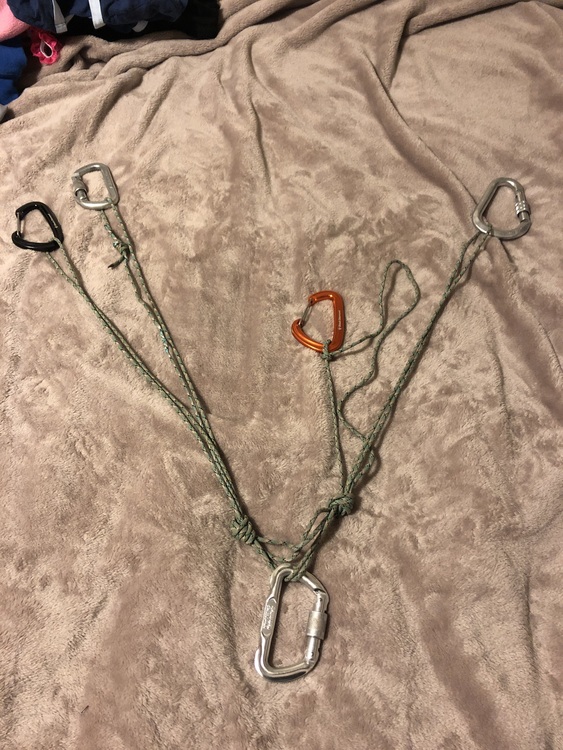
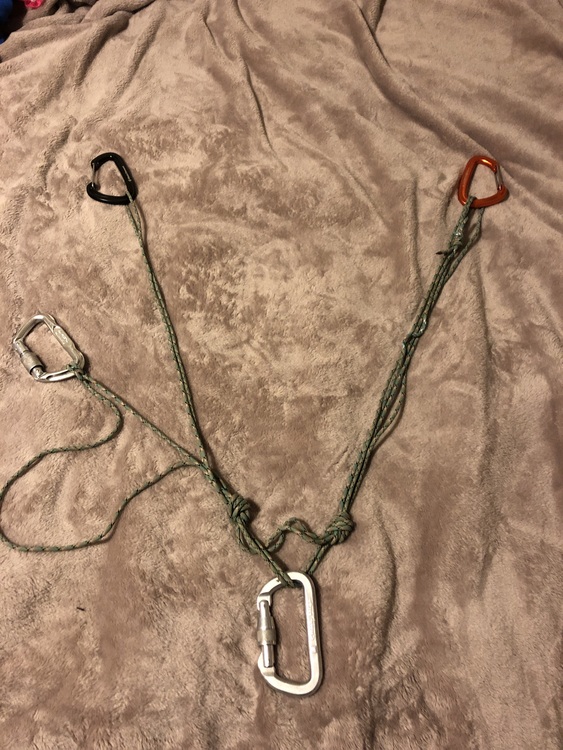
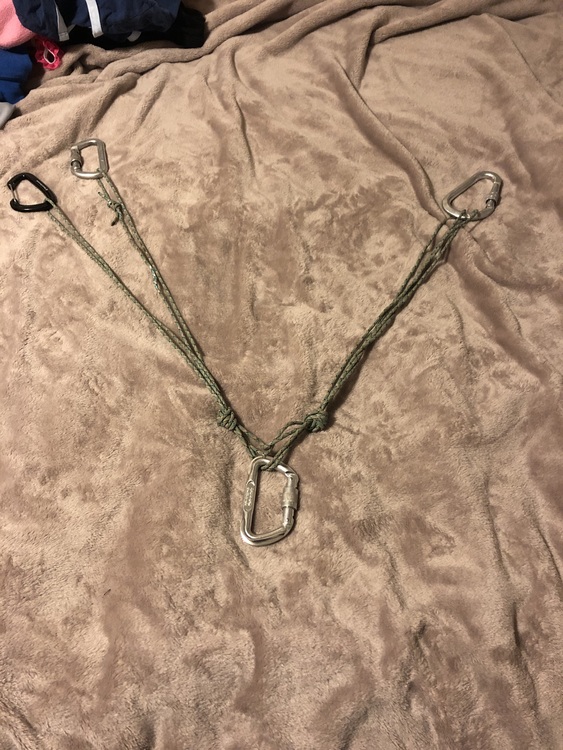
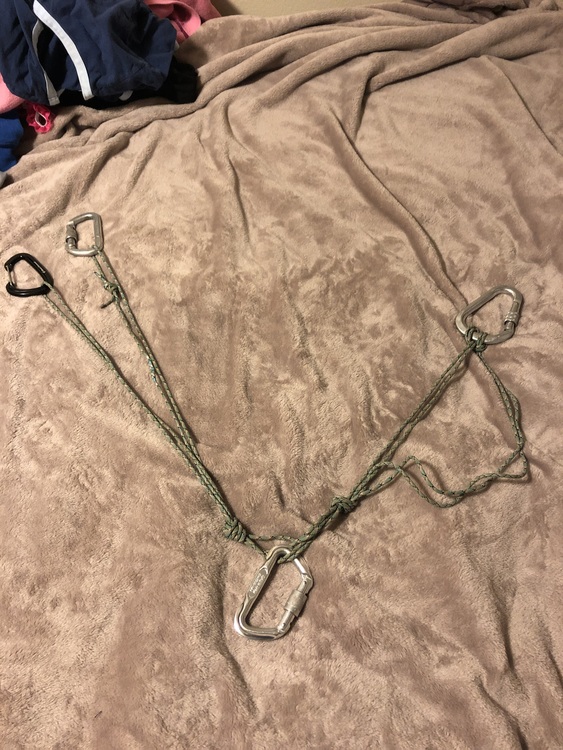
Michael Tilden wrote: Hypothetical quad anchor set ups. Somewhat complicated and could be bulky to rack depending on arm lengths, but seems reasonably equalized and redundant. Some extension. Issues??? Any remarks? |
|
|
Michael Tilden wrote: Safety wise, sure it's fine. If you can get to the point where you can rig all that in less than 1 min then that's great. Beyond a certain threshold, speed trumps safety because on a long multipitch climb speed is safety. If you're swinging leads (and sometimes even when you're leading in blocks), you should also consider building the anchor with the rope, something like what rgold depicts here. It's faster or as fast as using a cordalette and and adds more stretch, which tends to lower forces as well as improving load distribution. Whatever you do, though, practice it a lot at home or on the ground before using it for real. Experiment with different ways of constructing the anchor, different numbers of anchor points, and different locations of anchor points. When you've practiced with a lot of diverse scenarios, add a stopwatch into the equation and time yourself until you're rigging everything in less than a minute. Ted Pinson wrote: I don't think I know more about physics than those guys, nor did I ever claim to. I'm just waiting until I see more evidence that better mimics the reality of what I do when I'm out climbing. I don't take factor 2 falls on dyneema slings. |
|
|
Of the anchors you’ve built, how many have you actually fallen on? How many people do you know who have had pieces of their extendable anchors blow and lived to tell? The greatest safety margin we have is to simply never put our anchors to the test by making common sense decisions like not climbing above them when tethered and putting a Jesus piece in ASAP. This does mean, unfortunately, that we’ve pretty much all climbed without knowing it on subpar anchors that wouldn’t have held a leader fall. Testing anchors in a real life situation is immoral for the same reason testing parachutes in this way would be, so the best we can do is extrapolate from lab tests that simulate the relevant components of an anchor system. Based on these tests, the DMM engineers specifically recommended against using sliding equalization systems in gear anchor settings, so I’m gonna go with that. Choosing to ignore these warnings or, worse yet, telling others that it’s totally ok is irresponsible and dangerous. |
|
|
Ted Pinson wrote: Based on these tests, the DMM engineers specifically recommended against using sliding equalization systems in gear anchor settings, so I’m gonna go with that. Choosing to ignore these warnings or, worse yet, telling others that it’s totally ok is irresponsible and dangerous. First of all, they recommend not using a sliding x without limiter knots with artificial or natural pro. I never suggested that anybody do that, because it's a dumb thing to do even for reasons beyond extension. Secondly, once again, these tests were conducted without any dynamic rope in the system, which makes a HUGE difference as you can clearly when they tested a factor 2 fall on an anchor built with the rope. It is not unreasonable to be wary of extrapolating information from test conducted without any dynamic components to systems with a dynamic component. Especially considering how we know that our stretchy rope make a massive difference in peak loads. Care to point me to any literature that examines the effects of anchor extension with a dynamic component in the system? Seriously, if you know of any literature out there I'd love to take a look at it. |
|
|
I've never found the Quad to make sense for sport or trad. The 2 masterpoints thing is definitely cool but overall its more trouble than its worth. |
|
|
eli poss wrote: I would also be very interested in reading about tests that involve climbing rope attached to the anchor. |
|
|
eli poss wrote: It is not unreasonable to be wary of extrapolating information from test conducted without any dynamic components to systems with a dynamic component. Especially considering how we know that our stretchy rope make a massive difference in peak loads. Care to point me to any literature that examines the effects of anchor extension with a dynamic component in the system? Seriously, if you know of any literature out there I'd love to take a look at it. I´ve done a few and the DAV as well but neither as a direct comparison between with and without a rope. Without the rope is worst-case so the normal one to consider since we are investigating anchors not climbing systems, the possible permutations of with a rope, belay device, multiple persons etc etc are almost infinite so not something one would test casually! The preffered anchor systems have minimal extension anyway so inclusion of dynamic elements in the anchor irrelevant. |
|
|
After several years of going around on trad anchors on various forums, magazines, and blogs, the prevailing consensus was the most important thing was having at least two bomb pieces - do that and the rest is more a matter of personal preference. |
|
|
eli poss wrote: I bet most competent leaders can build a three piece anchor with a cordelette faster than you can turn a cordelette into a quad and build an anchor with it with 3 pieces. As for shock loading, if a piece would fail in a quad anchor setup it would definitely shockload the remaining piece(s). The rope does not prevent shockloading. It just lessons it. A short piece or rope is not as dynamic as you think, especially when it is already being weighted by the belayer. Keep in mind that rope stretch is proportional to the amount of rope between the anchor and the leader and shockload is reduced the more time the rope has to stretch in order to absorb the force and slow the fall. There usually isn't much rope in the system for a leader tied into the anchor. And some climbers (unnecessarily) use a PAS as a tether instead of the rope. An even worse scenario for extension and shock loading. |
|
|
rockklimber wrote: I was suggesting this for a 2 piece anchor, not 3. Three requires more futzing and faffery than it is really worth
I guess at this point, the only disagreement is semantic in nature. I understand shock loading to mean dynamic loading in a static system, which doesn't occur by definition when a dynamic rope is in the system. Of course anchor extension will always cause an increase in force, there's no disputing that, but the magnitude of this increase is topic of disagreement. A short piece or rope is not as dynamic as you think, especially when it is already being weighted by the belayer. Keep in mind that rope stretch is proportional to the amount of rope between the anchor and the leader and shockload is reduced the more time the rope has to stretch in order to absorb the force and slow the fall. There usually isn't much rope in the system for a leader tied into the anchor. And some climbers (unnecessarily) use a PAS as a tether instead of the rope. An even worse scenario for extension and shock loading. Keep in mind the length of extension relative to the length of rope. Again, we're talking about a few inches of extension with a few feet of rope in the system, meaning a very low fall factor. I recommended using the quad with 2 bomber pieces, which really ought to be able to handle a small increase in force due to extension. If your pieces aren't that bomber, then you should consider adding more pieces and/or rigging the anchor with the rope to further reduce forces. |
|
|
eli poss wrote: I was suggesting this for a 2 piece anchor, not 3. Three requires more futzing and faffery than it is really worth Just make your thingalette from dynamic rope and save all the worry. |
|
|
"Any remarks?" |
|
|
Russ Keane wrote: I can picture that quad rig, a triple rack of shiny cams, and a gallon jug of water off the back of the harness heading up a 2-pitch 5.5 at the Gunks. Bro gots to keep up with his creatine regimen, right? |
|
|
eli poss wrote: I was suggesting this for a 2 piece anchor, not 3. Three requires more futzing and faffery than it is really worth If you happen to get 2 “bomber pieces,” why do you even need to bother with all of this quad nonsense? You’ve spent all of this time coming up with ridiculous hypotheticals for how a person MIGHT use a quad with 2 perfect cracks and a low tide with a full moon, but you have yet to present any compelling reason for doing so over literally any other rigging system. |
|
|
This is literally the most rediculous argument, use whatever anchor you feel like using. Quad, cordalette, rope, slings, whatever, just be safe. You should see the rediculous anchors Guides come up with because they are bored of guiding the same route 100 times in a season. It’s all fun to mess around, be safe and try different stuff. |