|
|
eli poss
·
Jan 18, 2019
·
Durango, CO
· Joined May 2014
· Points: 525
Drew Nevius wrote: I played with a few configurations and this proved to be the easiest way to lengthen the tether when clipped to something. Like Eli and others said, it requires partially unweighting it. While my weight is off it, I flip the device and hold it in place while I lean onto it and rope pulls through. Once it’s at the length I want, I let go of the Slyde and it locks up again. Not sure if this is within recommended usage and there may be potential dangers if the Slyde moves up onto the gate or spine of the biner rather that staying in the bottom of it (causing it to los incorrectly), but it’s been working for me.
https://youtu.be/lmygw-FJHa8 This is what I used to do initially when I started using the slyde but I stopped for two reasons: it was more effort to rotate the slyde while slightly weighting it to feed out slack than to just fully unweight it and pull slack through the plate after a while, it slowly started fraying the sheath if I put slightly too much weight on it while adjusting
If it continues to work well for you, I wouldn't worry to much about the slyde moving out of the basket.
|
|
|
Bentjammer Brown
·
Jan 22, 2019
·
Giles, VA
· Joined Oct 2014
· Points: 5
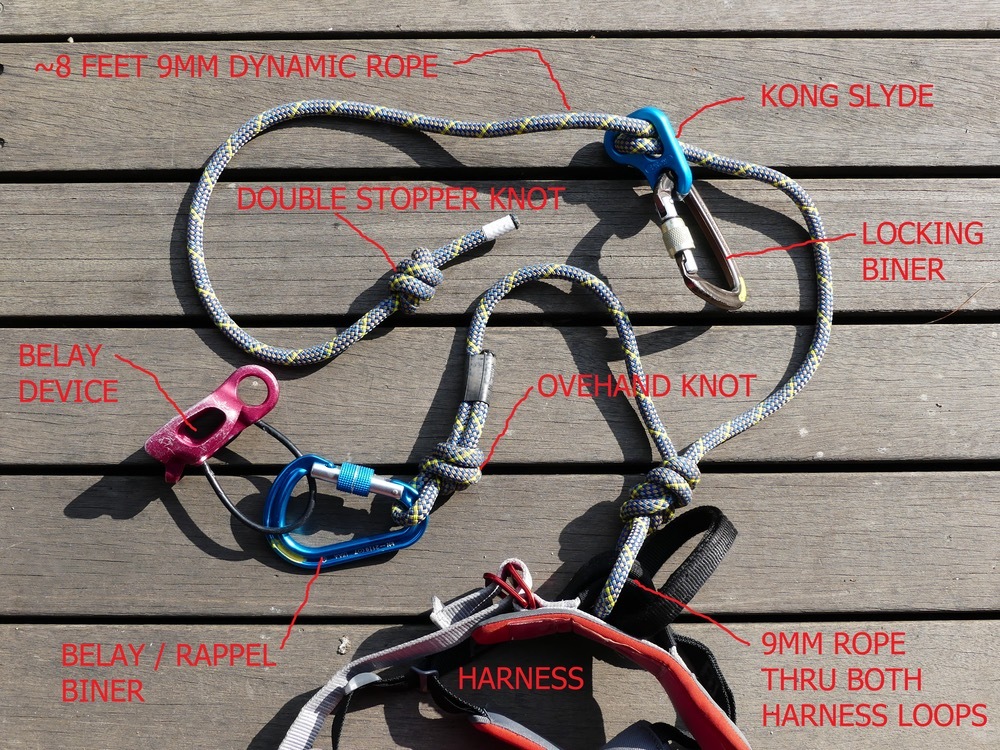
I set my Kong Slide up similar to the one in this photo. Only exception was I have a Grivel Clipsydra on the ATC end, it has a keeper clip that prevents me from dropping my ATC when opening the gates. I like having my PAS already set up for pulling closer to the anchor. Having a pre-rigged ATC that is properly adjusted for optional extended rappel is very handy and saves time. I also keep a Hollowblock clipped on my leg loop for third hand safety - can use as a Kliemheist, auto block, or Prussik as required.
|
|
|
Drew Nevius
·
Jan 22, 2019
·
Tulsa, OK
· Joined Jun 2012
· Points: 2,699
eli poss wrote: This is what I used to do initially when I started using the slyde but I stopped for two reasons: it was more effort to rotate the slyde while slightly weighting it to feed out slack than to just fully unweight it and pull slack through the plate after a while, it slowly started fraying the sheath if I put slightly too much weight on it while adjusting
If it continues to work well for you, I wouldn't worry to much about the slyde moving out of the basket. I think with my rope being 9mm, it’s much easier to use my full weight to pull rope through than to pull it by hand. If I had a skinner rope I could see how manually pulling it might be reasonable in order to reduce fraying. I think any minor fraying is worth it though since I have more rope to easily replace when the time comes
|
|
|
eli poss
·
Jan 22, 2019
·
Durango, CO
· Joined May 2014
· Points: 525
Drew Nevius wrote: I think with my rope being 9mm, it’s much easier to use my full weight to pull rope through than to pull it by hand. If I had a skinner rope I could see how manually pulling it might be reasonable in order to reduce fraying. I think any minor fraying is worth it though since I have more rope to easily replace when the time comes Makes sense. Are you just using a chopped off section of old rope or did you by rope specifically for the slyde? If buying specifically for the slyde, it may make sense to choose a rope with a higher sheath % in anticipation of this.
|
|
|
Drew Nevius
·
Jan 22, 2019
·
Tulsa, OK
· Joined Jun 2012
· Points: 2,699
When i got my Slyde, I already had a 5yo 9.1mm rope that had some fuzz spots, so I’m just using it
|
|
|
El Duderino
·
Aug 13, 2025
·
Unknown Hometown
· Joined Feb 2013
· Points: 70
Cole Lawrencewrote:If you look at the design of both devices, the way in which friction is generated is totally different with each design. The Kong Slyde uses a bend in the load end rope to pinch the slack end - preventing progress. The Petzl Connect Adjust is a totally different design which uses a cleverly engineered channel to pinch the rope between the body of the device and the carabiner (in which the rope is not bending and little friction remains while in the adjustment position). The comparison, even though the desired function is the same, isn't valid or fair due to the vast differences between the two devices. The Kong Slyde is cheaper (yes!) but does not work as smoothly, it doesn't come with a sewn cord specifically designed for the body, It has the potential (even when using the correct diameter cord) to slip. I have both devices and do not use the Slyde anymore on walls. I do like the Slyde but it is not as good as the Connect Adjust. The inherent differences in the design of both products makes this comparison similar to comparing a tibloc to an ascender - they both will grab a rope, but they do so with different designs, one is more insecure and yes, much cheaper - I also like and use both in different situations. I still use my Kong Slyde at anchors. But not on walls where the ease of adjustment not only saves time but after thousands of aid moves and adjustments on a 30+ Pitch wall the smooth adjustment of the Connect Adjust will save your arms, neck, back and energy, it might even stop you from wiggling around and blowing a precarious hook. You find the Kong Slyde slips more than the Connect? I've found that the Slyde is really difficult to adjust out, even once unweighted...
|

|
|
Cole Lawrence
·
Aug 13, 2025
·
Salt Lake City, UT
· Joined May 2017
· Points: 16
El Duderinowrote: You find the Kong Slyde slips more than the Connect? I've found that the Slyde is really difficult to adjust out, even once unweighted... If the load end pops over the slack end in the slot it will slip to the end of the cord (stopper knot). Thats all I meant.
|

