
 Continue with onX Maps
 Sign in with Facebook






best rope solo setup? feedback


|
|
Has the CT Roll n Lock not been mentioned yet? Half the price of a micro trax and far nicer to your rope. |
|
|
Max Rausch wrote: Has the CT Roll n Lock not been mentioned yet? Half the price of a micro trax and far nicer to your rope. I use exactly the same setup. It works well. |


|
Max Rausch wrote: Has the CT Roll n Lock not been mentioned yet? Half the price of a micro trax and far nicer to your rope. That’s my set up as well. What I really like about these is you can lock them in the open location for descending as well. |
|
|
As mentioned earlier, it would be wise to use the toothless device as a backup if you are using a combination of toothed and toothless. |
|
|
i use a similar set up to the original post picture except i just use two mini traxions and have the upper capture a little tighter to my upper body / neck |
|
|
Also... YOURRRR GUNNNAAAA DIEEEE ... sorry had to... |
|
|
Mak Ely wrote: that's because, if you're doing it right, you're never taking a real fall onto the ascender because you don't let any slack accumulate and so it's the equivalent of having your belayer "take". Also because using dynamic ropes drastically limits the force so that you won't be near the force threshold for cutting |
|
|
Mak Ely wrote: Because teeth don't do shit to a rope up until a certain force threshold and anybody with half a brain TR soloing never reaches that force threshold. If you want to be ignorant that's fine but don't go around spreading your ignorance. |
|
|
eli poss wrote: As mentioned earlier, it would be wise to use the toothless device as a backup if you are using a combination of toothed and toothless. I would tend to disagree with this, and actually approach it the opposite way. For these reasons: |
|
|
This is really all just minutia, though. The short answer is that toothed devices are totally fine for TR soloing, for both the primary and/or secondary devices. Using two microtraxions on one rope is a perfectly good and totally safe system. It is, for good reason, one of the most popular options among people working El Cap free routes on fixed lines. |
|
|
Fair enough, I guess we have some slightly different priorities in our decision making. You're right, though, it really is minutia, although perhaps only so for dynamic ropes. Using a static rope, I could see even the tiny fall from your primary device failing generating enough force to shred the sheath. IIRC, petzl said it will damage the sheath at 3 or 4 kN |
|
|
Mak Ely wrote: ...none of those are designed to catch a fall. If you watch the beginning of that video if clearly states these tests are beyond normal circumstances. Which seems accurate to me because I've never seen two people clip in to one mini-traxion with a long leash and then jump off. Maybe that is some new form of fixed rope tr soloing I'm not aware of but it sure sounds sketch and if people can't realise that then fixed line TR soloing is probably beyond their current experience and understanding level. Best to stick with a more standard setup and climb with a partner. My anecdotal evidence, which is derived from probably over 500 days (I believe I was one of the first people in Yosemite to start using the pro-traxion back in 2002...) of using toothed ascenders to fix line TR is that i've never ever seen even the slightest bit of sheath damage from falling with my setup. My guess is I've fallen well over a couple thousand times. Often these falls occurred in the exact same place on the rope over a period of months (this happens while projecting multi month FA's). These weren't slumps on to the rope, I was going to 100% and falling off on steep terrain. I use a bungee cord to keep the device high and the average length of free fall is probably < 3". Occasionally there has been more slack in the system but I've never found myself in a situation where the fall was longer than 12". |
|
|
Mikey, or anyone else who uses a similar setup (camp lift over micro traxion on a single line.) I'm curious what your process is for lowering. I have been using the other half of my rope for rappelling and the transition is smooth. However, when I try it on a single line, while hanging in space, it's a big cluster fuck. |
|
|
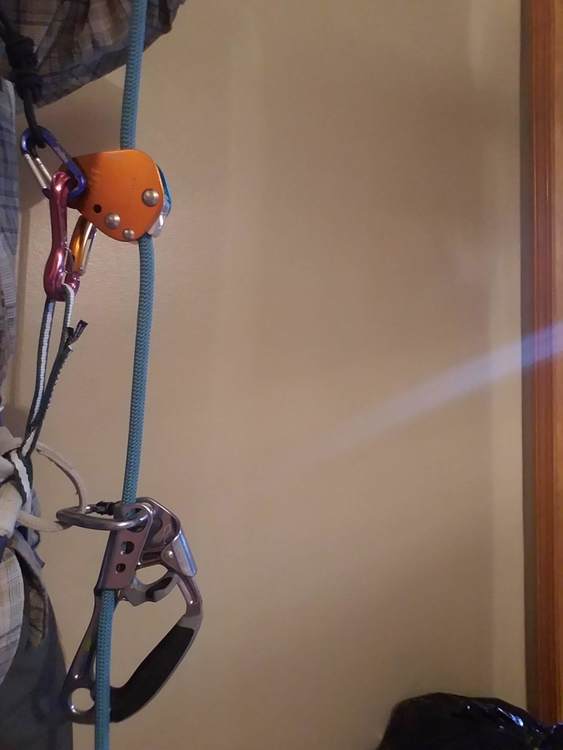 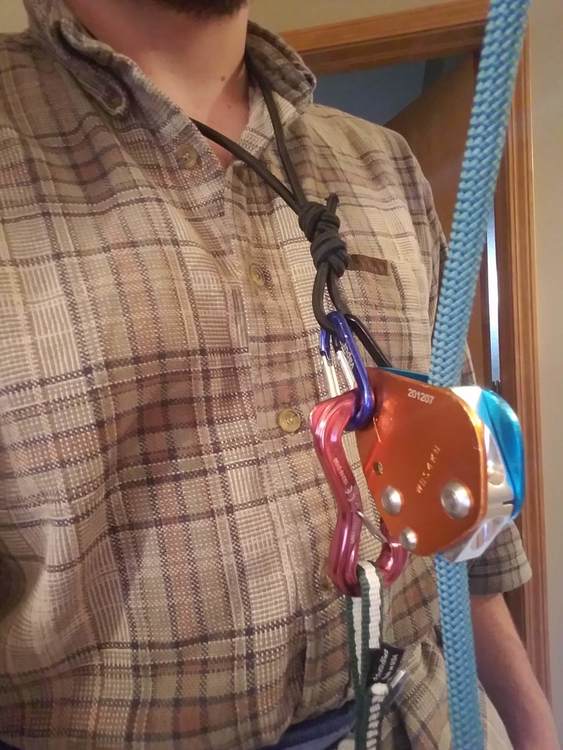 Single rope set up. Smooth as can be with a bit of weight on the bottom of the rope. The top device that mainly gets loaded is toothless (if you care, I don't) |
|
|
Mak Ely wrote: Thank you for watching. However the video still demonstrates the spectrum these devices perform on. I'd recommend going back and watching the video again, specifically pay attention to 1:52 where they demonstrate using the HeightSafety Backup, which is a non tooth fall arrest device that is very similar to the Kong Backup. Watch what happens to the rope, the sheath is shredded. All devices used incorrectly and placed under extreme conditions will eventually lead to failures. This isn't something that is unique to toothed camming devices which you seem to be inferring. Understanding the limits of every piece of equipment is fundamental in safety systems. |
|
|
Anyone use a hollow block above a micro traction? I’ve heard the micro will push a “loose” hollow block up the rope, but under load it will still grab. (TR solo). Next question- obvious pros and cons having a second rope for total redundancy, is it worth it? |
|
|
Greg R wrote: obvious pros and cons having a second rope for total redundancy, is it worth it? Pros:
Cons:
|
|
|
Greg R wrote: Anyone use a hollow block above a micro traction? I’ve heard the micro will push a “loose” hollow block up the rope, but under load it will still grab. (TR solo). I would assume the hollow block would have the same issues as prusiks do - they begin to melt at fairly low impact forces. ~4kn if I remember correctly. They're also more of a pain to move up the rope. I want my devices to feed smoothly. If it stops sliding I may fall further down than I was expecting to and increase impact throughout the system. Next question- obvious pros and cons having a second rope for total redundancy, is it worth it? I've only set up on cragging routes. I wouldn't carry a second rope just for this; if I can get both ends to the ground I'll set it up so each strand is independent via two figure 8s on bights separated by about a foot. I don't see a compelling reason to only use one strand when two are available. |
|
|
Dan Gozdz wrote: Nope. Hollow blocks are made of aramid so they have a much much higher melting temp. Also, if you're generating 4kN when TR soloing you're doing it wrong and are likely going to desheath your rope if not completely severing it. |
|
|
Dan Gozdz wrote: I don't see a compelling reason to only use one strand when two are available. - A second rope can be annoying and will get in the way more while climbing. It is slightly more effort to set up. - Using one rope is perfectly adequate for safety, provided you use reasonable good-sense measures around potential sharp edges.These reasons are “compelling” enough for me. Whether they are compelling to you is up to you. This comes down to the philosophical difference between “safe enough” and “as safe as possible”. Similar lines of reasoning drive decisions related to when to wear a helmet, when to equalize anchors, etc. I tend to the “safe enough” viewpoint. I make sure to do everything to ensure a level of safety I’m comfortable with, and once that is reached I don’t waste any extra effort on additional superfluous safeguards. Hence, if 1 tr solo rope is safe enough, 1 rope it is. Using a second rope, in most normal situations, does not make you safer in a meaningful way. |


