|
|
Kendra Ocanez
·
Dec 28, 2018
·
Somerville, MA
· Joined Dec 2018
· Points: 0
I am a big hiker, have done a little backpacking, and have started winter hiking in NH/White Mountains (live in MA) this year; I'm taking a class through AMC (Appalachian Mtn Club).
I am looking to explore mountaineering. I don't have any rock climbing experience. I am interested in climbing higher peaks in snowy evironments on less technical routes (class 2 or 3). I would say Rainer would be an eventual goal.
Would getting some experience climbing Colorado's 14ers be helpful towards this goal? I have only climbed summits in the Whites (Mt Washington being the tallest).
Or would it be better to skip that and go right to a guided tour/expedition of something like Baker or Adams?
I'm planning to spend some time out west next year and wanted to plan something that would build on my skills.
In the meantime I'll be buying Freedom of the Hills and taking more courses through AMC/NH's 'International Mtn Climbing School'
Also, are there any particular websites you would recommend as far as looking up peaks/routes/classifications besides peakbagger and summit post (those are the 2 I've been using), and/or that are geared towards beginners?
Thanks in advance!
|
|
|
Josh
·
Dec 28, 2018
·
Golden, CO
· Joined Jan 2006
· Points: 1,420
Hi Kendra-- welcome aboard! There's a ton of fun and challenge to be had climbing high peaks and snow routes all over the West (and New England), and your plan to build your skills over time and work towards something like Rainier with at least a few seasons of higher and snowier but nontechnical peaks sounds wise.
As a former New Englander who's been in Colorado for close to 20 years now, I may be a bit biased, but I would say Colorado's 14ers provide a very good training ground for some aspects of bigger and snowier peak mountaineering. For that matter, so do Colorado's hundreds of 12- and 13,000 foot peaks, most of which are not nearly as crowded as the 14ers.
Which peaks to use to build your experience and your skill set depends on your goals. If Rainier (combining altitude, size, and glaciated/technical terrain) is the long-term goal, eventually you'll need to work on navigating crevassed terrain and practice your crevasse rescue skills, but that's mostly if you plan to lead your own trip or want to tackle a harder route. If you plan to use a guide (an excellent option) and perhaps do one of the "standard" routes (Disappointment Cleaver, Ingraham Icefall, etc.), you can likely take a day of ground school with your guide service at the base of the mountain right before you go up. I don't mean to downplay those routes or the commitment of using a guide service-- I did the Ingraham Icefall in 1999, and it was a fantastic and serious route with big crevasses, aluminum ladder crossings, rockfall hazard, the whole nine-- but just to say the most significant tools in your box for tackling even Rainier are still going to be your fitness, your general mountain travel skills (like route finding, understanding of snow conditions, personal and team management, etc.) and readiness for the environmental conditions.
For that stuff, a bunch of time on Colorado's high peaks would be great. There are plenty of big peaks with Class 2, mostly-on-trail summit routes, as well as some that will dial up the factors like route finding, fall exposure, ease-of-escape in bad weather, etc. just a little bit over the baseline, to help you gradually up the ante.
As for which peaks, there really are too many to list, but some of the most common 14ers to start with are Greys and Torreys Peak (often climbed together), Lincoln-Democrat-Bross (also often climbed together), and Quandary Peak (which offers great summer snow slopes). Mt. Evans and Pikes Peak are sometimes overlooked for hiking/climbing because they both have roads to the summit, but they both offer good summit trails from down lower, too. Pikes Peak's standard walking route is 25 miles round trip! Mt. Shavano is also excellent, I think, but perhaps a bit more scrambly in places. Mt. Elbert (the highest 14er in CO) is a pleasant one for an overnight backpacking trip. The Collegiate Peaks (including Harvard, Yale, Columbia, Princeton) are generally very good as well, I think, but mostly a bit more of an undertaking than the shortest, easiest starter ones. Many will argue with my exact choices here for which ones to start with, and I didn't include anything here that is in the southwestern part of the state (all of the San Juan mountains, etc.), but you gotta start somewhere.
One aspect of your training that CO can be good for is opportunities to climb snow. That said, by the height of the summer, many peaks have at least one way to the top which is snow free, so you will end up doing a lot more travel on rock (some of it loose) than you will on a glaciated peak like Rainier. And with a few exceptions, you will not cross any crevasses or bergshrunds on Colorado snow climbs. Still, if you want to practice roped travel on snow slopes, and while huffing at altitude, there are many peaks to do so on.
A word about weather: if you're doing winter peaks in New England, you've likely already experienced a worse kind of cold than even the heart of winter here in the Rockies. In my experience, the relative lack of moisture in the air in CO means that while it can be windy and cold here, as long as you are in the right layers our cold is more survivable than that insipid, gnawing cold of a New England winter- the kind that tries to burrow through your clothes and eat at your soul. Colorado can certainly get epic bad storms, and we will generally have a far deeper snowpack than anywhere in New England, but it is usually a drier snow (hence our much better powder skiing conditions). This means you'll get to wallow in bottomless soft snow up to your chest out here if you want to, or posthole up to your crotch in spring snowpack on your way to the high peaks, but even in winter you'll be climbing less often through sideways blowing sleet. Yuck. In general, the snowpack on the northwest volcanoes like Rainier is wetter and heavier, like New England, so if you get a snowstorm on route, conditions might feel more familiar to you. Oh, but the lightning. In summer in the Rockies, you'd better be off the summit by noon. We get a lot more lightning than New England or the northwest.
As for websites, SummitPost and Peakbagger are good sources, if a bit sparse on details sometimes. Look for the places on SummitPost where people have linked to their own trip reports, even if those are posted on their own blogs, etc. Some of those can be more detailed and helpful.
The other source I like a lot are quality guidebooks. For Colorado peaks, there are dozens, but almost anything by Gerry Roach is going to be very helpful and fun to read. he has written guidebooks to CO's 14ers, 13ers, Indian Peaks, Rocky Mountain National Park, nontechnical peaks in the Lost Creek Wilderness, etc. They're all good. Keep in mind if you join the American Alpine Club, you can access their entire library of guidebooks and more and have them sent to your home for free. Another good source for information and also good trips to join when you're out here is the Colorado Mountain Club.
Hope that helps you get started! Be safe and have a great time!
|
|
|
Kendra Ocanez
·
Dec 30, 2018
·
Somerville, MA
· Joined Dec 2018
· Points: 0
Thanks Josh!! I appreciate the thoroughness of your reply. I am big on guidebooks and was thinking about purchasing Roach's book, so that is helpful. I didn't know that about the AAC; I have been listening to the Sharp End podcast lately (right now actually), and keep hearing plugs for joining!
I understand you being biased towards CO, but any thoughts on the peaks in the other western states? CO is the most familiar to me (I've never been to WY, MT, Oregon or Washington); but I'm interested in exploring them as well. If there are any guides you recommend in addition to the AAC, let me know!
Thanks for your help,
Kendra
|
|
|
mark felber
·
Dec 30, 2018
·
Wheat Ridge, CO
· Joined Jul 2005
· Points: 41
Like Josh said, winter travel in the Whites is pretty serious winter mountaineering in its own right. Actually, the Whites can be pretty demanding any time of the year, the trails are rougher and steeper, and the weather is not nearly as dependable as Colorado or much of the western US.
I did Rainier with the guide service many years ago, and the one day ground school that we did before we went for the summit was very educational in its own right. If your goal is to do Rainier unguided, then you'll need to learn something about glacier travel before you go. A guided ascent of Disappointment Cleaver (the easiest way up Rainier) would be a good start.
Other western states: California has the Sierra Nevada, Wyoming has the Tetons and the Wind River range, all of which are at least as deserving of a visit as Colorado. The Winds have the added benefit of being not quite as heavily travelled as the Sierra Nevada or the Tetons, but that benefit is diminishing quickly. If you do decide to visit Colorado, 14ers.com is an excellent source of information for 2nd-3rd class peak bagging on Colorado's 14ers. Gerry Roach's guidebooks are, as Josh says, an excellent source of information.
Set your sights a little higher and at least take an introductory rock climbing class. If nothing else, a little time on easy 5th class terrain on a toprope will make 3rd class terrain easier and safer. You posted on a rock climbing website, don't be surprised when we push you towards rock climbing.
HTH,
mark
|
|
|
Josh
·
Jan 2, 2019
·
Golden, CO
· Joined Jan 2006
· Points: 1,420
Mark is right: the Sierras and Tetons and Wind Rivers are all great options as well. The Tetons are morphologically interesting as interior western ranges go: they are essentially missing their foothills, so you'll go from the trailhead down in the flat valley straight into Big Mountain terrain. Trails there are often steep and unrelenting. I'd add the high Uintas in northeastern Utah as a good mountain range as well, with a fraction of the traffic that CO 14ers get.
The coastal mountain ranges (e.g. Cascades in Oregon and Washington) have a different feel due to the much higher moisture levels. Soggy camping in big temperate rain forests down low, and real glaciers up high. If Rainier is your goal, go ahead and get there first, but there are other big volcanos in the northwest that are very worthwhile-- Mt. Baker, Shuksan, Mt. Adams, Glacier Peak, etc. Some of them are much more remote- less infrastructure at the base than Rainier. The Paseyten Wilderness in far northern Washington is also beautiful, remote, and rugged terrain. Slightly lower mountains, but lots of options with few people.
Added bonuses on AAC membership: rescue insurance and discounts at their campgrounds and lodges, as well as at some other lodge systems around the world. I've stayed at their campgrounds at the Gunks and Rumney and their climbers ranch at the Tetons. They are all excellent.
|
|
|
Nick Goldsmith
·
Jan 5, 2019
·
NEK
· Joined Aug 2009
· Points: 470
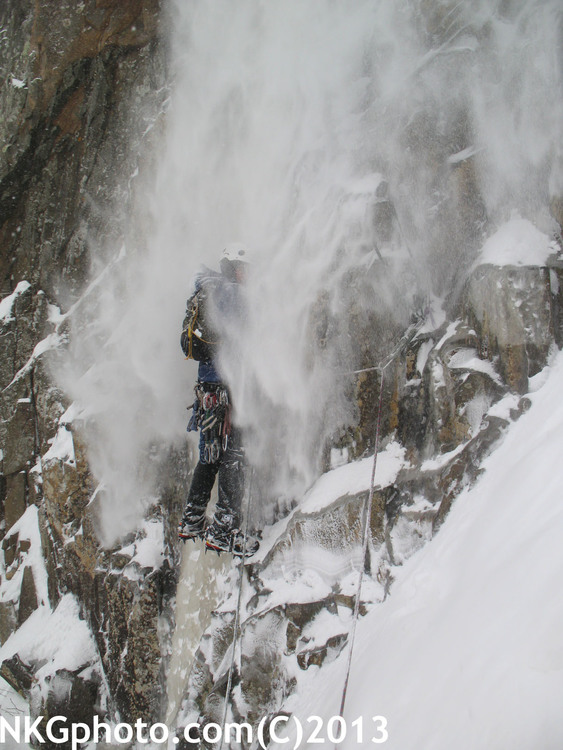
If you live in the north east train in the north east . Pleanty of world class climbers got their starts here. many still call the NE home base. No need to wait until your trip to take a class. get out every single weekend. learn to ice climb. Climb all the gullys in Hunnington Ravine. get stronger, get better, take trips to bigger mountains out west. tetons are a real ass kicker :) Come home, train some more. Solo all the gullys in Hunnington in a day. take more trips to bigger mountains. the limit is defined by your desire. Full Conditions on Canon Cliff NH
|
|
|
Robert Hall
 ·
Jan 5, 2019
·
North Conway, NH
· Joined Aug 2013
· Points: 28,851
·
Jan 5, 2019
·
North Conway, NH
· Joined Aug 2013
· Points: 28,851
A friend of mine who climbed Everest via the North Ridge ("Mallory / Chinese Route") [ which means other than some fixed ropes and "luggage support" he climbed everything "guideless"] stated that he "learned everything he needed climbing in the Northeast" in the Adirondacks and the Whites. (Mostly in winter, of course)
Re' Josh's comment on "cold" - I once met two ice climbers from Colorado at the Frankenstein Trestle. It was what I and my partner considered about a "NE 8 day" (sun + clouds, 3-5 mph gentle breeze, temps mid-20's ) They were looking for a "warm" place to put on their crampons and remarked that, although they had done much ice and winter hiking in Colorado, this was a "Different kind of cold !"
|
|
|
David Maver
·
Jan 5, 2019
·
Philadelphia PA
· Joined Nov 2012
· Points: 0
I am not sure, trips to Colorado 14ers would help too much to get to your goal of a summit like Mount Rainier. It won't hurt, but I am not sure you'll get more than by being active in the Whites. I began mountaineering on Mount Washington in the winters in prep for a trip with two friends to Mount Rainier. Trips up the Winter Lions Head route with crampons and ice axe allowed me to get that technique down. I did have to find other ways to practice for crevasse travel and crevasse rescue.
For my first trip to Mount Rainier, we chose to climb the Disappointment Cleaver route and this is a relatively simple mountaineering route with no technical ice or rock climbing.
I think that by taking courses through the AMC and at IMCS is a great way to get you started. Getting out into the Whites this winter will do a lot to hone your technique, clothing, and equipment. Building on that experience, you can either find some locals to make the trip to Rainier with you or pursue a guided trip.
I enjoyed learning techniques from reading books like Freedom of the Hills and watching the now many good videos on youtube. The AMGA and Outdoor Research have some fantastic instructional videos on youtube.
Best of luck to you!
|

 Continue with onX Maps
 Sign in with Facebook