|
|
Dresden M
·
Dec 11, 2018
·
Unknown Hometown
· Joined Dec 2018
· Points: 0
Hi Troy, I too had my surgery on November 15th! I’ve had TOS since I was about 5 years old which was always misdiagnosed and brushed away.
My right first rib resection surgery was done at my collarbone and I also had a pectoral minor release done. My surgeon also specializes in TOS. I am progressing - slowly but surely.. still on a 5lb weight limit with no lifting my arms above my head and my nerves are on fire (if that makes sense) I have a lot of cramping from my nerves.. mostly in my hand and arm. Some days are better than others, I get tired easily and I did have a chest (drain tube) which causes some pain and discomfort. My nerves are also giving my chest and back a feeling of a sunburn. It is an extremely weird feeling. I am still having pain here and there so I am still taking some meds. I am in therapy 3x a week for 6 weeks and then 2x a week for 2 weeks after. I normally heal very fast but this surgery has been a little different. I am a right side sleeper so i have had to train my body to stay on the left side exactly how you said you have been sleeping. I still have some numbness but they said it will eventually wear off. I wanted to see how everything is going for you? Are you able to sleep on your operative side? I am symptomatic on my left side as well unfortunately... waiting to see if physical therapy helps relieve those. If not looks like round 2 for me also! I know I have typed a ton and I am sorry for that.. it just helps to talk to others that know what you’re going through! After all true Thoracic Outlet is rare and I was one of the lucky ones. *yay* haha. So I appreciate any of your responses.
|
|
|
Troy K
·
Dec 11, 2018
·
Unknown Hometown
· Joined Oct 2018
· Points: 0
Hi Dresden,
Coincidently, I can recall having TOS symptoms as a young kid (mostly not being able to hold my arms above my head for any length of time), but somehow managed to have a very active lifestyle without strong symptoms until my mid-forties (all vascular related, no nerve issues).
Sorry to hear that the recovery is progressing a little slowly and with some discomfort. I hope that improvements come soon and strongly.
It's now a couple of days shy of 4 weeks post-surgery for me. Mechanically, I have no complaints. I had almost full range of motion immediately after surgery, and very little pain (never needed pain meds of any kind except a bit of tylenol the first week). It's not that I'm sort of superhuman with a high pain threshold, I just never felt much, don't know why - certainly I've had lots of pain from other things. The scar is pretty well healed up, although quite raised, but still a bit of numbness around the site, especially where the hemovac line was inserted - that's more tender than the surgery site! I was lucky to not need a chest tube.
For me, the most bothersome thing is that the sternocleidomastoid muscle in my neck is still swollen and extremely tight. It's slowly resolving, but definitely still very inflamed.
I'm doing the stretching exercises daily, although not as diligently as I should, and I've started seeing a physiotherapist once a week. I was probably a little over ambitious, but I started using my arm right away after my hospital stay, starting with easy things like doing dishes, sweeping, etc. I have no problems now lifting my 40lb son with both arms, but won't higher weight-wise as I know soft tissue is still knitting together.
I started riding my bike on a trainer 9 days post surgery, and have slowly ramped up volume and intensity of rides. I started back to work (I'm a scientist) after 3 weeks.
I find that I'm sometimes turning onto my surgery side during sleep now, and it's not bothering me much. No nerve pain to speak of, but I also didn't have much prior to surgery (all vascular issues).
I will say that the worst thing for me has been that I developed pretty severe sleep maintenance insomnia after surgery and it hasn't resolved. I fall asleep fine and sleep well for 3-6 hours, then wake, usually hot and sweating, and can't get back to sleep for 1-3 hours if at all. My body seems to be in stressful overdrive trying to heal (and I certainly seem to have healed very quickly), and that's really disrupted my sleep patterns. I'm trying to dial back the workouts a bit to see if that helps. The insomnia has some pretty lousy side effects like jacking up my blood pressure, and it definitely feels lousy to be under slept all the time.
Best wishes for recovery and continued improvements!
|
|
|
Matt V
·
Dec 11, 2018
·
Unknown Hometown
· Joined Dec 2018
· Points: 0
I’ve been diagnosed with Paget Schroetters and wondering if you guys could help me find an excellent vascular surgeon that specializes in TOS...my right arm feels swollen and I’m on blood thinners for now. I’m really hesitant to have my rib re-sected if their is something else to try first. Thanks in advance for your help.
|
|
|
Amanda Ellis
·
Dec 11, 2018
·
Unknown Hometown
· Joined Jun 2018
· Points: 0
Matt V wrote: I’ve been diagnosed with Paget Schroetters and wondering if you guys could help me find an excellent vascular surgeon that specializes in TOS...my right arm feels swollen and I’m on blood thinners for now. I’m really hesitant to have my rib re-sected if their is something else to try first. Thanks in advance for your help. Matt! Do your regimen of blood thinners, like 6 mos or so. And find an awesome physical therapist who has seen TOS before, neurogenic or venous... doesn't matter because it willbe the same exercises. I opted to not get the surgery after finding out this summer that I have venous TOS (paget schroetters) after getting a blood clot. I think the potential is high of returning to normal without the surgery for VTOS, you just gotta be mindful
of your body and not overdo it during the healing process. I'd love to go into more detail about what my healing protocol looks like if you're interested! Keep those positive vibes alive!
-Amanda
|
|
|
Brent Kelly
·
Dec 12, 2018
·
Boulder, CO
· Joined Jul 2010
· Points: 176
Matt, seconding what Amanda said about the conservative approach here. If you can find positive results with physical therapy, blood thinner therapy, and mild lifestyle/hobby modifications, awesome! That being said, I also definitely recommend making sure you’re consulting with experienced medical pros who can help you triage whether surgery is necessary - and, if it’s not *necessary*, help you sort through your personal cost/benefit analysis of whether surgery will be a better or worse option than a less invasive approach. In my case, I pursued physical therapy (though with an admittedly imperfect dilligence) for generic shoulder instability and discomfort, with no specific diagnosis and numerous MRI’s, for a few years before the clot manifested and TOS was identified/diagnosed. Once the clot developed and the diagnosis determined, it was presented to me as two main options: more PT, blood thinners for a while and an accompanying abundance of caution, and probably much less climbing in my life OR surgery and all the potential risks/benefits that involved. As my PT track record was somewhat fruitless so far, abundant caution isnt my forte, and the notion of less climbing in my life horrified me, the docs suggested surgery benefits would outweigh the risks, and I agreed with their reasoning and judgment. I’m glad I had surgery, but I still wish I had been diagnosed earlier, when a more targeted and informed conservative would have been a stronger option.All that just to say, if the conservative approach is an option for you, its definitely worth considering and pursuing under proper medical supervision.Anyways. In the interest of more personalized surgeon recommendations from the crowd: Where do you live? How far are you willing to travel for surgery? How far for consultation and conservative care plan discussions if you’re told surgery is not recommended? My surgeon was Dr Zimmermen in Redwood City CA. I was introduced to him as an experienced, confident and highly capable surgeon, one of the best in the region for TOS. Based on my surgical results and his willingness to discuss my concerns and reservations, I agree.
|
|
|
Matt V
·
Dec 15, 2018
·
Unknown Hometown
· Joined Dec 2018
· Points: 0
Thank you Amanda, Brent and Dr Stoxen...I appreciate the support. I'll give some detail/context on how this started for me. I am 40 years old tomorrow...I started seeing a personal trainer to lift weights in January this year...3 times a week and after month 3 I was getting a lot stronger(never lifted weights in my life before this) Trainer was great and we did all muscle groups but focus was put on my arms/chest/shoulders during this time...I lifted weights until right before our vacation in late May....then nothing after that. Then this...It was a Saturday mid-July this year and I was painting my outdoor kitchen, of course using my dominant right arm. My arm was above my head for a long time, then I rested, then I continued to paint like this for a couple hours at least. I felt some burning in my right shoulder area but nothing unusual from what I expected to feel after that kind of painting...I was tired after that day but no symptoms of TOS at all. Fast forward 3 days, I arrive home after a business dinner and while changing my clothes I feel my right arm swollen, heavy and some throbbing in it. I went to sleep that night hoping it would resolve itself overnight but it didn't. I ended up going to the ER that next morning and was told I have a PE in my right lung(scary stuff)and a another clot in my right shoulder area. Heparin was used right away and the Paget Schroetter diagnosis came a day later from the attending hematologist who prescribed me eliquios blood thinner when I go home. I have been on that blood thinner for 5 months now. I am not a rock climber, I do play golf, basketball and spearfish(scuba dive). I am somewhat active especially around our home. I live in Melbourne, FL and willing to travel anywhere in the US of course...I have excellent health insurance and resources behind that so I'm willing to do whatever it takes for help with this PS diagnosis. Currently I have no pain, but do have slight swelling discomfort if I exert the right arm...not lifting weights anymore though. My current appt is on Tuesday the 18th next week at the Mayo Clinic in Jacksonville FL with their vascular team. They plan a full workup for me on that day including surgery prep for whatever they find and thats planned for Dec 27th. I haven't tried PT but I probably should before they take parts out of me.
Amanda, I would like to know your healing protocol if your willing...really appreciated. Brent, thanks for sharing the surgeon info...I have made note of him in CA. Dr Stoxen, I will download the book and check it out this weekend, thank you for all your input and helping all those people over the years...remarkable.
|
|
|
Troy K
·
Dec 16, 2018
·
Unknown Hometown
· Joined Oct 2018
· Points: 0
A quick question for those who have had the surgery and are still reading the thread, and do things like cycling:
I had the surgery just over 4 weeks ago now. I've healed very quickly, and had very little pain post-op, and no lung impingement that I noticed. What has bothered me most is the seemingly large loss in my exercise capacity. I started riding on a trainer-mounted bike very gently 9 days after surgery. I've ridden short distances (15-20km) most days since, at easy pace, and I'm noticing that my heart rate is still popping higher than pre-surgery at equivalent wattages. e.g. warming up at 100 watts, my heart rate will quickly jump up to 100-105bpm vs ramping up to 90bpm prior to surgery. Holding 200 watts has my heart rate ~15bpm higher than pre-surgery. That hasn't improved since I started riding again, and I thought by 4 weeks it would be improving. I can accept that my max power output will be lower because my body is healing and I'm now pretty detrained, but the higher heart rate at low wattages has me concerned. I feel fine, but my heart rate is acting like it does when I'm quite sick.
|
|
|
Amanda Ellis
·
Dec 16, 2018
·
Unknown Hometown
· Joined Jun 2018
· Points: 0
Troy K wrote: A quick question for those who have had the surgery and are still reading the thread, and do things like cycling:
I had the surgery just over 4 weeks ago now. I've healed very quickly, and had very little pain post-op, and no lung impingement that I noticed. What has bothered me most is the seemingly large loss in my exercise capacity. I started riding on a trainer-mounted bike very gently 9 days after surgery. I've ridden short distances (15-20km) most days since, at easy pace, and I'm noticing that my heart rate is still popping higher than pre-surgery at equivalent wattages. e.g. warming up at 100 watts, my heart rate will quickly jump up to 100-105bpm vs ramping up to 90bpm prior to surgery. Holding 200 watts has my heart rate ~15bpm higher than pre-surgery. That hasn't improved since I started riding again, and I thought by 4 weeks it would be improving. I can accept that my max power output will be lower because my body is healing and I'm now pretty detrained, but the higher heart rate at low wattages has me concerned. I feel fine, but my heart rate is acting like it does when I'm quite sick.
Hey Troy...I know 4 weeks seems like a while but is a short amount of time for recovering from such a large surgery. As far as your heart rate goes... I wouldn't read too much into it right now. It's good to take note though. Keep tracking for at least 6 mos amd see if you notice any improvement with your bpm.
|
|
|
Amanda Ellis
·
Dec 16, 2018
·
Unknown Hometown
· Joined Jun 2018
· Points: 0
Hey Matt!
I will get back to you asap, but been super busy with work and I don't want to skimp on descriptions of exercises, stretches, etc. Let me get back to you within the week.
|
|
|
master gumby
·
Dec 16, 2018
·
Unknown Hometown
· Joined Jan 2016
· Points: 262
master gumby wrote: Glad your feeling good man but dont be surprised that walking around the block leaves your heart pounding. You just had garden type loppers in your chest cutting a rib out. Took me over 8 weeks to feel like i had my "normal" energy back. After any big procedure your body is going to take time to adjust - this one is no different.
Glad your doing well tho. Troy - I am requoting myself ......
|
|
|
Sash H
·
Dec 17, 2018
·
Berlin, DE
· Joined Aug 2018
· Points: 0
I wonder what happend to Dr. Stoxen?
|
|
|
master gumby
·
Dec 17, 2018
·
Unknown Hometown
· Joined Jan 2016
· Points: 262
Sash H wrote: I wonder what happend to Dr. Stoxen? Flagged for spam. This is not an advertisement forum. He created an account to sell his book and that's not the point here.
|
|
|
Sash H
·
Dec 17, 2018
·
Berlin, DE
· Joined Aug 2018
· Points: 0
master gumby wrote: Flagged for spam. This is not an advertisement forum. He created an account to sell his book and that's not the point here. Sounds ok to me
|
|
|
Paul Smyth
·
Dec 29, 2018
·
Belgium
· Joined Dec 2018
· Points: 0
Hi all,
I'm a first time poster on Mountain Project and have ended up here after a long search for information on neurological thoracic outlet syndrome. Here's my story:
I’ve been climbing for about 15 years, but for the last 4 years I’ve essentially been totally laid up with cubital/ulnar nerve problems in both arms. The symptoms are mainly intense, localised pain on the ulnar/outside of each hand and occasional numbness. I’ve now had three surgeries (2 left and 1 right) and both nerves have been moved to the front of the elbow to stop the irritation coming from subluxation/rubbing against the funny bone/medial epicondyle of the humerus. Both nerves showed clear irritation at the elbow, so this was likely one source of the problem. The occasional numbness, which was a minor and very infrequent symptom, has gone but the pain remains. After a lot of tests carried out by a specialised hand surgery centre in Belgium, where I live, the remaining symptoms are being blamed on thoracic outlet syndrome. This is a diagnosis by excluding other options, and is compression in the brachius plexus i.e., the neck and front of shoulder. While the symptoms are neurological, brachius plexus compression has also been inferred via an ultrasound showing blood vessel compression here too. I’m also positive for the various clinical tests for thoracic outlet syndrome.
Physiotherapy has helped me control the symptoms when not climbing, but each time I start back slowly I eventually always have a flair-up of symptoms that takes 6-8 weeks to settle (and hurts like hell). The flair-ups always come after climbing or road bike sessions, so seem likely to be caused by muscle tension rather than direct compression during sport. My current doctor suggests surgery is the next option, despite the exact area of nerve entrapment only being roughly identified. This will involve removing a piece of rib (I do not have the extra rib that sometimes causes this) and is quite a heavy procedure. Before proceeding, I’d like to get some more opinions, preferably from surgeons with experience of treating this problem in climbers or other sports people.
I was wondering if anyone here knows of any surgeons with experience of treating this problem in climbers (anywhere, but Europe preferably)?
Based on the previous replies I'm guessing these will mainly be in the US, but that would at least be a start!
Thanks all!
Paul
|
|
|
James Stoxen
·
Dec 29, 2018
·
Chicago, IL
· Joined Dec 2018
· Points: 0
Hi Paul,
If you have numbness on the outside of the hand and elbow it can be either irritation of the T1 nerve from an elevated first rib (thoracic outlet syndrome) or cubital tunnel syndrome. Now that you have had 3 operations for cubital tunnel syndrome compression but the pain is still radiating into your outside forearm and hand? Now they think it is thoracic outlet syndrome because of the process of elimination. When you wake up from surgery they will tell you that the nerve showed irritation at the elbow but they can tell you anything because they are trying to cover their misdiagnosis.
Its a shame they did not do a better examination to check the movement pattern of the first rib, check the 9 muscles which cause when in a spasm can compress the thoracic outlet. If they would have done Adsons test they may have been able pinpoint the thoracic outlet syndrome as the definitive diagnosis and got you the care you need instead of the 3 surgeries you did not need. This is common to see patients come in with scars on the wrist (misdiagnosed carpal tunnel), elbow (misdiagnosed cubital tunnel), neck (misdiagnosed herniated disc) etc and a 10 minute quality hands on examination reveals a blatant thoracic outlet syndrome.
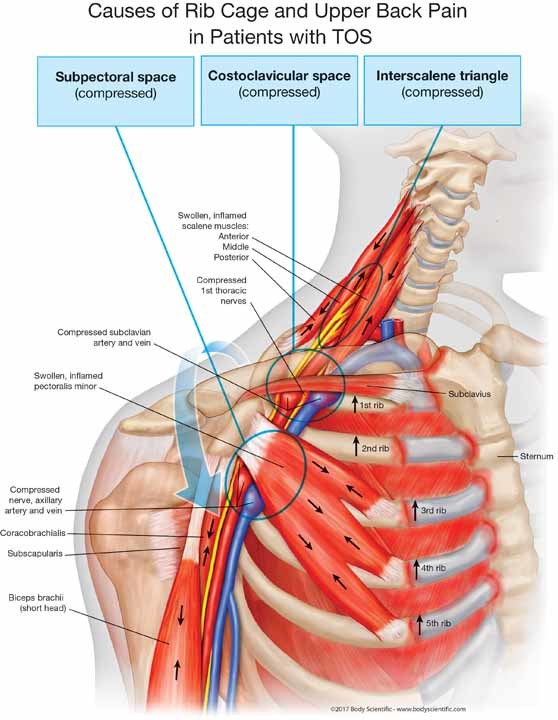
Irritation to the 7th cervical nerve, the one at the bottom of the brachial plexus closest to the elevated first rib is the same nerve as the one pinched in the cubital tunnel. There are 3 areas of compression in the thoracic tunnel/outlet. To save your confusion there is simply a floor to the tunnel (first and second ribs of the chest) and a roof to the tunnel (shoulder girdle including the collar bone).
TUNNEL ROOF - If the shoulder girdle is not supported from the trapezius and levator scapula from above it can fall into the tunnel/outlet.
- If the subclavius muscle, pectoralia minor muscle, coracobrachialis muscle, biceps short head muscle are in a spasm they can pull the roof (shoulder girdle) into the tunnel.
TUNNEL FLOOR
If the subclavius muscle and scalene muscles are in a spasm they can lift the first rib up into the tunnel. As the rib rises it compresses the first nerve it comes to at the bottom which is the exact dermatome pattern of your pain.
Now, what I said was tight muscles, right? So why would you do another surgery to cut out a piece of a rib and the scalene muscles which support your neck and aid in breathing when all you have to do is find someone to do deep tissue treatments to the muscles
If you surgically remove the rib you have to remove the scalenes too because they are attached and the cause of the elevated rib. Once you do that you will have a PERMANENT imbalance of strength in that area for the rest of your life with no possibilty of correction. i would not go back to the same doctors who did your elbow surgery for obvious reasons. Any doctor that recommends surgery for simple nerve irritation is one to be avoided. Also why didnt the doctor recommend physical therapy? They made a fortune off the 3 elbow surgeries you most likely did not need
Ill give you some important advice You must find someone who works on every one of these muscles and not miss one fiber getting down to the bone. Also it usually takes 10 passes through all of the muscles to get them to calm down
After all the tension is clear and the outlet tunnel is as open as possible you can train your trapezius and levator scapula to lift the shoulder off the outlet tunnel. If you train with the compression still on the artery and vein blood will pour into the arm over the obstruction but wont get over the obstruction so easily out with the vein because you dont have the pump (heart) pushing the blood over the obstruction so you could get a clot in the vein when it backs up.
Never ever stretch the neck to the side because it lifts the rib up even higher
You MUST determine what postures are causing 'SUSTAINED" contraction of your scalenes and other muscles. This is sitting at any angle with your 9-12 pound head being held there for a sustained period of time. The science tells us that if you sit body lean left you activate the scalenes on the right and vice versa. If its an equal spasm in both right and left scalenes then your bad habit is sitting leaning back with your head held there for a sustained period of time causing strain, fatigue, muscle damage, inflammation and the circuit of inflammation constantly activating the circuit of spasm that maintains the scalenes in constant contraction
It usually takes 25 - 30 hours of deep tissue with pressure points to rid all muscles of spasm That is because you have 9-10 muscles which are 5 inches long every point is an inch which means 50 points and if they take 2 minutes to drop that is 50 x 2 or over 100 minutes each time you go through all 10 muscles with deep tissue This is why many dont make it through the non surgical reduction of tension causing the compression of the thoracic outlet opting for surgery they did not need because they gave up thinking they did everything
Dont give up
I hope this helps
|
|
|
ASHLEY 21
·
Jan 3, 2019
·
Unknown Hometown
· Joined Jan 2019
· Points: 0
Hi Mitch,
I had a FRR and scalenectomy about 10 weeks ago to treat VTOS. During the procedure my vein would not "bounce back" - even after angioplasty - and the surgeon (he's a TOS specialist) had to make a decision between placing a stent and doing venous reconstruction. Neither is perfect - reconstruction fails about half the time (but I know yours worked!) and stents eventually occlude or break. In any case he decided on a stent. At the one month follow up the ultrasound showed that the stent is partially blocked. I have swelling in my arm because of this. It's not nearly as bad as it was before the surgery (when my subclavian was 100% occluded) but it's def. not the way it was before I woke up on Sept 30 with a clot (prior to that I had zero symptoms but that day my L arm was easily twice the size of the R).
I see my surgeon again in 2 weeks for the 3 month follow up and plan to ask him about the possibility of reconstruction. I don't have pain and collateral veins are already growing ( I can see some and many others show on ultrasound) so I don't know if reconstruction would even be worth it, or if waiting it out would be better. How did you make the decision? How bad was your swelling?
I know of two other people who had a 100% return to function/no swelling even with occluded subclavian veins post surgery - so I do know it's possible, but it did take time. But then your story.....so I'm not sure what would be best.
Thanks so much!
Ashley
|
|
|
Mitch Y
·
Jan 3, 2019
·
Flagstaff
· Joined Dec 2012
· Points: 295
Ashley,
My swelling was quite bad. When I would go climbing, I would grab the first hold and pull up and my arm would instantly swell and turn deep red. It would swell up to the point that my shirt was pulled tight on my arm. I think it was maybe 6 cm larger than my other arm. This would happen any time that I would exert my arm at all, but not so much when I wouldn't be exercising. I also didn't have any associated pain, but rather just a full or 'pumped' feeling in my arm that was more uncomfortable than painful.
For me, I didn't really get to make the decision about the stent. The research that I had read said that stents in the subclavian vein were usually a bad idea because that part of the vein tends to bend and move a lot, make the stent prone to break and fail. However, the radiologist told me that the new stents were made of a more flexible material that wouldn't break and were lined with a special material that wouldn't allow clots to form internally (I'm not sure how true all of this was). The radiologists attempted to open the vein via an angioplasty and when they opened it, the plan was to put a stent in. However, they couldn't pass a wire through, so no stent. I went back to my doctor and he said vascular reconstruction was too risky. He suggested I do nothing but take a baby aspirin every day and wait until the collateral veins can enlarge to take on the extra blood load. He finished by telling me that I should give up climbing and to buy some golf clubs instead. I was sold on waiting it out until he told me that I would have to give up climbing. So I did some more research and asked some more questions. Before surgery, the surgeon said he was the best venous TOS doctor in the region and treats a dozen patients a year with it, calling himself a TOS specialist. While that might have been somewhat true, venous TOS is such a rare condition that there are only a handful of doctors that solely treat it and nothing else. He deemed the reconstruction too risky, but only because he had never really performed it. So I searched for a doctor that really specialized in TOS.
I found a great doctor that is at the forefront of TOS, referenced in every other TOS scholarly article, author of TOS manuals that are studied in hospitals, and treats many, many professional athletes that develop TOS. This guy literally wrote the book on TOS! When I saw him for my initial consultation, he was so confident that it would work and that this was a (almost) textbook case. I was willing to do it even with the associated risks. I didn't want to (COULDN'T!) give up the one thing I loved most and spend the rest of my life wondering what would have happened if I went for the surgery. So I did a little soul searching and weighed the risks of waiting it out vs the reconstructive surgery. Since this surgeon only dealt with TOS, I trusted that he knew what he was doing and I read many of his papers that talked about the success rate of this particular procedure they do for subclavian reconstruction, specifically with athletes. As things turned out, the surgery was a success and I am back to climbing as hard as I was before this all started.
So in my unprofessional opinion, it seems like it depends on what kind of lifestyle you see yourself living. If you want to live a very active lifestyle that requires a heavy stress on your arms, maybe the surgery is worth considering. If you prefer to stick to hiking and biking (maybe), then maybe you can get away with waiting for the collateral veins to open up a little. Either way, it really seems like it would be worth consulting a specialist. That is the SINGLE thing I wish I would have done right away when I was diagnosed with a blood clot. Instead, I bounced around between 7 doctors and wasted so much precious time. If you want, I can give you the doctor's name that I saw and any other information you need.
Let me know if you have any other questions!
Mitch
|
|
|
ASHLEY 21
·
Jan 4, 2019
·
Unknown Hometown
· Joined Jan 2019
· Points: 0
Hi Mitch,
That's all really helpful! I'm thinking maybe you saw Dr. Thompson? The physician I saw does about a dozen of TOS surgeries per month - so more than the first one you saw but I don't think he has done many reconstructions or stents because he says he rarely has needed to.
My swelling isn't worse with exertion (which is weird) - it's actually the worst in the morning when I wake up. My L arm is about 5cm bigger than the R now. I'm a surfer/swimmer/yogi (not a climber) and I certainly don't want to give up those things! I'm getting back in to them now and the swelling is annoying for sure but not worse when I do them. I think the first step is to talk to my surgeon on the 17th at my follow up and then maybe I should consider a second opinion.
I would definitely like to hear about what the reconstruction surgery/ recovery was like - and also have your physician info if you're willing. Interestingly, one of the people I "know" (from another forum) that I mentioned in my last post had a venous reconstruction with Dr. Thompson that did not work and had to wait for collaterals to form. He also loved Thompson - said great things about him but clearly reconstruction doesn't always work. But he's back to full function now even though it took time.
Aside from that, I'm having a lot of referred pain in my back - mostly on the opposite side - which is making sleep really difficult. Weirdly I didn't notice it the first month, but around the one month mark (maybe when I started adding in activities again?) it started getting bad. Did you - or anyone else on here - have that after surgery? I've been going to PT for myofascial release which helps some, but not enough.
Thanks again!!
Ashley
|
|
|
ASHLEY 21
·
Jan 22, 2019
·
Unknown Hometown
· Joined Jan 2019
· Points: 0
Hi Mitch,
I'd still love to have the name of your doctor/hear more about your reconstruction if you're willing!
Ashley
|
|
|
Mitch Y
·
Jan 23, 2019
·
Flagstaff
· Joined Dec 2012
· Points: 295
Ashley,
Yes the physician was Dr. Thompson in St. Louis at the Barnes-Jewish Hospital.
The reconstruction isn't going to work 100% of the time since TOS is such a complicated syndrome. This can be due to many factors, most of which are related to how the patient rests during the recovery period. I was also very concerned with this before the surgery and I talked extensively with Dr. Thompson about why sometimes it fails. He told me the number one reason the reconstruction "fails" is because the patient returns to work/sport too early after surgery. In those cases, the surgery goes as planned, but the recovery period is 3 months with a 5 pound weight limit on that arm. Also, he doesn't want the arm lifted above shoulder height for at least a month until physical therapy can begin. He said most people get really bored or need to go back to work (bad idea if its a laborious job) or have children and are always used to picking them up, and one or more of these things happen and can rip the sutures in the vein, put too much stress on that vein, or causes the already-irritated muscles to swell around the vein and pinching it off. Any number of these things can lead to the reconstruction failing during the initial recovery period.
After the one month mark, physical therapy can begin. This is a very important time because many of muscles around the surgical site are tight and usually cramping (for up to 3 months or more). PT consists of simple stretching at first and then light strengthening. After not using your arm for a month, you can imagine how weak that side of your body would be. So regaining strength and mobility in that side of the body is very important. He has a PT protocol that gradually increases intensity as time passes and symptoms ease. Eventually, you work up to full strengthening exercises and back to normal lifestyle.
I am extremely lucky to have a partner that was able to support us so that I could take the 3 months off of work in order to recover from the surgery. I didn't want to risk anything that would compromise the recovery process and these were the toughest times I've had. It sounds nice to have 3 months off of work and climbing to finally do things that I've been meaning to do, but you are really limited to what you can do and I didn't want to push anything at all. I remained steady with the physical therapy and had to drastically change my lifestyle for quite some time. This is the hardest part of the whole process, but also the most crucial. If the recovery isn't taken seriously, the reconstruction could fail and the TOS will be drawn out even longer.
The takeaway: the success/failure percentages of the surgery are skewed because almost always the surgery is a success, but the reconstruction fails due to the patient's activities post-surgery. Look up articles by Dr. Thompson on PubMed as he has many research papers published and some are specifically on athletes. If you have any more questions, I'd be happy to answer them and share more of my story, but send me a personal message as that might be more appropriate on this forum.
|

 Continue with onX Maps
 Sign in with Facebook