Mountain Project Logo

ATC devices and rope slippage?

Old lady H · · Boise, ID · Joined Aug 2015 · Points: 1,375
Anonymous wrote: Helen, not sure if it was mentioned up thread or not but what belay biner are you currently using?

A big locking pear, which seems to make up it's own mind which end it is on (gets flipped over). But, I just got biners with the steel bit for top ropes, hoping to go to steel down the road for the ATC biner too. I've got the oddball assortment of mishmash stuff in the closet, though, including locking and nonlocking ovals, some keeper types, and don't remember all of it, lol!

I have an alpine up, but I haven't had the opportunity to get as fast as I'd like with it. Honestly, when I've had partners this season, I've been outside, climbing, not indoors, practicing. Plus, I'm down a gym, too. I miss it soooo much! But, this off season, that's on my list to get it dialed. I ended up with a Jul, also, but I think, because of two line raps, the Up will be my go to, hopefully fluently by next spring. Ive been on an ATC for years now, and I really don't want to change the way the hand instincts work. For others reading this, though, the market has an awful lot more to offer in belay devices than just a few years ago. Grigris, sure, if that suits you. They are by far the most popular and  time tested for that type of belay device, and pretty fool proof. As I said, I do use them, now and then. But the other type of assisted belays, with a carabineer doing the locking, are gaining ground, based on what I'm seeing out there. When I started, it was grigris, ATC, and something else, only now and then. 

Best, Helen

Christian Hesch · · Arroyo Grande, CA · Joined Aug 2017 · Points: 56

H, have you tried flipping the megajul around on rappel? I've zero problems with using it as a tuber in this manner, though I'm also the guy who hauls a Shunt up the wall instead of a hollowblock or prussik, so keep that in mind...(did I just "outnoob" you!??? ;)

Old lady H · · Boise, ID · Joined Aug 2015 · Points: 1,375
Christian Hesch wrote: H, have you tried flipping the megajul around on rappel? I've zero problems with using it as a tuber in this manner, though I'm also the guy who hauls a Shunt up the wall instead of a hollowblock or prussik, so keep that in mind...(did I just "outnoob" you!??? ;)

Christian, I've not used the Megajul, except the brief time with the rep. I ended up with one, as part of a package deal when I bought an almost brand new harness from a local lady. I'm sticking with the ATC to rap for now, extended and with a backup, because I'm dialed on it. I'll learn the Up also, as I get a chance. The megajul languishes in the closet for now. Nothing against it, but for me, I'd rather keep my hands trained in the manner they are used to.

There are threads for the Jul devices, dig those up, or start your own one with questions. Yes, you may get roasted, sooner or later (I do no matter what I ask), but, you have just an astonishing pool of knowledge and experience on here. I am very, very grateful to these people.

Christian, you can't out noob me. Trust me on that. My brain is wired to put two and two together....then the square root of three and add fifteen....and somewhere in there, a wonky cross pollinated question arises, after a long, long, meander through the woods, a stream crossing or two, and a lot​ of bushwhacking. On my good days. Post coffee.

Best, Helen

Ted Pinson · · Chicago, IL · Joined Jul 2014 · Points: 252
Old lady H wrote:

Two questions, then. 

Would this be a good application for two ovals? The carabineers flip around, ovals would always have a similar profile.
Probably not.  I wouldn’t use ovals for belaying, and there’s no great reason for why your carabiners should be flipping around so much.https://blog.weighmyrack.com/how-to-pick-the-best-carabiner-shape-for-rock-climbing/


Second, rapelling. I use an extended rappel and prussik backup, and that has worked fine on both double and single ropes, adjusting the prussik to suit. But, I've not had to rap on anything really skinny yet. As a lighter climber (127ish), should I add the friction, especially for a long free hanging rap? Or, is it not needed, with the backup?

Thanks! Helen

I would assume that the prussik would be holding you most of the time, so it shouldn’t be too big of a deal.  I REALLY like the idea for multipitch where there’s a concern of a fall onto the anchor, though.

eli poss · · Durango, CO · Joined May 2014 · Points: 525
Christian Hesch wrote: H, have you tried flipping the megajul around on rappel? I've zero problems with using it as a tuber in this manner, though I'm also the guy who hauls a Shunt up the wall instead of a hollowblock or prussik, so keep that in mind...(did I just "outnoob" you!??? ;)

That kind of defeats the purpose. At that point you might as well just use an ATC

Old lady H · · Boise, ID · Joined Aug 2015 · Points: 1,375
Ted Pinson wrote: Probably not.  I wouldn’t use ovals for belaying, and there’s no great reason for why your carabiners should be flipping around so much.

I would assume that the prussik would be holding you most of the time, so it shouldn’t be too big of a deal.  I REALLY like the idea for multipitch where there’s a concern of a fall onto the anchor, though.

Ted? "Around so much" is not the same as flipping ends, now and then. That's all I meant. If it was an issue, I'd put a keeper type on it. And, I expect we'll hear back on preferred biners for doubling, or even tripling.

What did you mean on the last? Noobs here, remember? It's super helpful to delineate just what you have in mind. My "expertise" for actual multi, is precisely three pitches, as a follower, sir! Heaps of reading up too, of course, that's my default setting, to learn as much as I can. A surprising amount has been used, often in a different context than was originally presented.

Thanks, sir! H.

Ted Pinson · · Chicago, IL · Joined Jul 2014 · Points: 252

H - one of the worst possible scenarios in climbing would be a leader fall at the beginning of a second (or higher) pitch before getting their first piece of protection in.  This would cause a “Factor 2” fall* directly onto the anchor (the leader would fall PAST the anchor), which is not only very high force but also hard to hold because the belayer ends up having to hold the fall as if they were belaying a second from above (pulling UP to brake instead of down), since the leader ends up underneath the belay.

*yes, this is a simplification and the actual fall factor is something between 1 and 2 due to friction and other factors

Old lady H · · Boise, ID · Joined Aug 2015 · Points: 1,375
Ted Pinson wrote: H - one of the worst possible scenarios in climbing would be a leader fall at the beginning of a second (or higher) pitch before getting their first piece of protection in.  This would cause a “Factor 2” fall* directly onto the anchor (the leader would fall PAST the anchor), which is not only very high force but also hard to hold because the belayer ends up having to hold the fall as if they were belaying a second from above (pulling UP to brake instead of down), since the leader ends up underneath the belay.

*yes, this is a simplification and the actual fall factor is something between 1 and 2 due to friction and other factors

Ted, what were you thinking to apply to this, and how? Increasing friction? It's only theoretical for me, but I do understand the evilness of a leader falling past an anchor, without anything in. I also find rgolds stories of catching these amazing!

If you're taking it this direction, might as well get more information on here, eh? And best you speak for yourself, rather than leaving us guessing.

Thanks, sir! Helen

Pavel Burov · · Russia · Joined May 2013 · Points: 50
Christian Hesch wrote: have you tried flipping the megajul around on rappel?

Don't. It locks when taking slack. It makes leaving from hanging belay anchors really tricky and it makes retracing your rappel (e.g. in case if you missed the next station a bit) tricky and even dangerous when tired, and hungry, and thirsty, and wet, and frozen a bit, and in the dark (read: when rappelling after another long day). Just uz yer das alte gut ATC.

Ted Pinson · · Chicago, IL · Joined Jul 2014 · Points: 252
Old lady H wrote:

Ted, what were you thinking to apply to this, and how? Increasing friction? It's only theoretical for me, but I do understand the evilness of a leader falling past an anchor, without anything in. I also find rgolds stories of catching these amazing!

If you're taking it this direction, might as well get more information on here, eh? And best you speak for yourself, rather than leaving us guessing.

Thanks, sir! Helen

H, I’m saying it might be a good idea to add a second carabiner if you’re belaying a leader on a multipitch with an ATC.  I think it’s also a great idea for belaying a second off your harness.

Old lady H · · Boise, ID · Joined Aug 2015 · Points: 1,375
Tim Lutz wrote: the OP stated that she has issues belaying one person with an ATC, and you are recommending that she belay two at once?!

Isn't that what the haul loop is for???

:-)

Old lady H · · Boise, ID · Joined Aug 2015 · Points: 1,375
Billcoe wrote:

Reread Idaho Bob. Use 2 MATCHED (same sized) carabiners in your ATC, always do this simple thing in fact if you want to catch a fall H,  you'll get substantially more friction and the lock off will be easy(ier). Much much so. If someone is really heavy, tie off on something, some gyms have weights you can clip onto so you won't launch up very far.

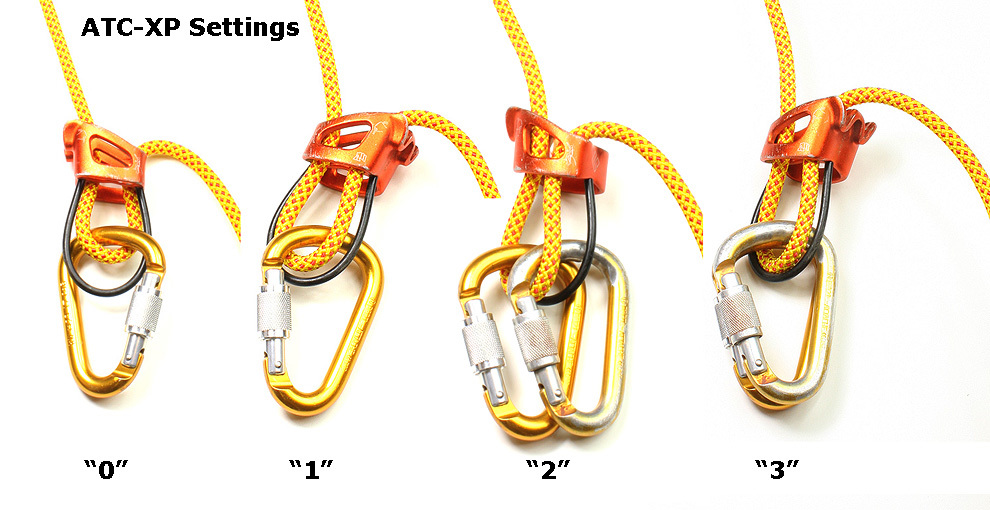
There are instances where rope size and ATC unit match are an issue (research DMM Bug vs DMM Bugette vis a vis rope size for that train of thought). Use 2 biners, just start doing that and you'll be happier. Think #2 below (borrowed off web), except the brake rope gets reversed and goes over the teeth the direction #3 is set up for.  The 2 larger biners will give more friction than 2 small ones, and much more braking power than a single biner all other things (device, ropes size) being equal.

Always use 2 biners and you'll be a happier camper. Only use one biner if you are flying and trying for time on a long multipitch where you don't expect any falls and need to shave time at belay changeovers.

Okay, so it's been a couple years since I used two biners like this, and don't remember which ones I did. However, I'll have the opportunity to try this, at the gym, soon. So, two locking pears, high friction side, just like three above, correct?

I'm curious how this adds friction. It seems like it would increase the radius the rope is over, which should be less ​friction, like the big capstans for top rope anchors? Or, is it that the other angles through the ATC are pulled sharper??

Thanks! Helen

Bill Lawry · · Albuquerque, NM · Joined Apr 2006 · Points: 1,822

Yes.  Of the options in the pic, I believe #3 will get you the most friction.

I suspect it adds friction because of more surface area contact with the rope plus perhaps the rope bending through a greater angle before exiting/entering the ATC slot (if that makes sense - probably same meaning as your "pulled sharper").  And I think I've heard of warnings of avoiding such a large biner girth that the rope is pinched between a biner and the ATC body - though I have neither seen this problem nor understand how serious that might be.  If it happens, I suppose friction may sharply increase in a rope-damaging sort  of way.

Also you may be able to milk out even more friction by having the two biners with their gates opposite (a.k.a., opposite and opposed).  How much you get depends on the angle between the spine of the biner and the biner segment the rope runs over.  If this is less than 90 degrees, the smaller the angle the greater the friction when using two biners opposite and opposed.   Because, under load, the two spines are sort of pulled towards each other and sort of hug the rope.

Old lady H · · Boise, ID · Joined Aug 2015 · Points: 1,375
Bill Lawry wrote: Yes.  Of the options in the pic, I believe #3 will get you the most friction.

I suspect it adds friction because of more surface area contact with the rope plus perhaps the rope bending through a greater angle before exiting/entering the ATC slot (if that makes sense - probably same meaning as your "pulled sharper").  And I think I've heard of warnings of avoiding such a large biner girth that the rope is pinched between a biner and the ATC body - though I have neither seen this problem nor understand how serious that might be.  If it happens, I suppose friction may sharply increase in a rope-damaging sort  of way.

Also you may be able to milk out even more friction by having the two biners with their gates opposite (a.k.a., opposite and opposed).  How much you get depends on the angle between the spine of the biner and the biner segment the rope runs over.  If this is less than 90 degrees, the smaller the angle the greater the friction when using two biners opposite and opposed.   Because, under load, the two spines are sort of pulled towards each other and sort of hug the rope.

Thanks! I'll give it a try tonight...gym night, time to get after the odds and ends list of "stuff to try out". 

:-)

Jim Titt · · Germany · Joined Nov 2009 · Points: 490
Old lady H wrote:

Okay, so it's been a couple years since I used two biners like this, and don't remember which ones I did. However, I'll have the opportunity to try this, at the gym, soon. So, two locking pears, high friction side, just like three above, correct?

I'm curious how this adds friction. It seems like it would increase the radius the rope is over, which should be less friction, like the big capstans for top rope anchors? Or, is it that the other angles through the ATC are pulled sharper??

Thanks! Helen

Two karabiners side by side is two radii seperated, not a large radius. To bend the rope, straighten it and bend it again takes more force than just bending it once and so the friction increases, for two biners about 8-10%. The effect continues to increase up to around 5 to 7 karabiners and is also why deep tube devices like the ATC XP work better than low profile ones.

Using two karabiners to increase the braking force is shown in the early advertising for the Salewa Sticht plate, with an ATC XP and two older model Petzl Attache karabiners (exactly as in the photo earlier) gives up to about 50% more braking power (depends on the rope) and three karabiners gives roughly double the braking power.
However there is one concern, the underside of some belay devices is very sharp and you can start to get furring on the rope so check the entry to the slots first and if nescessary take a file to them, there are various generations of the ATC XP and some of them are particularly bad for this as are one end of the slots on the Reverso. In normal use (like increasing the friction for rapping) this isn´t a real problem but at full load on our test rig it certainly is!

Old lady H · · Boise, ID · Joined Aug 2015 · Points: 1,375
Jim Titt wrote:

Two karabiners side by side is two radii seperated, not a large radius. To bend the rope, straighten it and bend it again takes more force than just bending it once and so the friction increases, for two biners about 8-10%. The effect continues to increase up to around 5 to 7 karabiners and is also why deep tube devices like the ATC XP work better than low profile ones.

Using two karabiners to increase the braking force is shown in the early advertising for the Salewa Sticht plate, with an ATC XP and two older model Petzl Attache karabiners (exactly as in the photo earlier) gives up to about 50% more braking power (depends on the rope) and three karabiners gives roughly double the braking power.
However there is one concern, the underside of some belay devices is very sharp and you can start to get furring on the rope so check the entry to the slots first and if nescessary take a file to them, there are various generations of the ATC XP and some of them are particularly bad for this as are one end of the slots on the Reverso. In normal use (like increasing the friction for rapping) this isn´t a real problem but at full load on our test rig it certainly is!

Thanks so much! I'll check my ATC tonight, and get out the file, if needed. I've never used a file to "dull" something before, I'm always putting edges on, shovels and the like!

Hey, since you're here, didn't a munter hitch outdo all of the devices in your testing, for braking, IIRC? And, your own design for an ATC? :-)

Two big pear lockers worked very nicely! This was just top rope, in a gym with shorter walls and no friction on the anchors, heavier climber, not very dynamic ropes....  Aligned, they were even easy to open and load in tandem, so, except for screwing/unscrewing two gates, there wasn't any extra time involved. They did flop around a little, though, so outside of the gym, I think I'd consider using the keeper types, just to be sure they don't go sideways or something. I'm looking to get the edulrid belay biners with the steel insert soon, anyway.

So, all, when would you typically expect to add friction on a rappel? For myself, single and/or skinny lines, I'm guessing, but I don't actually know. A tandem rappel? A really long rap? I usually extend my rap and use a prussik backup. Tandem rappel is on my to do list, at some point, as is learning how to do more with less (all that stuff you can do with just rope and carabineers).

Yes, some of this is not noob 101, some is, but it's surprising what us noobs run into. Being "new" makes you much more vulnerable to other people getting you into trouble. I've guarded against that all along, trying to read up and ask questions, but it isn't unusual for folks to be way too trusting of "experienced" partners. Even scarier, I'm now finding myself to be considered that "experienced" person, based only on the fact that I climb outside. Starting in a gym is okay, but sheesh. People sure are overconfident about getting on real rock. I'm so glad I started on the real thing! 

Best, Helen

Jim Titt · · Germany · Joined Nov 2009 · Points: 490

Well making a "better" ATC was a challenge, stopping it twisting real thin ropes was another!
Rapping I´m often on either a single 9mm or two 7.8´s and free-hanging raps with my svelte 90+kg and 20kg of gear gets a bit tiresome, with a single 9mm I just wrap once around the biner which does nothing for the rope but wonders for me! When you are out in the backcountry you really need to know what to do if rapping on a single strand of a half/twin rope, it might be useful one day. Bolting when I´m loaded up with junk I put a krab brake above my GriGri which makes one-handed control easier.
Climbing gear techniques it´s all about learning loads of useful concepts and then applying whatever combination is practicable, "systems" as taught in climbing manuals are mostly junk!

Jim Titt · · Germany · Joined Nov 2009 · Points: 490

Looking for something else I found a file with some test results for multiple karabiners;-
12mm round bar HMS karabiners (Petzl Attache). ATC XP in high friction mode. 18kg hand braking force.
9mm rope single strand
1 karabiner 1.64kN Braking force
2 karabiners 2.72kN
3 karabiners 3.44kN
8mm rope single strand
1 karabiner 1.13kN
2 karabiners 1.85kN
3 karabiners 2.54kN

patto · · Unknown Hometown · Joined Jul 2012 · Points: 25

TL Dr; knowing how to add friction might not be needed often but on the few occasions your might need it it can make things alot more comfortable and safer.

Adding friction is something most climbers don't give too much thought about.  At least I didn't.  Sure I had read about it, knew the adding carabiners approach, had used rappel racks in caving before.  But really a regular tubular had never worried me and my lightish 70kg weight, so adding friction was something I hadn't practiced.

Until events led me to a rescue rappel.  Suddenly I was on a single strand brand new rope 9.8mm, DMM bug (which according to Jim is fairly low friction).  So now I had 140kg, on a single strand and it took effort to keep it safe and controlled.  It certainly wasn't a comfortable situation.  I locked off and added a biner.  Not much difference.  After a bit more fiddling I ended up created a Z-redirect of the brake stand from my belay loop to the extended device and back to my brack hand.  So two extra 180degree bends.  It made things alot more comfortable to safely descend to the ground.

Bill Lawry · · Albuquerque, NM · Joined Apr 2006 · Points: 1,822

Self rescue (including practice) is kind of an unsung hero in teaching us about this and other nuances in the rigs we use or potentially might need to use in every climbing day.

Guideline #1: Don't be a jerk.

Climbing Gear Discussion
Post a Reply to "ATC devices and rope slippage?"

Log In to Reply
Welcome

Join the Community! It's FREE

Already have an account? Login to close this notice.