|
|
Ted Pinson
·
Jul 10, 2018
·
Chicago, IL
· Joined Jul 2014
· Points: 252
David Kerkeslager wrote: I think the difficultness of them is maybe exaggerated by most people--they're not that hard, and they have a lot of uses mid-pitch too. Not to derail this thread too far, but there's generally three spots where I'd consider a tricam over a cam: - Rounded pockets, huecos, pin scars, etc.: It's likely a cam won't even fit, but a tricam will. If a cam fits at all, it likely won't get as good of rock contact as the tricam.
- Pebbly, uneven cracks: cam lobes will get bad surface area, whereas a tricam fulcrum slips in between the pebbles and locks in better.
- Horizontals, especially if they're upward facing: a horizontal can often kink the stem of a cam, whereas the sling on a tricam will just bend over the edge.
I only used tricams on a few routes in Red Rock (but they were indispensable on those routes). Used them a bunch at T-Wall but could have done without them. In the Gunks they're pretty ubiquitous. I agree that the difficulty is exaggerated. I started leading with tricams and never found them particularly difficult to place. Pretty easy to do one handed and the smaller ones take up next to no space/mass on your rack. To be honest, I would say that smaller active cams that fit that black/pink/red size are actually harder to place well, given the narrow margin of error.
|
|
|
Jim Titt
·
Jul 10, 2018
·
Germany
· Joined Nov 2009
· Points: 490
David Kerkeslager wrote: I only used tricams on a few routes in Red Rock (but they were indispensable on those routes). Indispensable is such a strong word don´t you find ?
|
|
|
David K
·
Jul 10, 2018
·
The Road, Sometimes Chattan…
· Joined Jan 2017
· Points: 434
Jim Titt wrote: Indispensable is such a strong word don´t you find ? True. :) The routes where tricams are indispensable are rare, but they exist.
In this case, the two routes in question had small huecos in which tricams are the only thing which could fit. Without anything to put in those pockets, the last 12ish meters of the 20m climbs would have been unprotected. I suppose one more strong and confident than myself could solo more than half the pitch, but for me the tricams were indispensable. :)
However, I've been to Red Rocks twice and those were the only routes I placed tricams on.
|
|
|
jason.cre
·
Jul 10, 2018
·
Unknown Hometown
· Joined Aug 2014
· Points: 10
JCM wrote: The above is all true for routes where you need to build a gear anchor at every belay. While this is the case at remote or old-school areas, in 2018 this has become the exception rather than the rule on popular multipitch routes. You’ll often find 2 bolt anchors at most belays, even on trad routes. Or belay at a tree, or fixed pins, or a big slung horn, etc.. I guess it depends on where you climb but I can only think of 2-3 routes trad multipitch I've ever been on that had a single bolted anchor. None that had them all bolted.
|
|
|
Fail Falling
·
Jul 10, 2018
·
@failfalling - Oakland, Ca
· Joined Jan 2007
· Points: 1,096
jason.cre wrote: I guess it depends on where you climb but I can only think of 2-3 routes trad multipitch I've ever been on that had a single bolted anchor. None that had them all bolted. FACT
|
|
|
Ted Pinson
·
Jul 10, 2018
·
Chicago, IL
· Joined Jul 2014
· Points: 252
David Kerkeslager wrote: True. :) The routes where tricams are indispensable are rare, but they exist.
In this case, the two routes in question had small huecos in which tricams are the only thing which could fit. Without anything to put in those pockets, the last 12ish meters of the 20m climbs would have been unprotected. I suppose one more strong and confident than myself could solo more than half the pitch, but for me the tricams were indispensable. :)
However, I've been to Red Rocks twice and those were the only routes I placed tricams on. A black tricam made the 20’ or so of delicate faceclimbing at the start of P2 of Great Red Book MUCH safer. Also (to Jason), bolted anchors on popular trad routes are kind of the norm at Red Rocks.
|
|
|
phylp phylp
·
Jul 10, 2018
·
Upland
· Joined May 2015
· Points: 1,142
Ryan, it looks like you might live right near me? I'd be happy to spend a day out with you at some point and talk about all this stuff in depth and maybe some demos if you want. I'm sending you a PM.
Phyl
|
|
|
Tapawingo Markey
·
Jul 10, 2018
·
Reno?
· Joined Feb 2012
· Points: 75
JCM wrote: The above is all true for routes where you need to build a gear anchor at every belay. While this is the case at remote or old-school areas, in 2018 this has become the exception rather than the rule on popular multipitch routes. You’ll often find 2 bolt anchors at most belays, even on trad routes. Or belay at a tree, or fixed pins, or a big slung horn, etc.. Maybe we've just climbed at completely different crags but I'd say the 2 bolt anchors at most belays seems to be the exception not the rule.
|
|
|
phylp phylp
·
Jul 10, 2018
·
Upland
· Joined May 2015
· Points: 1,142
jason.cre wrote: I guess it depends on where you climb but I can only think of 2-3 routes trad multipitch I've ever been on that had a single bolted anchor. None that had them all bolted. Jason, at least in the areas I climb, bolted anchors are getting to be much more common on newly developed multipitch trad routes. For example, if you look at all the new route development at PSOM in Pine Creek, many of them have bolted anchors. And as was said, they are not uncommon in Red Rocks.
|
|
|
jason.cre
·
Jul 10, 2018
·
Unknown Hometown
· Joined Aug 2014
· Points: 10
phylp wrote: Jason, at least in the areas I climb, bolted anchors are getting to be much more common on newly developed multipitch trad routes. For example, if you look at all the new route development at PSOM in Pine Creek, many of them have bolted anchors. And as was said, they are not uncommon in Red Rocks. I wonder what the reasoning/justification is?
|
|
|
Thomas Carson
·
Jul 10, 2018
·
Moose, WY
· Joined Oct 2013
· Points: 99
tl;dr all the replies
Tricams. I always bring 2 pinks and one of the next 3 or so sizes to use in the anchor. They're bomber, and I generally don't want to use the time placing them on a route when I can place a quick cam or even a nut. (I have the older, floppy tricams which make it hard to place from anything other than a solid stance.) I don't think I've ever only used tricams, but they certainly can save a cam or two.
|
|
|
splitclimber
·
Jul 10, 2018
·
Unknown Hometown
· Joined Jan 2007
· Points: 29
jason.cre wrote: I wonder what the reasoning/justification is? for pine creek, it is because there is not a walk off for most climbs/crags
|
|
|
Aleks Zebastian
·
Jul 10, 2018
·
Boulder, CO
· Joined Jul 2014
· Points: 175
|
|
|
Ryan Underwood
·
Jul 10, 2018
·
Laguna Hills, CA
· Joined Sep 2015
· Points: 55
Derail all you want, my question was answered with great detail already and I can always use more info on the things I wouldbt think to ask about.
|
|
|
Tyler Newcomb
·
Jul 13, 2018
·
New York, New York | Boston
· Joined Dec 2012
· Points: 81
Another good idea is trying to use other forms of pro as much as possible. Sling chockstones, clip older (but solid) pitons, sling trees, sling horns. Granted all of that is much easier for anchors at a stance, but on moderate long routes it shouldn't be ruled out.
|
|
|
Ryan Underwood
·
Jul 14, 2018
·
Laguna Hills, CA
· Joined Sep 2015
· Points: 55
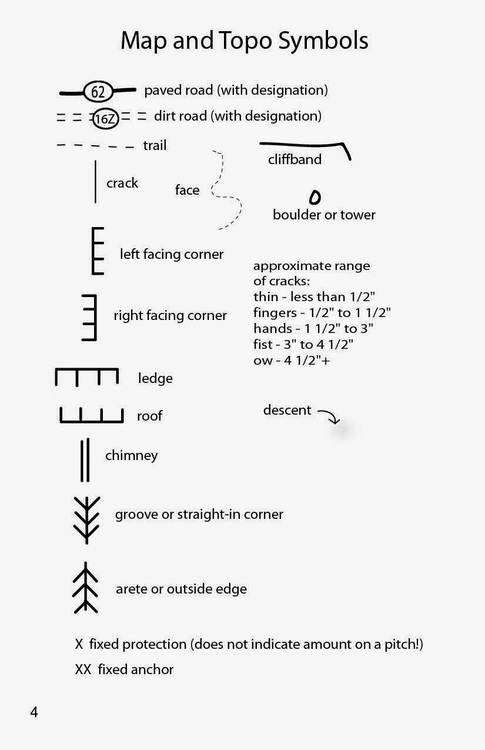
I'm having trouble understanding the lines on multipitch topos. Such as the ones placed drawn along the crack or an arete. Anything I should know when reading one?
|
|
|
NegativeK
·
Jul 14, 2018
·
Nevada
· Joined Jul 2016
· Points: 40
Ryan U. wrote: Anything I should know when reading one? 1) Topos aren't perfect. 2) Topos are still more perfect than me. 3) I've become confused as fuck looking for a bolt, when it had been chopped in the 15 years since the topo was published.
|
|
|
Fail Falling
·
Jul 14, 2018
·
@failfalling - Oakland, Ca
· Joined Jan 2007
· Points: 1,096
Ryan U. wrote: I'm having trouble understanding the lines on multipitch topos. Such as the ones placed drawn along the crack or an arete. Anything I should know when reading one? The lines “placed drawn” on cracks aren’t cracks, those lines indicative it’s a corner. The lines on the arete are telling you it’s an arete.
|
|
|
Gunkiemike
·
Jul 14, 2018
·
Unknown Hometown
· Joined Jul 2009
· Points: 3,762
kevin deweese wrote: The lines “placed drawn” on cracks aren’t cracks, those lines indicative it’s a corner. The lines on the arete are telling you it’s an arete. Like this:
|
|
|
Ryan Underwood
·
Jul 14, 2018
·
Laguna Hills, CA
· Joined Sep 2015
· Points: 55
Thanks! It was the lines that represented corner systems and grooves vs arete that I didnt understand. The map legend is exactly what I needed!
|

 Continue with onX Maps
 Sign in with Facebook