
 Continue with onX Maps
 Sign in with Facebook






Clove Hitch Climbing Anchor


|
|
Thanks for that and for taking the time. To be fair, we have to say the likelihood of such a cut occurring is pretty infinitesimally small. This is the image from the accident posted by Marc above: 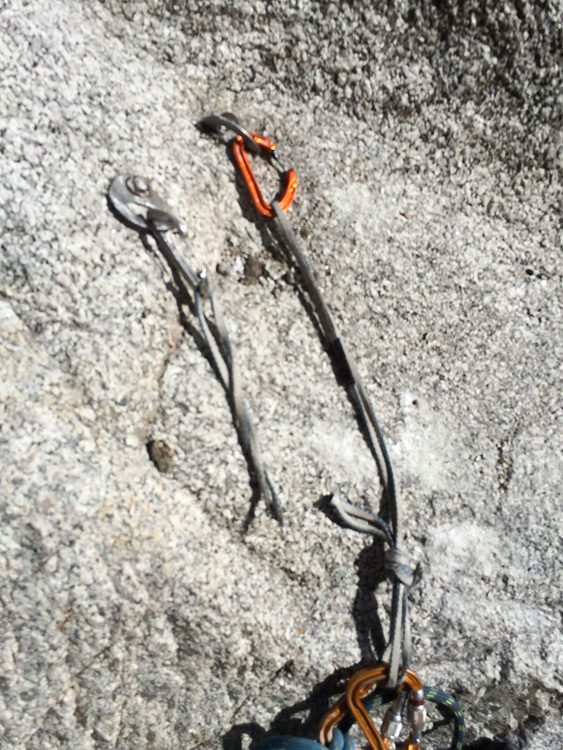 Rock fall has severed one end of the sling and the accident analysis cites this as an example of "redundancy" saving both their lives.... Well, that is true, but in reality this is just plain dumb luck. The rock(s) in question could just as easily taken out the master point or the rope of one of the climbers etc...really its just an act of God/Gaia what have you that this didn't end tragically. There is no solution that we have that is any better or worse really when you are rolling the dice like this. A lot of people just end up dead in such an event. BUT, if the rope was also tied into one or both bolts and you were using a sling like this with a master point for organizational utility or a (cumbersome) party of 3 it could only be faulted as over kill most of the time and unnecessary, but utterly bomber. My concerns are more the forces on the anchor in falls and simplicity/efficiency. This sling business is simply making for one more thing to carry that adds very little for people that know how to use a rope and I believe people are not using it like they should. What would it take to also throw the rope into one or both bolts with a clove hitch? Seconds. How long to make an identical master point with the rope? 30 seconds tops. Use the rope instead unless you have (insert your own definition here) you have pressing need for more organization and you are unfamiliar with using the rope to accomplish your anchoring needs. When free climbing this is just an example of a solution in search of a problem, imo, for people other than Guides. People just can't grasp they are using more and more gear to cover up they don't know what they are doing and they could be using simpler tools and carrying less when they do know what they are doing. |
|
|
Kyle Tarry wrote: No, I think a lot of people have to tow others up stuff. Doesn't mean for a second that they need to treat their second like a child and use unnecessary gear. Look at that anchor above. Why isn't the rope tied into one (at least) of the bolts as well? If I saw anyone tied in like that I would know immediately I was dealing with inexperienced climbers, or the even worst phase: When you think you know what you are doing but you don't. |
|
|
Kyle Tarry wrote: 1. You ain't Will Gadd bro. Or Haley and Cordes trying to do Cerro Big Ass Alpinism. You are trying to learn to understand your tools and stay safe. 2. So guides climbing like guides? Who knew? lol Guide certification means fuck all for actual experience and had ZERO to do with this accident. Honestly, and not trying to belittle anyone but "certified guide" as something significant would lead to LOLs in my circles. Lots of noobs pass an AMGA course, it means nothing. The rope should at least also be tied in. If you grasp that you will learn something. Why didn't they? Only being comfortable with "good enough usually but very, very nearly wasn't in this case" explains it. Hopefully they have learned something and survive the "think they know what they are doing but actually don't phase" or chalk it up to Karma....And smile. We are trying to have a discussion about "ideals" not trying to brow beat anyone. :) PS Note Will Gadd actually directs you to tie in with the rope directly in his article and demonstrates how efficient and fast it is... |
|
|
Ryan Swanson wrote: Ok. Harumpf™ Its a dialogue. I ain't writing a textbook here. ps lol Freudian slip. |
|
|
I find rope anchors inconvenient when block leading (especially with inexperienced partners). pre-tied quads are pretty slick on two bolts... Not much to do with more or less safe, just has to do with convenience. |
|
|
King Tut wrote: Thanks god you're not the one writing the textbook, you come off as narrow minded douche. Maybe one day we'll meet in person and I can confirm or debunk this, though I'm probably not 'cool' enough to hang out at any of the places your circle hangs! I knew the guide hate was coming from you at some point! There is absolutely nothing wrong with their being an organization making sure those that call themselves guides meet a minimum standard, nearly every industry has some sort of regulatory organization like this, and it keeps the government out of our business. The minimum standard of competency in different areas obviously changes based on the terrain you operate in, I think the AMGA does a great job of making the minimum standard high enough to ensure guides are competent in the terrain they're certified for. Most badass climbers pre sponsorship era, did some guiding at some point Jim Bridwell, Lynn Hill, etc. Being a guide doesn't make you a badass, but many guides are badasses. |
|
|
sean o wrote: This might be my favorite post of all time. |
|
|
DrRockso wrote: No dude, what I am is plain spoken. "Certified AMGA Guide" doesn't mean shit which is all I posted. Nothing wrong with working guides. Nothing wrong with the leadership of the AMGA and their goals of having some kind of certification for them. However, claiming that the possession of AMGA Guide Certification is some sort of qualification of expertise is sorely mistaken. Look, its pretty damn simple and I can't say it any more clearly than Jim Titt: "Get strong anchors and tie yourself to them." And DMM et al or John Long or Will Gadd or Mark Hudon or anyone that knows what they are doing "ideally you always tie in with the rope". And lastly, from me: "Stop carrying a bunch of macrame and lockers that you are using to mask that you don't know what you are doing." Now, why would I say that? Because in my experience teaching beginners to build anchors they think equalizing a bunch of shit with a cordallette is how you build an anchor. Instead, I ask that they leave all that bullshit behind and concentrate on getting strong placements or learning to recognize bad bolts and backing them up and how to get bomber gear placements and if not, keep trying. Once they have strong placements I really don't care how they tie themselves to it as long as the rope is connected at more than one point. But they need to learn good from bad gear placements/bolts before macrame. This is consistent with the teaching I have seen from anyone I have ever seen that knows what they are doing. Some quad or cordallette or clove hitched sling is not going to save your life. Only strong placements will (leaving aside acts of fate like we have seen images of in this thread where in reality, despite a cut sling, a strong bolt is what really saved their lives). Take it or leave it. |
|
|
Actually... that's precisely what it is, at least within the scope of skills and terrain that the particular certification tests for. This doesn't mean that person is more knowledgeable necessarily than someone else, but it does hold clout with many people since it's an industry recognized organization with set standards on minimum levels of competency, among many reasons, this is one of the reasons everyone isn't just using pirate guides. I've climbed with many people who have claimed to have "been climbing for 40 years", it can range from someone who is extremely knowledgeable to "I climbed once 40 years ago and need help tying my figure 8 knot" How long someone has been climbing isn't always a good indicator of experience or expertise, personally I'd be much more interested in what routes they've done, how many el cap routes they have under their belt, etc. Imagine you go to the mechanic with your nearly new Toyota Prius, the mechanic say's he's been turning wrenches for 40 years, "Ok great?" Have you worked on this model car before? Are you up to date on the new ways things were engineered in the Prius? Have you been a good mechanic for 40 years or were 38 of those years spent working on cars in your backyard garage? You're really making stretches with this always tie in with the rope thing and muddying the waters the way you explain it. I would say I always do tie in with the rope, cloving into the powerpoint I've built with other materials sometimes, and not tying DIRECTLY to the anchor with the rope. I'm still tied in with the rope and retain the dynamic properties of the rope, DMM's test were primarily aimed at people using slings as personal tethers connected directly to the anchor with no rope incorporated. Don't use slings (especially dyneema) for applications in which large amounts of slack might build up in the system in which no rope is incorporated. That is absolutely all the DMM tests proves, and your constant extrapolation of the findings beyond what is correct or likely intended by DMM is concerning. If the rope is the strongest thing "evah" then why don't you connect directly to the cam loop instead of using the pre-sewn sling on the cam, the answer is very simple because the sling is suited for the application, just as using a sling to connect two bolts is. Has anyone ever described you as being dogmatic? |
|
|
Welp, can't help you there. Guide certification is passing a course, not actually climbing much of anything. Should a working guide have AMGA certification? Sure, clients can reasonably expect that. Does AMGA certification mean you have some expertise? lol? Lotsa kids have their parents pay for the course and pass and haven't climbed a thing of consequence. AMGA Certified Guide! LOL. Seen it. I can't post my own climbing resume without sounding even more like a dick so, sorry? Here, read this thread: https://www.mountainproject.com/forum/topic/112361618/how-do-you-escape-el-cap ps I get it. You take from the DMM video precisely what you want because you don't want to take home their real point which is at the 8:30 mark or something. The point of their testing is to demonstrate the worst case scenario when using slings for your anchors and documenting the stress they put on the anchors, slings and humans. That is why they say "and this is why you would ideally always tie in with the rope" both to prevent people from belaying off of a PAS of one kind or another and to take advantage of the rope as much as possible to spare your anchors and humans. |

|
King Tut wrote: Not really wanting to get into this fray, but just for clarity sake, you do realize there are several different levels of AMGA certification? It's a bit disingenuous to compare a SPI to rock or mountaineering guide. |
|
|
I don't like that clove hitch idea, because there is no master point. |
|
|
Kyle Tarry wrote: ROFL. "You have led 10 traditional climbs rated 5.10a or harder on various rock types (single or multi-pitch)" "Multiple days of outdoor guiding...." Sounds really neat! "The RGC trains aspiring guides on routes up to Grade III and 5.9 while emphasizing risk management and client rewards." I stand corrected LOL. Those are some real credentials lol. Yea, dude. I get it. Its a frickin course. I don't care how long it is. That you are impressed by this is kinda sad. |
|
|
King Tut wrote: You could sound more like a dick than you already do? Hard to believe. You are stuck in the past and that's OK. But thinking that your way is the best way is narrow-minded. Dyneema anchors with a masterpoint are unsafe? As Jethro Tull said, "Living in the Past." Kyle, why are you continuing to argue with Tut? You won a long time ago, but you're not going to convince him. Give it up! |
|
|
King Tut wrote: Um, as a reminder, do you recall me, you, and others saying a number of times that there is little room in climbing for absolutism? Don't you think there's a worthwhile middle ground between totally discounting any kind of guiding certification and genuflecting before the mighty AMGA certified guide? Sure, like any field of endeavor, there are mediocre/not-so-good certified guides. There are also a crap ton that any of us would trust our lives with. "Routes up to Grade III and 5.9" may not be impressive guide credentials to/for you, but they certainly are fine for teaching people who have never led a pitch. I get your point about not being automatically impressed with "certified AMGA guide", but at this point you're really taking it to an illogical extreme. |
|
|
DrRockso wrote: P.S. in my hometown they call it the "Cincinnati Bowtie." I will not be "wearing" one thankfully, but if you want to I don't judge. |
|
|
For many of the climbers who know about origins of the club; the formation of the AMGA, it is hard to accept that they have upped their game - they have. For the last 20yrs the AMGA has been doing an excellent job at all levels, and should be proud of the way the work they have done, has changed the perception of American guides. The best way to appreciate the AMGA is to ask if you and your AMGA, certifications will be accepted as credentials internationally. |
|
|
Seems like this might be a good way to create a masterpoint when using a snakeloop with a 3 piece anchor. Anyone see downsides besides those already discussed on a 2 bolt anchor? Seems to me that this might help in situations where you are setting up a toprope and can't really reach where the masterpoint will be from say the top of a boulder (very common scenario when setting up topropes at my home crag). |
|
|
Michael Schneider wrote: AMGA certifications are accredited internationally with the International Federation of Mountain Guides Association after both the rock, alpine, and ski guide certifications are attained. I suspect individual terrains are not dual accredited because many European guides work across multiple terrains. |
|
|
WTF who spoiled our fun :( ? |


