|
|
Stever
·
Feb 8, 2018
·
Vancouver, CA
· Joined Nov 2009
· Points: 56
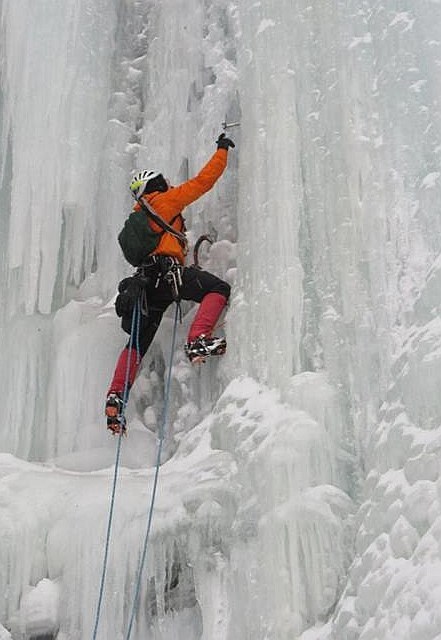
How should I position my body to apply adequate inward pressure on the screw on vertical ice? I understand on ice less than vertical I can easily use my weight to push into the ice and get the screw started. On vertical ice, am I pulling on the tool while pushing the screw? I felt off balance while trying to push the screw in- I felt like I was pushing myself away from the ice instead of pushing the screw into the ice - any suggestions on what I can do to prevent this?
|
|
|
Highlander
·
Feb 8, 2018
·
Ouray, CO
· Joined Apr 2008
· Points: 256
Triangle body position, good solid feet. Place screw at hip level, elbow to you side, engage core push hips in and can use hip to help start the screw.
|
|
|
FosterK
·
Feb 8, 2018
·
Edmonton, AB
· Joined Nov 2012
· Points: 67
This sounds like you're either reaching too far to the side to place the screw or have poor core control. Do not place the screw outside shoulder width, and engage your core. You shouldn't feeling like your're barn-dooring off. Additionally, this should only be to get the screw (securely) started - after that you can relax and use the handle.
|
|
|
Paul Morrison
·
Feb 8, 2018
·
Unknown Hometown
· Joined Nov 2006
· Points: 55
Steeper ice = sharper screws
|
|
|
Gunkiemike
·
Feb 8, 2018
·
Unknown Hometown
· Joined Jul 2009
· Points: 3,732
All good advice here. I would add that you can counter the barndoor tendency by reaching across your body line i.e. if you're placing a screw with your R hand, hang on a tool that's placed roughly above your R shoulder with your LEFT hand. And as Foster said, don't go far out to the side; that just puts more torque on your body.
|
|
|
Allen Sanderson
·
Feb 8, 2018
·
On the road to perdition
· Joined Jul 2007
· Points: 1,100
With todays screws it does not take too much effort to get a screw started and in deep enough to have the threads hold. As others have said it is all about body position and some patience. Anymore I typically do not place screws more than tit high as any higher it is harder to get enough force to start the screw.
|
|
|
Gunkiemike
·
Feb 8, 2018
·
Unknown Hometown
· Joined Jul 2009
· Points: 3,732
Allen Sanderson wrote:With todays screws it does not take too much effort to get a screw started and in deep enough to have the threads hold. As others have said it is all about body position and some patience. Anymore I typically do not place screws more than tit high as any higher it is harder to get enough force to start the screw. Your first sentence doesn't seem to jive with your last sentence. I place screws overhead quite frequently FWIW.
|
|
|
MyFeetHurt
·
Feb 8, 2018
·
Glenwood, CO
· Joined Oct 2011
· Points: 10
Lets assume you are placing a screw with the right hand. Your right foot should be solid and weighted, sometimes this can be achieved easily by pointing your right foot rotated clockwise enough that you can actually stand on your heal instead (takes a little flexibility, but gets you off your calves and toes). Now, your right foot acts as a pivot for your body. Your left foot/toe pushes out which rotates your body around your right foot (weighted and centered), and allows your right hand to push in toward the ice. All this while using a high left tool for balance. Try to place the screw between the nipples and navel. In rock climbing terms, the left foot is lightly "flagged."
|
|
|
Allen Sanderson
·
Feb 9, 2018
·
On the road to perdition
· Joined Jul 2007
· Points: 1,100
Gunkiemike wrote:Your first sentence doesn't seem to jive with your last sentence. You are correct, what I was trying to say is that once one goes overhead that one has less leverage to seat the screw. In especially hard ice and not enough leverage the screw will grind away the ice rather than cut into the ice. Thus making it harder for the threads to catch and place the screw.
|
|
|
Gunkiemike
·
Feb 9, 2018
·
Unknown Hometown
· Joined Jul 2009
· Points: 3,732
Allen Sanderson wrote:You are correct, what I was trying to say is that once one goes overhead that one has less leverage to seat the screw. In especially hard ice and not enough leverage the screw will grind away the ice rather than cut into the ice. Thus making it harder for the threads to catch and place the screw. I agree with all that (and figured that's what you meant to convey). My screws tend to be ridiculously sharp, which is a big plus for my overhead antics. I also find that the original Grivel 360 hanger is good for overhead work; it's almost like screwing in a light bulb.
|
|
|
ROBERT LOOMIS
·
Feb 9, 2018
·
SPOKANE
· Joined Aug 2012
· Points: 82
Hi Stever & Others, Many others have given you good advice, but I have one more suggestion to add. That is, practice getting proficient at threading in your screws with either hand. It is not uncommon on challenging routes to find that you are nearly forced or outright forced to place your screw with your non-dominant hand from your non-dominant side. If the pitch is easy (smooth, uniform ice, good bumps/stances to stand on, etc.) then no, this will seldom occur. But on tougher pitches (overhangs, weird mushrooms to get around and over, heavily featured ice, etc.) then this is more likely to occur. For instance, I am right handed and tend, more naturally, to do things from the right side of my body (kind of like being right handed means being more coordinated at throwing a ball from one's right side). Knowing this, and knowing how tough pitches of ice do not always give me what I want in the way of a stance that favors my right hand and side, I regularly practice threading in screws with my left hand from my left side. I do this every year to remind myself. I will typically do this a few times just standing on the ground, then a few more times on an easy pitch and then more times on tough pitches. Sometimes I do this on lead even when I do not need to. Practice pays off over time. There has been a time or two when this practiced ambidextrous screw placement skill saved my skin. Too often I see ice climbers who can place a screw only one way. In my opinion (I know it is just my opinion) this is too limiting and potentially dangerous on tough leads. I also feel the same way about placing gear on rock. In sum, a lot of good people have given you some good suggestions and in a kindred spirit I offer you mine. I hope it helps. Cheers, Bob Loomis, Spokane, WA.
|
|
|
Stever
·
Feb 9, 2018
·
Vancouver, CA
· Joined Nov 2009
· Points: 56
Thanks for the responses everyone. Great info and a lot to consider next time I'm out. Glad it was a question well received...wasn't sure if I was missing something obvious Cheers!
|

 Continue with onX Maps
 Sign in with Facebook