
 Continue with onX Maps
 Sign in with Facebook






Glacier travel with ergonomic tools (e.g. nomics)

|
Wondering what people are doing for glacier travel when they're carrying ergonomic tools like nomics or x-dreams (ergonomic grip, no spike, possibly no adze) for the objective. I've tried a couple of strategies: 1. A nomic with a less technical tool (e.g. sum'tec or quark) for less difficult climbs. 2. two nomics, at least one with an ice pick and adze so I can actually grip in self arrest mode (the mixed pick has teeth in all the wrong places for piolet cane mode), and make do, but then there's no spike which has really sucked at times (e.g. walking down the arete on the Aiguille du Midi to get the Valle Blanche). Could perhaps mix and match a spike-less tool like a nomic with another mixed tool that has a spike (e.g. BD fusion/fuel), but never tried this. 3. Two nomics and a mountain axe for when there's a lot of glacier travel followed by harder technical climbing. For anybody who's tried this, what mountain axe do you prefer? One option is to go ultralight (e.g. camp corsa/nanotech) another is to go with a tool that could double as a third tool in a pinch (e.g. BD venom or petzl sum'tec), and finally the last option might be to use a ski pole with a self arrest grip (e.g. BD whippet). Thoughts? There must be other strategies out there. It seems that Ueli Steck only ever climbed with a pair of stripped down nomics with mixed picks, which is a combination that doesn't make sense to me (e.g. see here for a partner climb on the north couloir of the dru, which involves some glacier travel on approach: https://www.youtube.com/watch?v=tT3hyLvYNNo; neither climber has an axe that would work well for self arresting on the glacier) so wondering what people have seen or tried that I might not have thought of. |
|
|
What's the problem with just walking across the glacier carrying your nomic? Personally, this is when I opt for a more traditional tool like the Grivel North Machine Carbon. I filed off the teeth on top of the blade/head and it works great. |
|
|
They're not ideal for self arrest due to the shape of the pick (reverse curved, more likely to bounce when trying to arrest), short lever arm and it makes it impractical to use two mixed picks on them because of the teeth on the top (grip a nomic with a mixed pick in self arrest possition; the spikes bite into your palm the spikes on the underside bite into your fingers. Probably not realistic to imagine you could hold on to that as you're being dragged across a glacier and trying to arrest your partners crevasse fall). Sure you can file them off, or better yet use a pick without teeth on the top, but those teeth are nice for mixed climbing. There are certainly scenarios where just using the nomics for glacier travel is fine (see no. 2 above), but there are also times I'm not satisfied with that. For instance, most recently I was attempting some early season climbs in the alps, the glacier was sometimes windswept and dry, othertimes wind drifted and I had to put on snowshoes to avoid wallowing. In between there were places with very thinly covered crevasses, making the prospect of a crevasse fall greater than normal (actually went up to my armpits in one), and making self arrest more difficult due to the potentially icier surface. In this case I wasn't comfortable carrying just my nomics and also brought a basic axe for the glacier travel part. This experience is what inspired this line of thought on the topic and this post. |
|
|
I think ultralight axes are the way to go here. The one that has really caught my eye is the Petzl Ride. 8oz or so, with a steel head so it should have no problem self-arresting or cutting steps (unlike the Corsa). |

|
When carrying two ergonomic tools on a glacier, I usually carry both tools, using the high pommel, or one tool in the self-arrest position with both hands. 2x 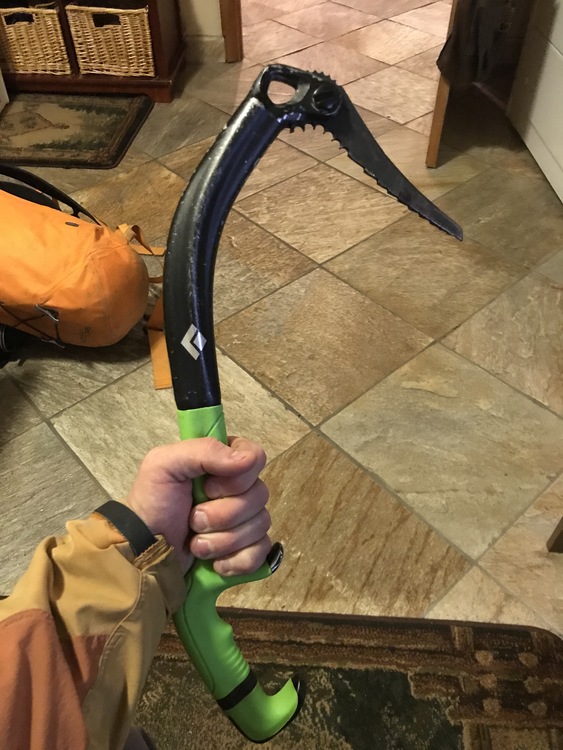 or 1x 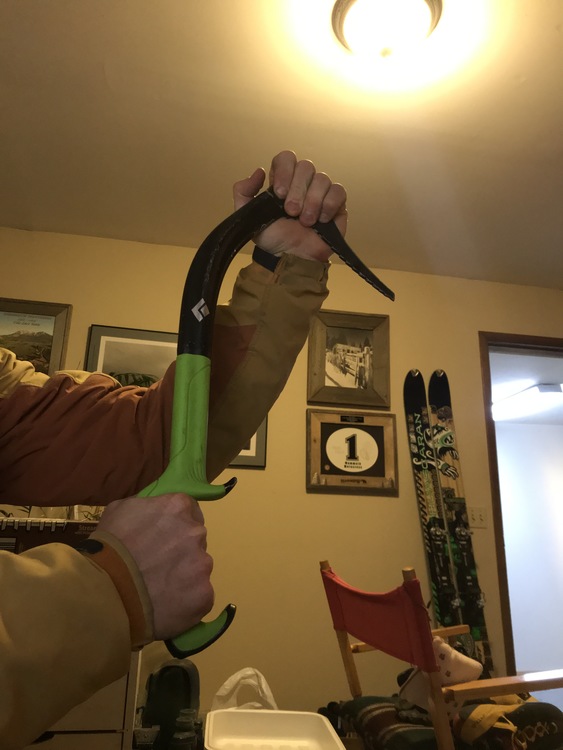 If those two options are unlikely to work for self arrest and the probability of dangerous crevasse fall is high, then I use anchored belays. It is not common for a wet glacier to be steep enough that I cannot self-arrest, yet shallow enough that it is not practical to actually be daggering into the glacier and maintaining 3 points of contact. On a dry glacier, self-arrest is generally not realistic, even with an purpose built ice axe. Using one technical tool and one hybrid ice axe/tool is common practice for many routes. For what is worth, I have never carried a third axe for self-arrest, nor have I seen anyone else do so. |
|
|
Self arresting with an aggressive tool is a lot harder than I imagined until I had to do it. Not ideal whatsoever. I’ve never actually self arrested with my Grivel North Machines, but the pick seems to have less of a reverse curve than other technical tools and even some hybrid tools. I feel more comfortable walking around with those than, say, X-dreams. |
|
|
Don't bring a third tool. Karl nailed it! |
|
|
Self arresting with an ice tool is a great way to blow up your shoulder. Only do it if you have to. |
|
|
Kevin Mcbride wrote: While there is a greater risk of injury, in my opinion, it is better to practice self-arresting with ice tools in incrementally more challenging conditions to find out what your limits are. When practicing, if you feel a high stress on your shoulder, immediately let go to avoid injury. Figure out what your personal limits are in a safe area, so you can then make good risk management decisions in high-consequence terrain. If I need to two ergonomic ice tools to climb something (sustained vertical or overhanging), carrying a third ice axe is probably going to add significant weight and bulk and increase my risk of falling. |
|
|
Karl Henize wrote: Don't practice with an ice tool, thats a shit idea. I've had to self arrest with a tool and it's not a whole different strategy than a standard self arrest, you just have hang on way fucking harder and pray your shoulder doesn't dislocate. Also it's kind of hard to tell when your shoulder is going to dislocate, it's typically somthing that happens almost instantaneously, so letting go when you feel it start to go is extremely difficult. And if and extra 300 grams is going to make you fall then you should probably get better at climbing. |
|
|
Context dependency matters. If you're crossing a glacier with two tools, you're implicitly stating that the risk of falling while on the challenging climbing ahead outweighs the risk of a crevasee fall; you've selected your equipment accordingly. If that's not true, adjust your plan. There are strategies to help manage this if you go with two tool (and no axe). 1. Consider tools that do reasonably well at both (BD Cobra, Petzl Quark, etc.). Practice self-arresting with these tools as required in advance. 2. Put stopper knots in the rope for glacier travel (works for wet glaciers). 3. Pitch and belay appropriately to increase security. 4. Solo the glacier as appropriate (often on dry glaciers). Note that glaciers get skied unroped quite frequently and many climbers don't rope up for snow climbing. This implies that you've decided you're just not going to fall in (to a crevasse) or off (the slope/mountain). If that's the risk management decision, self-arresting becomes a moot point. On a dry glacier, you can often identify all the crevasses so that hazard can be significantly reduced by solid route finding. Similarly, if the glacier is dry, you're not likely to do well self-arresting your partner anyway, so it's far better to just not fall and/or pitch it out. For cutting edge ascents, these ideas often predominate, so you take two ergonomic tools for the hard climbing, sink your pick if you need a belay before a self-arrest ever becomes necessary, and avoid the crevasses with solid route finding borne from years of experience on a glacier. If conditions don't permit these tactics, you wait for better conditions. This might increase the overall hazard, but then again, so does speed soloing. |
|
|
I have done a lot of glacier travel with short tools. It is not any big deal as in general glacier travel is low angle so I am not worried about self-arresting per say. By that I mean I might need to plant a tool but it is not going to happen with much sliding. More often than not I'll be on a glacier with a ski pole and a tool or another ski pole. In the video posted they skied to the base of the Dru. There is not that much glacier travel involved from the Montenvers Station. The real question that is worth asking is how does one travel to the base of a climb with technical tools that can not plunge where one is on steep terrain where one may take a tumble? Which is really the question I think the OP is asking about. Watch the video at 12-15 seconds. Low angle swinging. Blah but it works and if you slip one is already in a position to arrest. But as others have said technical tools have an aggressive bite. |
|
|
As mentioned above, I do believe that a tool that can plunge is appropriate on that sort of terrain. Basically, the tool needs a spike. For example, I personally would not find Nomics appropriate for a glacier situation. |
|
|
A cool trick. I used nomics for a while at work and you can turn it upside down and use the pick top most point that sticks out as a spike to walk with. You keep a finger under the finger stop on pommel and rest of palm on the end of pommel,, like your holding a t grip on a rafting oar. It gets good traction. Also you can definitely self arrest with it, it just requires a slightly more aggressive shoulder position and a big arch of the back, really trying to dig your shoulder in. Kicking is what's gonna help the most anyways. After all, worst case scenario you fall without an axe because you were to lazy to take it out for a short section, you dig your trekking poles tip in and use it as an axe in same fashion. Or if nothing, you use your elbows, but it's mostly the kicking in a self arrest in all but the hardest glacier hardpack, and even then, the hard glacier pack, a Nomic pick will bite enough with good solid kicks. Of course skill, experience, and frequency of practicing it with your own setup will be the most useful thing you can have in your toolbox. |


