
 Continue with onX Maps
 Sign in with Facebook






New to me Silent Partner. Some questions for the seasoned vets
|
|
I recently acquired a silent partner from a friend as well as he instruction manual. I have a few questions for those of you who have used this device. Is anyone connecting with a single maillon instead of two biners? is anyone carrying the slack rope in a pack instead of on their harness? If you are carrying the slack on your harness, where? How do you carry the slack and backup knots if doing the continuous loop method? Thanks Joe |
|
|
I use large d-shaped maillon I use the SP for aid, so the rope is in a bag at the lower anchor For free solo I use an Eddy with rope in back pack, with the back on my back Not sure what you mean by a continuos loop, unless it is with a haul line, and in which case the ropes would both be in bags at the lower anchor. And the backup knot on the non-protection side of the SP. |
|
|
Is anyone connecting with a single maillon instead of two biners? Short answer: Yes, but they shouldn't. Long answer: The Silent Partner is designed to be used with two (2) locking biners (as you'll notice in the manual pictured below). A single mallion or steel biner, though obviously strong enough, allows the two sides to rotate a bit which could lead to issues with the rope as it runs through the device. (I've used a single steel locker in the past and noticed this happen before I returned to just following the instructions from the manufacturer.) 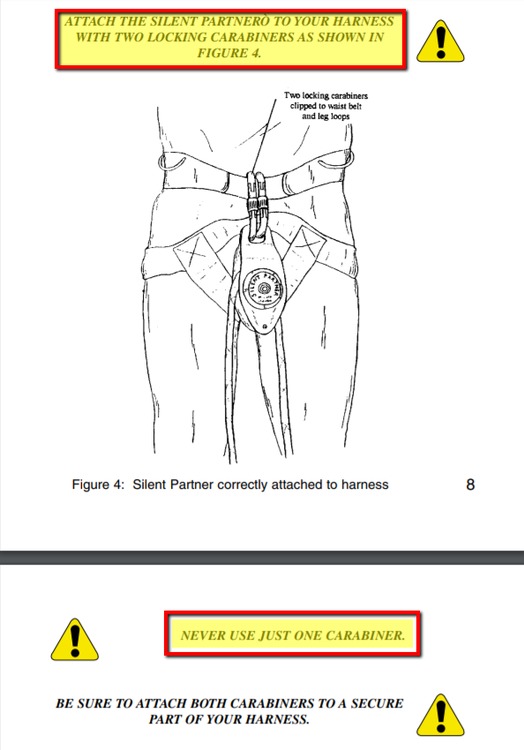 Is anyone carrying the slack rope in a pack instead of on their harness? Short Answer: Some do, some don't. Backpacking the rope is used more for freeclimbing than aid. Long Answer: In general, you'll see the backpack being used more for freeclimbing than aid so that you can move more quickly with less likelihood of the hanging rope loop getting snagged on things while climbing. In aid climbing, most will leave the rope puddled/flaked into a rope bag at the belay. By far the best method of connecting ropes is to use the continuous loop method of tying the end of the lead line to the haul/rap line with the end of the haul/rap line being tied into the anchor. this method allows you to move without the added weight of the haul/rap line on your person.  If you are carrying the slack on your harness, where? I only know one climber who carries ALL of the slack on their harness and he does this by preloading all of his backup loops before setting off (see picture). Almost everyone else will keep it in the backpack or down at the belay. EVERYONE will keep at least one loop of slack tied to their harness (or a pretied knot in the rope flaked in their bag - less common) to backup the system.  How do you carry the slack and backup knots if doing the continuous loop method? The slack is carried in a loop tied to your harness (usually 10-20' in length). You will always need at least one loop of slack going from your silent partner to the knot on your harness before the rest of the rope heads back down to the flaked rope at the belay below. |
|
|
Hi Kevin, What form did the issue with a single maillon take. Thanks |
|
|
David Coley wrote: You'll have to excuse the crappy MS Paint drawing as it's the best I can do at work right now. Basically, with a single mallion or carabiner, the top slot can slide enough for the rope to get jammed a bit in the space that provides (Yellow circle). Not a safety issue but I can imagine it happening during a dynamic movement which could be a bad time. Additionally, I noticed that the lower bars that come together when the device is locked were separated enough that I was worried that there could be the possibility of the clove around the clutch cylinder being loose enough to come out or get jammed. (Blue circle) This never happened to me and I actually doubt it would in 99.9% of situations, but then again, in these sort of things, something only has to happen once for that bad time to be the worst of times. 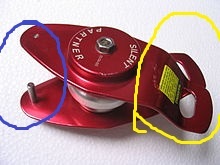 |
|
|
Long discussion here: https://www.mountainproject.com/forum/topic/106691846/silent-partner-leading |
|
|
The picture of the rope fully loaded on the harness had me cringe hard. Thanks for sharing |

|
Kevin knows his shit. |
|
|
Anyone have success with rope diameters less than 9.8 in the SP? Interested in the smoother feeding but worried about the clove not tightening enough to catch falls. |
|
|
Thanks for all the input. Kevin specific. Thanks for taking time to answer my noob questions. I'm looking forward to getting good with this device. Also, that link to the other thread covers a lot of useful terrain. Earlier this month i saw an aid soloist on the nose who was keeping up with everyone else no problem. That is the long term goal. |

|
Ryanb. wrote: Yea, I use a 9.4 on mine a bunch. It works great. Super smooth feeding and no problem catching falls. |
|
|
jlind wrote: Read up and make sure you understand the use of rebelays at least once a pitch. Additionally, for aid, where you'll be jugging the line afterwards, think of rebelays as a way to prevent you from having to jugg on a line going over a sharp edge by placing a rebelay BEFORE the offending edge. Does wonders for piece of mind when cleaning the pitch, works great for using hooks as pro, and will help prevent the weight of the rope hanging down to the anchor from backfeeding the SP.
|
|
|
Kevin - you mentioned a pre-tied knot flaked in the bag as a possible backup when backpacking. Can you clarify? Does the knot just jam the Silent Partner, or is it attached to something else? I've been considering starting to backpack when lead soloing, but can't figure out how best to backup the Silent Partner when using this approach. -Hamish |
|
|
Hamish Malin wrote: Note: I have never done this because I'm happy leaving the rope at the belay for both free climbing and aid BUT I've had it explained to me by those that have done it as well as consuming most of what I can find online, so take this with that grain of salt. Yup, the knot (overhand or something similar) is caught in the Silent Partner should the unspeakable become spoken while soloing with this method. Personally, I'm not a fan of this simply because the time it takes to untie a knot (which may come at an inopportune freeclimbing point if hidden in the backpack) can be fixed by simply using a clove on a locker on your harness (my prefered method) which comes undone much more quickly than untying a knot. Although, now that I think about it, one could fix that issue by using a biner and clove hitch left loose in the backpack instead of the overhand knot. This would then be just as easy to undo when it comes out of the backpack as a clove to a locker on the harness. hmmmmm. |
|
|
Yep, plus that biner would certainly jam up the SP. that's worth some more thought... cheers! |


