
 Continue with onX Maps
 Sign in with Facebook






Leaving quicklinks on bolts when bailing


|
|
EDIT: the discussion of quicklinks begins half way down page 1. (original thread title: "Backup for Texas Rope Trick (bail without leaving a biner)") 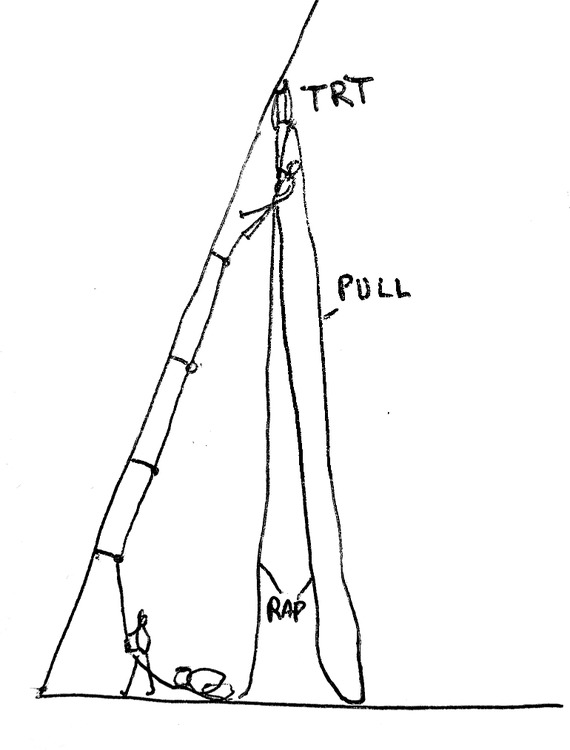 It occurs to me the Texas Rope Trick ( mountainproject.com/v/11022…) can be backed up. One just needs a rope 4x longer than the bail distance (or a 2nd rope). This limits the consequences of sling failure to a lead fall. To avoid having to climb the distance twice (or tag a 2nd rope end on lead), one might bring 15-20m of light accessory cord, so one can haul up the loose end of the climbing rope when needed. The accessory cord can be pre-tied to the loose end in advance, or the belayer can do it (if the belayer knows how to tie-off the belay). This is just an option to keep in mind - I have nothing against leaving a biner (with https://www.mountainproject.com/images/10/99/108671099_large_a48399.jpg backup) or stick-clipping one's way to the top. |
|
|
The rope would need to be 5x the bail distance. At the bottom of the descent you would have pulled the lead rope (the portion going up through the biners) back down to the ground leaving you with 5 vertical strands. |
|
|
John Wilder wrote: Oh right I'm an idiot |
|
|
A friend pointed out this can be optimized to work with 3x rope by using a friction hitch (shown in red) on one of the rappel strands (below the rappel device). |
|
|
If distance to the ground is a problem, you could lower to the lowest bolt you can reach, then go in direct, pull, and re-rig and continue downward. |
|
|
Kyle Tarry wrote: nah man it's just for spraying how 5.16 you are at your local gym |

|
Kyle Tarry wrote: No kidding. I have dozens of worn-out biners. Biners are consumables. |

|
These shenanigans are ridiculous. My time is worth way more than the $3 maillon rapide I carry for emergencies. Save your time, here's the link. You're welcome. For this cost, buy 2 |
|
|
Not very chill to leave rapide in the middle of a route yo |
|
|
Lou Cerutti wrote: I strongly agree. Leave a biner, even if it's a worn-out one. |
|
|
John Byrnes wrote: Who the fuck cares, next person up can clip it and remove it if needed. If its an emergency, use it. As the next climber, I would be happy to remove the piece as a service to the safety of the previous climber. A correctly made rapide is climbing safe (they are used in anchors) and is produced with material that doesn't corrode. They have the additional safety of locking closed over a standard carabiner. If you have random lockers sitting around, great use them. I carry a rapide because it is small, effective, and I won't use it until I need it. Regardless it is significantly safer than some janky system like the rope trick. If you want to be polite and use a carabiner, ok. But there is nothing wrong with a rapide |
|
|
Screwing a rapide closed tightly “in an emergency” seems pretty time consuming. Wouldn’t you just leave a draw or a carabiner? |
|
|
Idaho Ian wrote:(they are used in anchors) oh wow. “and is produced with material that doesn't corrode.” Not always true. Anyway... I think the context in which the OP is suggesting these shenanigans might be useful is a non emergency single pitch sport climbing type scenario. Rapide is nice for leaving on rap anchors that’s about it |
|
|
Or take up thick enough cord to rap on and long enough to reach between bolts. When need to bail, thread it through the bolt hanger (yur gonna die) to middle, and quickly thread through atc, remove draw, rap down to next bolt (or farther if cord is long enough) while belayer is taking in slack, full take, pull through cord from last bolt, repeat until on ground. It goes pretty fast, all you are having to do is setup an atc with short cord (no need to backup as belayer has you on "lead" belay) and do not have to leave anything behind or worry about using a friction hitch or have 4x/3x length of rope left. Obviously be mindful of where the cord is over the bolt hanger as it could easily damage your cord depending on the hanger and the middle section should be cut out if you use it for anything else or is damaged. |
|
|
Idaho Ian wrote: You should fucking care, because you're wrong. Here's why: 1) A rapide that was tightened under body-weight usually cannot be unscrewed by hand without weighting it again; assuming it's not corroded shut and needs to be cut off with a hacksaw. 2) A rapide often takes up so much space a biner cannot also be clipped through the hanger, you must clip the rapide. Rapides are often hardware store quality, and the smaller diameters are NOT rated for climbing. 3) Clipping the rapide changes the orientation of the quickdraw to the rope/wall, which is NOT the orientation you want for safety. A climber going for an on-sight is often fucked by some weenie who left a rapide. He can't unscrew it, he can't clip the bolt-hanger and has to clip the rapide, which can't be trusted to hold a fall, and his draw is perpendicular to the wall instead of parallel. A biner can be quickly removed, or even clipped.
Now this is total bullshit. A lot of "rapides" are low-grade steel purchaced in hardware stores and they corrode fast. A stainless one costs as much as a carabiner and is far heavier. The cheap, small diameter ones are NOT rated for climbing. Many of the ones I've seen left on routes are only rated for 250lbs. Sure, it's small and effective for YOU, but the next climber is screwed. LEAVE A BINER. |
|
|
John Byrnes wrote: 1. Never had that problem after removing multiple rapides in local areas, but you probably have experienced differently. Never had a corroded one either, albeit we live in the desert 2. I specifically said to using a climbing rated one... and gave a link to such. I never suggested a hardware store piece 3. Yeah, that's agreeable. There are also a lot of bolt hangers out there in the wrong orientation. 4. I don't get miffed about onsighting or needing to pull a piece that someone left in a bind. Again, if you feel like using a carabiner, go for it. I carry a climbing specific rapide and a bit of cord for random anchors when needed, so that is what I do and will continue to do. Someday when i retire some locking biners I may use them instead. |
|
|
Lou Cerutti wrote: Sure if you have a locking carabiner handy, why not. Personally, I wouldn't leave a standard draw or carabiner though |
|
|
Idaho Ian wrote: 1) I don't believe you. 2) Climbing rated rapides cost as much as a biner, and weigh more. So what's the point? 3) So you created safety issue right at the crux, and that doesn't bother you. Hmmmm. 4) Some people DO want to onsight at their limit, and they get pissed at weenies who leave rapides. Yup, you'll continue to be a PITA for other climbers. |
|
|
stolo wrote: Nice. Weak spots in old ropes tend to be 5-7m from one end, so when you cut off the end you get a free piece perfect for this application. |
|
|
Idaho Ian wrote: Wait, am I reading this right? You wouldn't bail off a non-locking biner, presumably because that's less safe, but you're willing to fuck the next persons climb by leaving a rapide? That's some handy entitlement. |
|
|
I don't mind climbing past bail 'biners, links, or whatever. It's a reminder that I can still climb better than somebody. |


