|
|
Kyle Taylor
·
Oct 23, 2017
·
Broomfield CO
· Joined Sep 2017
· Points: 0
eli poss wrote:Also, I grew up in Chattanooga and typically visit my parents there over summer and winter break. If you can make the drive, Chattanooga has some phenomenal climbing and I'd be happy to climb with you and show you the ropes (pun intended). yea hit me up man! I just started leading. I've been to stone fort, leda, yellow bluff and sand rock so far. Pretty impressed! I hate Atlanta but it is what it for now! thx
|
|
|
Lee Green
·
Oct 23, 2017
·
Edmonton, Alberta
· Joined Nov 2011
· Points: 51
jaredj wrote:I like the "feature" of this method of not having to untie a knot once biner(s) are removed from the master point. One question I have is the usability / wisdom of this setup in a "leading in blocks" multiptich context where a second is brought up, and then connects into the master point of the anchor - in this situation, the "middle" of the clove hitch. Is it easy / not sketchy to just work some slack into the hitch to create space for a second biner to go in (I'm assuming it isn't a hanging stance since then this would be impractical)? I don't know. For the scenario you describe, and for multipitch sport, I typically use what the Association of Canadian Mountain Guides calls a "fixed point belay anchor". It's a bit more complicated so I pre-tie it. If I were using a clove hitch anchor I wouldn't have the extra person clip to it, I'd have them put their own slings through the biners attached to the bolts. No reason one can't do two clove hitched slings, each with its own master point.
|
|
|
David Gibbs
·
Oct 24, 2017
·
Ottawa, ON
· Joined Aug 2010
· Points: 2
Dan Africk wrote:Dyneema vs Nylon doesn't really matter much- knots drastically reduce the strength of either material, but the benefits of a master point or limiter knots far outweigh this academic concern. The idea of 'never tie knots in dyneema' is a silly notion that result from taking one factoid out of context and blowing it out of proportion and shows a failure to understand the broader concepts of anchor building and realistic risk factors and pros and cons of various techniques and materials. There is one concern on nylon vs dyneema for knots -- but not a safety concern in the TR situation. It is generally a lot easier to untie a knot in nylon than dyneema after that TR anchor has been weighted a few times by people flailing around on TR.
|
|
|
Gunkiemike
·
Oct 24, 2017
·
Unknown Hometown
· Joined Jul 2009
· Points: 3,762
David Gibbs wrote:There is one concern on nylon vs dyneema for knots -- but not a safety concern in the TR situation. It is generally a lot easier to untie a knot in nylon than dyneema after that TR anchor has been weighted a few times by people flailing around on TR. True. I clip a notchless biner through the knot when using Spectra/Dyneema for this. Makes it trivially easy to untie the knot. Also, know that an overhand is harder to untie than an 8 knot, all else being equal.
|
|
|
Dan Africk
·
Oct 24, 2017
·
Brooklyn, New York
· Joined May 2014
· Points: 275
David Gibbs wrote:There is one concern on nylon vs dyneema for knots -- but not a safety concern in the TR situation. It is generally a lot easier to untie a knot in nylon than dyneema after that TR anchor has been weighted a few times by people flailing around on TR. I'm not so sure about this.. Nylon stretches more, so if anything I would expect the knot to get tighter. I suspect it has more to do with the size of material you're using- thinner materials will make a smaller and tighter knot than bulkier materials. A bulky nylon sling is probably easier to get undone than a super thin dyneema one, but I think that's more to do with size. I use the more burly Bluewater titan slings, and while they can get pretty tight, I haven't had much trouble undoing a figure-8 knot in them after being used as a top-rope anchor. I definitely agree with using a figure-8 rather than an overhand if possible, much easier to untie. If it's really a major concern and you're familiar with the alpine butterfly knot, that would be an alternative that's secure and much easier to untie. But most rock climbers I know aren't very familiar with it, so you are risking a knot that is potentially more difficult to inspect and probably more likely to be tied incorrectly. You can also use a figure-9, it's pretty messy but I use it occasionally, mainly if I need to take up material to make the master point higher. But I only really do that with a cordelette.
|
|
|
Nick Drake
·
Oct 24, 2017
·
Kent, WA
· Joined Jan 2015
· Points: 651
If the sling is draped over a lower angle section on the top out of a pitch there is one other consideration for a sling vs. cord, abrasion. Remember on a sling when you abrade a sling you're directly damaging the load bearing material. With cord you're just wearing out the outer cover, core is still fully intact once you've cut through it. I doubt you could destroy a nylon sling in one day of TR use no matter how hard you try, so not really a safety concern but more of longevity. In one weekend of instructing on lower angle granite slabs I had a nylon sling get ground up enough to retire it. Cord seems to hold up to the abrasion better.
|
|
|
Brandon.Phillips
·
Oct 25, 2017
·
Portola, CA
· Joined May 2011
· Points: 55
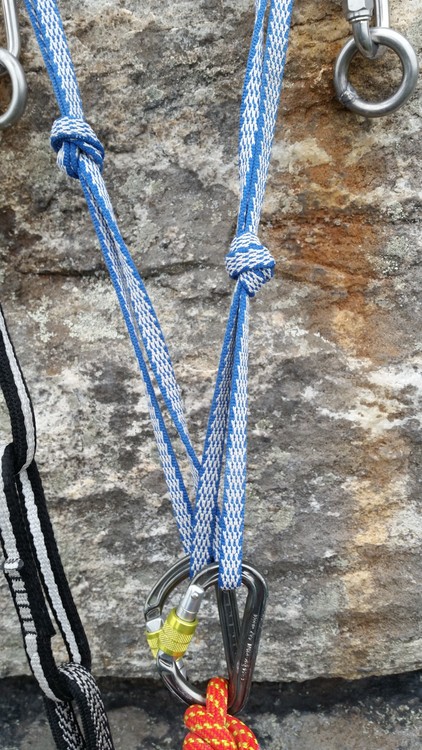
If you have load limiter knots, you don't need the "X". Two knots will give you two strands enclosed between them. Put one carabiner on each strand and toprope through both.
|
|
|
Josh Gates
·
Oct 25, 2017
·
Wilmington, DE
· Joined Mar 2017
· Points: 5
Brandon.Phillips wrote:If you have load limiter knots, you don't need the "X". Two knots will give you two strands enclosed between them. Put one carabiner on each strand and toprope through both. If one of the middle strands fails, you'd still have the other, but wouldn't a biner rocket down the rope, either towards the climber or belayer? Why _not_ twist it?
|
|
|
Josh Gates
·
Oct 25, 2017
·
Wilmington, DE
· Joined Mar 2017
· Points: 5
Michael P wrote:When using a setup like this on a multipitch sport route, I like to use the pretied anchor to extend my rappel: - One anchor-leg clipped to my belay loop, atc on a locker at the master point, other anchor-leg clipped to the bolt at the rap station.
- Rig the rappel, double check and weight the atc, unclip the leg from the anchor bolt and clip it to my belay loop for some more redundancy.
- Rap down and repeat
Comes with all the advantages of extending your rap and doesn't take any set up time. That sounds intriguing, but I'm not quite following. Is this what you do when you reach the anchor and are cleaning and rapping down?
|
|
|
Eric L
·
Oct 25, 2017
·
Roseville, CA
· Joined Jan 2015
· Points: 260
Josh Gates wrote:Any issues with using a (nylon or dyneema) double-length sling (sliding x with limiters) for a two-bolt anchor, either on TR (where there's no issue with rope or biners running over an edge, so no static line build needed)? I usually use a quad or a sliding x with limiters made from 7 mm cord, but the slings are more compact, and I'm curious. jg I have a sliding X, with knots and lockers, on a 120cm nylon sling which I use as my TR anchor. It's a dedicated piece of equipment for me. Works great. I like the nylon for the shock absorbing quality, although with TR the rope will take much of the force. Dyneema will work fine but is harder to untie after being weighted (smaller knot). I tried and don't use the quad because of it's bulk and because it's more of a specialty item than a sling (which can be used for extending placements too). I don't use draws because of the lack of lockers (if you are using it multiple times) and the angle can pull more sideways on the bolt - slings and cord extend further downward in the direction of pull. Lots of people use draws (and don't die), but starting out on TR I'd stick to a dedicated anchor (at least use slings and lockers). Get John Long's book on anchors - it's a little dated but is still a good read. Last, there is no perfect answer but there are bad ideas. Read all these answers and measure your own risk level.
|
|
|
Dan Africk
·
Oct 25, 2017
·
Brooklyn, New York
· Joined May 2014
· Points: 275
Josh Gates wrote:If one of the middle strands fails, you'd still have the other, but wouldn't a biner rocket down the rope, either towards the climber or belayer? Why _not_ twist it? Nope. Take a look at this image again- if either strand between the limiter knot fails, the biner on that strand will come off and slide down the rope, but nothing happens to the other biner. No extension, and you probably wouldn't even notice except for the other biner sliding down the rope. Now if one of the middle strands fails and also one the two bolts fail, or one of the middle strands fail and the sling is also cut a second time above either limiter knot, then you'd have a problem. In that highly unlikely scenario, the remaining carabiner would slide down the strand, probably pass over the limiter knot, and then slide off the end of the severed sling. If a bolt failed but the carabiner remained on that end of the sling, then depending on the size of the two carabiners, that might stop you. The only situation I can thing of where such multiple failures are realistic is in a rock fall, and this is usually not much of a risk in top-roping. A master point knot instead of limiter knots is somewhat safer in that situation, and for multi-pitch climbing, is preferable anyway for several reasons. To answer your question, twisting one strand offers no advantage, it would not add any redundancy or make any difference in the above scenario. It also adds friction, which reduces the ability to self-equalize, and makes it harder to ensure that the middle strands are the same length.
|
|
|
Dan Africk
·
Oct 25, 2017
·
Brooklyn, New York
· Joined May 2014
· Points: 275
Josh Gates wrote:If one of the middle strands fails, you'd still have the other, but wouldn't a biner rocket down the rope, either towards the climber or belayer? Why _not_ twist it? To clarify, the twist is pointless (and detrimental) if you are using two carabiners at the master point. If you're only using one carabiner, then you need the twist (to provide redundancy in case one of the anchor legs fail).
|
|
|
Dan Africk
·
Oct 25, 2017
·
Brooklyn, New York
· Joined May 2014
· Points: 275
Michael P wrote:Yeah. If it takes multiple rappels to get down, I'll use the anchor setup to extend my rappel device (see video), for single pitch I don't bother with it. Oh I see you're talking about using the same sling as both an anchor and a rappel extension. Interesting. I'm still not sure how this would work in practice, since when you're setting up a rappel usually you have a partner that also needs to be secured to the anchor until the rope is setup for rappel. Sounds like more hassle and juggling than it's worth just to carry one less sling or PAS, but to each his own..
|
|
|
eli poss
·
Oct 25, 2017
·
Durango, CO
· Joined May 2014
· Points: 525
Eric L wrote:I have a sliding X, with knots and lockers, on a 120cm nylon sling which I use as my TR anchor. It's a dedicated piece of equipment for me. Works great. I like the nylon for the shock absorbing quality, although with TR the rope will take much of the force. Dyneema will work fine but is harder to untie after being weighted (smaller knot). I tried and don't use the quad because of it's bulk and because it's more of a specialty item than a sling (which can be used for extending placements too). I don't use draws because of the lack of lockers (if you are using it multiple times) and the angle can pull more sideways on the bolt - slings and cord extend further downward in the direction of pull. Lots of people use draws (and don't die), but starting out on TR I'd stick to a dedicated anchor (at least use slings and lockers). Get John Long's book on anchors - it's a little dated but is still a good read. Last, there is no perfect answer but there are bad ideas. Read all these answers and measure your own risk level. The Quad isn't a specialty item because it is made from either a quad length sling, two double length slings, or accessory cord, all of which serve several other functions. That's a pretty shitty reason not to use the quad. If you're gonna have a dedicated a dedicated anchor setup for TRing on two bolts, it might as well be a quad. A lot more bomber than a sliding X and a whole lot more useful if shit hits the fan. Plus, when you graduate from TRing and start leading multi-pitch, the quad gets even more useful. It makes it super easy to organize a lot of stuff at anchors because each climber gets their own masterpoint which should help beginners to mitigate some of the typical beginner multi-pitch clusterfuckery. Also very useful on semi hanging or hanging belays because each person can lean in the opposite direction without pulling the other off. There's really no good reason to use a sliding X instead of either a quad or a masterpoint.
|
|
|
Eric L
·
Oct 25, 2017
·
Roseville, CA
· Joined Jan 2015
· Points: 260
eli poss wrote:The Quad isn't a specialty item because it is made from either a quad length sling, two double length slings, or accessory cord, all of which serve several other functions. That's a pretty shitty reason not to use the quad. If you're gonna have a dedicated a dedicated anchor setup for TRing on two bolts, it might as well be a quad. A lot more bomber than a sliding X and a whole lot more useful if shit hits the fan. Plus, when you graduate from TRing and start leading multi-pitch, the quad gets even more useful. It makes it super easy to organize a lot of stuff at anchors because each climber gets their own masterpoint which should help beginners to mitigate some of the typical beginner multi-pitch clusterfuckery. Also very useful on semi hanging or hanging belays because each person can lean in the opposite direction without pulling the other off. There's really no good reason to use a sliding X instead of either a quad or a masterpoint. Generally agree with you except... you are off topic. The OP was TR and Sport climbing focused - specifically not about trad. When you are TR and sport climbing the quad (accessory cord) is a more sturdy/redundant item for an anchor but is overkill IMHO. Never seen a hanging belay nor had to organize stuff on TR. :) I would never use a sliding X on trad, didn't say that I would or that it's a good idea. FWIW, I use the rope or dyneema slings on trad/multipitch, because I use them for other things.
|
|
|
eli poss
·
Oct 25, 2017
·
Durango, CO
· Joined May 2014
· Points: 525
Eric L wrote:Generally agree with you except... you are off topic. The OP was TR and Sport climbing focused - specifically not about trad. When you are TR and sport climbing the quad (accessory cord) is a more sturdy/redundant item for an anchor but is overkill IMHO. Never seen a hanging belay nor had to organize stuff on TR. :) I would never use a sliding X on trad, didn't say that I would or that it's a good idea. FWIW, I use the rope or dyneema slings on trad/multipitch, because I use them for other things. I never said anything about trad climbing. I was talking about multi-pitch climbing. Yes that's a bit off topic but chances are that the OP will likely climb multi-pitch someday if they stick with it. I think there is value in learning a system that will serve you well as you continue to progress onto more advanced forms of climbing. Disagree about the quad being overkill for TRing. If I'm gonna set up a TR for a bunch of people to climb on all day then I want something super bomber. We also don't know how sharp or abrasive the rock is where the OP climbs. If there's any question about sharp or abrasive rock, I think the quad is worth it. 4 Strands would have to cut for it fail or 2 strands and a bolt ot biner. And even if you do consider that overkill, who gives a crap you're top roping. Unless your hiking in miles to climb, I don't think that a cordalette is going to weigh too much or take too much space. How often do you hear about alpine top roping with a 5 mile slog of an approach
|

 Continue with onX Maps
 Sign in with Facebook