
 Continue with onX Maps
 Sign in with Facebook






The French take on belay anchors and technique (ENSA video)


|
|
Here are some german documentation. Plenty of pictures if you can't read German. Anchors and belaying: Specific to tube belay devices(ATC type): |
|
|
Jacon wrote: Faulty physics here. The anchor is indeed not an "infinite-weight belayer" but neither is it a "no-weight belayer", as you indicate. The fall-catching biner acts as a pulley, transmitting the force of the fall/weight of the leader to the belayer's strand. If that strand arrests the fall, it's because it applies the counterforce/weight necessary to do so, weighting the rope to precisely the right extent. As for the force on the fall-catching pro, it's the sum of the forces on each strand. In other words, the anchor acts as a belayer of precisely the weight necessary to arrest the fall, just as (hopefully) the real belayer would. So, in a simple theoretical approximation, there shouldn't be a difference between the two types of arrest and that's why people are trying to figure out why there appears to be a difference in the video. Finally, a solid enough anchor would arrest the fall pretty much no matter how heavy the climber and how long his fall are, which, I guess, is where the "infinite weight" came from. The points I make in this post are very basic physics that have a huge bearing on climbing. Climbers don't need to be scientists/engineers (though a lot of them seem to be) but I think that it's pretty critical that all of them should grasp these basic concepts. |


|
1. Instant of loading of the top piece; between labels 1 and 2 is the inertial phase beginning the movement of the belayer, the anchor connection is not yet tight. The rope is slipping through the device. 2. Maximal load to top piece. Between labels 2 and 3 the belayer is being (lifted and) rotated around the anchor point. This lowers the force on the top piece. 3. The end of the rotational lift of the belayer occurs, the load to the belay anchor is accelerating. 4. Peak force on the belay anchor as the belayer hits the end of their tether. This generates a second peak load on the top piece corresponding to the peak load on the belay anchor. 5. The belayer's tether remains stretched to the height of the belay. Reverso on the belay anchor 1. Instant of loading of the top piece; rotation of the device around the anchor point resisted by the belayer's grip. 2. Instant of loading of the belay anchor and beginning of rope slippage through the Reverso. 3. Instant of maximal load occurs simultaneously on top piece and belay anchor. The load on the belay anchor with the Beal Gully used as twin and the Reverso is 135 daN (~303 lbf) when the Reverso is on the belay anchor and 165 daN (~371 lbf) when the Reverso is on the belayer; so +22% (on belay anchor with harness belay). The top piece got a load of 410 daN (~922 lbf) for the belay on the anchor vs. 388 (872 lbf) for the harness belay, so -5% (on top piece for the harness belay). 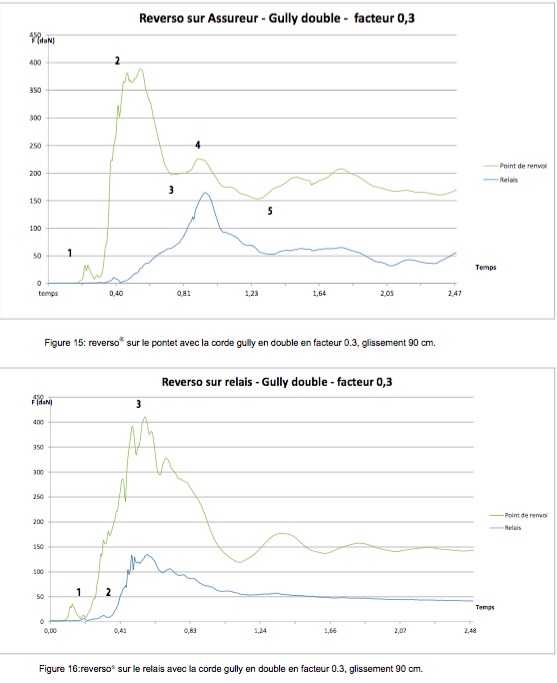 |
|
|
David Coley wrote: The explanation is on page 6: L’assureur, entraîné par le chuteur prend de la vitesse, donc de l’énergie cinétique. Dès quel’assureur ne peut plus bouger le relais est soumis aux deux forces d’arrêt cumulées du chuteur et de l’assureur. L’assureur est stoppé par son système d’autoassurage qui correspond à une chute sur une longe, sans assurage dynamique. which means: The belayer, dragged by the faller, gains speed and hence kinetic energy. As soon as the belayer can no longer move, the belay anchor is subjected to the cumulative arrest forces of faller and belayer. The belayer is stopped by his attachment to the belay anchor, which corresponds to a fall on a sling, without dynamic belay. |
|
|
I thought the reason for a lower force was because they let rope slip through the belay with the munter. You guys are talking about an increase in force because of the momentum of the belayer once his or her tether comes taut. 2 questions:
|
|
|
rgold wrote: I know you are just proving data, not taking a position. Here's my take: So, a 22% increase on the anchor and a 5% decrease on the top piece catching the lead fall when belaying of the harness. These numbers appear as a significant increase on the anchor and a small decrease on the top piece. But, we are talking about a small percentage on a large number with regard to the tope piece, which sees the greatest force in a fall and may be the most important piece in the system at that moment. We are talking about forces on the anchor around 1.3 kN vs 1.6 kN. If my anchor is not good enough for this, I should quit climbing now. Personally, I would still favor minimizing the force on the top piece of gear catching the lead fall, as this is usually the more dangerous part of climbing. Remember all the anchor debates. Yet, anchor failure is quite rare. But, lead protection failing is not so rare. Of course the are other consideration, such a a violent yank on the belaying causing injury, hitting a roof, loss of control, especially with significant weight differences, etc. |
|
|
There have been small-sample-size tests using a plaquette (ATC Guide, Reverso, etc) when direct-belaying. Using a plaquette, the climber strand is redirected through a higher carabiner until the leader clips his/her first piece of gear, then the belayer removes the redirect. The redirect ensures that in the event of a factor 2 (the leader falls past the belay without any intermediate gear), the plaquette rotates into its braking position. There is literature and limited testing on this avail. I'll try to post. (Found it, ACMG video on direct belays--helpful: vimeo.com/44869774) The belayer is out of the system when direct belaying; the upward forces come directly onto the small-loop (generally double-stranded!) on the anchor. The belayer's weight isn't a factor in overall forces on the highest piece. I think (reaching into hazy memory here) earlier discussions on this video proposed slippage in the Munter as the reason fall forces are lower in these tests than with a belayer in the system. If you think about it, the leader falls, pulls the Munter upwards into its "non-ideal" orientation, meaning the brake strand is not parallel to the load strand (as is "ideal" and provides the most holding power). This orientation allows slippage through the Munter, lowering peak forces. Maybe Rich has a better way to articulate this or reasoning? Ron Fundurburke at the AAC has some interesting info on this. The Canadian ACMG video is a good primer, too. This technique is also popular ice climbing in Eurolandia---as long as you have two bomber screws (or three, etc). We go into direct belaying a bit in The Mountain Guide Manual. It's definitely an advanced technique, one to be employed after a climber has mastered his/her anchor fundamentals and as important--belay fundamentals. Marc and I published a piece in Climbing a few months back on safer belaying, too. Direct belaying is awesome when there's a big discrepancy in weight between leader/belayer (weighty climber, skinny-ass belayer), there's potential for the belayer being pulled up/into something (cave, overhang, etc), and/or real possibility of a factor 2 onto the anchor. The Munter doesn't need to be redirected like a plaquette, which is nice.....another strategy guides often use with a lighter/less experienced client, is to take a direct belay for the first meters of a pitch (hard climbing with little pro off the belay, for example, might be an appropriate situation here), but have a plaquette pre-rigged on the rope behind the direct belay...so that after the harder climbing is surmounted, then guest can disassemble the direct belay and begin belaying with the plaquette in regular mode.... I'd caution some folks to be careful adopting the direct belay until they fully understand its uses, shortcomings, and strengths...especially when using the technique with trad anchors. Certainly interesting research and technique, though! |
|
|
FY wrote: Cause it's old and worn out and no longer funny. |
|
|
jktinst wrote: "precisely the weight necessary to arrest the fall" isn't a well-defined concept. A broad range of belayer weights can arrest the fall. A lighter belayer provides a softer catch but allows the falling climber to travel farther (increasing the chance of hitting something). The ideal point on that tradeoff depends on the locations of ledges etc. in the falling climber's path, i.e. situation-dependent. |
|
|
The increase in peak force on the belay anchor catches one's attention because it's likely unexpected. The report, however, recommends directly belaying from the anchor when the risk of the belayer being slammed into the wall is significant, not as a way to reduce the peak force on the belay anchor. (The recommendation is in the orange box at the bottom of the page translated by rgold.) |
|
|
i belayed the leader on a multipitch directly off the anchor (bolted) for the first time a week ago, and caught a fall. I wasn't slammed into the wall or pulled sideways. It was great. That will be my go to method for the future. |
|
|
|
|
|
Just FYI from the old thread: bear breeder wrote: The fixed point belay actually has Higher forces on the top piece than a regular belay ;) cdn-files.apstatic.com/clim… rgold wrote: I think the Munter on the anchor is primarily for bolted multipitch sport climbs. The fact that it can as much as double the load on the top piece compared to an ATC on the harness suggests it is not a great idea for trad protection.
|
|
|
Squeak wrote: You should always have multi-directional control with your anchor. This is also why cams are so nice for anchors. |
|
|
One major reason for lower forces when belaying directly off the anchor is actually a bit tricky and unexpected. When belaying off the harness with a redirect, both climbers pull on the redirect, as is well known. The same would be true when belaying off one piece and having a redirect on a different piece; which is the "infinite-weight belayer" situation mentioned above. But if the climber falls directly onto the anchor without any redirect, the force of the fall is only applied to the anchor once, not twice. Unfortunately, this force will be higher because of the higher fall factor and lack of dynamic belay, but apparently, still lower than the usual force applied to the anchor when belaying off the harness. (In theory, you could achieve the same effect if the "infinite-weight belayer" were somehow connected to the redirect in a rigid way. Then the forces would cancel each other out so that only the falling climber applies any real force to the anchor.) |
|
|
Sebastian Reichelt wrote: Lots of confusion here. |
|
|
I think the situation Sebastian brought up (pulley effect on the anchor in near-factor-2 fall) was discussed here: https://www.mountainproject.com/forum/topic/105819763/bombproof-anchor |
|
|
jktinst wrote: Yes, I was trying to simplify the explanation of why the top piece might take more force at some point during the fall scenario. I understand that the force of the fall gets transmitted to the top piece as well as through the pully to the counterweight, whatever that may be. The point remains, however, that in a direct-to-anchor scenario, you never have a situation where two climbers are hanging from the top piece (so the theoretical static-weight force on the top piece has a lower maximum; granted, it's very unlikely that the static weight of two belayers is greater than the force generated by a fall). That said, the graphs provided by rgold are illuminative, in that they contradict what the narrator says in the video (starting at 3:00). The narrator says the top piece takes less force when they receive a dynamic belay directly from the anchor, yet the graphs indicate that it is in fact the other way around (a 5% difference). Finally, Greg D makes the point I was trying to make, though he says it better. The impact force on the top piece is what we should be really concerned about. |
|
|
Jacon wrote: Different experiment, no contradiction. You have to read at the bottom of page 13. |
|
|
"I think the Munter on the anchor is primarily for bolted multipitch sport climbs. The fact that it can as much as double the load on the top piece compared to an ATC on the harness suggests it is not a great idea for trad protection." ^^^^^ This is the entire point. What the Climbing Team needs to understand is that there is a difference between a softer catch for the leader at the cost of the belayer maybe getting pulled into the anchor vs higher load on the top piece when belaying on the anchor. They need to then decide the best way to belay depending on the pro on the pitch (ie maybe add more directional stability). Otherwise we should place an anchor at the base of every sport climb to belay from but we don't. We greatly prefer a softer catch for the leader it is a reasonable alternative at the cost of the belayer having to use some technique and maybe getting a scrape or two. There is no one size fits all answer.
|


