
 Continue with onX Maps
 Sign in with Facebook






Why don't we have lightweight steel carabiners?



|
I use edelrid HMS steel locking carabiner as my belay biner. It weighs some more but not terrible. 134 grams for steel HMS Bruce vs 65 for aluminum HMS strike. The great thing about it is I am no longer wearing out belay biners. Mine is over 2 years old and has no sign of wear. I would have bought 2 aluminum ones in the same time. I am willing to care a few extra grams to avoid buying new belay biners. https://www.edelrid.com/us/sports/locking-carabiners/hms-bruce-steel-fg.html |
|
|
climber pat wrote: This is interesting to me, in just how different I am on this. I actually like wearing out my belay and rap ‘biner. It shows me I got some climbing done. And a new belay ‘biner costs less than a dinner, and I only buy it once every year or two. I like taking out the old ones and feeling the notches worn into them by all the fun I had. |
|
|
that guy named seb wrote: For toprope I usually use two opposed non-lockers, and the non-lockers seem to be not too expensive (https://www.backcountry.com/edelrid-bulletproof-carabiner) espeically since I'd only be getting two. If I get a locking one, I'll only be getting one for the belay/rap device so I don't mind if it's a little expensive. |
|
|
Teece303: You paint a very poetic picture about wearing out your belay/rap biner. I like your style. For me it's less about the cost of wearing it out once a year or so and more the fact that there will be less of that aluminum black stuff on my ropes and hands. I know it's not a huge problem but seems like the fix is easy enough that I might as well. |
|
|
Wait. People are wearing out belay biners? In one year? Is this for real or are you guys super paranoid? I have aluminum belay biners 25 years old that are still in totally usable shape - just some very slight visible wear. What do you consider "worn out"? |
|
|
Marc801 C wrote: I have ‘biners that developed grooves 2-4mm deep. Easy to see and feel. Are they unsafe? I doubt it. But the grooves become rope traps, and thus become self-reinforcing. So I replace them when they become very noticeable. When I had tons of free time to climb, that was a year or two’s worth of climbing. |
|
|
Jim Turner wrote: This a thousand times. |
|
|
Marc801 C wrote: Yeah noticeable grooves appear. Probably still usable for a bit longer, yes. I think it might be more from rapping than belaying. I don't have one handy to show a photo of unfortunately. I think it comes from a bit of grit in the rope. If you're super careful about always using a mat I'm sure your biners will last longer. I once got a noticeable groove in a toprope anchor biner in a single day of lowering off. We were using a friend's rope which was pretty dirty from sandy ledges on multipitch routes and such. Here's a photo with another of the same biner for comparison. The one on the left was less worn than the one on the right before this happened. 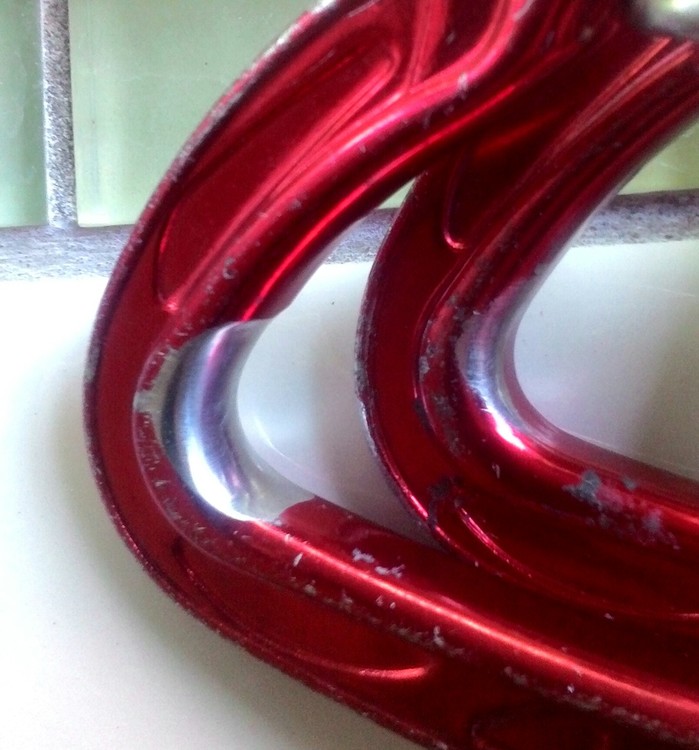 |
|
|
Ronald B wrote: I don't see any grooves, just worn off anodizing. That can happen by sneezing hard on the biner. If you're replacing biners like that as "worn", you're wasting a crap ton of money. |
|
|
Marc801 C wrote: Well, first of all I still use that one (although not for toproping since then), and second of all, there is a noticeable "lip" at the edge of where the anodizing was worn off. |
|
|
Ronald B wrote: At 6 oz. each, these aren't light, but no more grooving in my top rope anchors: https://www.kong.it/en/2-products/items/c2-sport/f1-carabiners/p47-oval-steel-classic-screw-sleeve Edit: And no rust after about two years of occasional use. |
|
|
Marc801 C wrote: I am certain my worn belay carabiners are still safe to use, in fact they move on to other purposes. The problem is the shape changes and several belay devices (mammut smart, alpine up, jul family) are sensitive to the shape of the carabiner to function well. I never had much of a problem before changing to these assisted belay devices that trap the rope with the carabiner. The grigri users might never wear a belay biner out because rope does not run through the biner. I have 40 year old carabiners both locking and non-locking that are serviceable. In fact older carabiners seem to be much more durable. I think the chasing of lightweight carabiners has led to using different alloys that are not as durable as 40 years ago. I would love to hear from someone knowledgeable on the subject. There are some super scary videos about ropes being cut by worn biners on draws. http://blackdiamondequipment.com/en/qc-lab-how-sketchy-is-a-ropeworn-sharpedged-carabiner.html I cannot find the image but fancy lightweight carabiners with groves to make the carabiner lighter can form extrememly sharp edges well before one might consider it worn out. Just another thing to look for. |
|
|
Kyle Tarry wrote: +1 I was about to say the same thing - shape and cross section create those issues far more than alloy. |
|
|
that guy named seb wrote: I think we might want to examine this statement carefully because addressing its assumptions might help. First, are the materials different? While there are a variety of materials in airplanes, 7000 series aluminum alloy is common in both aircraft and carabiners. But why? Second, are the forces different? Much of basic mechanical engineering design is based on stress/strain considerations. The general concept of stress/strain is to normalize force and response by size (cross section / critical dimension) such that, while the magnitude of the forces can be vastly different between applications, if the stress is similar then the design considerations (at least relative to strength of materials) are also similar. This is why specific strength is important for both airplanes (that have to fight gravity) and carabiners (that you have lug up climbs)...because unless the specific strength of one material exceeds another, any gains in strength (steel) can be offset by increasing cross section (aluminum) without a weight penalty for applications that must meet an application defined force to failure (i.e. 20 kN) . So unless you can produce a reasonable steel with a specific strength better than the common aluminum alloys, it is a lost cause. |
|
|
Ronald B wrote: I bought two of these Edelrid Bulletproof bent gate biners and put them on two quickdraws for clipping to the anchor and lower off. I like them. The difference in weight compared to regular aluminum biners is negligible (if any). |
|
|
aikibujin wrote: Sweet, yeah I've put them on the ol' wishlist! |
|
|
I remember reading in an old magazine that once upon a time people were able to create carabiners using high strenth steel tubes that were strength/weight wise superior to contemporary aluminum alloy carabiners. They were much more expensive. |
|
|
Ronald B wrote: That makes sense. |
|
|
Yury wrote: At 40 g, not so light compared to current tech. http://www.alpinist.com/tcl/email/11_July/root/page1.html |
|
|
Yury wrote: The Salewa ones were aluminium, can´t remember anyone making real steel tube karabiners though there was one where the round stock had a maybe 3 or 4mm hole down the middle. I´d guess you could make fairly competetive steel karabiner weight wise but the manufacturing would be more complicated than just forging an alloy one. Rust is a big problem, the old Hiatt karabiners came black or chrome plated and after a while it started flaking off and you´d have bit´s of chrome embedded in your fingers (I was a sea-cliff cimber back then). |


