
 Continue with onX Maps
 Sign in with Facebook






Fall on Nutcracker, Cathedral Ledge


|
|
|
|
|
DRusso wrote: That looks like an over-camming situation. Is that what I'm seeing? I warn climbers about that all the time (seems to be a common practice). In the BD booklet attached to the cams they even warn of over-camming. |
|
|
Chris Reyes wrote: With the C4 the tips of the lobes should not cross. Note the orange color in the diagram below, it means it's weakened in this state but functional. Let's say - not ideal. ;) 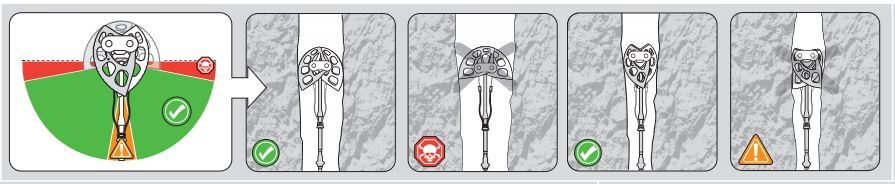 Taken from: This chart can be used as a general rule of thumb across all cams based on how they operate/the physics involved. The differences between brands and models will buy more tolernace and they will have their own exact published data on appropriate use. |
|
|
Kevin Heckeler wrote: Awesome thanks. In the OPs case, it was a .2 X4 that seems to be the cam of question. The BD docs for the X4 seem to illustrate the same range, however it only shows the dual axle cams. Would the same concept apply to the smaller single axle cams? A quick glance through the totem, metolius and fixe docs don't seem to carry a similar warning (aside from avoiding getting them stuck). Edit: Actually Wild Country does show a similar diagram for its larger friends: http://www.wildcountry.com/en/technical-friends/#product-tab3 |
|
|
Kevin Heckeler wrote: As far as I understand it (and have been directly told at least once by a representative of Metolius), it is an "urban legend" that an over-cammed cam is "weakened" or has any tendency to pull out. Rather, the only reason not to overcam cams is that they are likely to get stuck. If having the cam not pull out in a fall is your only concern, essentially the tighter the better, including being totally overcammed. This is one of those things that comes up year after year on Internet threads. Normally I don't say anything as I'm not a cam expert or a math/science guy who can give a real explanation of cam behavior, but since this post directly raises the issue, I'll put my comment out there and see if anyone responds. |


|
I am getting out of the hospital today. Overall as Rob said I am very lucky that my trama is going to heal quickly considering the fall. I wish I had some answers to give about the failed placements. I only pulled the number 2 because I was 100% confident in the two small cams. I was wrong. I don't really remember the fall, my next memory is of Rob and the rescuers carrying me out on a litter. I do want to reiterate that my helmet most likely saved my mind, if not my life. |
|
|
pfwein wrote: The BD diagram above clearly shows the open cam scenario as being the most ill-advised [in red skull crossbones], and the over-cammed scenario as a warning [in orange exclamation]. They are apparently trying to differentiate the two for a reason. The PDF I found only tells part of the story, I'll see if I can get the written description... **edit -- so that brochure has changed since from the original C4 brochure that was attached to the cams. The old one had a detailed "how to use" section with written descriptions, whereas most of the important information in the new brochure is contained in those diagrams. I doubt I have any old brochures laying around at home but I will keep an eye out for one next time I rummaging through the gear pile. From memory what I recall reading about over-camming was that the spring action that forces the cam open (which generates the pressure the lobes exert against the rock, to keep it in place) is degraded in an over-camming situation, such that as the cam might be pulled forward/out the lobes would not spring outward quick enough to make or maintain contact. Fall forces are so great that this entire process happens in fractions of a second. In short, an over-cammed cam can be yanked out of a crack before the lobes have enough time to react to the sudden forced exerted. I'm obviously open to some correction on this since I can't verify anywhere this is/isn't the case. |
|
|
pfwein wrote: Well, that's sort of correct. But, this statement is not: If having the cam not pull out in a fall is your only concern, essentially the tighter the better, including being totally overcammed. Because: True, a cam exerts the same outward force on the rock when it is 5% retracted as it does when it is 95% retracted (or 99% for that matter). So, holding force is not compromised when over cammed. Also, the cam is not weakened, per se, at full retraction if the lobes are loaded properly. What BD's diagram illustrates is when the tips of the lobes may be touching the opposite side of the crack. This may compromise the placement. One, it could incidentally release the lobe when pressed on, which would put the load on the cam tip. Anyone that has fiddled with a stuck over cammed cam knows that you can push near the lobe tip to aid in its removal. Now, if the cam tip is bearing the load, the cam is definitely compromised. It is not intended to be loaded in this way. So, it is not that full retraction is an issue, it is loading the cam tip that is. |
|
|
Mike, glad to hear that you are out of the hospital. I think I speak for many of us when I say this: I really appreciate you and OP for being candid and starting a conversation on this accident. Stuff like this always reminds me to play as safely as possible. I hope you have a smooth recovery! |
|
|
The "tips crossing" is not in itself any problem. It's when the lobes are so compressed that further reduction in size is not possible i.e. the unit is going to be difficult/impossible to remove (as the Metolius rep said). The physics of cams dictates that there is no "weakness" associated with such overcamming. |
|
|
Greg D wrote: 1 -- That's the part I recall reading [the opposite] but can't verify. How do we know this to be true? **Edit - Found an explanation in this Metolius pdf: http://www.metoliusclimbing.com/pdf/cam-manual.pdf It doesn't discuss over-camming, there isn't even an illustration for an over-camming situation. Not sure if this is specific to only their products(?). 2 -- That makes perfect sense looking at their right-most over-cammed diagram, but doesn't fully explain the left most diagram with the cam's range colorized and the lobes crossed in orange (but not full over-cammed, with the tips nowhere's near contacting the rock). |
|
|
I trust the yellow X4 to hold about 50% of the time, in a good placement |
|
|
Kevin Heckeler wrote: Kevin, It's just a fundamental physical principle of how camming devices work - they translate the downward force of the fall into perpendicular forces against the rock. The spring force you talk about earlier has almost nothing to do with how the camming device holds a fall, it's just there to hold the cam in place until a fall occurs. There are a few links in this thread to explainers: https://www.mountainproject.com/forum/topic/109263175/cam-math It's definitely worth reading through some of them if you find this stuff interesting. This is the one that seemed to make it the clearest: http://www.vainokodas.com/climbing/cams.html Given a certain camming angle the force on the crack walls will be constant through the entire range of motion of the cam, and the logarithmic spiral cams are designed with provides a constant camming angle through the range of motion. This is fundamental to cam design. 2 -- That makes perfect sense looking at their right-most over-cammed diagram, but doesn't fully explain the left most diagram with the cam's range colorized and the lobes crossed in orange (but not full over-cammed, with the tips nowhere's near contacting the rock). This is most likely just sub-optimal diagram making on behalf of BD. The explanation of the tips touching possibly causing the cam to dislodge is totally valid, any argument based on the camming action no longer working when fully compressed is not. |
|
|
Alexander Blum wrote: Thanks! Those were the pieces of the puzzle I needed. :) |
|
|
Hi Rob, Terribly sorry to hear of your incident and I hope your friend heals up well. I can say that both the yellow cam placement at that move is very tricky to seat well. It must be nested and wedged tightly like a stopper. The small blue cam is fairly shallow and parallel at best. I often place that little blue cam but don't like it so much. Like many cruxes at Cathedral the gear is tricky and over a ramp or ledge. I've taken that fall when the climb was seeping at the crux and the impact on the cam is quite sharp with little rope out. My guess is that increased impact force with the climber only 25-30 feet out played a role too. Thanks for posting and best wishes for your partners full recovery. With regard to general discussion upthread... I've always treated smaller cams as a stopper and cam. It's very important to remember that smaller cams do not have the greater margin of error in expansion range of larger cams which do allow for a second chance if shifted in the placement. An 1/8" or 1/4" shift in a yellow C4 is a big deal but inconsequential with a gold number 2 cam in a normal range placement. Steven |
|
|
Marc801 C wrote: What do you know ? |
|
|
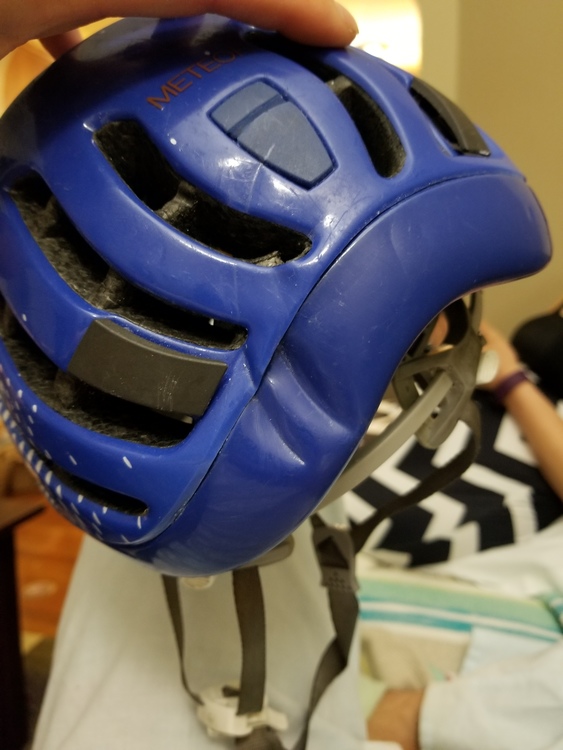 This is the impact site on my helmet. Very glad it was on. |
|
|
Rob, I am really sorry to hear about your friend. At least he was wearing a helmet and will live to talk about it. I have been climbing for over forty years and using cams since they first came out and have NEVER had a good placement blow. The only ones that have were suspect to begin with, or moved around with rope movement. That said, I think the margin of error is much greater for a bigger cam. The smaller units have such a limited range that even a little shift could cause it to open out and be unsafe. As for the x cams, I have found them to be really valuable in pin scars and small pockets where a c4 won't fit. I have fallen on my green alien and I think the yellow, but not sure. I use some of each for small units. Bottom line, I am a coward and always err on the side of over protecting. This means you have to carry more gear. The only times I have been hurt were sport climbing, so go figure! Great job by rescuers! Best to all. TK |
|
|
Rob, after further thought: first piece is going to experience an upward rotational force as the rope comes tight on top piece. If top one not great and it blows, second one may have shifted into poor placement, esp if small cam. If he had left the lower c4 in, even as a directional, the cam that is now second might not have shifted? A non directional first piece is always the ideal........food for thought. tk |
|
|
Were the cams that blew clipped directly, slung with a draw, or extended draw? |


