
 Continue with onX Maps
 Sign in with Facebook






Are biner blocks a good or bad idea for long rappels?


|
|
I was reading this thread , in which someone mentioned carrying some cordelette and doing biner block rappels instead of carrying a second rope, for a pitch that required a 70 meter rope to rappel, where the poster only had a 60m rope, rather than carrying a second rope. |
|
|
The problem arises if the fat rope gets stuck when pulling it and all you have to ascend back to it is the skinny tag line. Lower margin of safety. |
|
|
To be fair, I'm not sure anyone would've suggested the biner block as a more sensible alternative to carrying two ropes, or even moreso to climbing with the proper length single rope - just as a more sensible option than treating a single bolt as a rap anchor. |
|
|
ckersch wrote:I was reading this thread , in which someone mentioned carrying some cordelette and doing biner block rappels instead of carrying a second rope, for a pitch that required a 70 meter rope to rappel, where the poster only had a 60m rope, rather than carrying a second rope. In my (admittedly limited) trad climbing experience, I've always lugged a second rope up any rope that has long raps without giving it a second thought, but it seems like, in many cases, the biner block would offer a lighter, easier solution. I know my canyoneer friends tend to rig rappels with a biner block, but I've never given it a thought for climbing. The only issue I can see with it is that the biner+clove hitch is bulkier than something like an EDK for joining two ropes, and hence might be more likely to wedge in a crack on the way down. Are there any other reasons not to go for a biner block + tag line as the default for long rappels? Are you sure that's the link you meant to put in this thread? The one you gave is the "passive-pro only" thread. I think you meant the "rap on one bolt" thread? |

|
ckersch wrote:The only issue I can see with it is that the biner+clove hitch is bulkier than something like an EDK for joining two ropes, and hence might be more likely to wedge in a crack on the way down. Are there any other reasons not to go for a biner block + tag line as the default for long rappels? Frank already mentioned that the only "rope" you have in your hands for a bit is the tag line - lower margin of safety.
|
|
|
From my view, the primary advantage of a biner block + tag line is the lower cost. |
|
|
I've come across a few routes where I decided to use a block and a 40 foot piece of chord instead of a full second rope. Its rare that its the best solution, but every now and then, when there is a long enough approach, its only one rap (in my experience it was the last one to the ground), and a regular 70M wont cut it, I would say it makes good sense. |

|
Given that I was one of the people who suggested the biner block for the rappel let me give some insight as to why. Basically because it was a one off. Namely one rappel and the last rappel. So if there is an issue like a stuck rope in the big scheme of things there would be no harm no foul other than a stuck rope to deal with. Would I suggest that when there are multiple raps - probably not. |
|
|
Some background: Many times I have used a tag line for multiple raps where the risks are higher; but these days money is not so tight and so the doubles usually come out ... or more rarely the 70m single. Still, I do have a long scramble loop I do solo (but no rope soloing) where a 40m tag line with a 35m rope are perfect for going light while still being able to do the three raps and continue the loop. |
|
|
I use blocked rappels all the time; commonly I use a blocked rap with a single rope so I can rap on a grigri, which is increasingly becoming the only device I carry. I think blocked rappels are very useful and never understand why my partners and other climbers sometimes seem opposed to them. |
|
|
Its really hard to rig the tagline against biners, instead of chainlink, rapides rings ect. |
|
|
When I am doing multi-pitch climbs with a walk off, with optional long raps down, I always bring a thin tag line so I can bail as a last resort. |
|
|
Check out the Edelrid Rap Line...you can double it and lead on it in a pinch, in case your dynamic rope gets stuck...just did so in Vegas last month. Worked great, quick solution for a snagged rope! |
|
|
J Cwrote: I use blocked rappels all the time; commonly I use a blocked rap with a single rope so I can rap on a grigri, which is increasingly becoming the only device I carry. I think blocked rappels are very useful and never understand why my partners and other climbers sometimes seem opposed to them. I'd like to revisit this topic after listening to a recent episode of the Sharp End ( soundcloud.com/the_sharp_en…). In that scenario, it appears to me that they were rapping (canyoneering) on a single side of a single rope, using a biner block to hold it in place and the other side of the rope to pull (no pull cord). Can anyone explain to me why that should ever be done as opposed to a standard double rope rappel? Based on the rest of your post, I think when you say 'blocked rap with a single rope' you are still talking about using a pull cord, which would have avoided the accident described in the SE podcast. In their case, there was a very good reason not to use a biner block, being that she set up on the wrong strand and died. |
|
|
nrj5011wrote: Can’t give this one a listen just yet, but a Reepschnur rappel is the primary way to rap if you only brought a grigri (limited to single strangle, excluding the other improvised methods). Benefits of safer simulrapping described earlier, but I find this especially useful if I know I will likely prefer to have two hands free on the rap (cleaning gear, wandering route, photos, whatever), since the grigri is easier to go hands free on imo than ATC+backup. Lotta other threads on this as well |
|
|
nrj5011wrote: I listened to that episode too, but it was unclear to me why they decided to use a biner block. They talked about doing two rappels in a row and not wanting to bag the rope, which doesn't seem all that compelling. Biner blocking a single strand can be useful in certain situations. For example, if there's a pool of water at the base of the rappel. If you do a standard double strand rappel, you either toss the ends and have the rope soak in the water, or with more work you can stack/bag both ends and carry them with you. But an easier way is to lower the first person or one end of the rope so it's just above the water, biner block the rope so you're rappelling on that single strand, and carry/bag the other end of the rope down. If the pool is small, with a good pull you may be able to keep the rope dry. Not really a concern in rock climbing though, climbers rarely have to rappel into a pool of water. |
|
|
nrj5011wrote: I remember writing the comment you quoted, and I was referring to using a blocked rap with no separate pull cord, but only one continuous rope. From what I gather this is the setup used in the accident. Yeah, gotta do things right when you accept physical risk for fun. My reason for using this is that I very often have the need to rap <1/2 of my rope length, and am accompanied by a single strand ABD (Eddy if lead rope solo, Gri Gri if top rope solo or with partner). By default I carry no carabiners that play nicely with a munter hitch (because they are heavy, and I'm not carrying a tube device). One rope and a blocked rap is pretty much SOP for me at a crag. When possible, I prefer to self lower (if you don't know what this is, I'm not teaching it over the internet). This is way faster because you don't have to thread your rope, and you don't have to pull more rope than necessary on a short rappel. The applications are highly limited due to anchor configuration (single point or else twisted rope) and rope drag against rock, resulting in avoidable rope abrasion. I self lower the most when I am cragging with a partner. (I don't let other people lower me when I can avoid it, plus this frees up your belayer to get ready to climb.) The following is written in the context of multipitch rope soloing: In the years since that post, I had several experiences with getting the knot/carabiner stuck during the pull. Some of those experiences were strong enough to make me consider other options for very snaggy terrain. I experimented with the old school carabiner brake for a few years. This is appealing because I could grab carabiners from the rack when it was time to rap. But almost all my carabiners are quite small, plus it is easy to loose the two horizontal carabiners. Use a tether for them. Contrary to popular belief, no ovals needed. Photons work adequately. Far better than a munter for a bunch of raps. As I phased over to Nano 22's for most of my rack, this required me to think about bringing a few specific carabiners. Around that time I bought an Ovo. I was struck my the unique setup used to rap with the device (read the instructions, it's worth the effort for not dying) and instantly saw that it didn't require a big old HMS carabiner. The Ovo weighs maybe the same as three or four lightweight carabiners, but it is very compact. The weight savings really come from not needing heavy locking carabiners dedicated to the device; if it's time to go down, I basket hitch a sling through the hole on the Ovo, then girth hitch that to my belay loop. I use one or two quickdraws clipped through the rope, then clipped back to the sling to tether the carabiners between raps. This is light enough that I often take the Ovo when I plan on multiple raps to descend. My latest experiments have been to incorporate the equivocation hitch a bit more. I first rapped on it years ago just for the learning experience, but recently I have been considering it for its benefits and not just novelty. The big advantage I see is eliminating the need to pull and thread the rope (I dislike this chore). I recently used it to avoid pulling the length of my rope over an abrasive edge on a single rappel. I suspect the equivocation hitch would permit using certain anchors that otherwise would need to be slung with tat. When released, a bight of rope falls. Maybe it falls over a rock feature. On high friction rope pulls the equivocation hitch saves some energy expenditure. That said, I'm not yet confident in how much friction I can overcome to break the first loop, and this has been surprisingly difficult with softer ropes. On rappels from an anchor on a vertical wall at the back of a ledge (pretty common setup for routes with bolted belays and rap descents), a blocked rap snags the edge of the ledge on the pull. An EDK is more likely to make it, but can still snag in my experience. An equivocation hitch (which could be used in tandem with a tagline) might be less likely to snag, if the main obstacle is simply the lip of the ledge. For now, I bring the Ovo and do all I can to only carry one rope at a time. |
|
|
For multiple consecutive double-rope rappels, you lose the time optimization of threading the next rappel through the chains while pulling down the previous one. Also likely spend time pulling back up the tail that couldn't be caught and flew down past you. |
|
|
I'm glad to come across this thread. Recently I went multi-pitch climbing as a party of 3. The pitches were low angle and we were all on the smaller side which meant even with thick carabiners and an extra carabiner for reduced friction, we were all having to really force-feed our rappel devices for a massively bouncy slow rappel. It occurred to me that a better system might be to use a biner block with the double ropes already set up so that the first two people can more comfortably and quickly rappel and then have the last one down convert the system to a double rope rappel. No one else in the group seemed interested in the idea, maybe due to unfamiliarity with it. Seems like a pretty reasonable application for a biner block. Having had a rope get stuck twice with biner blocks canyoneering, I think I'm more inclined to haul two ropes up than rely on a tagline. |
|
|
Gina Schaeferwrote: A couple of thoughts. If you're using round stock carabiners (I assume that's what you meant by "thick carabiners"), doubling the biners will actually increase friction, not decrease it, due to the increased angle the rope enters and exits the belay device. That may have contributed to your bouncy rappel. Always test the biner/device combination first to see if it increase or decrease the friction. If you use a standard auto-blocking belay device like the ATC Guide or Reverso, you can set it up in a non-standard way (what I call the "carabiner brake mode") for rappelling. It has reduced friction compared to the normal rappel set up and can make the rappel smoother. Test this first because it doesn't work with all auto-blocking devices, I know the Mega Jul doesn't work due to its shape. 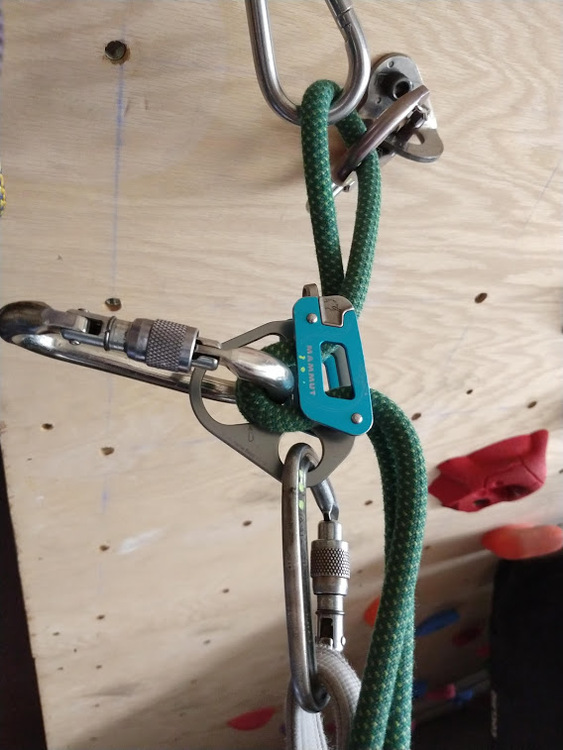 If this looks sketchy, just know that it's how you'd rappel with the Gigi/Ovo, and it also works similarly to the LSD method for lowering that has been popularized in recent years. Finally, for your particular situation a stone knot may be a better choice than a biner block. Stone knot allows you to fix the rope so two climbers can a single-strand rappel at the same time without the need to coordinate a simul-rappel, this saves time in a party of three compared to the biner block. The last person down remove the stone knot and perform a double-strand rappel. |
|
|
Bill Lawrywrote:skinnier cord tangles more easily; leads to extra steps / measures to avoid tangles; This. The more raps you do the more the ropes start to tangle. It's not just the skinny cord either. As the lead line links from rappelling it is more likily to wrap around itself and the skinny cord as you pill. It can develop enough friction that you can't pull the rope anymore even though it's not caught up on anything. It's not a problem on freehanging raps where you can hang the line to let it unkink itself but on slabby or ledgy terrain anything over 4 raps can be problematic |


