
 Continue with onX Maps
 Sign in with Facebook






The Devils Lake top rope cluster Fu&k thread...


|
It looks like a disaster first look... |
|
|
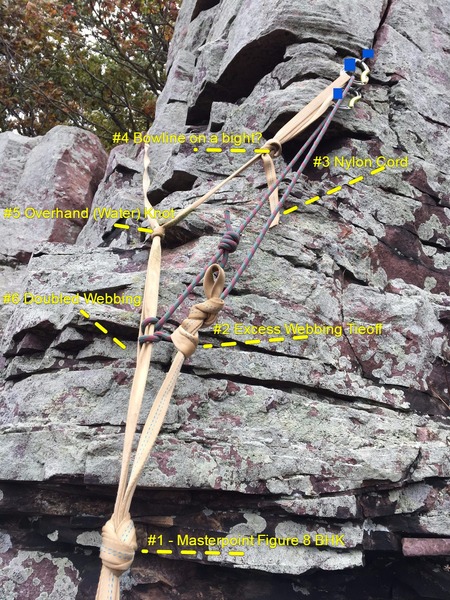 I borrowed Andy P's photo and annotated it, because, depending on the quality of the gear in the upper right, I actually think this is less irredeemably bad than it appears at first blush. Let me pause and say this isn't my anchor, nor would it likely be the solution I would use, or teach. |

|
James, you don't have concerns over the nylon cord melting through the webbing? |
|
|
Ted Pinson wrote:James, you don't have concerns over the nylon cord melting through the webbing? Ted,  5. Like Doug, I'm most concerned about wear and tear on the webbing if the system is being used across the width of the wall. |
|
|
Nice, James! I hadn't looked at it quite that way, but eliminating the water knot in the middle would vastly improve this. |
|
|
Doug Hemken wrote:Nice, James! I hadn't looked at it quite that way, but eliminating the water knot in the middle would vastly improve this. My suggestion was to move an anchor point and completely redo the webbing. Thanks Doug! |
|
|
Nice work James breaking down the goodness and/or badness in this TR setup. I especially liked your citation, at the end, of the anchor builder's possible motivations for creating this anchor.. Ha! |
|
|
Burt Lindquist wrote:Nice work James breaking down the goodness and/or badness in this TR setup. I especially liked your citation, at the end, of the anchor builder's possible motivations for creating this anchor.. Ha! Ha! Thanks to you too Burt. My competing theory is that it was built by some grizzled veteran who literally gives zero f@#ks what someone thinks or says about his anchor and was just trying to get it done and go climbing. |
|
|
Ted Pinson wrote:Yeah, that doesn't concern me. The angle's a little weird since that's such a huge ledge so you might get a little bit of force multiplication, but the eventual direction of pull is always the same for TR: down. yeah, I guess as said, it's the big ledge and distance back that the gear is placed that had me concerned on direction of major axis of pull. ,,ya know, vectors and all that physics stuff. |
|
|
James M Schroeder wrote: Ha! Thanks to you too Burt. My competing theory is that it was built by some grizzled veteran who literally gives zero f@#ks what someone thinks or says about his anchor and was just trying to get it done and go climbing. grizzled old fart? Hey, that would be me ,,but I love just trying to count all the knots on the pic of that set up. I DO try not to put rope to sling , or even nylon sling to sling ever. Use carabiners; that's what they are made for and why you should buy in volume when some online store has them for under 5 bucks each. Load up for your toprope use needs. |
|
|
WTF? AHHHH! |
|
|
James M Schroeder wrote: Ted, 1. It takes considerable load, or travel, of nylon over nylon to melt said nylon. The nylon cord isn't under load or moving along the webbing, and there doesn't appear to be a mechanism to create a load or movement. 2. I don't think I would be concerned even if there was a load, as I've seen 5mm prusik loops hold extreme (holding the tension on slackline back before there were pre-rigged kits) force when tied as a prusik around webbing and neither of them looked any worse for the wear. 3. Even if someone outright cut the nylon cord in this photo anchor would still be redundant. 4. Consider the schematic below which, for clarity, eliminates the cord from the system. 5. Like Doug, I'm most concerned about wear and tear on the webbing if the system is being used across the width of the wall. In the end, my assessment is that the anchor builder was trying to "show off" some knowledge, and, in the end, did what most over-engineering types do and over-engineer a less effective system in place of what could have been simple and elegant. Again, largely a mistake in efficiency and aesthetics. Gotcha. Thanks for the detailed response. :) I try to make a habit of avoiding soft goods on soft goods, but it's good to know that there are exceptions. |
|
|
My "theory of the anchor builder" in this case was someone who was tired, running out of patience and gear, and ended up rethinking their anchor partway through building it. They started off tethered to the tree, got below the edge and found a couple of nut placements, tried to tie it all together with the webbing they were tethered with, got impatient with all that webbing, and decided to add the perlon because they knew they had been impatient. |
|
|
We of the CMC (Chicago Mountaineering Club) climb regularly at Devil's Lake, and this is the first time I've seen evidence of insufficient anchors. All the rest of you are jealous of our fine Quartize routes here. Billk |
|
|
Climbed at the lake for nearly a decade and saw plenty of bad anchors, many from CMC'ers. Fortunately many of the sketchy nut placements were backed up by the (now dead) trees. I think the primary problem is that for many of these folks, the only time they ever handle protection in their climbing career is when they setup a top rope anchor, thus severely limiting their overall experience. |
|
|
Yeah, but just about all of them (except the needle/towers) can be toproped, so you can't blame people for wanting a safe day outside or the ability to project climbs above their level. I've never seen "sketchy" anchors from the CMC; if anything, their anchors are overbuilt (3 legs, even if one of them is a massive tree!), which is understandable because they invite lots of people onto their ropes. |
|
|
How to Clusterfu&k at the Lake - a long post so I can procrastinate on doing real work today. 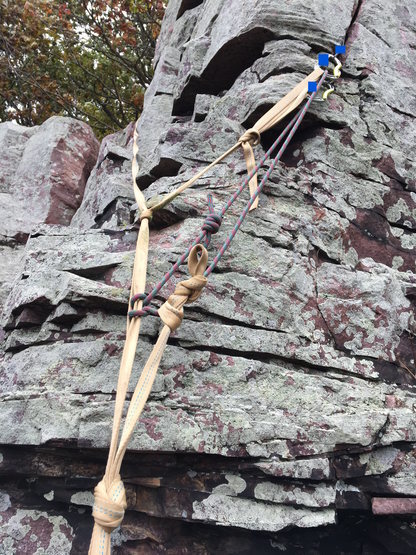 To set the stage, it is a very windy day on top of the East Bluff, you are tasked with setting 6 anchors in the 90 minutes before your group arrives with ropes and lots of cordage/webbing. You have only set one of these anchors before (on Peter's project) so you have budgeted in time to look at both Jay’s new guidebook and the MP app in order to place them right.  Once I got down there it was apparent I did not have enough webbing to keep the MP sufficiently over the edge. I elected not to try an equalette because I wanted more redundancy at powerpoint. So much for self equalizing, onto plan B, my standard setup:  In setting this up I found some disconcerting edges that the three strands to/from the nuts would encounter, it also appeared to me that this would use so much webbing as to leave insufficient tail after the final clove hitch. So, how can I use a bit less webbing? - onto plan C:  So I get this thing tied and by now I’m shivering and the wind is driving me insane. No excuses, I know, but perhaps this contributed to me just wanting to get down, warm, and climbing. But as I prepped for rappel I just didn’t like those single strands of webbing coming into the BHK. I came up with the idea to tie an OH knot right behind the BoB to almost eliminate the distance that the single strand from the nuts would be exposed to potential edges or abrasion.  That OH knot was a bad idea, it messed up my MP positioning, made a much sharper angle on the nuts, and made the anchor ugly. Oh whatever, lets just go climb, right?  Due to a huge rope eating crack below, and the wind, I saddlebag coiled the rope up for a rappel and as I weighted the system I just felt uncomfortable with the setup. I knew full well that it was SRENE, I logically trusted the tree, nuts, etc… but sometimes you just get a weird feeling. So, with the rope all saddlebaged up, I grabbed what I had to spare, my foot prussic, and added it in, just maybe for psychological comfort. Something to backup that exposed single strand from the nuts. Note that this is taking absolutely no load. As I leaned back for rappel I let the BHK tail out of my pocket where I had stuffed it and it started slapping the sh*t out of me in the wind (I deserved it for all my anchor problems)! This is a problem for other climbers, too, so I reached up to tie it off with an OH on the foot prussic. At this point, I fully admit, I realized how incredibly ugly this anchor was - and, with the full intent of MountainProject clusterf*ck glory on my mind - I tied yet another overhand with the BHK tail and took a pic.  Since Burt has nominated me for the top cluster*ck ever, I’d like to thank the wind, the crappy rock on top of Moldy, my trusty foot prussic, and my gloves that I forgot. |
|
|
Andy, |
|
|
Here's an example of goddamn mess I had going on top of Ironmongers one day this summer:  Genius? right? No - equalizing this thing was a pain in the ass before tying the lock-off knot, having to pull the strands of cord which kept wedging in the boulders. I padded what looked like might be a sinister crack or two that could eat up the anchor cord as well. I got the masterpoint and two locking biners over the edge. Dangled my climbing shoes clipped on a biner to equalize well and tied the knot |
|
|
Andy. Actually after reading the analysis by James and Doug above (and now your own account), I have to admit I was a bit off/wrong about my comment about your anchor in question. It was a poorly chosen and flippant reaction after only ever giving the photo a weak and lazy ass look see. I was drawn to the loose end tie offs in the anchor and assumed they were meant to be the primary knots in the anchor system.... I must also admit I am more then capable of at times putting together a poorly thought out TR anchor.... I am sure if you ask a few friends they will laugh and agree.... |


