
 Continue with onX Maps
 Sign in with Facebook






Are any of the new-school belay devices worth using? Also GiGi questions


|
|
Great discussion--      |
|
|
Yo Sam--Indeed, but Scott Bennett already beat you to the punch above! Great techniques, all of 'em, in slightly different applications... |
|
|
fromtheestuary wrote:Here's a question that arose in my mind from that CAMP video. He says he is following on a doubled half rope. Obviously the leader tied into the two ends, but what configuration did the follower have in terms of tying in? Rescue 8 with two lockers attached to belay loop? Figure 8 on a bight with two lockers? Just curious if I ever had to improvise in a situation like that. In the very rare instance that I lead on a doubled over half rope, I actually prefer to tie into the middle. My reason is any kink that develops in the rope (and my rope always gets pretty kinky) is easier to get out with the ends on the belayer's side. This also give me the option to have two followers each tied into a strand. My preferred tie-in knot for this is the bowline on a bight. It is just slightly little more complicated to tie than the alpine girth hitch (both requires you to step through a loop of rope). I'm sure the girth hitch works, but the bowline just makes me feel better. The method Camp USA posted is much easier if you ever need to tie (or untie) at a hanging belay though. |
|
|
I've had the megajul for a while now and just recently got the smart alpine. the megajul is awesome for belaying thinner ropes, readily locks off, and stupidly light as far as a belay device goes. if you count grams like some people it might be right up your alley. that said i absolutely hate lowering or rappelling with it. especially if there's cleaning to be done. pulling the thumb loop is like an on/off switch, with no fine control. best way i've found is to continuously hold the thumb loop up and lower like a standard atc with my other hand slowly letting the brake end slide through my hand. also not too fond of feeding slack quickly, but that's what i get for pulling a 10.1 through it. will leave a good raw spot between your thumb and index finger after a good day out. gloves are highly advised. |
|
|
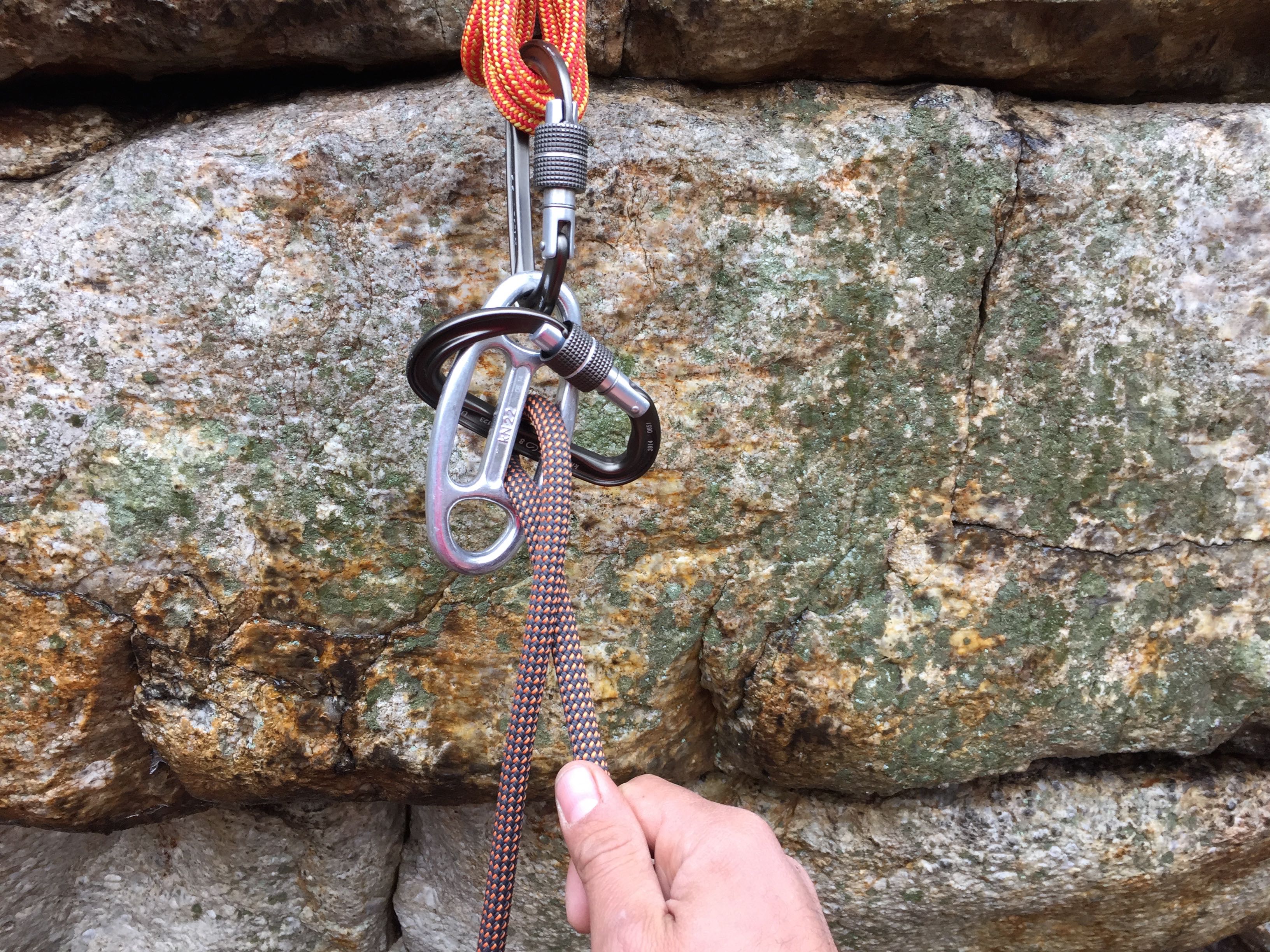
A failure to block condition can also take place when the blocking carabiner is clipped to the upper carabiner. Check out this video: |
|
|
Interestingly, I picked up a Gigi-like device in Switzerland a couple years ago, and the instruction manual for it states to set the brake carabiner up in exactly the manner suggested by the video James posted above. |
|
|
More discussion on correctly rigging the Gigi here, on Elevation Outdoors... |
|
|
For tying into the middle of the rope I would use an overhand on a bight,put bight through your tie-in points and retrace the overhand as you would a figure eight.It may be a little bulky but it is a hard knot with no biner rattling around in the mix. |
|
|
Re GiGi, which I do use...  |
|
|
It's so you can still take in slack for the third after the second has fallen and vica versa. New versions still have it but it's more subtle. |

|
The OVO instructions state that the minimum diameter for single rope use in guide mode is 10mm. Is this just because of the failure mode of the blocking biner flipping? And if so, does that mean that of that failure mode is prevented, the device will work fine on smaller diameter single ropes? |
|
|
benlucky13 wrote:I've had the megajul for a while now and just recently got the smart alpine. the megajul is awesome for belaying thinner ropes, readily locks off, and stupidly light as far as a belay device goes. if you count grams like some people it might be right up your alley. that said i absolutely hate lowering or rappelling with it. especially if there's cleaning to be done. pulling the thumb loop is like an on/off switch, with no fine control. best way i've found is to continuously hold the thumb loop up and lower like a standard atc with my other hand slowly letting the brake end slide through my hand. also not too fond of feeding slack quickly, but that's what i get for pulling a 10.1 through it. will leave a good raw spot between your thumb and index finger after a good day out. gloves are highly advised. the smart alpine feels like the same idea as the megajul but opposite strategy. big and bulky and not quite as eager to lock on thinner ropes, but super smooth lowering and rappelling. both can be done one handed if you really needed to. the curved channel and extended thumb loop give a great fine control to the descent speed, with a nice wide spot to push on with your thumb so as not to create such a pressure point like the megajul. can belay all day without issue. if you don't mind the bulk and the extra $15, i strongly recommend the smart alpine over the megajul. climbing friend, |
|
|
Owen Witesman wrote:The OVO instructions state that the minimum diameter for single rope use in guide mode is 10mm. Is this just because of the failure mode of the blocking biner flipping? And if so, does that mean that of that failure mode is prevented, the device will work fine on smaller diameter single ropes? Owen- The dimensions of the Ovo accommodates much smaller diameters- I believe CAMP rates them down to 8mm on half ropes. I run 7.6 halfs with my Ovo and it autoblocks 100% reliably with them. Same with an 8.7 single. |
|
|
@Owen: Despite what the device may be rated for based on rope diameter, I'd still encourage some specific testing. In theory, eliminating the failure mode should solve the problem. However, it might not entirely. If the device is rated to 10mm, but your 10mm rope is particularly new skinny, and slippery, you might still be able to invert the ropes at least partially, even after eliminating the failure mode. Or perhaps you have a 9.7mm rope that is from a manufacturer whose ropes typically run "fat," and it's also older and a bit swollen and fuzzed up. That rope might work fine, despite the indicated size. You should be able to test this pretty easily at ground level. |
|
|
Derek DeBruin wrote:@Owen: Despite what the device may be rated for based on rope diameter, I'd still encourage some specific testing. In theory, eliminating the failure mode should solve the problem. However, it might not entirely. If the device is rated to 10mm, but your 10mm rope is particularly new skinny, and slippery, you might still be able to invert the ropes at least partially, even after eliminating the failure mode. Or perhaps you have a 9.7mm rope that is from a manufacturer whose ropes typically run "fat," and it's also older and a bit swollen and fuzzed up. That rope might work fine, despite the indicated size. You should be able to test this pretty easily at ground level. +1 |
|
|
Yeah, I'll test it. I'm just trying to wrap my head theoretically around how one rope in the device can possibly be different from two once the failure mode is eliminated when two ropes potentially works all the way down to 8mm (depending on the rope of course). Perhaps it is just a matter of remaining wiggle room even after limiting the blocking biner. The instructions are clear enough if one isn't interested in knowing *why*. Other manufacturers do a better job of that. |
|
|
I know the conversation has taken a bit of a turn, but I really like the new Mammut Bionic Alpine Belay. Bentgate Mountaineering Review - Bionic Alpine Belay |
|
|
Owen Witesman wrote:Yeah, I'll test it. I'm just trying to wrap my head theoretically around how one rope in the device can possibly be different from two once the failure mode is eliminated when two ropes potentially works all the way down to 8mm (depending on the rope of course). Perhaps it is just a matter of remaining wiggle room even after limiting the blocking biner. The instructions are clear enough if one isn't interested in knowing *why*. Other manufacturers do a better job of that. doc.camp.it/Manuali/OVO_MAN… I'd be interested to know at what diameter you can get the double ropes to invert (if at all). I would guess it might be possible, but it's a pretty significant edge case wherein there would need to be strong sideways loading in the same direction on both ropes simultaneously. |
|
|
Owen Witesman wrote:Yeah, I'll test it. I'm just trying to wrap my head theoretically around how one rope in the device can possibly be different from two once the failure mode is eliminated when two ropes potentially works all the way down to 8mm (depending on the rope of course). Perhaps it is just a matter of remaining wiggle room even after limiting the blocking biner. The instructions are clear enough if one isn't interested in knowing *why*. Other manufacturers do a better job of that. doc.camp.it/Manuali/OVO_MAN…
 Give us a call or email if anyone has additional questions: |
|
|
Thanks CAMP for the clarification! You might consider updating your printed specs to match the explanation you just gave. I get that it's hard to give absolute numbers for rope diameters, but right now the printed instructions make the device sound nearly useless for modern single rope use (most sub-10mm). I look forward to taking the OVO out for a spin! |


