
 Continue with onX Maps
 Sign in with Facebook






Do these bolts look right?


|
|
Morgan Patterson wrote:Will the PS bolt rust out at the same rate regardless of whether one uses a SS or PS hanger? The answer as with most things is that it depends. |

|
Mike Slavens wrote: ... Again, how are you so sure they aren't platted. They could be stainless, nothing definitively indicates they aren't... Geez Louise, |
|
|
John Byrnes wrote: Geez Louise, They are OBVIOUSLY stainless because they have spent the same amount of time in the same environment as the bolt they are attached to, and they haven't corroded at all! Thanks for helping to point out the obvious, I didn't even think of going that route! |
|
|
John Byrnes wrote: Jim or anyone, Show me proof of galvanic corrosion on climbing bolts outdoors (not in the lab) between plated (Zn) steel or carbon steel, and stainless steel (304 or 316) and I'll retract my statement. I've heard a lot of people say it could happen but I've never seen a case or heard of a case from a reliable source. There´s shedloads of information on using plated (and unplated steel) with stainless on any of the stainless steel websites. |
|
|
My understanding of the situation is as follows:  These tests are done to simulate the effects in seawater (and hence the presence of ions, notably chlorine), however the inherent different electric potentials is always present - this is important because a voltage potential will accelerate the rate of a corrosion reaction for a metal. The corrosion mechanisms that are most likely active (SSC aside) are pitting corrosion (apparent on the surface of nut, threads, and washer) and crevice corrosion (between the surfaces of the nut, threads, washer, and inside of the of the bolt hole itself). Both pitting and crevice corrosion rates will be increased by a voltage potential. Zinc is used as a coating in plated steel because it is more reactive than steel, when it is paired with steel, and therefore it will corrode before the carbon steel (in addition to forming a passivization layer of ZnO). Broadly speaking, in a carbon steel/zinc pairing, the zinc acts as the sacrificial anode. 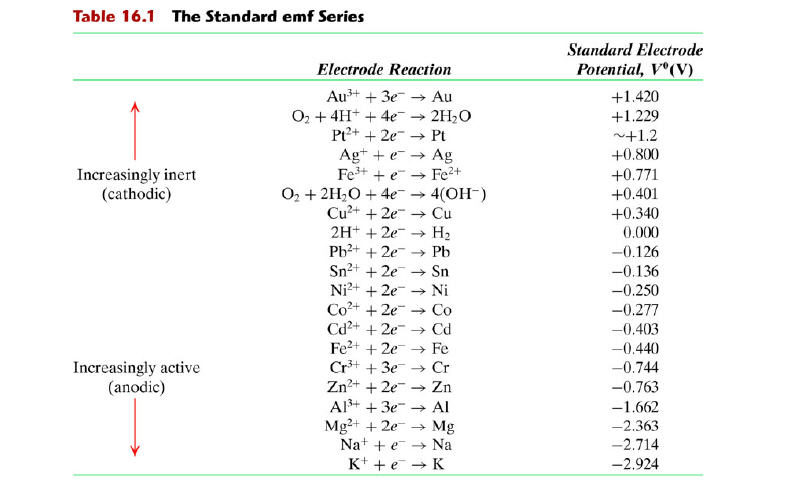 Combining all of the above, the important conclusion is that mixing stainless steels and plated/carbon steels will almost certainly result in increased corrosion rates of the plated/carbon steel because of the induced voltage potential associated with the metal's pairing. |
|
|
Whether they have a stainless hanger or not all regular steel bolts will rust. As I remember stainless bolts aren't quite as strong as regular steel bolts but will far out last them. Here is a photo from the Boulder craigslist, All the bolts in this box will rust over time.  |
|
|
kennoyce wrote: Yes, rain will quickly pick up electrolytes, but for galvanic corrosion to take place the electrolyte must be present and in solution (i.e. in water) to allow the flow of electricity to cause corrosion. The area where these bolts are located (south platte) is a desert environment that typically receives around 15" of rain each year, the route is south facing and sunny, and the bolts don't sit in a water runoff area. All of these factors add up to show that there is very little time when an electrolyte is present. Will galvanic corrosion occur at times on these bolts, yes of course it will, but the percentage of time when galvanic corrosion would be able to occur is extremely limited due to the points I already mentioned. The corrosion in the first two photos shown is obviously uniform corrosion and doesn't appear to have any significant galvanic contribution (easy to tell because galvanic corrosion just occurs at the interface between the two dissimilar metals unless they are submerged in an electrolytic solution). The third photo is kind of hard to tell, but again looks to be mostly uniform corrosion, just not as advanced as the first two photos (look at the washer). My guess is that the zinc plating was removed to decrease the shininess of the bolts (this was a popular practice a few years ago where people would make the bolts (and or chains) less shiny by dipping them in vinegar not understanding that they were removing the protective zinc coating). Most likely all of the bolts in the area of a similar vintage are plated bolts on stainless hangers since that was just the accepted norm at the time. If this is the case, the reason for the corrosion rate disparity is the removal of the zinc plating on the bolts found on this route. Thanks for your comprehensive and clear reply kennoyce. You have help clarify my understanding of galvanic corrosion in this context. |
|
|
Jim Titt wrote: There´s shedloads of information on using plated (and unplated steel) with stainless on any of the stainless steel websites. Your statement didn´t concern either climbing bolts or zinc plated, you wrote "That doesn't happen with stainless and common steel." which is incorrect. Technically, yes, I'm incorrect. Touche'. |
|
|
The problems we see with plated bolts and stainless hangers (in normal climates not deserts) are underneath a healthy looking nut the stud is corroded away and under the washer the hanger has pitting and corrosion cracks from contact with the iron in the washer after the plating has been damaged. |
|
|
Jim Titt wrote:The problems we see with plated bolts and stainless hangers (in normal climates not deserts) are underneath a healthy looking nut the stud is corroded away and under the washer the hanger has pitting and corrosion cracks from contact with the iron in the washer after the plating has been damaged. Yes, I agree. |
|
|
Mike Slavens wrote: petzl.com/US/en/Sport/Ancho… Petzl absolutely makes low allow/carbon steel bolts and have for years. That's a different hanger than what's pictured by the OP though. I have placed tons of the hangers in the photos, both the Metolius Enviro and the Petzl hanger. They are both, absolutely, stainless steel. Chris N wrote: As I remember stainless bolts aren't quite as strong as regular steel bolts but will far out last them. That's a complicated statement. There are many alloys which a hanger could theoretically be made out of, each with different properties. Even within one alloy, there are many treatments that can be applied to change its strength. For example, A2, which is 304 in the USA, can come in A2-70 ranging up to A2-140 or so, which is around the strength of SAE grade eight. Then there is also A2 tool steel which is even stronger than that. |
|
|
20 kN wrote: For example, A2, which is 304 in the USA, can come in A2-70 ranging up to A2-140 or so, which is around the strength of SAE grade eight. Then there is also A2 tool steel which is even stronger than that. In any case, Fixe rates their carbon hangers as 25kN and their stainless as 30kN (which used to be rated for 40kN, and some still are). Fixe's belay station hangers are rated for 18kN in carbon and 26kN in stainless. A2 is an abbreviation of VA2 which is a proprietry designation from Thyssen-Krupp meaning Versuchsschmelze 2 Austenit or test melt Nr 2 Austenitic, it has no official meaning any more but is commonly used in German speaking countries. The current grade is 1.4301 or ASTM 304 and comes only in one grade (apart from the L version)but the strength varies from ca 520MPa (N/mm²) in the extra-tempered form, 600 in normal soft condition and around 980MPa fully worked. |
|
|
Galvanic action has become the emperors new clothes. Unless you are in a very wet environment, it is rare. Regular old corrosion will be happening at a faster rate than galvanic. Either way, no, those bolts don't look right... and they likely look worse on the inside. |

|
Jim Titt wrote: A2 is an abbreviation of VA2 which is a proprietry designation from Thyssen-Krupp meaning Versuchsschmelze 2 Austenit or test melt Nr 2 Austenitic, it has no official meaning any more but is commonly used in German speaking countries. The current grade is 1.4301 or ASTM 304 and comes only in one grade (apart from the L version)but the strength varies from ca 520MPa (N/mm²) in the extra-tempered form, 600 in normal soft condition and around 980MPa fully worked. A2 steel is a designation for an aircooled tool steel (hence the A) and has absolutely nothing to do with stainless steel, there´s about 14% chromium and 10% Nickel missing to start with. Whether a stainless bolt is stronger than a steel bolt depends on what they are made of and how they are made, in the Metric series a 316 bolt and the standard 8.8 bolt are about the same. Loaded as a hanger does a bolt then the stainless bolts get about 15% better strength than a steel bolt as it´s a bit more ductile. Really hard steel bolts pop their heads at quite depressingly low values considering the material as they can´t take the bending forces imposed. And some of the confusion also comes from the way people throw around the word "strength". Is it ultimate, 1-shot tensile strength? Is it ultimate tensile strength after 50,000 loads to 50% of the original yield stress? 150%? Is it just the yield stress? |
|
|
Brian Scoggins wrote: And some of the confusion also comes from the way people throw around the word "strength". Is it ultimate, 1-shot tensile strength? Is it ultimate tensile strength after 50,000 loads to 50% of the original yield stress? 150%? Is it just the yield stress? All of these and more can be considered "strength", so you're gonna need to define terms before we start comparing. Not disputing Jim Titt's contribution, he illustrates an important aspect that's hard to tease out just by talking about broad swaths of materials, or even narrow ranges. Unfortunately when talking about bolt-ins and hangers using the UTS is useless anyway, the usual failure is by bending shear and there´s no real way of working the failure strength of a bolt out from the normal material specs. Plate hangers usally tear apart rather than "break" as well which doesn´t help armchair engineers either. |
|
|
Well the hanger is ok but the bolt is fucked is rusty and personally I do not climb on rusty bolts, so for me doesn't look ok, is bad,,,, that bolt is not good,,,, |


