
 Continue with onX Maps
 Sign in with Facebook






The Bolting End-Game


|
|
Who Dat wrote: I think we can reach an agreement.. Electrolye: An electrolyte is a substance that produces an electrically conducting solution when dissolved in a polar solvent, such as water. The dissolved electrolyte separates into cations and anions, which disperse uniformly through the solvent. Air, for all intensive purposes, has at least some quantifiable amount of water in it. That water is capable of carrying electrolytes. Of course "air" is composed of many different elements in varying concentrations depending on different things. A notable case is "marine air," which contains a high concentration of Na and Cl ions, as well as other elements. It's also important to keep in mind that pure H2O will not conduct electricity - it needs electrolytes in solution. This applies to the water in the air as well. Have we attained harmony? NO AGREEMENT! NEVER! |


|
John Byrnes wrote: I only heard about the bolt on Pump O'Rama. Maybe someone here has more info. But I don't think it really matters if the sleeve/wedge comes out at the same time. If the threads rust to the point that tension is released, that thing is coming out. I think it was the 5th bolt on Pumporama that "pulled". It was a Fixe Triplex and it was drilled poorly so the hanger didn't sit flush. Over time the nut worked loose and came off with the hanger. It's the same kind of thing that has happened to some other bolts, like on Pump Action a couple years ago. |
|
|
Thanks for the hanger cleaning beta! |
|
|
DrRockso wrote: Of course don't use a carbon steel hammer to place your wave bolts, you can buy the installation tool, use a SS hammer, dead blow hammer or a big rubber mallet. I usually just bore out the hole so they go in without hammering. Or make one of these for your old hammer from a retired handball. The rubber is tough enough to survive a lot of abuse (photos taken after 5 routes' use) and dense enough to transfer the energy well. 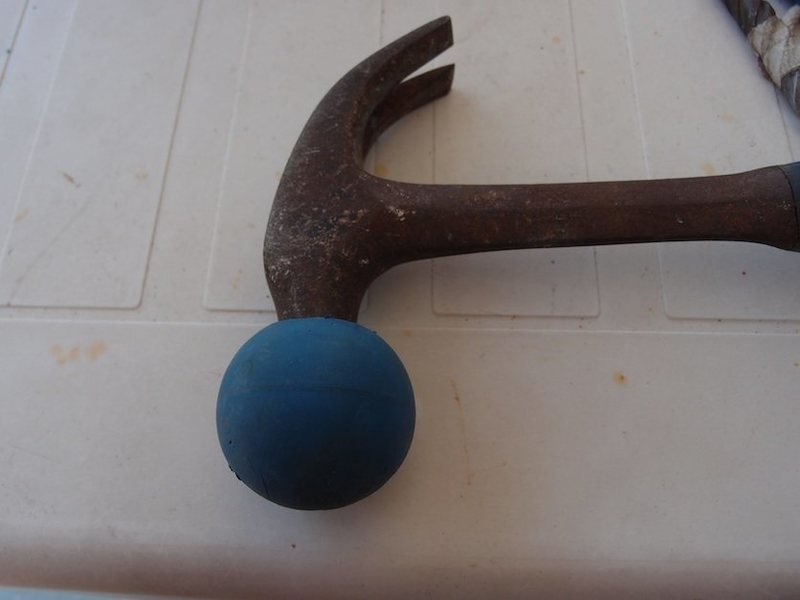  |
|
|
Brian in SLC wrote: SLC-6 at VAFB is near mid-60's vintage. LC-40 at CCAFS similar. Both locations near salt water. Hmmm. Lot of fastener and corrosion data from those locations/situations... Interesting to note that when the VAB was built at the Cape, they drilled into limestone to anchor the building (over 4000 steel rods at 160 feet deep). They had to account for the galvanic current. Used over a million fasteners. When I used to visit those locations (spent weeks at a time on SLC-6, SLC-4E and LC-41)...I used to get a kick out of the stainless fasteners used in/on the urinals in the bathrooms. Now, that's a corrosive environment! Ha ha... I've always thought some of the info from MSFC/NASA with regard to fastener testing was somewhat pertinent to climbing anchors. Those old launch complexes have gobs of fasteners installed into concrete...all sittin' out in the weather...percolating away... Brian, please speak/write in English. |
|
|
Jim Titt wrote: . In simple terms that means Hilti say products made of 304 and 316 are expected to have an economic lifetime of 50 years in a marine environment. And yet we know they don't. At best 2 years in Thailand, 3 years in Cayman Brac, maybe 5 years in Portugal, etc. etc. etc. |
|
|
Bruce Hildenbrand wrote: John, where did the bolts break? I have had 5-piece Powers bolts break when I tried to remove them because the cone had rusted onto the bolt and would not turn. In this instance, the bolt breaks right down near the end where the threads for the cone are located when using a breaker bar to attempt to loosen it. Personally, I don't think this makes for a weak bolt especially if you consider shear strength to be the most important factor. It is just that plated steel will eventually rust. What you say is all true. But my point is that if they are rusted to the point you can't turn them in only 8 years, then in 10 years, or 15 years the rusting process may have proceeded to the point the bolt rusts free of the wedge/sleeve. A far cry from a 50 year lifespan. |
|
|
John Byrnes wrote: Brian, please speak/write in English. I have no f-ing idea what a "SLC-6 at VAFB" is. I think he's talking about the various super structures for the various NASA/Air Force launch complexes. |
|
|
Greg Kuchyt wrote: I think he's talking about the various super structures for the various NASA/Air Force launch complexes. VAFB is Vandenberg CCAFS is Cape Canaveral The relevance being that both launch facilities are right on the ocean and involve a lot of fasteners. Okay. I'd like to hear more about them in order to evaluate the relevance to climbing bolts. |
|
|
You haven't seen any last that long because their wasn't many (any?) placed that long ago. It seems like you're trying to prove a point here, but even if 0 stainless climbing bolts have lasted 50 years you have proved nothing. How many titanium climbing bolts have lasted 50 years? |
|
|
John Byrnes wrote: And yet we know they don't. At best 2 years in Thailand, 3 years in Cayman Brac, maybe 5 years in Portugal, etc. etc. etc. So what are you trying to say here, Jim? Some comment on the glue or a comment on 304/316 in a marine environment? The standard says 50 years for the glue. |
|
|
DrRockso wrote:You haven't seen any last that long because their wasn't many (any?) placed that long ago. It seems like you're trying to prove a point here, but even if 0 stainless climbing bolts have lasted 50 years you have proved nothing. How many titanium climbing bolts have lasted 50 years? Sorry 'bout the long delay in responding. I've been doing other stuff. |
|
|
Jim Titt wrote: The standard says 50 years for the glue. The standard says 50 years for 304 in a marine environment. If one is false then why should the other be true? Using the ETA (European Technical Approval,note it is only applicable to Europe anyway) LOTS DELETED ascenscionists. All I have to say is this: |
|
|
"Chemical anchoring is "new" and even 20 years ago the idea you could go and pick up a few cartridges down the local hardware store was unheard of" |
|
|
Jonathan Cunha wrote: Anyway, where exactly does one get 316 SS bolts + hardware (that doesn't literally cost an arm and a leg) in the US?? Cool thread... There arnt many options. The Wavebolt is 316L. Hilti and a few other companies make 316 wedge bolts and glue-in threaded studs, but those options cost more than the Wavebolt even when you consider the cost of epoxy. The Petzl Longlife used to be made from 316, but the bolt is no longer being made. Fixe makes a 10 or 12mm (I forgot which) 316 bolt, but again, the Wavebolt is more economical in most cases. |
|
|
AustriaAlpin make 316L hangers, we supply either these or the 304 ones depending on what the customer wants. A 10mm 316 wedge bolt and a 316 hanger costs roughly $4.50 -$5.00 delivered to the USA. |
|
|
John Byrnes wrote: Submersion in boiling MgCl2 is a standard metallurgical test that closely parallels the environment found on Class 1 cliffs. Is that on Mars? |
|
|
mattm wrote: Double check me but I'm pretty sure the Wavebolt made by Climb Tech is now 304SS - It was 316L when Issac was making them. That bummed me out as the 316L Wave was a decent value. Not so much now. A bulk buy from Bolt Products in 316L could get you bolts sub $4 I suspect. That's amazing. Yes, far more companies make 316 products in Europe - eg Raumer Matt, I thought the same thing, but I contacted climb tech and was told that they are being made of 316L again. I told them that they need to put that information on their website and they took me up on it. Check it out: |
|
|
mattm wrote: Double check me but I'm pretty sure the Wavebolt made by Climb Tech is now 304SS - It was 316L when Issac was making them. That bummed me out as the 316L Wave was a decent value. Not so much now. A bulk buy from Bolt Products in 316L could get you bolts sub $4 I suspect. That's amazing. Yes, far more companies make 316 products in Europe - eg Raumer I asked Chris Vinson about five months ago and he told me they are still 316L. I too heard they were 304 which is why I asked him. Also, FYI Issac still sells his Wavebolts, so if you want to be sure you can buy from him. |
|
|
Jim Titt wrote:5-piece and sleeve type bolts are unpopular in the construction industry (and with climbers) so the choice is lower and the price higher. . The 5-piece is one of the most common bolts used in the USA. I have no idea what the exact numbers are, but it's in the top three most common for sure. If we are talking about specific models, I would suspect the Power Bolt is actually the single most common bolt used in the United States. If we are talking about bolt types, wedge bolts are probably more popular, but not by a large margin. |


