
 Continue with onX Maps
 Sign in with Facebook






The only book on crack technique worth reading:


|
|
bearbreeder wrote: actually for the same grad out here tips and fingers are usually lower angle ... a 5.10- hand crack here is often closer to vertical, however a 5.10- finger crack is often lower angle ... ie less "physical' Doesn't what you just said perfectly illustrate that finger cracks are generally harder? Or do finger cracks only tend to form on lower angle terrain? A route can be much more strenuous on the same angle if the feet are poorer. bearbreeder wrote: as to the "cobra experience" being more chill ... one of them sent it by the skin of his teeth the last burn on the last day ... didnt look too "chill" ... but then neither you or i has tried to free it so its all moot Well, if I had to deal w/ Squamish weather window...The route is in your backyard, not mine. & apparently a crack size you are more interested in than I. I don't want to turn this into measurebating, but you don't want to compare with me on finger cracks. |
|
|
reboot wrote: Doesn't what you just said perfectly illustrate that finger cracks are generally harder? Or do finger cracks only tend to form on lower angle terrain? A route can be much more strenuous on the same angle if the feet are poorer. Well, if I had to deal w/ Squamish weather window...The route is in your backyard, not mine. & apparently a crack size you are more interested in than I. I don't want to turn this into measurebating, but you don't want to compare with me on finger cracks. no ... because given a 5.10- hand crack and a 5.10- finger crack ... the finger crack will be LESS steeper and physical generally out here ... |
|
|
bearbreeder wrote: no ... because given a 5.10- hand crack and a 5.10- finger crack ... the finger crack will be LESS steeper and physical generally out here ... I said finger cracks are generally harder grade wise (and will be more strenuous than a hand crack of the same steepness). You made a non-sensical reply comparing the steepness of cracks of the same grade. Are you trying to say older climbers will have more trouble on a 5.10- finger crack than a 5.10- hand crack? |
|
|
reboot wrote: I said finger cracks are generally harder grade wise (and will be more strenuous than a hand crack of the same steepness). You made a non-sensical reply comparing the steepness of cracks of the same grade. Are you trying to say older climbers will have more trouble on a 5.10- finger crack than a 5.10- hand crack? oh gawd .... yr contradicting yourself !!!! 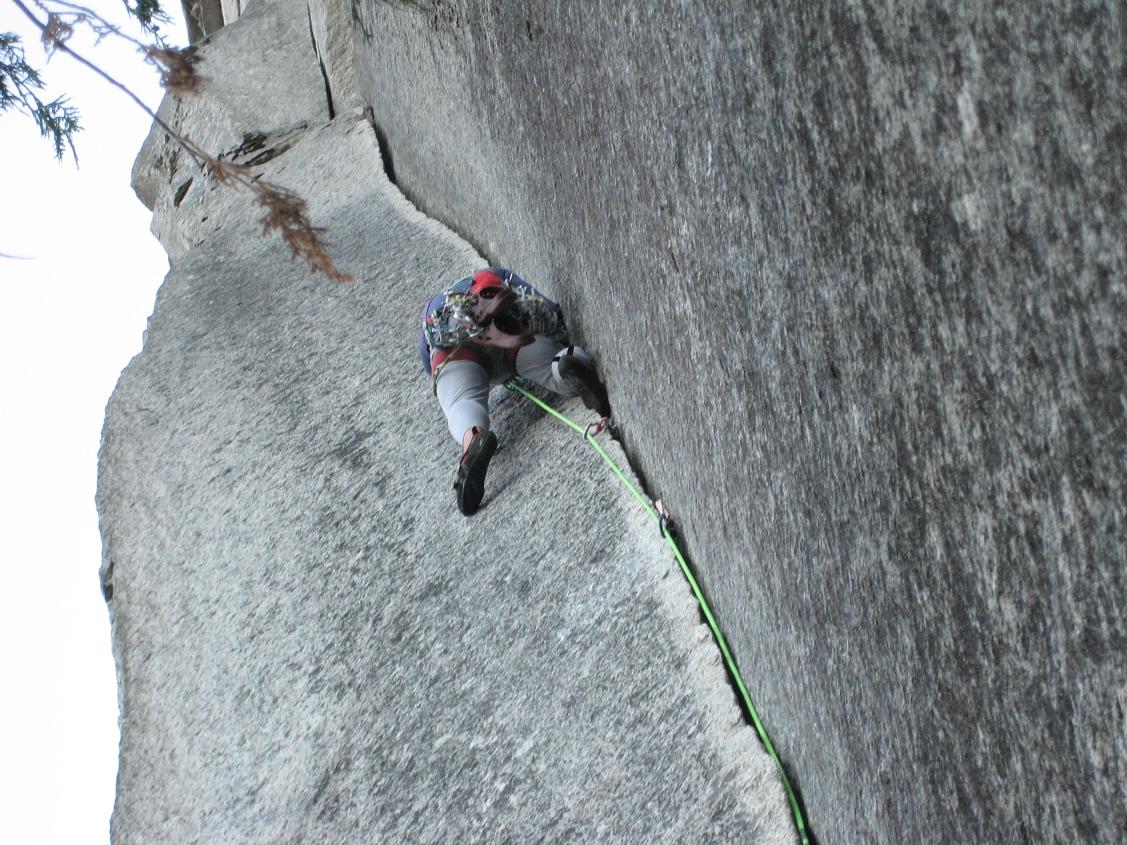 its angle is steeper and its MUCH more physical and sustatined than another classic finger to off fingers 10b ... arrowroot ... or almost any other 10- finger crack in squamish for that matter  neither of these photos are mine ... but i can did through my archives for em for shots of when we climbed em if u want .... |
|
|
bearbreeder wrote: but the finger cracks out here are generally EASIER for the same grade If properly graded, how can routes of the same grade be easier or harder? Or do you guys up in the great white north use climbing grades for something else? |
|
|
reboot wrote: If properly graded, how can routes of the same grade be easier or harder? Or do you guys up in the great white north use climbing grades for something else? seriously buddy? |
|
|
bearbreeder wrote: what did you think of the book that you obviously own I think it's an excellent book on pure crack climbing techniques, with great physics illustration on constriction & leveraging, something you almost never find on non-crack climbs. It probably pays to think in those terms as you flip through the pages & you may be able to come up w/ techniques based on these principles outside of the book that works for you. |
|
|
bearbreeder wrote: im simply pointing out that there isnt too much on fingers and below in the book ... probably something to consider if one was expecting a "comprehensive" book ... So I just flip thru the pages again & I'd like to know what you found missing in the fingers and below that's actually crack climbing (the author specifically pointed out that thin cracks draw a lot on face climbing techniques, which given this is a crack climbing technique book, seem reasonable those would be omitted). Specifically, what crack techniques in the wide boyz videos you linked to that aren't in this book (there's obvious benefit to video illustration of techniques). I sure didn't see any. There are Chapter 1,7,8, which are more general to all sizes of crack climbing. It isn't laid out in individual "for dummies" chapters for each sizes of cracks as that'd be way too much repeated information. |
|
|
reboot wrote: So I just flip thru the pages again & I'd like to know what you found missing in the fingers and below that's actually crack climbing (the author specifically pointed out that thin cracks draw a lot on face climbing techniques, which given this is a crack climbing technique book, seem reasonable those would be omitted). Specifically, what crack techniques in the wide boyz videos you linked to that aren't in this book (there's obvious benefit to video illustration of techniques). I sure didn't see any. There are Chapter 1,7,8, which are more general to all sizes of crack climbing. It isn't laid out in individual "for dummies" chapters for each sizes of cracks as that'd be way too much repeated information. specifically i would have liked to seem a better explanation or illustration of footwork for thin crack techniques ... the author states that 1-1.5" (purple/green camalot) is generally too small to toe jams ... im certainly no expert but i can often get decent shoe tips down to the small blue/grey camalot size, especially if the shoes are a bit worn (green and purple camalot IMO are solid toes)  the ability to walk a traversing crack up here is also pretty important and i feel those are glossed over a bit ... we tend to have less than vertical cracks into the 10-11s (and below) where one can walk significant with the shoe tips ... perhaps thats more an artifact of our lower angle granite cracks |
|
|
Bearbreeder is the punchline to his own joke. |
|
|
highaltitudeflatulentexpulsion wrote:Bearbreeder is the punchline to his own joke. He's a mix between "One time in band camp" and "If this were the gunks..." except you just replace it with Squamish. He makes me not want to go there, even though I know it's incredible. I just can't seem to like somewhere that's becoming associated with someone so fuckheaded. He doesn't even know that he doesn't know what he thinks he knows. Slapping my computer hasn't shut him up yet. BTW, does anyone fix computers. As for the book. It's good. It's really good in fact. The descriptions are clear and the drawings are precise. You will have an exact idea of the technique to employ prior to leaving the ground. Will real life force you to make changes? Yes. Will you still have to work hard and pay your dues? Yes. It keeps you from inventing this in a vacuum like so many have. One thought on my personal experience, maybe it's true for everyone. In the case of both hand stacks and for rand smears (what the book describes as crack smears) I was aware and had been given tutorial on each of these techniques and I simply could not apply them. One day, like a cartoon lightbulb it happened. At the time I was getting progressively stronger and I was finally strong enough to apply these techniques. Keep that in mind as you grow and progress. If a technique doesn't work now, it might in 6 months once your body is ready. shut folks up? |
|
|
bearbreeder wrote: shut folks up? pot calling the kettle black there ... you noticed youre the one throwing insults around ;) I feel no remorse in insulting those that need to be insulted. |
|
|
highaltitudeflatulentexpulsion wrote: I feel no remorse in insulting those that need to be insulted. My pots are stainless steel. you MP psychopath !!! |
|
|
bearbreeder wrote: you MP psychopath !!! if you feel the need to insult perhaps you should stick to folks who said it was too "expensive" before buying it or that its a shietty book i keep on saying that its a FINE book, i had one brought in from yankee doodle land ... just that i felt it could use a bit more in certain areas and for that you throw insults ;) Good point actually. Your comments aren't that bad, dumb, but not that bad. My post contained a lot of spillover from the rest of the site. Are you able to see that you're both frustrating and annoying most of the time? |
|
|
highaltitudeflatulentexpulsion wrote: Good point actually. Your comments aren't that bad, dumb, but not that bad. My post contained a lot of spillover from the rest of the site. Are you able to see that you're both frustrating and annoying most of the time? says the guy who annoyingly throws out insults and calls people dumb for an honest review? |

|
bearbreeder wrote: says the guy who annoyingly throws out insults and calls people dumb for an honest review? perhaps we should take this somewhere that ISNT a review thread ... and i say that to those other ones here who want to have more fun with a bear i gave my opinion of the book ... which against is a FINE book if you want to throw insults im sure MP has the appropriate kiddie sandbox somewhere ;) Haha.. That was.. Awesome! |

|
BB is usually right AND annoying. Kind of reminds me of a more juvenile JT512..remember him Bear?? He was also a thorn in many a side, but he was usually right. Somehow, I think I'd like to climb with both of them. |
|
|
bearbreeder wrote: the author states that 1-1.5" (purple/green camalot) is generally too small to toe jams ... im certainly no expert but i can often get decent shoe tips down to the small blue/grey camalot size, especially if the shoes are a bit worn (green and purple camalot IMO are solid toes) That's because most granite cracks have plenty flare/irregularity. It'd be hard to do that on wingate sandstone, at least with most non-child feet w/ shoes on. bearbreeder wrote: in the thin crack section they only showed corners in the illustration, contrast that with the videos where they showed more specific placements as well as in relation to pressure of the foot due to body positioning... the ability to walk a traversing crack up here is also pretty important and i feel those are glossed over a bit ... an example is using the drop knee in a stem/corner crack to rest (or place gear) which is very useful even for beginners ... Yes, and in those videos they are essentially using corner techniques when there are crack offsets. The type of traverse you are talking about is just undercling traverse, that you have a crack as hand hold doesn't necessarily change the foot technique. The book also mention chick leg technique more than once... |
|
|
reboot wrote: That's because most granite cracks have plenty flare/irregularity. It'd be hard to do that on wingate sandstone, at least with most non-child feet w/ shoes on. Yes, and in those videos they are essentially using corner techniques when there are crack offsets. The type of traverse you are talking about is just undercling traverse, that you have a crack as hand hold doesn't necessarily change the foot technique. The book also mention chick leg technique more than once... You seem to be a bit disappointed that this isn't a cook book on how to climb different cracks. That's fine, it's your opinion. But I think you fail to realize just how many different variations of routes w/ crack there are, which would require a combination of crack & non-crack techniques (do we need to include knee bar? heel hook? I got my own thin crack foot technique drawn from face climbing & utilizes my core strength, should that be included?). The book shows you how to use all the specialty tools in a crack climbing toolbox, can you really expect it to also show you how to carve out wooden bear cublets? well this book already shows you how to stem, use yr calf, layback, etc ... and the traverses are more than underclings out here, ie walking the crack itself... i dont think it unreasonable to add a bit more the next edition should the author desire  photo from squamishclimbingsource.com/… as ive said OVER and OVER again ... its a fine book ... and comparing against the self coached climber is no mean compliment however as you said yourself "this isn't a cook book on how to climb different cracks" which is EXACTLY what im saying ... its not absolutely "comprehensive" ... yet some folks are going on about how utterly awesome it is and the best thing since sliced bread as the title of this thread shows ... theres things that are likely not in there or a bit glossed over than perhaps take more than 20 min or two hours to learn ... now the author likely cant make a truly comprehensive book in 208 pages, or for 29 yankee dollahs ... and thats just fine ... i stated thats fine by me as i was looking for the wider techniques anyways but its obviously a crime on MP to point out that the book focuses more on some things than others, and perhaps doesnt have absolutely everything .... why folks pop up out of the woodwork swearing that you learn anything not in the book in 20 min (or 2 hours) !!! if i had to rate the book i would give it 4/5 stars .... which is pretty good IMO and worth the moolah ... but obviously on MP it invites attacks calling one "dumb", inviting insults, and comparing one to kids carving out bear cublets MP intraweb fanatics for ya ;) |
|
|
bearbreeder wrote: heres an example where the crux part below the flare takes purples all the way up (now you can try to smear or layback it but thats just shietty technique) This crack (in the crux section) has plenty of flare at the edge of the crack, as most granite cracks do, making toe jam much easier (equivalent to a 0.75 camalot or wider crack). A "perfect" wingate splitter on vertical wall in purple camalot size for a few body length would usually warrant a mid 5.12 grade, not 5.10d. |


